Skip to content
DevMeme
4754 of 7435
Multiplying negatives with turn-around logic confuses anonymous forum math poster
Mathematics Post #5209, on May 17, 2023 in TG

Multiplying negatives with turn-around logic confuses anonymous forum math poster

Why is this Mathematics meme funny?

Level 1: Back to Start

Imagine you’re standing and looking forward. Now, if I tell you to turn around one time, you’ll be facing backward. Everything behind you was in the opposite direction, kind of like a “negative” direction. Now I tell you to turn around again. After doing it a second time, guess what? You’re back to facing forward – the same way you started! 😊

This is exactly how multiplying two negative numbers works, but with numbers instead of your body. One “turn around” is like multiplying by a negative once. It sends you backwards (a negative result). But doing that a second time undoes the first turn, pointing you forward again (a positive result). In simple terms: two negatives cancel out and make a positive. That’s why if you take away a “take away,” you end up with something, or if you say “no” to no cake, it means you do get cake! The meme is funny because the person was confused and a helper basically said, “Think of a negative as turning around. Do it twice and it’s like nothing changed!” It’s a silly little story that makes the math rule easy to see. In the end, the confused frog guy realizes that doing an opposite thing two times just brings you back to the start, and that’s why a negative times a negative feels like you never left the positive direction at all. So the joke teaches us: two “no’s” make a “yes” in math, just like turning around twice points you forward again. 🍭

Level 2: Turnaround Analogy

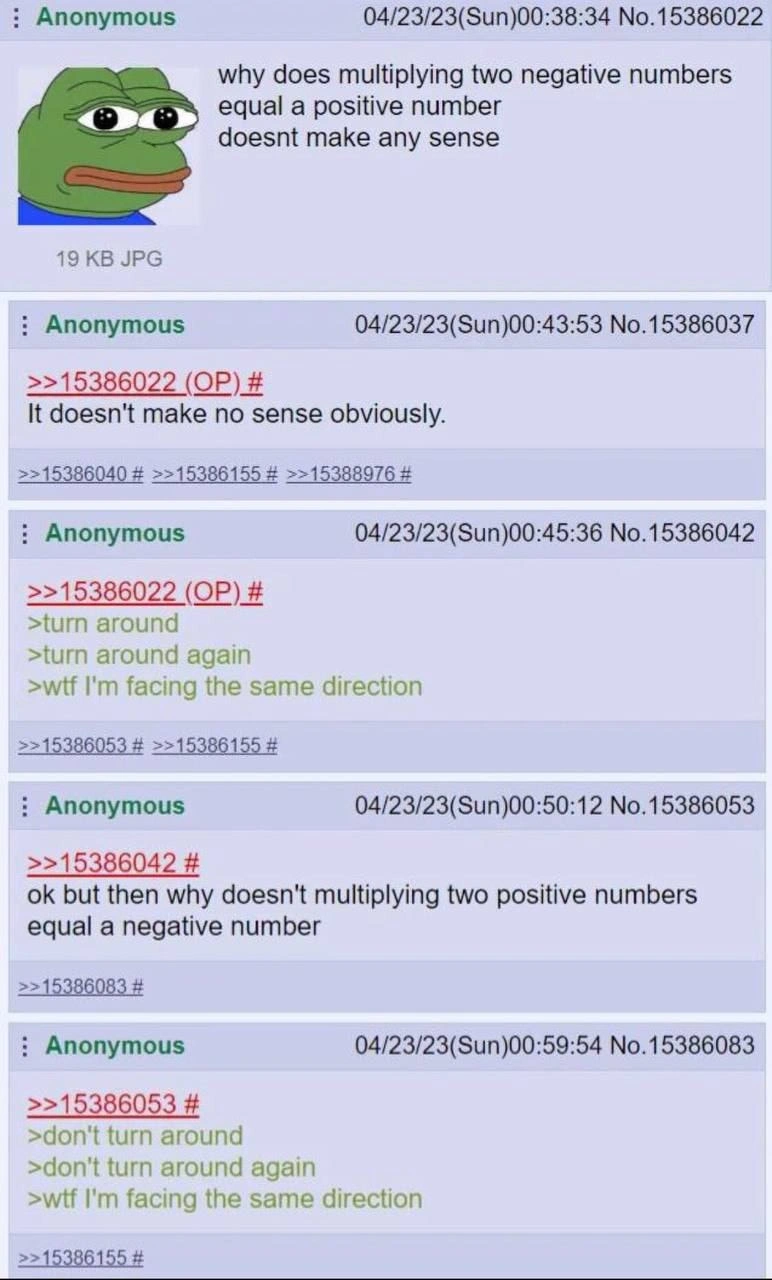
Let’s break down what’s happening in this meme in simple, practical terms. The conversation is taking place on an anonymous forum (think of a site like 4chan, known for its green-text quote style and Pepe memes). The original poster (labeled "Anonymous" with a Pepe avatar) is basically asking a very fundamental math question: “Why does multiplying two negative numbers equal a positive number?” In plain language, if you take a negative number (like -2) and multiply it by another negative number (say -3), why do you get +6 instead of -6? At first glance, this rule might seem weird or counter-intuitive if you haven’t seen the explanation. That’s why the OP says “doesn’t make any sense.” They are genuinely puzzled by this basic rule from Mathematics.

Now, the responses come in a humorous fashion. The first reply jokingly says, “It doesn’t make no sense obviously.” This sentence itself is a bit of a goofy grammar joke: it contains a double negative (“doesn’t” and “no”) which in correct English would actually mean “It does make sense, obviously.” It’s likely a playful jab — the responder is teasing that the rule does make sense, and implying the OP just hasn’t grasped it yet. It’s also a subtle nod to the idea of two negatives canceling out (in this case, in an English sentence!).

The real explanation comes with the next reply, delivered in what’s called greentext format (lines starting with “>”). Greentext on forums is often used to quote something or to tell a short story in a quirky, sarcastic way. Here, it’s used to create an analogy:

  • turn around” – Imagine you’re standing and facing forward, and someone tells you to turn 180 degrees (turn around). Now you’re facing backward. This “turn around” act is analogous to multiplying by a negative once (because it reverses your “direction” on the number line or flips the sign of a number). If facing forward was positive, one turn (facing backward) is like a negative orientation.
  • turn around again” – Now they instruct you to turn around a second time. After the second 180° turn, you’re facing forward again, the same direction you started. This second turn is like multiplying by another negative. Doing it twice brought you back to a positive orientation.
  • wtf I’m facing the same direction” – “Wtf” is internet slang for shock (“what the flip”), and here it humorously conveys the surprise that after two inversions you ended up back where you began. This corresponds to the surprise some people have that a negative times a negative gives a positive. But the little story makes it clear: two sign flips restore the original sign.

So the rotation_analogy is illustrating the rule: a negative times a negative equals a positive, because flipping something twice cancels out. In math class you might have heard “minus times minus is plus.” This is exactly that, dressed up in a funny, visual example (turning around twice). This kind of analogy is helpful for a newbie or anyone who’s ever been stuck thinking "Why is -×- = +?". It ties an abstract rule to something concrete you can imagine doing.

Then a follow-up question is posed (likely tongue-in-cheek): “ok but then why doesn’t multiplying two positive numbers equal a negative number”. In other words, if two negatives give a positive, why don’t two positives give a negative? This question might sound silly to someone who knows the basics — two positives do give a positive (like 2 × 3 = 6, still positive). The person is either joking or genuinely mixing themselves up. The answer, given again in greentext by another user, uses the same analogy style to hammer home the point:

  • don’t turn around” – Interpreting a “positive” instruction as doing nothing to your direction (since multiplying by +1 leaves a number unchanged, like an instruction that says “keep facing the way you are”). If you’re facing forward and someone says “don’t turn,” you stay facing forward.
  • don’t turn around again” – They tell you again not to turn. You still haven’t moved an inch. You’re still facing forward (the same direction).
  • wtf I’m facing the same direction” – Of course you are! If you never turned at all, even after two non-turns, you remain just as you started. This corresponds to positive × positive = positive — applying no change twice results in no change.

This second greentext is basically telling the questioner: “See? Doing nothing twice obviously changes nothing. That’s why two positives don’t magically yield a negative.” In math terms, +1 is the identity for multiplication (think of it like an operation that leaves things as-is). So $+1 \times +1 = +1$ (no change in sign or value). The meme uses the everyday action of not turning to get that idea across with a bit of humor.

For a junior developer or student, this is both funny and educational. It’s funny because it takes a serious question and answers it with a very silly literal scenario. And it’s educational because it actually does teach why the rule works in a memorable way! In the context of computing or programming (the CS_Fundamentals angle), understanding that negative numbers follow these sign rules is important. For instance, if you have (-5) * (-7) in code, you’ll get 35. If a new programmer saw that and was confused, they might recall this “turn around twice” story and realize, “Oh right, two negatives cancel and give a positive.” The concept of “two negatives cancel out” also appears in other areas: for example, in Boolean logic, !!TRUE evaluates back to TRUE (because one ! negation would make it FALSE, and the second brings it back to TRUE). Or even in everyday language, as we saw: “I don’t have no time” is intended as a negative statement, but literally it cancels out to mean “I do have some time.”

The meme also features Pepe the Frog as the avatar of the original poster, which is a popular internet meme character often used to convey emotions like confusion, sadness, or frustration. So when you see Pepe’s droopy eyes next to “doesn’t make any sense,” it emphasizes that the person is despairing over this math problem. This little detail adds to the humor for those who recognize Pepe from meme culture.

All in all, the thread is a lighthearted mini-lesson. It takes a mathematics rule that can trip up learners, and explains it through a goofy forum interaction. The turn-around logic is something you might even remember for life because it’s so simple: if you ever forget why -×- = +, just think of physically turning 180° twice and realizing you’re facing the original direction. It’s a neat example of how even anonymous internet forums can sometimes brilliantly clarify CS fundamentals or math basics with just a few clever lines (and a healthy dose of humor).

Level 3: Two Wrongs Make a Right

At its core, this meme gets a chuckle from developers and math geeks because it brilliantly simplifies a fundamental rule that we usually take for granted. The original poster (OP) on the imageboard is baffled: “why does multiplying two negative numbers equal a positive number doesnt make any sense”. This is a classic math_confusion moment — many of us remember a time (probably in middle school algebra) when the rule “two negatives make a positive” felt a bit like black magic. Here, on an anonymous forum thread (the screenshot has that distinct light-lavender 4chan aesthetic), someone is openly admitting “it doesn’t make any sense.” Enter the witty responders: they address the confusion with a dose of internet humor and a dash of CS_Fundamentals insight.

The first reply is pure ironic snark: “It doesn’t make no sense obviously.” Notice the double negative in that sentence – doesn’t and no – which actually cancels out to imply that it does make sense. It’s a tongue-in-cheek way of poking fun at the OP’s lack of understanding using the very concept in question. Any seasoned developer or math veteran reading that gets the layered joke: the responder is effectively saying, “Of course it makes sense,” but phrased in a way that itself breaks English grammar rules (two negatives in English typically imply a positive). It’s a subtle nod: two negatives, whether in math or in language, end up affirming a positive. AcademicHumor often lives in these kinds of parallels that make us grin and think “touché.”

The real punchline is the famous rotation_analogy delivered in classic greentext format (lines starting with > in green). This is the forum’s way of illustrating a concept with a mini story or POV narrative. It goes:

>turn around
>turn around again
>wtf I'm facing the same direction

In just a few lines, the poster conjures a vivid mental image: imagine facing forward (a positive orientation). One “turn around” (180 degrees) makes you face backward (that’s a single negation, like multiplying by -1). Another “turn around again” flips you forward once more (a double negation, -1 × -1, landing you back at a positive orientation). The final line, “wtf I’m facing the same direction”, humorously mimics the OP’s astonishment — it’s the aha! moment wrapped in meme-speak. Developers often use spatial or physical analogies like this when teaching or debugging tricky sign issues. For instance, think about debugging a piece of code and realizing you applied a negation function twice: “Oh, I reversed the reversal, no wonder it’s back to the original!” We’ve all had that bug where we subtract a negative or double-invert a Boolean and momentarily scratch our heads before remembering that doing the same thing twice undoes itself. This CSFundamentals meme distills that experience to its simplest form.

But the fun doesn’t stop there. Another anonymous replies, asking in essence, “ok but then why doesn’t multiplying two positive numbers equal a negative number”. This question is cheeky — it’s like someone in class trying to be clever (or trolling) by flipping the logic: If double negative flips back, why wouldn’t double positive flip to something else? Of course, the community is ready with an equally cheeky rebuttal in green text:

>don't turn around
>don't turn around again
>wtf I'm facing the same direction

This is hilariously straightforward. Multiplying by a positive doesn’t change your sign or direction at all — it’s like giving the instruction “don’t turn”. If you don’t turn twice, obviously you’re still facing the original way. In math terms, +1 is the identity for multiplication: doing nothing twice leaves things unchanged. For a senior developer, this is a satisfying little demonstration of how identity operations work. It’s reminiscent of how calling a function that is effectively a no-op twice still does nothing. Or consider a scenario in code: using the logical NOT operator twice !!condition simply returns the original boolean value, because the first ! flips it, and the second ! flips it back. A positive number in multiplication is like a no-op (multiplying by +1 leaves a number unchanged, just as “not turning” leaves your orientation unchanged). The meme is highlighting that in a witty, conversational way.

From a seasoned perspective, there’s extra humor in the contrast between the OP’s despair and the elegant simplicity of the solution. The OP is represented by the classic sad Pepe the Frog avatar, a shorthand for feeling lost or dumbfounded. That little green frog with a blue shirt and teary eyes is practically the mascot of internet angst and confusion. Many developers have been that Pepe at some point — staring at a puzzling bug or concept and thinking “this makes no sense.” And just like in the meme, the answer often turns out to be something basic once it “clicks.” We laugh because we’ve all had moments of overthinking a simple issue. In debugging, sometimes you’re perplexed why a value is coming out positive when you expected negative, only to realize you multiplied two negative inputs. Facepalm. The meme captures that exact revelation: something that “didn’t make sense” suddenly seems obvious with the right perspective.

This thread also exemplifies DeveloperHumor and AcademicHumor blending together. It’s the kind of exchange you’d find humorous on an online forum frequented by both techies and math nerds. The community’s use of a rotation analogy to explain a sign rule is a teaching tactic wrapped in a joke. It’s the same reason a senior engineer might say to a junior, “Think of a negative sign like a reverse gear. If you go in reverse twice, you’re moving forward again.” It’s memorable and visual. The fact that the explanation is given in a greentext meme format just adds an extra layer of geek culture. Those familiar with imageboard culture know that >green text often denotes sarcasm or a storytelling format for comic effect. Here it’s used earnestly to clarify a concept, making it fun and not just dry algebra.

In summary, the meme is funny-’cause-it’s-true: it educates the confused poster (and any onlookers) on the rule (-) × (-) = (+) using everyday logic. And it preempts the next silly question (“what about (+) × (+)?”) with a deadpan obvious answer. A senior developer or mathematician can appreciate the multi-layered wit — from the double-negatives in the text to the rotation metaphor — and also the satisfying correctness of it all. It’s a quick CS_Fundamentals lesson delivered with a punchline. Two wrongs make a right, and two 180° turns make a full 360° — as expected, order is restored in the universe! 😄

Level 4: Involutive Negation

This meme inadvertently brushes up against some deep algebraic principles. In mathematics, negation (multiplying by -1) is an involution – an operation that when applied twice returns you to your starting point. Formally, -1 is an element of multiplicative order 2 in the real numbers:

  • $(-1) \times (-1) = +1$ represents the identity element (positive one) coming out of two negations.
  • This is akin to a 180° rotation performed twice giving a full 360° rotation, landing you back at the original orientation. In group theory terms, the set ${+1,\ -1}$ under multiplication is a simple two-element group where -1 is its own inverse.

Why must two negatives multiply to a positive? It’s baked into the axioms of arithmetic. Consider the distributive law: for any real numbers $a$ and $b$, we have $0 = a \times 0 = a \times (b + -b) = a \times b + a \times (-b)$. Now if we set $a = -1$ and $b = -1$, this becomes $0 = -1 \times (-1) + -1 \times -(-1) = -1 \times (-1) + -1 \times 1$. We know $-1 \times 1 = -1$. So $0 = -1 \times (-1) - 1$. The only solution that keeps arithmetic consistent is $-1 \times (-1) = 1$. In short, defining negative times negative as positive preserves the fundamental consistency (no contradictions) in our number system. If we tried to say $(-1) \times (-1) = -1$ (a negative), many basic rules of algebra would break down – the mathematics would literally make no sense.

There’s also a geometric intuition: on the number line, multiplying by -1 reflects a point across 0. Do it twice (a double reflection) and you’re back where you started – a reflection of a reflection restores the original. Similarly, in computer science, a double bitwise NOT (~~x in some languages) or a double logical NOT (!!x) returns the initial value. This parallels the logical law of double negation: ¬(¬P) ≡ P. In formal logic and in Boolean algebra taught in CS fundamentals, two negatives cancel out. The meme’s turn-around analogy is capturing this involutive nature: a negative times a negative gives the identity (a positive) just as turning 180° twice points you forward again. It’s a delightfully concise explanation for a property that is essential to the mathematics underpinning all our code. And it shows that what might seem like an arbitrary rule (“why does -×- give +?”) is rooted in a deep requirement for consistency in algebraic structures. The fact that an anonymous forum managed to illustrate this with a quick physical analogy is both amusing and educational from a theoretical standpoint!

Description

Screenshot of an image-board thread on a light-lavender background using the classic 4chan layout. The original post shows a sad Pepe the Frog avatar (green cartoon frog head, blue shirt) beside the text: "why does multiplying two negative numbers equal a positive number doesnt make any sense". Replies cascade underneath: 1) "It doesn't make no sense obviously." 2) green greentext lines " >turn around >turn around again >wtf I'm facing the same direction" illustrating how two reversals restore orientation. 3) "ok but then why doesn't multiplying two positive numbers equal a negative number" followed by another greentext inversion: " >don't turn around >don't turn around again >wtf I'm facing the same direction". The meme humorously explains the algebraic sign rule via physical rotation, a concept developers frequently recall when debugging sign errors or implementing arithmetic in code

Comments

15
Anonymous ★ Top Pick -1 × - 1 is just math’s way of teaching git: revert the revert and you’re back on main, only now the history is twice as hard to reason about
  1. Anonymous ★ Top Pick

    -1 × - 1 is just math’s way of teaching git: revert the revert and you’re back on main, only now the history is twice as hard to reason about

  2. Anonymous

    This is basically how we explain two's complement arithmetic to junior devs - just keep flipping bits until you accidentally discover that -1 * -1 = 1, then pretend it was intentional all along and call it 'elegant mathematical design.'

  3. Anonymous

    This thread perfectly captures the moment when you realize your elegant spatial metaphor for explaining sign multiplication rules has the same logical structure whether you're multiplying negatives or positives - essentially proving that your intuitive explanation is just as arbitrary as the rule itself. It's the mathematical equivalent of explaining a bug fix with 'it works now' and then discovering your explanation applies equally well to code that doesn't work. Sometimes the best way to understand why (-1) × (-1) = 1 is to accept that our brains weren't optimized for abstract algebra, just like they weren't optimized for understanding why `'5' + 3` equals '53' but `'5' - 3` equals 2 in JavaScript

  4. Anonymous

    Turn around? That's OpenGL left-handed vs DirectX right-handed coords flipping your 'positive' Y-axis - graphics vets know the pain

  5. Anonymous

    Multiplying negatives is the numeric version of git revert twice - an involution with identity 1; if you want ++ to be −, you’re proposing a ring where 1 = −1, enjoy your CI exploding

  6. Anonymous

    Two negatives make a positive because -1 is a 180° rotation; compose it twice and you get the identity - like two “rewrites”: you end up at the same monolith, just with a service mesh and a bigger cloud bill

  7. @ZgGPuo8dZef58K6hxxGVj3Z2 3y

    😂😂😂😂😂💀💀💀💀💀

  8. @trainzman 3y

    most intelligent being inhabiting 4ch

  9. @dsmagikswsa 3y

    and imaginary number is 90 degree turn

    1. @Sariell 3y

      A fact of 1-179 degree turn is just zero The measure of where and what degree you turn - is imaginary number

  10. @dsmagikswsa 3y

    Follow the metaphor…

  11. @denis_klyuev 3y

    dude tries to learn 6th grade maths? good luck

  12. @prirai 3y

    That's the way how imaginary numbers work

  13. Денис 3y

    Boolean logic is literally about true and false, and still it is an issue. ChatGPT must replace them.

  14. @roped 3y

    its pretty accurate, if consider that minus is complex number (-1; 0) with length 1, that gives rotated by 180 vector when multiplying

Use J and K for navigation