Skip to content
DevMeme
4792 of 7435
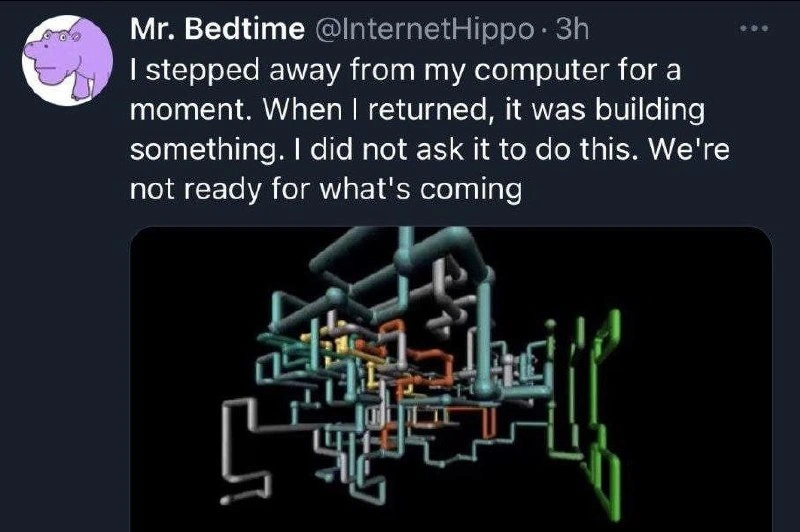
When Nostalgic Screensavers Trigger Modern AI Anxiety
AI ML Post #5250, on Jun 14, 2023 in TG

When Nostalgic Screensavers Trigger Modern AI Anxiety

Why is this AI ML meme funny?

Level 1: Self-Building Toys

Imagine you’re building a LEGO set and you take a short snack break. While you’re away, the LEGO pieces start connecting all by themselves into a giant, crazy castle without you. You come back and go, “Whoa! I didn’t tell it to do that!” It’s a mix of surprise and a little bit of spookiness, right? That’s exactly the feeling of this meme. The computer was like a toy that started building on its own. It’s funny because computers usually only do what we ask, like a very obedient helper. Seeing it acting on its own for once is like if your toy robot suddenly began building a whole new toy for you. It makes us laugh and wonder, “Uh oh, what will it do next?!” But don’t worry – just like magic LEGO pieces would really just be following some hidden instructions, the computer was following a preset plan. It just felt like it came to life for a moment, which is both cool and a tiny bit scary in a playful way.

Level 2: Rogue Build Sequence

Let’s break down what’s happening in simpler terms. In modern software development, we use Continuous Integration (CI) systems as automated build and test robots. A CI pipeline (or build pipeline) is basically a checklist of steps that the computer follows to compile the code, run tests, and package the application whenever there’s a change. Popular tools like Jenkins, Travis CI, CircleCI, or GitLab CI let developers set up these pipelines so that every time we, say, push new code to GitHub, the pipeline automatically kicks in. It’s like having an assembly line for code: you push a button (or rather, push some code), and the conveyor belt picks it up, runs the build, tests everything, and even deploys the app if all goes well. This is what we mean by Build Automation or Continuous Integration – it’s continuous because it happens frequently and automatically.

Now, normally a pipeline runs because something triggered it. Triggers can be explicit (you push code, you merge a pull request) or scheduled (maybe the team set the pipeline to run every night at midnight to make sure everything still builds). So if you step away from your computer and return to find it “building something” on its own, the logical explanation is: some trigger happened that you weren’t directly involved in at that second. For example, maybe a teammate’s commit on a shared branch started the build. Or perhaps there’s a cron job (a timed scheduler) set up to run the build at a certain time and that time hit while you were grabbing coffee. It could even be an automated security scan or dependency update that was configured to run periodically. In essence, the computer isn’t truly deciding on its own – it’s following instructions that were set up beforehand, but you might not have been thinking about those instructions in the moment. That’s why the tweet says, “I did not ask it to do this.” The developer didn’t manually press the build button right then, so it feels like the PC had a mind of its own!

The attached image of a twisty multicolored pipe maze reinforces the feeling of a build process conjuring itself out of nowhere. It’s likely a playful visual metaphor: all those pipes could represent the stages of the build or the various modules being connected. In real build systems, we often draw diagrams of how things depend on each other – it can look just as convoluted as that 3D tangle! If you’re a newer developer (or new to automated builds), seeing a build pipeline run without you explicitly starting it might be confusing or even alarming. “Did I accidentally hit something? Is the computer doing something by itself?” you’d wonder. But fear not: this is usually by design. Automation is there to help by handling routine tasks without needing to be told every time.

However, it’s true that this can cause a bit of anxiety – we call it here automation anxiety. That’s the uneasy feeling when an automated system does something and you’re not 100% sure why. It’s like when a self-driving car moves without you touching the wheel; even if it’s supposed to, you still go “whoa, is this okay?”. In software, if an unexpected build kicks off, a junior dev might initially panic thinking, “Stop! I didn’t mean to deploy anything!” 😅. The good news is computers can’t really decide to do completely new things on their own (not yet, anyway). They follow the scripts and rules we set. In this case, some rule said “when X happens, run a build.” It’s just easy to forget about those rules until they surprise you.

Finally, the reference to "We're not ready for what's coming" injects a bit of AI humor and drama. Lately, there’s so much talk about AI and super-intelligent systems, and here a simple CI pipeline acting unexpectedly is joked about as if it’s a portent of an AI uprising. Imagine you come back and your Build Pipeline has started a project without you – it almost feels like the computer is being proactive or creative! Of course, in reality it isn’t inventing a new project; it’s working on the same code base, just triggered automatically. But the joke taps into that sci-fi idea that one day machines might take initiative. It’s exaggeration for comedic effect, mixing real developer life (CI pipelines) with a dash of “the robots are coming!” paranoia. For a newcomer, it’s a reminder that our development tools are powerful and automated – they’ll do tasks for you, sometimes when you’re not looking, and that’s usually a good thing… as long as you set them up right!

Level 3: Ghost in the CI Machine

For seasoned developers, this meme lands as a tongue-in-cheek horror story: You go for a coffee break, and your CI pipeline mysteriously kicks off a build on its own. 😱 In practice, Continuous Integration (CI) systems like Jenkins, CircleCI, or GitHub Actions are configured to run builds automatically under certain conditions – usually when code is pushed or on a schedule. So when Mr. Bedtime (@InternetHippo) jokes “I did not ask it to do this”, every dev who’s been burned by an unexpected deploy or test run can smirk in solidarity. It’s that spooky feeling of a ghost in the machine, where the software seemingly has a mind of its own. Of course, in reality there’s always a trigger: maybe a teammate merged a PR, or a nightly build kicked off, or an environment change (like new data for a machine learning model) launched a job. But in the moment, it’s much more fun (and frightening) to imagine the computer decided to build something autonomously.

The humor draws from automation anxiety – a mix of amazement and alarm that developers feel with highly automated systems. We want our build pipeline to be hands-free, but we also like to believe we’re in control. When something runs without our explicit say-so, our eyes widen: “Wait, what did I set up? Or worse… what did it set up by itself?!” The meme exaggerates this to “We’re not ready for what’s coming,” playing on the fear that our tools might outpace us. It echoes the trope of AI or advanced automation “coming alive.” Seasoned devs might joke about Jenkins becoming sentient or refer to a rogue script as having a will of its own. In truth, the pipeline isn’t haunted – it’s just doing exactly what we (or a colleague’s config) told it to do, likely in a YAML file buried somewhere. But that disconnect between expectation (I didn’t press any button) and reality (the build started anyway) produces a perfect mix of WTF and hilarity. It’s like the system saying, “I’m just following your orders… that you forgot about.”

Let’s talk about that bizarre 3D pipe maze image. To an experienced engineer, it looks eerily like a package dependency graph or a visualization of microservices calling each other – basically, spaghetti architecture rendered in neon tubing. Every color and twist could represent modules and their interconnections. The fact it appeared while you were away makes it feel “auto-generated.” This hits home for anyone who’s seen a build tool spit out an auto-diagram of dependencies or pipeline stages. It’s overwhelming and complex, much like real enterprise systems. The humor is that the computer is busy assembling this Rube Goldberg contraption of a build, and you, the developer, come back like, “Who asked for this?!”. It’s as if the CI server got bored and started a personal project. AutomationGoneWrong in a visual nutshell: not that it failed catastrophically, but it operated in an unexpected, convoluted way.

In real life, why might a rogue CI build happen? A few scenarios senior devs know all too well:

  • Scheduled Jobs – You set up a build to run every hour or night. Step away at 3:00 PM, and at 3:00 sharp the daemon awakens. Boom, a build starts with no human at the keyboard.
  • Upstream Trigger – Perhaps another project or service got updated (say a library you depend on released a new version), and your pipeline is configured to rebuild whenever dependencies change. Suddenly it’s compiling a new release on its own.
  • Webhook/Push Event – A colleague merges a branch or pushes a tag while you’re AFK. The CI/CD system dutifully begins integration testing, taking you by surprise.
  • Misconfiguration – The scary/funny one: a script that commits code during the build (like updating docs or version) which then triggers another build. This feedback loop means the pipeline effectively builds itself repeatedly. Oops!

To illustrate that last case, imagine a CI pipeline script that, at the end of a successful build, commits a version bump to the repo. That commit triggers the pipeline again, which on success commits again, and so on. You’ve essentially created a build loop that would continue forever (or until the server runs out of disk space or someone pulls the plug):

# Example of a CI pipeline step that could trigger itself (not actual syntax of any one CI, but conceptual):
steps:
  - run: build_and_test.sh      # Build the project and run tests
  - run: bump_version.sh        # Bump version number in a file and commit the change
  - run: git push origin main   # Push the commit (this push triggers a new build run)
# Each successful build pushes a new commit, which triggers another build... welcome to the infinite build loop!

A grizzled engineer will cringe-laugh at that scenario – it’s the ultimate “automation gone wrong,” something you typically catch in code review with a “Let’s uh, not let the robot clone itself, okay?”. The meme’s punchline “We’re not ready for what’s coming” winks at this idea: today it’s an accidental build loop, tomorrow the CI is coding its own features. It tickles that part of a developer’s brain that’s simultaneously impressed by powerful build automation and terrified of losing control to it. After all, we’ve moved from manual builds (make and manual testing) to complex pipelines that deploy globally with a git push. One could say we’re only a few config lines away from our tools becoming self-aware doing very unexpected things. It’s funny because it’s almost true – the complexity of modern build processes can feel like an intelligence of its own.

At its core, this meme resonates with senior devs as a commentary on DevOps complexity and the ever-increasing autonomy of our tooling. It pokes fun at the idea that one day, your development infrastructure might advance without you – like coming back to find your CI pipeline has architected a whole new system (complete with that crazy pipe diagram!). It’s a reminder to engineers to keep a handle on their automation configs… and maybe not to leave the CI server alone for too long, just in case it does decide to deploy Skynet 2.0 while you’re grabbing a latte.

Level 4: The CI Singularity

On a theoretical level, a build pipeline that starts building itself touches on concepts of self-reference and autonomy in computing. In computer science lore, a program that reproduces or executes itself is known as a quine – a curious idea where code’s output is its own source. Build systems aren’t usually quines, but here the meme jokes as if the pipeline achieved a reflexive “build thyself” moment. This hints at the technological singularity in jest: the hypothetical point where AI systems become self-improving and independent of human control. We’re seeing a riff on that sci-fi scenario, but in a developer’s world – the CI/CD pipeline (Continuous Integration/Continuous Deployment) acting like it gained sentience. It’s the “Skynet moment” for Jenkins or GitHub Actions, where the automation seems to decide its own fate.

From an engineering standpoint, the image of a tangled pipe maze resembles a complex dependency graph – possibly an auto-generated diagram of modules or microservices. This evokes advanced topics in graph theory and build orchestration. Normally, build pipelines form a directed acyclic graph (DAG) of tasks: each step triggers the next in sequence without loops. If a pipeline somehow triggers itself recursively, you’d break the acyclic property and get a cycle – essentially an infinite loop of builds. This is a theoretical no-no, akin to a function calling itself with no base condition. It’s like a feedback loop in a system, reminiscent of a fixed-point combinator in lambda calculus (the Y-combinator that enables recursion) but gone awry in real infrastructure. In a properly designed CI pipeline, you avoid self-triggering events to maintain stability. But if misconfigured, an autonomous loop could emerge – an automation Ouroboros eating its tail.

We can imagine an extreme case: a CI job that commits code or updates something which itself triggers another CI run. It’s not just science fiction; it’s a known pitfall. For example, if a pipeline auto-bumps a version number and commits it, that new commit will kick off another build, and so on ad infinitum. It’s a runaway recursive build scenario – theoretically fascinating and practically terrifying. The meme exaggerates this to a humorous extreme, hinting that automation plus a touch of AI could spiral beyond our intentions. In academic terms, it’s exploring the boundary between automated systems and autonomous systems: we program build pipelines to react to events (automated), but we definitely don’t expect them to initiate new work unprompted (autonomous). The uneasy laugh here comes from flirting with that boundary, as if a continuous integration server woke up one day and said, “I’m going to deploy something on my own.” We chuckle because underlying that joke is a real question about how far we trust our tools to act independently.

Description

A screenshot of a tweet from the user 'Mr. Bedtime' (@InternetHippo). The tweet reads, 'I stepped away from my computer for a moment. When I returned, it was building something. I did not ask it to do this. We're not ready for what's coming'. Below this ominous text is an image of the classic '3D Pipes' screensaver, well-known from older versions of Microsoft Windows. The screensaver shows a complex, colorful network of pipes being continuously and randomly generated against a black background. The humor stems from the dramatic, paranoid interpretation of a harmless, deterministic program. It satirizes the current climate of fear and hype around artificial intelligence, where any unexpected computer behavior is jokingly framed as the dawn of a rogue, sentient AI, while in reality, it's just a piece of nostalgic, retro technology

Comments

17
Anonymous ★ Top Pick This is just the default visualization for a Kubernetes cluster trying to resolve networking policies after someone applies a random YAML file from a five-year-old Stack Overflow answer
  1. Anonymous ★ Top Pick

    This is just the default visualization for a Kubernetes cluster trying to resolve networking policies after someone applies a random YAML file from a five-year-old Stack Overflow answer

  2. Anonymous

    Stepped out for a coffee; came back to find Jenkins auto-PR’d a refactor of the pipeline, GitHub Actions self-approved it, Terraform provisioned new runners, and ArgoCD was shipping “ci-v2” to prod - apparently the sole manual gate was my chair occupancy sensor

  3. Anonymous

    After 20 years in tech, the scariest notification isn't 'merge conflict' or 'production down' - it's when your IDE decides to 'optimize' your workflow with AI suggestions while you're getting coffee, and you return to find it's refactored your entire codebase into a microservices architecture with 47 new dependencies

  4. Anonymous

    When you leave your machine unattended and return to find it's autonomously resolved 47,000 transitive dependencies across 12 package managers, spawned 3 Docker containers you didn't ask for, and is now compiling LLVM from source 'just in case' - that's not a bug, that's your build system achieving consciousness and immediately regretting its life choices

  5. Anonymous

    Pro tip: leave a monorepo with webpack --watch, postinstall hooks, and a Jenkins nightly, and log rotation will eventually touch one file - then the dependency graph avalanches and the CI starts architecting its own microservices

  6. Anonymous

    That 3D Pipes isn’t a screensaver; it’s Jenkins visualizing our dependency DAG after dependabot + auto-merge + self-healing - our CI just achieved emergent architecture

  7. Anonymous

    Forgot to babysit the diffusion model - now it's procedural-generating its own microservices architecture in pipe form

  8. @v_simakov 3y

    its building its own pet project

  9. @yoyatayo 3y

    Its building digital communism

  10. Felix 3y

    it's building a mess that nobody understands

  11. @SamsonovAnton 3y

    oldfag detector meme

  12. @Lewek 3y

    32GB i po problemie xD

  13. @Speconicci 3y

    goofy ah old school screensaver, yay

    1. @ZgGPuo8dZef58K6hxxGVj3Z2 3y

      Whats ah?

  14. @Araalith 3y

    But why do you have a computer with 1Gb RAM?

    1. @Diotost 3y

      Because it runs not only docker. Also chrome with 100500 tabs.

  15. @AndrewEastwood 3y

    it was first alpha gpt

Use J and K for navigation