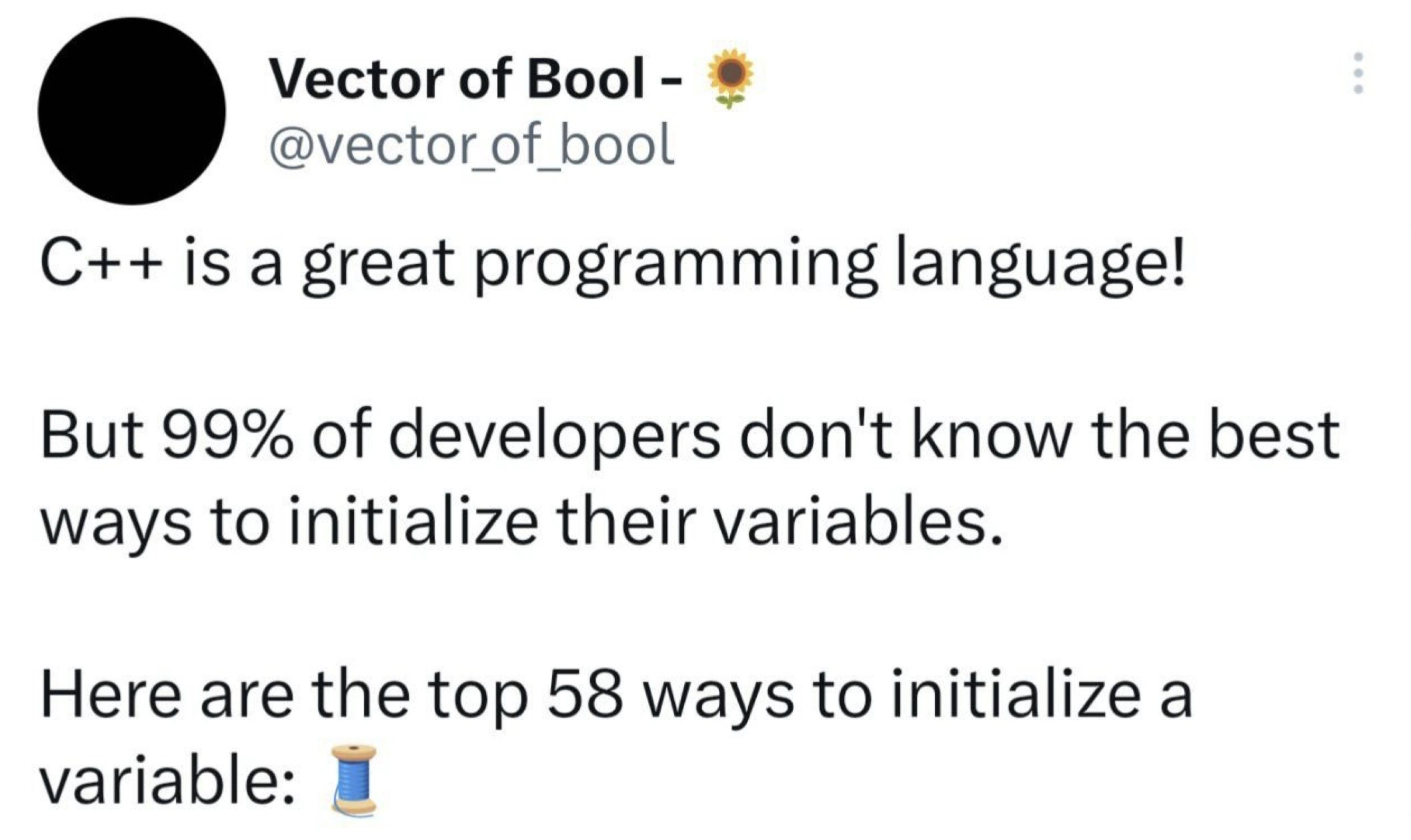
The 58 Shades of C++ Variable Initialization
Why is this Languages meme funny?
Level 1: Door with 58 Locks
Imagine you have a door that you want to unlock to get into your house. Normally, a door might have one key and one lock – simple, right? Now picture a very strange house that has 58 different locks on the same door 😮. Some locks are old, some are new, each added in different years, but none were removed. To open this crazy door, you have to figure out 58 ways to use a key (or a code, or a fingerprint… every lock is different!). That’s way more complicated than it needs to be just to do one basic thing: open the door. Kinda silly, isn’t it?
This meme is joking that the C++ programming language is like that door. Initializing a variable (which is basically “opening the door” to give a variable a starting value) should be simple, but C++ has so many methods accumulated over time that it feels like there are 58 locks on it. It’s funny in the same way the door story is funny – it’s poking fun at unnecessary complexity. Even though C++ is powerful (just like a high-security house might be very safe), people laugh about how something straightforward turned into a overly complicated task. The core feeling here is a mix of amusement and frustration: we’re laughing because we recognize how over-the-top and confusing it can get, and sometimes you just have to joke about it.
Level 2: One Value, Many Ways
Let’s break this down in simpler terms. The meme is talking about how in the C++ programming language, there are many different ways to give a starting value to a variable – so many ways that it becomes a running joke. Initializing a variable just means you're telling the computer, "Hey, set aside some memory and put this initial value in there." Most languages have one or two straightforward ways to do this. For example, in Python or JavaScript, you might just write x = 5 and that’s it. But C++ is older and more complex; it has gained new features over time while keeping the old ones. This has led to multiple syntaxes (formats) for initialization, each introduced at different times for different reasons.
Some common C++ variable initialization styles include:
- Using an equals sign, e.g.
int x = 5;. This looks just like other languages and it’s doing copy initialization (conceptually copying 5 into x). - Using parentheses, e.g.
int y(5);. This is direct initialization and does basically the same thing for simple types like int (put 5 in y), but is handy for initializing more complex objects or when calling a specific constructor. - Using braces, e.g.
int z{5};. These braces came later with modern C++ standards (C++11 and above) as part of uniform initialization. For anint,int z{5};also just sets z to 5. Braces are nice because if you accidentally tried something likeint bad{3.14};, the compiler will error instead of silently truncating 3.14 to 3 (so it prevents a certain class of bugs called narrowing conversions). - There’s even an odd-looking combination of equals and braces:
int w = {5};which is allowed and basically the same as the brace initialization (this form mostly exists for compatibility and for initializing arrays/structs in older C++).
Now, why would a language have so many ways to do the same thing? A lot of it is historical. C++ has been around since the 1980s, growing from the C language. Each time the language standard evolved, new features were added. But they rarely removed old ways (because that would break old programs!). So C++ ended up with accumulated quirks. For instance, the brace {} method was added to solve some problems (like removing ambiguity and avoiding certain errors), not necessarily to replace the other methods outright. That leaves developers with a choice: and sometimes too much choice can be confusing. If you’re a newcomer (maybe learning C++ in school or out of curiosity), you might scratch your head thinking, “Should I use =, or parentheses, or braces here? Do they all do the same thing?” The honest answer is: it depends on the situation, and that’s exactly what makes this meme funny to those in the know. It’s poking fun at how a C++ pro might over-complicate a basic topic (“the best ways to initialize a variable”) by listing dozens upon dozens of techniques, as if revealing great secrets.
The tweet format also has a little blue spool-of-thread emoji 🧵 at the end of the text. On Twitter, the thread emoji means the author is about to start a thread – a series of connected tweets – usually to explain something in detail. So the joke is that this person is about to enumerate “the top 58 ways” in a long list. Of course, 58 is an exaggerated count (there aren’t literally 58 totally distinct mainstream ways, but it can feel like it!). The humor comes from both language quirks and a bit of teasing of those verbose Twitter how-to threads. If you’re a junior dev or just someone learning, the key takeaway is: C++ has multiple syntaxes for initializing variables because of its long history and design decisions. And developers like to joke about how excessive it can seem. Don’t worry – in practice, you won’t actually use dozens of different styles in one program; teams usually agree on a consistent approach. But being aware that these variations exist is part of understanding C++ and why people both love and groan about it.
Level 3: Syntax Overload
For a senior developer, this meme hits home as a commentary on language complexity and the paradox of choice in modern C++. It’s funny because it’s true enough: C++ offers a smorgasbord of initialization syntaxes, and veterans have lived through the style debates and confusion each one can cause. The tweet format itself is a tongue-in-cheek parody of those long Twitter threads (🧵) where someone claims “99% of you are doing it wrong; here’s the right way!” – a familiar trope in DeveloperExperience_DX discussions. In this case, the author jokingly promises to reveal the “top 58 ways” to initialize a variable, satirizing both the overabundance of options and the overzealous tech influencer style.
Why 58? It’s an absurdly large number meant to provoke a laugh about just how many ways C++ lets you do something as basic as initializing a variable. Seasoned C++ programmers genuinely do joke that there are nearly as many ways to initialize as there are developers. This stems from C++’s evolution: instead of one blessed approach, the language accumulated legacy forms and new forms side-by-side. Every C++ codebase has that mix of = signs, parentheses, and braces – often all within the same project – because different contributors learned at different times or follow different style guides. If you’ve been around long enough, you’ve probably seen conversations like:
Dev A: “Why are we using
int x(5);here instead ofint x = 5;?”
Dev B: “We prefer direct initialization to avoid an extra copy.”
Dev C: “Actually, I useint x{5};now to prevent narrowing. {} is the modern C++ way.”
Dev A: sigh “Alright, as long as it works… I just want to initialize an integer!”
This back-and-forth is part of the DeveloperHumor in C++ communities. The meme exaggerates with “58 ways” the feeling that C++ gives you endless rope to hang yourself with – or, more positively, endless flexibility to suit any scenario. The humor also lies in the LanguageWars-like debates it spurs: which initialization style is truly the best? There are blog posts, Stack Overflow answers, and even sections in the C++ Core Guidelines about {} vs = vs (). Each camp has its rationale:
- Old school (C-style):
int n = 42;is clear and classic, understood by any CFamilyLanguages veteran. But it can call implicit conversions or copy constructors for objects. - Direct constructors:
std::string s("hi");calls the constructor directly. Many experts favored this to avoid the perception of a needless copy. It also neatly disambiguates function prototypes (most of the time… until you hit the vexing parse in specific cases). - Brace (uniform) init:
auto arr = std::array<int,3>{1,2,3};– braces became the one syntax to rule them all in modern C++11 and beyond. They can initialize containers, callstd::initializer_listconstructors, and even value-initialize builtin types with empty braces (e.g.int x{}; // x == 0). The upside: braces avoid narrowing conversions and some syntactic ambiguity. The downside: they introduced new ambiguity withstd::initializer_listpreference and surprises with theautokeyword (auto x = {5}doesn’t give you an int like you’d think, but anstd::initializer_list<int>!). So much for being “uniform”.
In practice, experienced C++ devs learn these nuances through painful trial and error – thus the dark comedy when someone promises to enlighten us with dozens of “best ways” to do it. It resonates because many of us have clicked such threads or articles out of genuine confusion or FOMO, only to realize the LanguageQuirks of C++ can’t be distilled into a neat list without asterisks and caveats galore. The tweet’s author, @vector_of_bool, is presumably making a facetious jab at the endless Cpp style tips circulating online. And indeed, if such a thread were real, it might start earnestly listing forms like a few of these:
int a = 5; // 1. Copy initialization for int
int b(5); // 2. Direct initialization
int c{5}; // 3. Brace initialization (universal/uniform)
int d = {5}; // 4. Copy-list-initialization (allowed, does same as 3 for int)
int e{}; // 5. Value initialization (e.g. int e = 0)
And that’s just for an int! A truly pedantic list would explode when you include pointers, references, new expressions, placement new, aggregates, static initialization, etc. 😅 The absurdity of “top 58 ways” underscores how a seemingly simple task grows in complexity when a language as powerful (and old) as C++ keeps adding features. It’s a classic case of LanguageComplexity: power at the cost of simplicity. Seasoned developers find it funny because they’ve been bitten by this. They’ve seen code where a different initialization style caused a subtle bug or compile error. Perhaps they tried to initialize a std::vector<std::string> with braces and got surprising results, or they spent hours debugging why auto x{42} wasn’t behaving like int x = 42. This meme is an affectionate eye-roll at C++’s expense, acknowledging that yes, it’s a great language (as the tweet opens by saying, possibly with a hint of sarcasm), but it sure can overwhelm you with options for something as basic as variable initialization. The DeveloperExperience aspect here is key: too much choice can be a pain. In a well-typed, performance-centric systems language like C++, every choice has trade-offs, and devs have to know the subtle rules. That’s simultaneously the fun and frustration of using C++ daily – a sentiment that powers a lot of CodingHumor in the community.
Level 4: Grammar Gymnastics
At the most granular, specification-level view, this C++ meme pokes fun at how the language’s grammar and compiler rules have evolved to allow so many initialization forms. In C++, the way you write a variable’s initialization can subtly alter how the compiler interprets it. Over the years, the C++ standards committee piled on new syntax to address old problems without breaking backwards compatibility, resulting in a sort of grammar gymnastics. Each new C++ standard often introduced a new initialization mechanism or tweaked an existing one:
- Copy initialization (classic C style, using
=) vs Direct initialization (constructor call using parentheses) were both present early on. For basic types likeint,int a = 5;andint b(5);produce the same machine code, but for class types,MyClass x = value;can invoke a copy constructor whileMyClass y(value);calls a direct constructor. Two different forms with potentially different function calls under the hood! - Uniform initialization using braces
{}came in C++11 trying to unify initialization and avoid the infamous “most vexing parse”. In older C++, something likeWidget w(Foo());could be parsed by the compiler as a function declaration (oh no, not a variable!) due to C++’s complex grammar. Brace syntaxWidget w{Foo()};removed that ambiguity by clearly signaling an object initialization. But it also introduced new rules, like forbidding narrowing conversions (e.g. you can’t brace-initialize anintwith adouble3.14 value without an explicit cast). - Initializer lists add another twist: if a class has a constructor that takes a
std::initializer_list<T>, brace initialization will prefer that. This is whystd::vector<int> v1(3, 42);creates a vector of 3 elements all42, butstd::vector<int> v2{3, 42};uses the initializer-list constructor and ends up with 2 elements{3, 42}. Same braces, wildly different outcomes because the compiler’s overload resolution sees an initializer_list. 😵
Under the hood, the C++ compiler’s abstract syntax tree (AST) has to accommodate all these forms. There are separate rules for direct-initialization, copy-initialization, list-initialization, value-initialization, etc., each defined in the language grammar and the standard’s flowcharts. Seasoned C++ devs joke that even the compiler sometimes needs a coffee to parse all possible initialization grammars correctly. Why does all this matter? Because subtle differences can call different constructors or perform extra copies, affecting performance or even correctness. One stray pair of { } versus ( ) could be the difference between efficient in-place construction and an unnecessary copy — or even a compile-time error if narrowing is disallowed. The meme’s hyperbolic “58 ways” number exaggerates, but not by a lot; if you enumerate combinations of high-level forms across versions of C++ and edge cases, the count of distinct initialization mechanisms gets comically high. From a language design perspective, this proliferation highlights the struggles of a multi-decade language (Cpp is over 35 years old) balancing power with consistency. As an expert, you see the humor: C++ gives you freedom to do something as simple as giving a variable a value, but that freedom comes with the complexity of a context-free grammar that’s anything but free of quirks.
Description
A screenshot of a tweet from a user named 'Vector of Bool - 🌻' (@vector_of_bool). The tweet starts with a deceptively positive statement: 'C++ is a great programming language!'. It then pivots to the core joke: 'But 99% of developers don't know the best ways to initialize their variables.' The punchline is delivered in the final sentence, 'Here are the top 58 ways to initialize a variable: 🧵', followed by a thread emoji, implying a long, convoluted list is to follow. This meme humorously satirizes a well-known pain point in C++ development: the language's notoriously complex and numerous syntaxes for variable initialization (e.g., copy, direct, list, aggregate initialization). The exaggerated number, 58, highlights the perceived over-complexity and the endless debates within the community about which method is superior, a frustration deeply felt by experienced C++ engineers

Comments
10Comment deleted
The C++ standards committee sees a new way to initialize a variable and treats it like a Pokémon: gotta catch 'em all. The 'Most Vexing Parse' is just the final gym leader
Uniform initialization in C++ feels like eventual consistency: after 58 syntaxes and a couple of SFINAE retries, the variable eventually gets a value - just don’t ask which overload actually committed it
The real initialization list is the segfaults we collected along the way - because after 40 years of C++ evolution, we've somehow managed to make int x = 5; require a PhD dissertation on whether you meant copy, direct, or uniform initialization, and God help you if templates are involved
Ah yes, C++ variable initialization - where you can choose from 58 syntactically valid approaches, 47 of which will compile but do something subtly different than you intended, and the remaining 11 trigger template instantiation errors spanning 400 lines. It's the only language where 'int x{};' and 'int x();' look equally reasonable but one gives you zero and the other declares a function returning int. Meanwhile, Rust developers initialize variables exactly one way and spend their saved cognitive cycles arguing about whether '.unwrap()' is a code smell
Braces and std::initializer_list hijack your overload set; parens resurrect the most vexing parse; '=' tiptoes past narrowing until runtime - “uniform” initialization mostly unifies the bikeshed in code review
58 ways to init a var in C++? That's before counting brace-elision UB variants across compilers
Only in C++ can v{10} and v(10) both compile, do different things, and still be marketed as 'uniform initialization' - which is why code reviews outlive the build
Lol, tw these days Comment deleted
*Kids these days Comment deleted
https://i.imgur.com/3wlxtI0.gif Comment deleted