Skip to content
DevMeme
4525 of 7435
When your contorted code draws stunned looks from interns to architects
CodeQuality Post #4964, on Oct 29, 2022 in TG

When your contorted code draws stunned looks from interns to architects

Why is this CodeQuality meme funny?

Level 1: Bending Over Backwards

Imagine you ask someone to solve a simple problem, but they do it in the craziest way possible. For example, suppose a kid wants a cookie from the top shelf. Instead of just asking an adult for help or using a step stool, he stacks three wobbly chairs, climbs up like a circus acrobat, and grabs the cookie by hanging upside-down from a lampshade. He does get the cookie in the end, but everyone watching is gasping and thinking, “Wow, that was a bit much!” In this meme, the silly pool table scene is like that kid’s wild cookie-grabbing stunt. The “code” is doing something in a super complicated, kinda ridiculous way. And all the people watching – from the newbies to the experts – are like the family watching the kid’s chair-balancing act with stunned faces. They’re all sharing the same thought: “It worked… but was it really supposed to be done that way?!” It’s funny and crazy at the same time, because usually you’d expect a much simpler and safer solution.

Level 2: Untangling the Spaghetti

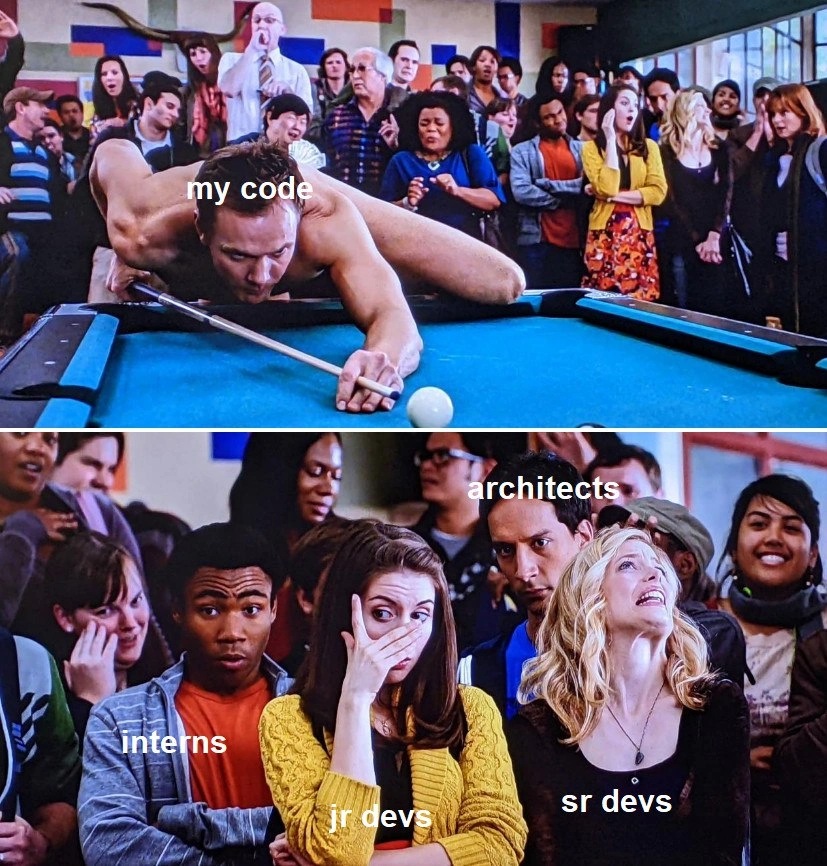
Let’s break down this meme in simpler terms. It’s highlighting a situation in software development where code is written in a very awkward, complicated way, yet it somehow works. In the top image, the text "my code" is placed on a man doing a bizarre pose on a pool table. That represents bad code (the code you wrote) doing something in a convoluted manner. When we say code is “contorted” or talk about spaghetti code, we mean the code’s structure is all tangled up – like a bowl of spaghetti – instead of being nice and straight. This happens when the logical flow of the program is twisted with lots of jumps, exceptions, or deeply nested conditions. It’s generally considered a code smell. A code smell is a term developers use for any hint that something might be wrong with the code’s design. For example, an extremely long function or a variable name like doStuff that doesn’t tell you anything – those are code smells. They don’t necessarily break the program, but they make other developers raise an eyebrow, just like the crowd around the pool table.

The bottom image labels the spectators as interns, jr devs (junior developers), sr devs (senior developers), and architects. This is comparing the onlookers in the meme to a real software team reviewing code together. In a typical code review, a team examines someone’s code change to catch mistakes and suggest improvements. Here, everyone from the least experienced (interns) to the most experienced (architects) is looking at "my code" (the contorted code) with shock or disbelief. Let’s explain these roles:

  • Interns: These are beginners, often students or new graduates in their first tech job. They have limited experience and mostly theoretical knowledge. In the meme, the intern has a look of pure shock. That’s because interns usually expect clean, logical code like they saw in tutorials or classes. Seeing such a bizarre workaround in real code is like a kid seeing a clown car for the first time – they didn’t know a car could work like that, and it’s both fascinating and scary.

  • Junior Developers (Jr devs): These folks have a bit more experience (maybe 1-2 years). They know the basic best practices – things like writing clear code, avoiding global variables, using loops and functions properly. The junior dev in the meme is facepalming (covering her face in disbelief). That’s because, with what she’s learned, she can tell this code violates a lot of design guidelines. It’s the kind of code her mentors told her not to write. For instance, maybe the code uses a bunch of goto statements or hacky tricks that make it hard to follow. A junior dev might be thinking: “Oh no, this is exactly the kind of thing I was warned about in bootcamp/college.” She’s embarrassed on behalf of whoever wrote that code, because it’s obviously not following the clean coding standards.

  • Senior Developers (Sr devs): These are veteran programmers with many years under their belt. They’ve likely seen and written all kinds of code – the good, the bad, and the ugly. The senior dev in the meme (the blonde woman) looks up in exasperation or maybe laughs in a "I can’t believe we have this in our system" way. Seniors know that sometimes, due to deadlines or legacy issues, even a messy solution is used just to keep the system running (technical debt, as we call it, accumulates this way). They recognize a hack when they see one. A hack is a quick-and-dirty solution that solves a problem but is not a clean or long-term approach. The senior dev’s reaction is half amusement (because it’s a familiar situation – “here we go again”) and half concern (because they know how hard that kind of code will be to maintain or debug later). They might chuckle and say, “Heh, I’ve written something like this in a crunch before... but we really should fix this.”

  • Architects: In software teams, software architects or system architects are very experienced developers who design the high-level structure of the system. They think in terms of modules, interfaces, and overall architecture. The meme labels the tall guy in the back "architects" and he’s giving a serious, almost disgusted look at the contorted code. Why? Because architects care about code consistency and cleanliness on a big-picture level. They set guidelines for how different parts of the system should interact and how code should be organized. Contorted code typically breaks those guidelines – it might be doing too much in one place, or bypassing the intended structure. An architect seeing this would worry that this weird code could become a fragile point in the system (meaning if anything changes, that part might break since it’s not built in a robust way). They might also be thinking, “We need to redesign that part of the system so nobody has to write code like this to get things done.” Essentially, it offends their sense of software design aesthetics.

All these reactions in the meme convey a common feeling: “This code is not okay.” 😅 It’s funny because it’s true – every developer, no matter their level, has encountered code so strange that it unites everyone in surprise. This usually happens when the code violates fundamental clean code principles. In software development, we have some guiding ideas like KISS (Keep It Simple, Stupid), meaning simple solutions are generally better, or DRY (Don't Repeat Yourself), meaning don’t duplicate code. Contorted code tends to ignore these principles. It might be doing something in 10 confusing steps that could be done in 2 clear steps, breaking KISS. It might copy-paste logic in five places instead of one, breaking DRY. Those are big no-nos taught early on, so when juniors or interns see contorted code, they know it’s “not supposed to be like that.” Seniors and architects, on the other hand, also know why it probably ended up like that despite not being ideal (maybe an urgent bug fix, or someone didn’t know a better way at the time).

Let’s consider a concrete example of contorted code to illustrate. Suppose we want to find if a value exists in an array. A simple, clean approach might be a straightforward loop or a built-in function. A contorted approach, however, might do something wild like throwing an exception to break out of the loop, which is generally bad practice. For instance:

function findValue(arr, target) {
    // Using exception throwing in place of normal control flow (a code smell!)
    try {
        let index = arr.length;
        while (index >= 0) {
            if (arr[--index] === target) throw 'FOUND';  // contorted way to exit loop
        }
        console.log("Value not found");
    } catch (e) {
        if (e === 'FOUND') {
            console.log("Value found at index " + index);
        } else {
            throw e; // rethrow any unexpected errors
        }
    }
}

In this JavaScript snippet, the code is doing something odd: it’s using a try/catch and throwing a string 'FOUND' as an exception as a way to break out of the loop early when the target is found. Technically, it works – if the value is found, an exception is thrown and caught, and we print the index. But this is a bizarre way to accomplish the task. It’s hard to read and definitely would draw stunned looks in a code review. A cleaner way would be just:

// Simpler and clearer approach:
let index = arr.indexOf(target);
if (index !== -1) {
    console.log("Value found at index " + index);
} else {
    console.log("Value not found");
}

The second snippet is straightforward and easy to understand. The first snippet, in contrast, is like that pool trick shot – doing backflips to achieve something simple. This is what we mean by spaghetti code or contorted code: it’s not linear or clear; it’s bending the normal rules of structure. Such code is harder to maintain because another developer might spend an hour just figuring out why the original coder chose that approach. It’s also prone to bugs – what if some other error happens inside the try? It might get caught incorrectly, etc.

Now, think of a team reading through the first snippet. Interns might say, “I didn’t even know you could use exceptions like that… is that allowed?” (Answer: it is allowed by the language, but it’s a bad practice). Junior devs might point out, “We should avoid using exceptions for flow control; it makes the code confusing.” They’ve read this in books or heard seniors say it. Senior devs would agree and likely add, “Yeah, this needs refactoring. Maybe the original author was in a rush or didn’t know about indexOf.” They understand how code like this happens but will advocate to clean it up. Architects might chime in, “Why are we manually searching the array at all? Don’t we have a service or database doing this for us? This code might not even belong here.” They’re thinking at a higher level about architecture and responsibility.

The meme is a humorous reflection of these scenarios. It exaggerates it with a funny scene, but in real life, having contorted code in a codebase is a serious CodeReviewPainPoints issue. It can slow down development (because people struggle to understand it), introduce bugs, and generally hurt the DeveloperExperience of the team (nobody enjoys working with confusing code). That’s why teams emphasize writing clean, readable code. Clean code might not be as flashy as a trick shot, but when others look at it, they don’t make the faces in the meme – instead, they nod in approval or, better yet, they don’t react at all because the code was so clear it didn’t even draw attention to itself.

In summary, this meme uses a funny TV show moment to illustrate what happens when code is written in a needlessly convoluted way. All the developers, regardless of rank, recognize it as a problem (hence the stunned looks). It teaches a simple lesson to junior engineers: if everyone is shocked or confused when they see your code, that’s a sign you may need to simplify or refactor it. Good code shouldn’t surprise everybody in the room. And if you’re an intern or junior who encounters code like this, don’t panic – it’s unfortunately common in older or rushed projects (we call that technical debt), and part of your job as you grow is to learn how to untangle the spaghetti into cleaner noodles 😊.

Level 3: Trick Shot Code Review

This meme perfectly captures a painful CodeReview spectacle: a developer’s contorted code that somehow works (like a crazy pool trick shot) while an entire team – from fresh-faced interns to battle-hardened architects – looks on in disbelief. In the top panel, the nearly naked man stretched awkwardly across the pool table labeled "my code" symbolizes a wild, code smell-ridden solution attempting to accomplish a task. It's an acrobatic feat of coding: technically hitting the target (the pool ball sinks!), but in a twisted, unorthodox way that violates every principle of good CodeQuality. The code is doing a metaphorical splits on the pool table: an overly clever hack or kludge contorting normal logic flow just to get a result. It’s the kind of inscrutable logic that might make even the computer say, "Are you sure about this?"

In the bottom panel, we see the reactions of the onlookers labeled by experience level: interns, jr devs, sr devs, and architects. This highlights a universally relatable DeveloperExperience moment – a piece of code so questionable that it induces a cascading WTF face from every rung of the engineering ladder. 😳 Interns are wide-eyed and slack-jawed, witnessing their first truly contorted_code monstrosity; they’re silently reconsidering everything they learned in school about clean code. Junior developers are cringing (one even covers her face) because they’ve just been taught proper patterns and now they’re staring at a total violation of those ideals – it’s like being told about healthy diet then seeing a chef deep-fry a salad. Senior devs gaze upward or laugh in a you’ve-got-to-be-kidding-me way, because although they’ve seen plenty of CodeSmells and bizarre fixes in their tenure, it still physically pains them to behold yet another spaghetti code acrobatics act. They know exactly how these kinds of hacks happen (usually at 3 AM before a release, when DeveloperFrustration is high and someone yells "I don't care how, just make it work!"). The seniors likely have flashbacks to late-night emergency patches – seeing this code triggers a mix of dark humor and PTSD. And the architects? The tall guy labeled "architects" has the most intense stare – architects are the high-level design guardians, concerned with system elegance and long-term maintainability. To them, this code is an architectural crime scene: it breaks the laws of good design with such flamboyance that even the architect is half-amused, half-horrified ("Who wrote this?!?!"). They’re already mentally calculating how many layers of abstraction this trick shot pierced and which carefully drawn architecture diagram is now basically a lie.

The humor here comes from just how relatable this situation is across the industry. The meme exaggerates it with a comedic pool scene from Community, but every developer has either written a desperate hacky solution or been the onlooker during a code review where someone’s code is doing figurative gymnastics. It’s a classic DeveloperPainPoints scenario: a piece of code that technically solves a problem but in a convoluted, fragile way that leaves everyone from newbie to expert collectively aghast. In real projects, this might be that one function that’s 500 lines long with 12 levels of if/else nesting, or that file named SpecialCaseFinal_v2_old_BAD.cpp hiding in the codebase that nobody wants to touch because it’s pure chaos inside. The reason everyone is stunned is because maintainable code should ideally be straightforward – like a clean pool shot you line up normally. Here instead, we have a behind-the-back, one-foot-on-the-light-fixture trick shot. Sure, it sunk the ball (the code produces correct output), but at what cost? Readability is near zero, the risk of failure is high, and any future change will be a nightmare. This is the essence of a code smell: it smells wrong to any experienced dev, a signal that the code should probably be refactored or at least closely reviewed for potential bugs.

Why does such contorted code exist then? Often it’s born out of pressure and technical debt. Maybe an urgent deadline or a production bug forced someone to bend the code “just this once” into an awkward shape. Like a trick shot done out of desperation during a bet, the developer might have thought: “Okay, this isn’t pretty but I have to get it working now.” Over time those "just-get-it-done" moments accumulate, and you end up with parts of a codebase held together by duct tape and sheer willpower. This creates CodebaseComplexity that everyone hates but is afraid to touch – exactly why the crowd in the meme looks half scared. Each role also has a slightly different lens on the problem, which adds to the humor: the intern is thinking “Is this what professional coding is?!”, the junior dev is thinking “There must be a better way – I just learned about better ways!”, the senior dev is sighing “Here we go again... I bet this was from last year’s crunch-time hack”, and the architect is silently plotting a complete rewrite of this component post-release. The juxtaposition of those reactions reflects the silent collective agreement: this code is a real problem. It’s as if the entire room holds its breath at the sheer audacity of the code’s approach.

The deeper irony is that sometimes these crazy solutions do work in production (like the pool ball actually going in). That’s both funny and frightening. In the sitcom scene, the character Jeff making the shot is triumphant in a ridiculous way – similarly, a programmer might brag "Well, it works, doesn’t it?" after pulling off an absurd coding stunt. But the onlookers’ faces say "Just because it works doesn’t mean it’s right." In software engineering, best practices exist for a reason: they’re like proper form in billiards. Sure, you can dangle off the table and hit the cue ball behind your back, but nine times out of ten you’ll scratch and ruin the game. The seasoned engineers in the room know that this kind of contorted code is a ticking time bomb that could misfire the moment something changes (or the next developer tries to modify it). They’re picturing all the potential bugs and on-call DeveloperSelfDeprecation moments this funky code will cause, hence the mix of dread and laughter.

In summary, Level 3 exposes the full absurdity and nuance of the meme: it’s a commentary on CodeQuality and team dynamics. The image exaggeration (a nearly naked trick-shot) underscores how exposed and precarious bad code can be – no cover, all risk. The crowd’s uniform shock spans all experience levels, emphasizing that everyone can recognize egregiously bad (or overly clever) code when they see it. The humor lands because it taps into that shared experience: we laugh because we don’t want to cry at how true it often is. This is a slice of real dev life – a public_code_review_moment where the code’s awkward posture speaks louder than any manager’s pep talk about “craftsmanship.” It’s cringe-worthy, it’s funny, and it’s a gentle reminder: if all your colleagues look like the Community cast recoiling in unison, it might be time to refactor that contorted masterpiece of yours.

Description

Two-panel meme from the sitcom 'Community'. Top panel: a nearly naked man stretched awkwardly across a pool table lining up a shot, overlaid with white text "my code". A crowd of onlookers surrounds the table. Bottom panel: a close-up of four spectators in that crowd, each labeled in white lowercase: "interns" on a young man, "jr devs" on a pensive woman in a yellow sweater, "sr devs" on a blonde woman staring upward, and "architec" on a tall man beside her. The joke compares painfully twisted yet functional code to the acrobatic cue shot, while every tier of the engineering ladder watches in disbelief, capturing real-life code-review dynamics and code-quality angst
Comments

6
Anonymous ★ Top Pick Wrote a reflection-powered runtime hotfix that serialises lambdas into SQL - interns see wizardry, juniors see tech-debt, seniors see a cry for help, and the architect is silently mapping the blast radius before the cue ball hits prod
  1. Anonymous ★ Top Pick

    Wrote a reflection-powered runtime hotfix that serialises lambdas into SQL - interns see wizardry, juniors see tech-debt, seniors see a cry for help, and the architect is silently mapping the blast radius before the cue ball hits prod

  2. Anonymous

    The architects' expression is exactly how they look when you propose adding 'just one more microservice' to fix a problem that could be solved with a simple database index - meanwhile, the senior devs have already mentally calculated the on-call rotation impact

  3. Anonymous

    The beautiful thing about this meme is its brutal accuracy: interns see code that works and think 'cool trick,' junior devs recognize the immediate code smell, architects mentally calculate the blast radius across microservices, and senior devs are already composing the post-mortem for the inevitable 3 AM incident - because they've seen this exact Jenga tower collapse before, just with different variable names

  4. Anonymous

    Interns see a trick shot; seniors see a rollback plan; the architect is quietly counting how many bounded contexts that cue just violated

  5. Anonymous

    My code lining up a trick shot on the prod DB: interns cheer, juniors tense, seniors pre-open the rollback PR, and the architect asks which invariant we just violated

  6. Anonymous

    Code stripped to bare essentials pockets the shot - architects approve the architecture, devs blush at the exposure

Use J and K for navigation