Skip to content
DevMeme
4524 of 7435
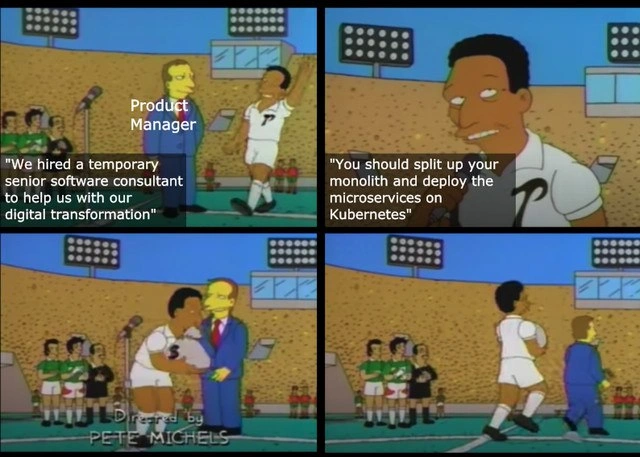
Consultant instantly prescribes Kubernetes microservices for every digital transformation effort
Containerization Post #4965, on Oct 29, 2022 in TG

Consultant instantly prescribes Kubernetes microservices for every digital transformation effort

Why is this Containerization meme funny?

Level 1: One Pill Fixes All

Imagine you tell a doctor that you want to become much healthier and fitter (that’s like a company talking about “digital transformation” – wanting to improve a lot). Now, instead of examining you or asking questions, the doctor immediately says, “Aha! I’ve got it – start taking this brand-new super vitamin pill and also join this high-tech gym program!” They say it with such confidence that it sounds like a miracle solution. You, not knowing much about medicine but eager to improve, get really happy. You give the doctor a big hug, thinking “Yes! This will fix everything!” and you walk away excited to begin this new regimen. Meanwhile, your family (or maybe your current fitness coach) is standing nearby looking a bit confused, because they know getting healthier might need a more specific plan (maybe a change in diet, or addressing a particular issue you have) – not just the same pill and program every person gets.

In this little story, the doctor is like the consultant in the meme, and the super vitamin + fancy gym is like saying “use microservices and Kubernetes.” It’s a one-size-fits-all solution. It sounds cutting-edge and great – who wouldn’t want the latest pill or the coolest gym? – just like buzzwords sound exciting in tech. And hugging the doctor shows how happy the person is to hear this easy fix. It’s funny because we know in real life getting healthy usually isn’t solved by one magic pill for everyone. You usually need to look at the person’s specific situation. Maybe someone needs to fix their diet, another person needs more sleep, another might have a specific vitamin deficiency – the solution should fit the problem.

The meme is making the same kind of joke but about companies and technology. The company says “we want to modernize and improve” (get healthier), and the consultant just hands them the trendiest solution that’s popular for everyone these days, without really diagnosing the actual problem. Everyone celebrates as if it’s solved – just like our imaginary person hugging the doctor and skipping off – even though the real work or the real solution might be different or more involved. It’s funny and a bit silly, because we recognize that genuine improvement usually requires understanding the problem, not just applying a popular fix. In simple terms: the meme is poking fun at how people sometimes trust buzzwords or fancy ideas too quickly, the same way someone might trust a miracle cure without question. It’s a reminder that just because something is popular (like Kubernetes or a super vitamin) doesn’t mean it’s the automatic answer to your problem – but it sure can sound convincing in the moment!

Level 2: Breaking the Monolith

Now let’s break down the buzzwords in this meme for a junior developer or someone new to these concepts. The company in the meme has a monolith architecture – basically one big application that does everything. Imagine a single giant codebase or a single server running the entire product (for example, an all-in-one website where the UI, business logic, and database access are all in one project). Monoliths are straightforward in the sense that all the parts live together, which can make communication between parts simple (just calling functions or using the same database). However, monoliths can become unwieldy as they grow: deploying a small change means redeploying the whole app, scaling requires scaling everything together, and different teams might step on each other’s toes working in the same codebase. That’s where microservice architecture comes in – the idea is to split a large application into many smaller, independent services that each handle one part of the functionality. So instead of one big app, you might have an authentication service, a payment service, an inventory service, etc., each running separately and possibly even written in different programming languages or managed by different small teams. These services communicate with each other over a network (like calling APIs) rather than via in-process function calls.

In the meme, the consultant tells them to break their monolith into microservices and deploy them on Kubernetes. Kubernetes is an open-source platform for managing containers at scale – basically, it automates the deployment, scaling, and operation of application containers. Let’s unpack that: containerization is a technology (popularized by Docker) where you package an application along with its environment (all the libraries, dependencies, and configs it needs) into a lightweight, portable unit called a container. Think of a container like a little box that has everything your app needs to run, so it can be moved from one server to another and still work the same. Containers are a bit like mini virtual machines but much more efficient. When you have lots of containers to run (say, dozens of microservices, each possibly replicated for load balancing), managing them by hand gets tricky. This is where Kubernetes helps – it’s like a container orchestra conductor. You tell Kubernetes what you want (for example: “run 5 instances of the payment service container, and 3 of the inventory service, ensure they can talk to each other, and restart any that fail”), and Kubernetes takes care of making it so, even if the containers are spread across multiple physical or cloud servers (the cluster). It handles DevOps concerns like automatic restarts, scaling up or down, rolling updates (deploying new versions with minimal downtime), and network routing between services. It’s a powerful tool in the DevOps/SRE toolkit because it abstracts a lot of the manual work of deploying and keeping services running reliably.

So why would the consultant recommend this? Well, the buzzword-heavy answer is that moving to microservices on Kubernetes is seen as a modern best practice for achieving agility and scalability – key goals of digital transformation. Digital transformation in general means an organization is trying to upgrade its technology and processes to be more modern (often to respond faster to market changes, handle more users, or develop features more quickly). Adopting microservices can, in theory, let different teams work independently (since each microservice is its own project) and allow each part of the system to scale as needed (for example, if the billing part of your app is under heavy load, you can scale just the billing microservice rather than the entire app). Kubernetes then provides a robust way to run all these services in a containerized form, often in the cloud, and keep them running smoothly. It’s intrinsically tied to DevOps culture as well – since with Kubernetes you treat infrastructure and deployment in a more automated, configuration-driven way. The consultant is basically suggesting: “Use the latest technology and architecture patterns to modernize your app.” In categories like Modernization and DesignPatterns_Architecture, this advice lines up with what a lot of tech blogs, conference talks, and case studies promote when talking about transforming older systems.

However, the joke inside this advice is that it’s very generic. It’s like a fashionable recipe: “Step 1, break it into microservices. Step 2, use Kubernetes.” Many junior devs hear these terms constantly, but it’s important to understand that it’s not a magic formula – it’s one approach, with pros and cons. A consultant, especially a short-term one, might not have the time (or sometimes the incentive) to do a deep analysis of the company’s specific issues. So they might default to this well-known solution because it’s widely accepted as “how tech companies do things now.” It’s also possible that the company’s leaders specifically wanted to hear something about Kubernetes and microservices – after all, those terms make it sound like you’re keeping up with the Googles and Amazons of the world. There’s humor in that too: the idea of “Kubernetes everywhere”. Kubernetes has become so popular that it sometimes feels like people want to use it whether or not it’s necessary, just because it’s the hot technology. (This is captured by tags like kubernetes_everywhere and buzzword_solution.)

Let’s define a few of the key terms more clearly:

  • Microservice Architecture: an approach where you build your software as a suite of small services, each running in its own process and communicating via lightweight mechanisms (often HTTP APIs or messaging queues). Each microservice focuses on a single business capability. For example, instead of one giant e-commerce application, you might have an accounts-service, an order-service, a catalog-service, etc. This design can make it easier to update or scale parts of the application independently. If one service goes down, it ideally doesn’t crash the entire system (as long as other services handle that failure gracefully). It also means teams can work in parallel on different services. However, it introduces the need for inter-service communication and handling partial failures.

  • Monolith (Monolithic Architecture): the traditional approach where an application is a single unified unit. Imagine one big war file or one big .exe or a single Node.js server app that does everything. All the logic is together, sharing the same memory space and database. Monoliths can be simpler to develop and test initially (you can run the whole app on your laptop easily, and you don’t worry about network calls between modules). Many legacy systems and even newer startups start as monoliths because it’s straightforward. Problems arise as it grows: the codebase can become tangled, and deploys become risky because a change in one part might unexpectedly affect another. Scaling is coarse-grained (you have to copy the whole application to another server, even if only one part is the bottleneck).

  • Kubernetes: often abbreviated “K8s” (since there are 8 letters between K and s), this is an orchestration system for containers originally developed by Google. It groups containers into pods (a pod is like one or more containers that should run together, usually a microservice container plus maybe a helper like a logging sidecar). It runs on a cluster of machines and has a control plane that decides which pods run on which machine, when to restart a container, how to expose them via networking, etc. You typically interact with Kubernetes by writing YAML configuration files (manifests) that declare your desired state (e.g., “I want 3 instances of image myapp:v1 running, connected to a load balancer”). Kubernetes will then schedule those containers on your servers and ensure that if one dies, another is started to replace it, etc. This automation is a huge help in running large-scale systems reliably. But it’s also an extra layer of complexity—there’s a learning curve to understanding all the moving parts (like Deployments, Services, ConfigMaps, Ingress controllers… a whole new ecosystem).

  • Containerization: this is the practice of packaging up software into containers (like with Docker). Instead of installing an app directly on a server, you put it in a container image that includes the app and everything it needs to run (runtime, libraries, dependencies). Then you run that image on any server that has a container runtime. It’s become a standard way to deploy apps because it solves the “works on my machine” problem – the container encapsulates the environment. It also makes scaling easier: if you need more instances of your app, you just start more containers from the same image. In the context of modernization, taking a legacy app and containerizing it is often one of the first steps, so it can be managed by systems like Kubernetes or run in cloud container services.

  • DevOps: this is more of a culture/mindset and set of practices than a specific technology. It stands for Development + Operations, meaning the team that writes code and the team that runs the code collaborate closely (often they are the same people). DevOps emphasizes automation (for building, testing, deployment), infrastructure as code, continuous integration and deployment (CI/CD), and monitoring. When the consultant suggests Kubernetes and microservices, they’re implicitly suggesting a more DevOps approach as well. Running microservices on Kubernetes requires automation and close cooperation between development and operations, since how you package the app (Dev) and how you deploy/monitor it (Ops) are tightly linked. So a DevOps/SRE (Site Reliability Engineering) perspective is needed to succeed – you can’t just throw code over a wall and have someone manually deploy it anymore.

Now, the product manager hugging the consultant is a bit of cartoon humor, but it reflects something real: sometimes non-technical management get very excited by buzzwordy solutions. They might have read an article or case study where “Company X moved to microservices on the cloud and saw a tenfold increase in deployments,” so hearing the consultant validate that approach feels like a win. It’s like getting approval to use the cool new tools. And the consultant coming in just for this is typical: often companies will bring in a consultant for a few weeks to assess their systems and recommend improvements. The meme suggests this consultant instantly recommended the trendy solution without much analysis – implying perhaps that they always recommend this, like a template.

For a junior developer, the takeaway is: Microservices and Kubernetes are powerful, but they’re not automatically the right answer to every problem. There’s a reason these terms are so popular – they do address real needs for many organizations (scaling, quicker deployments, aligning with cloud infrastructure). However, implementing them is a major project in itself. It’s not like flipping a switch; it’s more like reorganizing a city’s infrastructure. If you ever find yourself in a meeting where someone says “We need to go to microservices because our consultant/friend/CTO said so,” it’s wise to ask why and how, and to understand the existing pain points that microservices would solve (or in some cases, whether improving the monolith might be simpler).

The humor in the Simpsons soccer meme format adds a light touch – it’s a scene of people in a stadium, quickly coming to a conclusion and celebrating, which is ironic because in real software projects, nothing is that easy. The text overlays save the day with buzzwords and then roll credits, which is obviously not how real life works. As a newbie, you should know that despite the meme’s sarcastic tone, these technologies (microservices, Kubernetes, etc.) are valuable tools in modern software development. Just be aware that they come with a learning curve and should be applied when they make sense, not just because they’re fashionable. The meme is basically what happens when buzzwords drive decisions: everyone gets excited at the idea stage, but the implementation stage can be a rude awakening if folks don’t understand the complexity behind those buzzwords.

Level 3: Kubernetes All The Things!

On a practical senior engineering level, this meme lands as a satire of modern architecture recommendations and hype-driven tech adoption. The scenario: a product manager proudly announces they’ve brought in a “temporary senior software consultant” to guide a big digital transformation. Immediately, the outside expert declares, “You should split up your monolith and deploy the microservices on Kubernetes.” This is depicted in the second panel with the consultant confidently spouting the buzzword-laden advice. For many experienced devs, this triggers a knowing grin: it’s a textbook case of generic consultant advice. The humor comes from how predictable and one-size-fits-all the suggestion is – as if no matter what the company’s actual problem is, the answer from a consultant in 2022 is invariably “have you tried microservices and Kubernetes?” It’s essentially the tech equivalent of a doctor saying “Take two containers and call me in the morning.” 😄

Why is that funny (or painful) for those in the industry? Because we’ve seen this movie before. Monolith vs. Microservices is a nuanced trade-off, but consultants (and sometimes upper management) often treat microservices as the inevitable cure for a “legacy” monolithic system whenever “modernization” or “digital transformation” is mentioned. It’s a form of buzzword solutioning: recommending whatever is trendy (in this era, breaking everything into Microservice Architecture and using Containerization with Kubernetes) to seem cutting-edge. The product manager in the meme literally hugs the consultant in panel 3, with a “Directed by Pete Michels” credit as if the whole engagement was a quick feel-good sitcom episode. This hug is a comedic exaggeration of how eagerly management may latch onto such advice: the consultant gives a flashy, simple answer and the non-technical manager is thrilled, thinking “Great, we have our strategy!” The hug and the abrupt ending (like rolling credits) highlight the absurdity: complex organizational and technical change is boiled down to a single catchy recommendation, and everyone celebrates as if the problem were solved. In reality, of course, that’s just the beginning of a long and difficult journey – but the meme humorously freezes the moment of naive optimism.

Notice in panel 4, the consultant stands aside while the product manager struts off confidently, and the team in green jerseys (presumably the developers/engineers, i.e., the “soccer team” left on the field) look confused or unsure. This perfectly captures the dynamic in many companies: leadership gets sold on a new tech approach, possibly by high-level advisors, and then Engineering is left on the hook to actually implement it. The dev team is like, “Uhh, do we even know how to do that?” or “Was the monolith actually our biggest issue?” They’re the ones who will have to refactor the entire system, set up the Kubernetes clusters, break the database apart, implement DevOps pipelines, deal with new failure modes, and so on – yet their confusion implies they had little say in this decision. It’s a classic ProductManagementHumor scenario: the product manager is happy because it sounds like they unlocked the secret to innovation, while the implementation details (and headaches) will belong to the engineers.

The meme is poking fun at Consultant Life as well. External consultants often have a reputation for swooping in with a pre-baked solution. Sometimes it’s cynical: if all you have is a hammer, every problem looks like a nail. Here the hammer is microservices on Kubernetes – the consultant’s favored tool for any job. It’s an architecture recommendation that might be totally valid in some cases (many systems do benefit from better modularity and scaling with microservices), but the joke is how instant and context-blind the prescription is. The consultant didn’t ask what the monolith does, where the pain points are, or whether the team has the maturity and scale to run a complex Kubernetes cluster. It’s just “split it into microservices and put it on K8s” by default. This resonates because in recent years, Kubernetes has been the hottest infrastructure technology and MicroserviceArchitecture is the buzzword darling of software design patterns. We’ve reached a point in the industry where proposing “Let’s containerize everything and go cloud-native!” is seen as the de facto modernization playbook. Many architects and consultants carry around the same slide deck about breaking monoliths into a constellation of RESTful services, deploying with container orchestration, implementing CI/CD – it’s become almost buzzword bingo. In fact, many seasoned developers roll their eyes because they’ve experienced “hype-driven development”: adopting microservices because all the conference talks say so, not because it truly fits the business needs.

This meme also touches on the organizational dynamics at play. The product manager might not be very technical; to them, terms like Kubernetes, microservice, and digital transformation sound like magic bullets that Silicon Valley unicorns use. Bringing in a consultant to sprinkle some of that magic feels like the right move. There’s often pressure from upper management or the board: “We need to modernize, everyone is talking about cloud, DevOps, and microservices – why aren’t we doing that?” Consultants know this, and as the saying goes, “nobody ever got fired for recommending Kubernetes.” 😏 It’s similar to the old enterprise IT adage “nobody got fired for buying IBM” – choosing the popular, established solution shields you from blame. So the consultant gives the safest possible on-trend advice. If things go wrong, well, they suggested an industry best-practice approach (hard to fault on paper). If things go right, they look visionary. It’s a win-win for the consultant, but not necessarily for the engineering team!

For those of us in DevOps/SRE or senior development roles, the humor cuts deep because we know just moving to microservices and Kubernetes is not a panacea. Yes, containerization and Kubernetes can enable faster deployments, scalability, and isolation of concerns – when applied to the right problem. But they also introduce new problems: configuration complexity, the need for robust CI/CD, container security issues, managing stateful workloads in a stateless paradigm, etc. There’s an entire ecosystem (monitoring tools, service meshes, distributed tracing systems) that you often need to adopt to keep a microservices-based system running smoothly. None of that is mentioned by the consultant in the meme – and that’s intentional for comedy. It’s like those infomercials or simplistically edited TV episodes: “Just do these two things and voila, success!”

Many professionals have lived through “transformation initiatives” where a consultant or new CTO mandates microservices, and a year later the company finds itself with a half-finished, buggy rewrite, performance worse than before, or skyrocketing cloud costs. The term “distributed monolith” might ring a bell – that’s what you get when you break a monolith into services poorly, ending up with tightly-coupled microservices that all have to change in lockstep. You essentially recreated the monolith’s interdependencies, but now with network calls and Kubernetes YAML files in the mix. 😅 The meme’s consultant presumably isn’t sticking around for the long haul to see if the transformation succeeds; their job is done once the advice is given. That’s the consultant life humor: drop the advice, collect the check, and depart, leaving internal teams to wrestle with the implementation. Meanwhile, the Product Manager strutting off in the final panel represents leadership proudly announcing, “We’re adopting a state-of-the-art microservices architecture on Kubernetes!” in all-hands meetings, while developers quietly face-palm because they know it’s not that straightforward.

In short, at this level we appreciate the meme as a send-up of modernization clichés. It’s making fun of the way companies chase buzzwords in the name of digital transformation. The Simpsons cartoon frames it perfectly: a quick conversation, an immediate embrace of the trend, and roll credits – problem “solved.” It’s funny to us because real life isn’t a 30-second resolution. Architecture decisions carry enormous consequences. Yet here it’s portrayed as almost too easy: Step 1, hire fancy consultant; Step 2, implement microservices on Kubernetes; Step 3, digital transformation achieved! 🎉 For experienced folks, the gap between that simplistic narrative and the messy reality is comedic gold (tinged with a bit of “ugh, I’ve been there”). We laugh, and perhaps cry a little inside, because we recognize how often this scenario (or some flavor of it) happens in the tech world.

Level 4: Fallacies of Distribution

At the most theoretical level, this meme hints at the deep pitfalls of taking a monolith and turning it into a distributed system of microservices. Breaking an application into microservices introduces fundamental challenges known from distributed systems theory. One of these is the CAP theorem (Consistency, Availability, Partition tolerance): when you split a single application (with a unified data store) into many services across a network, you inevitably face choices between keeping data consistent versus staying available during network failures. In a monolith, a single database transaction can enforce strong consistency (all-or-nothing commits). But in a microservice architecture, each service might have its own database; keeping them perfectly in sync is hard, so systems often settle for eventual consistency. This means if Service A updates something, Service B might see the change only after some delay via an asynchronous message or event. The consultant’s one-size-fits-all advice glosses over the thorny question of distributed transactions – how to maintain data integrity across services. Techniques like two-phase commit or saga patterns exist to coordinate multi-service operations, but they are complex and error-prone. In other words, splitting the monolith transfers the burden from straightforward in-process calls to network calls where things can go wrong in new and unpredictable ways.

Distributed computing is notorious for its gotchas, often summarized as the "Fallacies of Distributed Computing". For example, the consultant assumes that introducing Kubernetes and microservices will just work as a cure, implicitly treating the network as reliable and latency as negligible. In reality, the network is not reliable – packets get lost, services might timeout or crash, and one service might not be able to reach another (partition tolerance issues). Also, latency is not zero – a function call inside a monolith might take microseconds, but a call over the network between microservices could take milliseconds or more, plus it adds serialization/deserialization overhead. Bandwidth is not infinite – if your microservices chat too much, you might saturate links or incur high cloud bills. And don't forget security – calls between microservices need authentication, encryption, etc., which were non-issues for in-process calls. All these fallacies mean that the consultant’s “just use microservices on Kubernetes” approach hides a complexity explosion: suddenly the team must handle network unreliability, data duplication, and observability challenges (distributed logging, tracing, monitoring across dozens of services). There’s a famous dark joke among engineers: “We replaced our monolith with microservices so that every outage could be a murder mystery.” 🔍 This captures how debugging a single big application is often simpler than debugging 50 interconnected microservices where the root cause of a failure can “hide” among many moving parts.

Even Kubernetes itself embodies advanced distributed systems concepts. Kubernetes uses an internal key-value store (etcd) and a cluster of components that must reach consensus about the desired state of the system (which pods should be running where). This relies on the Raft consensus algorithm under the hood to keep the cluster control plane in sync, offering consistency but with implications for availability if enough control plane nodes fail. In effect, adopting Kubernetes means you’re operating a distributed control system for your infrastructure – a level of indirection that brings tremendous power (automated rescheduling of failed containers, scaling, etc.) at the cost of additional complexity. You’ve introduced the need for managing deployments via declarative YAML manifests, handling container scheduling, service discovery, and dealing with the intricacies of containers (like ensuring the app is stateless or managing state outside the container). These are non-trivial, low-level concerns that a monolith on a single server might never expose you to. The meme’s humor is layered: it’s as if the consultant dropped a huge theoretical and engineering challenge on the team but made it sound like a simple best-practice upgrade. Seasoned engineers recognize that migrating to microservice architecture and container orchestration is essentially asking the team to solve distributed systems problems – something that has trade-offs and requires significant expertise. By starting at this theoretical level, we see why the “one prescription fits all” solution is a bit like suggesting a small town upgrade to a megacity overnight: it promises growth and modernity, but also brings along fundamental scalability challenges, consistency puzzles, and operational complexity that can’t be ignored.

Description

A four-panel Simpsons cartoon meme set in a stadium depicts a soccer player labeled "Product Manager" speaking to a suited consultant. Panel 1 text: "We hired a temporary senior software consultant to help us with our digital transformation." Panel 2 zooms on the consultant with the caption: "You should split up your monolith and deploy the microservices on Kubernetes." Panel 3 shows the product manager hugging the consultant while the episode credit "Directed by PETE MICHELS" sits at the bottom of the frame. Panel 4 has the manager strutting away as the consultant watches, leaving a confused green-uniformed team in the background. The joke highlights how external advisors often default to trendy architecture buzzwords - microservices, containers, and Kubernetes - whenever a company mentions digital transformation


Comments

6
Anonymous ★ Top Pick Consultant’s cure-all: glances at your 2-million-line monolith, scribbles “migrate to Kubernetes microservices” on the whiteboard, then invoices and vanishes - well before you discover distributed transactions don’t fit inside a Helm chart
  1. Anonymous ★ Top Pick

    Consultant’s cure-all: glances at your 2-million-line monolith, scribbles “migrate to Kubernetes microservices” on the whiteboard, then invoices and vanishes - well before you discover distributed transactions don’t fit inside a Helm chart

  2. Anonymous

    The consultant's hourly rate is inversely proportional to how long they'll wait before suggesting Kubernetes - this one must've been billing at least $500/hour to recommend it before even asking what the monolith does

  3. Anonymous

    The consultant's advice speedrun: Step 1 - Diagnose problem you don't have. Step 2 - Prescribe Kubernetes. Step 3 - Refuse to elaborate on operational complexity, monitoring strategy, or the 47 new failure modes you just introduced. Step 4 - Get physically ejected before explaining how to debug a pod stuck in CrashLoopBackOff at 3 AM when your monolith was serving traffic just fine

  4. Anonymous

    Nothing says “digital transformation” like paying six figures to replace a weekly monolith deploy with 60 microservices, a platform team, and the same lead time - now with 40,000 lines of YAML

  5. Anonymous

    Consultants pitch microservices like it's salvation - until you're firefighting Kubernetes rollouts across a dozen failure domains at 3 AM

  6. Anonymous

    Consultant: “Split the monolith into microservices on Kubernetes.” Outcome: we inherit a platform, a distributed monolith, and a 24/7 pager; he pockets the retainer

Use J and K for navigation