Skip to content
DevMeme
4526 of 7435
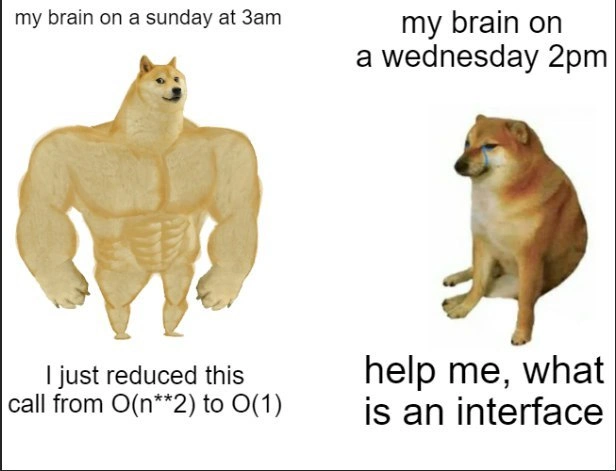
Late-night Big-O wizardry versus midday interface confusion in Buff Doge meme
CS Fundamentals Post #4966, on Oct 30, 2022 in TG

Late-night Big-O wizardry versus midday interface confusion in Buff Doge meme

Why is this CS Fundamentals meme funny?

Level 1: Brain in Beast Mode vs Brain in Nap Mode

Sometimes our brain feels super powerful, and other times it feels super confused. Imagine at night you turn into a genius superhero who can solve the hardest puzzle in one snap – that’s like the big strong dog on the left. He’s saying he made a really slow task go really fast, kind of like figuring out a clever shortcut to finish a huge homework instantly. 🚀 But then, the next afternoon, your brain might get tired and you suddenly blank on something very simple – like forgetting how to spell a common word or do a basic math problem you usually know. That’s the small dog on the right, who looks lost and is asking for help about something basic (“what is an interface?” is like saying “I forget this easy thing, help!”). It’s funny because it’s true: everyone’s brain has ups and downs. One moment you feel like the smartest person in the world, and the next moment you’re like “Uh… I can’t remember how this easy thing works.” The meme shows this with a big muscular dog representing the brain when it’s at its best – super confident and capable – and a little nervous dog representing the brain when it’s tired or having a bad day. We laugh because we’ve all been there. It’s like doing a magic trick one day and forgetting a simple card rule the next. The big idea? Our brains aren’t always consistent – sometimes we’re really sharp, sometimes we’re in a fog – and that contrast can be pretty hilarious (and totally normal!).

Level 2: Big O & Interfaces 101

Let’s break down the two technical ideas here: Big O optimization and interfaces, in plain terms.

Big O Notation (O(n^2) to O(1)): Big O notation is basically how computer scientists talk about an algorithm’s speed or complexity in terms of n, where n often means the size of the input. It’s like a vocabulary for saying “how does the work grow if I have more stuff to process?” When we say an algorithm is $O(n^2)$ (pronounced “order n squared” or “quadratic time”), we mean if you double the number of items, the work roughly quadruples (because $2^2 = 4$). Why? A common case is nested loops: imagine code that has to compare every item with every other item (like two loops each going through n items – that often leads to ~$n \times n = n^2$ steps). For a small n, that might be fine, but as n grows, $n^2$ grows really fast (e.g. 100 items -> ~10,000 checks; 1000 items -> ~1,000,000 checks). On the other hand, $O(1)$ (pronounced “order 1” or “constant time”) means the work doesn’t really increase with more items – it stays about the same. Whether you have 10 items or 10 million, an $O(1)$ algorithm would take roughly a constant number of steps. How is that possible? Usually by not iterating over the data at all when answering a single query: instead, you might do a direct lookup. For example, returning the first element of an array is $O(1)$ – you just jump to it. No matter if the array has 5 or 5 million elements, getting the first one is one step. That’s constant.

Now the meme’s left side says, “I just reduced this call from O(n2) to O(1).” (We use ** to mean exponent in text, so n2 is n squared). This means the person (or their brain) managed to make a particular operation that used to take quadratic time now take constant time. That’s a huge improvement! It’s like turning a slow, clunky process into an instant answer. Typically, how would someone do this in real code? Perhaps by using a smarter approach or data structure. Let’s say you had a function that checks if a certain value exists in two lists (like “is there a common element?”). A naive way might be to compare every element of list A with every element of list B – that’s $O(n^2)$ if both lists are length n. But a better way: put all elements of list A into a set (which allows $O(1)$ average-time lookups), then just loop through list B and check if any element is “in” the set. Checking membership in a set or hash table is typically constant time on average. So scanning list B (O(n)) and doing O(1) lookups in the set for each element gives you about $O(n)$ total – not quite $O(1)$ overall, but much better than $O(n^2)$. To truly get $O(1)$ for each query, you could even precompute something in advance. For instance, if this “call” is something you do repeatedly, you might do an expensive setup once (maybe that part was $O(n^2)$) but then store the results in a way that any single call can answer in constant time. This is known as memoization or caching. A classic simple example: suppose you want to know the sum of numbers 1 through n. You could add them each time (that’s O(n) per query). But with a math formula, you can get the sum instantly: $\frac{n(n+1)}{2}$. Evaluating that formula is $O(1)$. So by doing some math (deriving the formula) or storing values, you turned a linear or quadratic process into a constant-time lookup. No wonder the left side is proud – it’s not every day you achieve constant time. Usually, only certain problems or clever tricks allow that kind of jump. In developer culture, saying “I optimized this from O(n^2) to O(1)” is almost flexing that you did something really impactful and smart, hence why Buff Doge (the super-strong doge) is the one saying it. It’s algorithm humor at its best because it exaggerates a programmer’s late-night triumph in terms of Big O notation, which is a bit niche but beloved among coders who care about performance.

Interface (and forgetting what it is): Now to the right side: “help me, what is an interface”. The humor here plays on a very basic programming concept – the idea of an interface – and the notion of forgetting it when you really shouldn’t. So, what is an interface in programming? In many languages (like Java, C#, TypeScript, Go, etc.), an interface is like a template or contract that defines a set of methods (functions) without implementing them. It’s a way to say “any class or struct that claims to be this interface must have these methods.” For example, you might have an interface Shape with a method draw(). Then classes like Circle or Square can implement the Shape interface by providing their own draw() method. This way, wherever your code needs a “Shape”, it doesn’t care which specific shape – it could be a Circle or a Square – as long as it has a draw() method, you can call shape.draw() polymorphically. Interfaces are fundamental to designing flexible, extensible software. They let you separate the “what it does” from the “how it does it”. In simpler terms, an interface is like a job description and the class is like the employee fulfilling that job – as long as they can do everything in the description, they qualify. Here’s a quick illustration in a Java-like pseudocode:

// Defining an interface (contract of methods)
interface Animal {
    void speak();    // any Animal must have a speak() method
    void move();     // ...and a move() method
}

// A class implementing the interface
class Dog implements Animal {
    public void speak() {
        System.out.println("Woof!");
    }
    public void move() {
        System.out.println("The dog runs.");
    }
}

// A class implementing the interface differently
class Bird implements Animal {
    public void speak() {
        System.out.println("Tweet!");
    }
    public void move() {
        System.out.println("The bird flies.");
    }
}

In this example, Animal is an interface. It doesn’t specify how an animal speaks or moves, just that it can. Dog and Bird both implement Animal, but each in their own way. Thanks to interfaces, elsewhere in the code you could have a function that works with any Animal without caring if it’s a Dog, Bird, or something else, which is a powerful way to write general code.

So, forgetting “what is an interface” is kind of like forgetting a primary school definition if you’re a seasoned dev – it’s almost embarrassing. It would be akin to a car mechanic momentarily forgetting what a “wrench” is. The right side uses Cheems (a meme dog known for looking shaky or dumbfounded) to represent that fumbling state. Why would someone forget such a basic thing? It’s not literal amnesia – it’s more that sometimes your brain just stalls. You might be sleep-deprived, or your head is so full of complex debugging info that a simple term slips out. It’s a portrait of a very human moment: confusion and self-doubt creeping in. The poor Cheems is even tearing up a bit in the meme image – haven’t we all felt that little internal panic when we can’t recall something that “should” be easy? Especially if put on the spot at 2pm on a Wednesday – a time when maybe you’re multitasking or coming out of a heavy lunch or just low on energy – your mind can blank on the simplest concept.

The contrast is what sells the humor: on Sunday at 3am, this person’s brain is pulling off advanced performance hacks (something that impresses even senior devs), and then on Wednesday afternoon, that same brain is like, “Uhh what’s an interface again? Help!” It’s a big swing on the confidence pendulum. On Sunday the developer is a genius in isolation, on Wednesday they feel like a newbie in public. And yes, this is developer humor but it’s also relatable beyond coding – it’s like how you might solve a really hard puzzle on your own one day, but then forget a simple word or name the next day. In tech specifically, imposter syndrome and memory lapses happen to everyone. Even junior developers will be relieved to know: that senior engineer who seems to know everything? They have their Cheems moments too. They might blank on how to exit Vim or mix up terminology during an afternoon meeting. This shared experience is what makes the meme funny and comforting.

Also, just to decode the meme template a bit: Buff Doge (left) vs Cheems (right) is a popular way online to compare two states of one thing – usually one very strong or ideal, and one weak or flawed. Here Buff Doge is labeled “my brain on a Sunday at 3am.” That implies maybe late-night hacking on the weekend, when the brain is oddly awake and hyper-focused on something cool (perhaps a personal project or just an unsolved problem that’s been gnawing at them). Cheems is labeled “my brain on a Wednesday 2pm,” implying the mid-week work brain, likely under routine conditions. The fact that it’s the brain being personified is key – it’s not saying the person is always like Buff Doge or always like Cheems, just that sometimes their mindset or cognitive ability feels buff vs. derpy. That nuance makes it funny to developers: it’s poking fun at ourselves, not saying “I literally don’t know what an interface is,” but “Lol, sometimes I feel like I don’t know the simplest things, right after doing something advanced.”

This meme also touches on productivity_variability and maybe even self-care. It suggests that creative bursts might come at odd times, and routine hours might not always be the peak for deep thinking. There’s an undercurrent of truth: maybe this person was able to optimize that call at 3am because they were in a zone with no distractions, whereas at 2pm Wednesday they might be interrupted or tired. If you’re a budding developer, the takeaway isn’t “only code at 3am” (please sleep! 😄) but rather that productivity can ebb and flow, and that’s normal. If you ever find yourself staring at your screen thinking “I swear I learned this interface thing, why can’t I remember?”, just know it happens to everyone, even the ones who at other times pull off crazy optimizations. The meme is a lighthearted way to say: brains are weird. They don’t operate at 100% all the time like computers do; they have glitches and spikes. And in tech, we’ve come to laugh about it because one day you’re refactoring with fancy design patterns, and the next you’re Googling “Java interface example” like it’s day one.

In short, the Buff Doge side teaches a quick lesson in algorithmic complexity – celebrate those moments when you make code drastically faster (that’s awesome!). The Cheems side is a gentle reminder in humility and brain behavior – don’t beat yourself up for the moments when basic things slip. Together, these two sides encapsulate the rollercoaster of being a developer: the highs of feeling like a genius and the lows of feeling utterly confused. And the fact that those two extremes can happen in the same week (or even the same day) is both funny and reassuring. It means if you’re experiencing that, you’re not broken – you’re just human, and probably a true software engineer. After all, as the tags hint, this is as much about MentalHealthInTech as it is about code: take care of that brain, and maybe schedule those heavy problem-solving tasks for when you know you’re at your best (be it early morning, late night, or whenever your Buff Doge tends to show up), and give yourself grace during the Cheems hours. You can always look up what an interface is – it’ll come back to you! – and soon enough, you’ll be back to doing $O(1)$ wonders.

Level 3: 3AM Breakthroughs, 2PM Fog

Every experienced developer chuckles at this because it’s too real. We’ve all had that one night (often a Sunday at 3am, as the meme says) where we suddenly become a coding superhero – optimizing a gnarly piece of code or solving a complex bug in one brilliant streak of clarity. The left side’s Buff Doge – chest out, ultra-confident – is basically our inner engineer on those magic nights. Reducing a function from a sluggish $O(n^2)$ slog to a slick $O(1)$ execution? That’s a holy grail moment in coding. It means you found a way to do something in constant time that used to take quadratic time. In a real example, maybe you realized “Hey, instead of checking every combination in a double loop, I can use a direct formula or a dictionary lookup.” Perhaps a routine that compared every user against every other user (ouch) got replaced by a clever indexing scheme that returns results in one go. That’s a massive performance gain and a major DeveloperProductivity win. When that insight hits at 3am, you feel invincible – hence the buff Doge persona. You might pump your fist in the dark or post a proud message on the team chat (only to have colleagues see it the next morning and wonder, “Do you ever sleep?”). This half of the meme nails that coding high: the adrenaline rush of a breakthrough, the reason many of us fall in love with programming in the first place. It’s depicting a scenario all devs secretly crave: being the late-night Big O wizard who saves the day (or at least, the CPU cycles). There’s even a sly nod here to those legendary “10x engineers” or performance gurus who can optimize code in ways that boggle others – turning slow code into near-instant results.

Now swing over to Wednesday 2pm. The Cheems side – small, slouched, a bit teary-eyed – is the polar opposite vibe. It’s hump day, afternoon slump, brain running on maybe its third cup of coffee and still sputtering. The caption “help me, what is an interface” is hilarious because it’s such a basic question, one you’d expect a first-year CS student to ask. For an experienced dev, forgetting what an interface is (or how it works) is the ultimate brain-fart. But guess what? It happens! This is capturing that mortifying yet common experience where your mental cache fails at the worst time. Maybe you’re in a meeting or a code review on Wednesday after a long sprint, and someone asks a simple question about an interface or some other fundamental concept – and your mind just draws a blank. You sit there thinking, “I know this… I’ve known this for years… why can’t I explain it right now?!” That’s Cheems in a nutshell: the seasoned dev suddenly feeling like a clueless newbie, pleading for help on something elementary. This scenario screams DeveloperHumor and a touch of CodingFrustration – we laugh at it because if we didn’t, we might cry. It also resonates with the reality of mental_health_in_tech: our brains aren’t machines, and cognitive performance can swing wildly. By Wednesday 2pm, maybe you’ve been jumping between tasks, or you’re bogged down by constant context-switching (fix one bug, answer a code review, attend a stand-up, rinse, repeat). That can leave you mentally drained to the point where even recalling a textbook definition is hard. It’s a real phenomenon: the lightweight stuff can trip you up when you’re exhausted, even if you tackled heavy stuff just days or hours before.

The meme brilliantly uses the Buff Doge vs Cheems format as a visual shorthand for this contrast. Buff Doge (left) is drawn from a popular meme character known for representing something or someone in a ridiculously strong, competent state. Cheems (right) is the lovable underdog (pun intended) – often depicted struggling with something, sometimes speaking with a humorous lisp or typos. By pairing these two, the meme creator paints a picture of the same developer in two different modes: the late-night powerhouse vs. the midday meltdown. And the captions drive it home. It’s not literally that the person doesn’t know what an interface is – it’s that baffling feeling when your brain just won’t cooperate. It’s like having 128 GB of RAM in your head for complex computations on the weekend, then only 128 KB on Wednesday for simple tasks. Relatable? Oh, absolutely. Software engineers bond over these stories. You’ll hear seniors joke, “Yeah I wrote a whole compiler in my free time last night, but this afternoon I forgot the syntax for a for loop in Python.” It’s funny because it’s true: brilliance and brain-fog can coexist in the same week, or even the same day.

From a broader perspective, this also pokes fun at the myth of constant peak productivity. In tech culture, there’s often pressure to always be at 100%, always cranking out code flawlessly. But real life is full of ups and downs. Some days you’re in the zone (like that 3am zone of pure algorithmic focus) and you accomplish miracles. Other days, you’re burnt out or distracted, and struggle with basics. The meme normalizes this by exaggerating it – turning it into developer humor that says, “It’s okay, we all have our Cheems moments.” It even touches gently on work-life balance and cognitive cycles. Notice it’s Sunday 3am versus Wednesday 2pm. Sunday 3am implies this was likely on the developer’s own time – maybe a passion project or some idea that struck while fiddling with code for fun, free of office-hour pressures. Wednesday 2pm, conversely, screams “office hours”, maybe under the fluorescent lights, perhaps after a boring meeting or heavy lunch. The environment and context switch drastically. This contrast hints: our best breakthroughs sometimes happen off-schedule when we’re following our curiosity, while our worst brain freezes happen on-the-job, mid-week, when maybe we’re not as intrinsically motivated or we’re just plain tired. It’s a humorous take, but also a subtle nod to how productivity_variability works in creative fields like programming. You can’t force the 3am epiphany in a 2pm status meeting – that’s just not how our brains operate. In fact, many developers self-identify as night owls because of exactly this – fewer distractions and a quiet mind can lead to huge progress at odd hours, whereas structured 9-to-5 time can be peppered with interruptions or fatigue.

Finally, let’s appreciate that the meme strikes a balance between pride and humility. The buff Doge side is basically flexing – reducing complexity from quadratic to constant is a big deal! It’s the kind of achievement you’d brag about in a programming forum or during a tech talk (“We brought the page load time down from seconds to milliseconds”). It appeals to that engineer pride in solving tough problems elegantly. Then the Cheems side immediately humbles that pride – “Actually, I still struggle and forget simple stuff.” This brings a wholesome self-deprecating flavor. It’s like the community collectively saying, “Yes, celebrate the wins, but also, don’t get too cocky – we all screw up or blank on easy things sometimes.” That humility and shared understanding is great for mental health in tech: it reminds everyone that even the best of us have off days or gaps in our knowledge in the moment. No one’s a genius 24/7. In a way, this meme is a mini rollercoaster of a developer’s mindstate, and every seasoned coder recognizes both peaks and valleys. That knowing nod and chuckle we get from this comes from real empathy – we’ve been that buff algorithm optimizer at unholy hours, and we’ve been that confused pup puzzling over an “interface” definition when our brain is fried. And both are okay. It’s all part of the dev life.

Level 4: Asymptotic Alchemy

At the highest realm of geekery, this meme taps into the arcane art of algorithmic optimization. The buff Doge’s boast “I just reduced this call from $O(n^2)$ to $O(1)$” is basically saying: “I turned a quadratic-time operation into constant-time – a miracle of code performance!” In Big O notation – a core concept of CS fundamentals – $O(n^2)$ means an algorithm’s work grows quadratically with input size (like double the items means four times the work), whereas $O(1)$ means the work stays constant no matter how much input you throw at it. Reducing complexity this drastically is like going from brute-force to instant lookup. It’s serious BigONotation wizardry: perhaps the coder replaced a slow double-loop with a clever hash map or a precomputed table. For example, imagine originally scanning a list of size n inside another list of size n – that’s ~$n^2$ checks. The 3am epiphany might have been: “Hey, I can use an index or formula instead of two loops!” Suddenly the solution doesn’t depend on n at all – one direct access, boom, job done. This is an algorithm humor gem because it winks at those late-night eureka moments known only to the initiated. The theoretical significance is huge: in asymptotic terms, constant time is the holy grail of efficiency – it’s as if the code’s time complexity flatlined while the input grew. In practical terms, if n is large, going from 10⁶ steps to just 1 step is life-changing for performance (and for the developer’s ego). It’s like discovering a hidden mathematical shortcut that leaps straight to the answer. Under the hood, such a feat often involves advanced trade-offs: maybe extra memory (to pre-cache answers, achieving that $O(1)$ lookup) or deeper insight into the problem’s structure that yields a closed-form solution. This is big_o_optimization in its purest form – the kind of elite hack that would make Donald Knuth proud. It’s no wonder our buff_doge_meme brain is flexing academic muscles at 3am: we’re talking about summoning the spirit of computer science legends and doing high-level complexity sorcery while the world sleeps.

Meanwhile, the other half of this arcane contrast is the timid Cheems whimpering, “help me, what is an interface”. On the surface, “interface” seems trivial compared to Big O theory, but from a design perspective it’s a fundamental concept of software architecture. In languages like Java, C#, or Go, an interface is an abstract type – basically a list of method signatures that a class or struct can promise to implement. It’s how we achieve polymorphism and decouple modules by programming to a contract rather than a concrete class. That concept sits at the heart of solid API design and CS_Fundamentals of abstraction. But here’s the cosmic irony: understanding interface definitions is child’s play for a seasoned dev’s theoretical mind, yet our mighty algorithm optimizer is suddenly dumbfounded. This juxtaposition highlights an underlying truth in engineering cognition: deep focus and context matter. It’s as if the brain’s cache was optimized for one task (like analyzing polynomial time reductions) at the expense of swapping out some “simpler” knowledge. There’s actually a kernel of cognitive science here – extreme productivity_variability can stem from how our memory retrieval works under fatigue. The interfaces concept, usually straightforward, might slip out of mind if the brain is running on fumes or context-switching. In a way, the meme hints at how different parts of the brain (analytical vs. recall) can fire at different times. Late at night, free from interruptions, the mind dives deep into analytical problem-solving mode (the night_owl_coding phenomenon where many developers report hitting a flow state). It’s almost a meditative concentration, ideal for heavy algorithmic work. But by mid-week afternoon, after meetings, emails, and Slack pings, the same brain might be so scattered (high brain_latency in nerd terms) that even recalling a basic definition feels impossible. In summary, at this loftiest level, the meme spotlights the yin-yang of computational prowess: the theoretical triumph of slaying a quadratic-time algorithm with constant-time magic, contrasted with the baffling mental blank of forgetting an elementary abstraction. It’s a tongue-in-cheek nod to the fact that even a Big O conqueror can suffer a segmentation fault in their thought process when context or timing isn’t right. And if you think about it, that’s a beautiful paradox – one that resonates deeply in the lore of programming wizardry.

Description

The image uses the popular “Buff Doge vs Cheems” template on a white background split into two halves. On the left, a hyper-muscular Doge stands confidently; above him it says, "my brain on a sunday at 3am", and below him the caption reads, "I just reduced this call from O(n**2) to O(1)". On the right, a small, slightly teary-eyed Cheems dog sits timidly; the top text reads, "my brain on a wednesday 2pm" and the bottom text says, "help me, what is an interface". Visually the contrast highlights extreme confidence versus confusion, while technically it riffs on algorithmic complexity (Big-O reduction) and basic software-design concepts (interfaces). The meme humorously captures the unpredictable ebb and flow of developer cognition and productivity, resonating with engineers who optimize code at odd hours yet struggle with fundamentals during routine workdays
Comments

9
Anonymous ★ Top Pick 3 AM: brain’s JIT aggressively inlines until the call is O(1); 2 PM: stop-the-world GC kicks in, reclaims the very concept of “interface,” and I just stare at the heap dump formerly known as my mind
  1. Anonymous ★ Top Pick

    3 AM: brain’s JIT aggressively inlines until the call is O(1); 2 PM: stop-the-world GC kicks in, reclaims the very concept of “interface,” and I just stare at the heap dump formerly known as my mind

  2. Anonymous

    The real O(n²) complexity is calculating how many energy drinks it takes to maintain Sunday 3am performance through Wednesday afternoon sprint reviews while your PM asks why the 'simple interface change' isn't done yet

  3. Anonymous

    Every senior engineer knows that feeling: at 3am on Sunday you're casually optimizing nested loops into hash table lookups like you're Knuth reincarnated, achieving that sweet O(1) lookup that makes you feel invincible. Then Wednesday at 2pm rolls around, you're three meetings deep, context-switched six times, and suddenly you're staring at your IDE wondering if interfaces are the things with methods or the things that implement the things with methods. The real O(n²) complexity isn't in your algorithm - it's in your brain's ability to function consistently across the week

  4. Anonymous

    At 3am I'm a lock-free hashmap; by Wednesday 2pm, after calendar-driven interrupts, I'm a cache-miss linked list asking what an interface is

  5. Anonymous

    3AM hashmap hero; Wednesday wonders if interfaces violate Liskov substitution

  6. Anonymous

    Sunday 3am: O(n^2) to O(1) by swapping loops for a hash; Wednesday 2pm: after nine meetings, my brain is a marker interface - no methods, just a name

  7. @AlexAparnev 3y

    Well, maybe Balmer peak may help you, poor doge dev)

  8. @Agent1378 3y

    Is this Balmer peak?

  9. no name 3y

    python detected

Use J and K for navigation