Skip to content
DevMeme
3144 of 7435
Legacy zebra meets QR-coded upgrade in a tongue-in-cheek evolution joke
Modernization Post #3464, on Jul 27, 2021 in TG

Legacy zebra meets QR-coded upgrade in a tongue-in-cheek evolution joke

Why is this Modernization meme funny?

Level 1: Cool New Stripes

Imagine you have a favorite old toy that still works great, but your friend got the latest high-tech toy. Now your friend keeps saying, "Come on, get the new one!" That’s basically what’s happening here, but with zebras! One zebra has normal stripes (like he always did). The other zebra changed his stripes into a big square pattern that phones can scan (that’s called a QR code, a fancy kind of barcode). The QR zebra is proudly telling his friend to upgrade and be like him. It’s funny because in real life, zebras can’t just change their stripe patterns – and why would they even need to? It’s like telling your grandma who’s happy with her old phone to buy the newest smartphone just because it’s new. The poor zebra with regular stripes is like, “Really? I’m fine as I am.”

So the big joke is: sometimes people say you should change something just to be cool or modern, even if you’re doing okay already. The cartoon makes this point by using zebras: one got a super trendy new look and wants the other to follow. It’s silly and makes us laugh because the idea of an animal getting a software “upgrade” is crazy. And we feel a little sorry (and amused) for the normal zebra who’s being told his natural stripes aren’t good enough anymore. In simple terms, it’s showing peer pressure in a goofy way – one friend telling the other to ditch the old style and try the new style – and that’s why it’s light-hearted and humorous.

Level 2: From Stripes to Scans

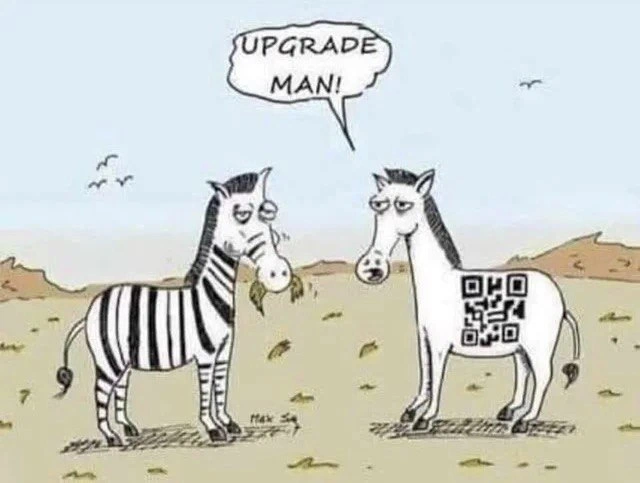
Let’s break down the joke in simpler terms. We have two cartoon zebras facing each other on a plain. The zebra on the left has the usual black-and-white stripes. This represents something legacy – in tech, legacy means an old, reliable system or code that’s been around a while. The zebra on the right is mostly white but has a big QR code pattern on its side, instead of normal stripes. A QR code is that square, pixelated barcode you can scan with your phone (you might have seen them on menus or tickets). In real life, QR codes are like an upgraded version of the old barcodes (the simple line patterns you see on product boxes). So here, the QR-pattern zebra stands for a modern, upgraded system – the new tech that’s supposedly better and fancier.

Now, the QR zebra is telling the striped zebra, “UPGRADE MAN!” in a speech bubble. He’s basically saying, “Hey buddy, you should improve yourself to the newest version – be like me!” It’s just like a tech lead telling a developer, “We need to update our old system and use this cool new technology.” The striped zebra looks exhausted and unimpressed, munching on grass with droopy eyes. That expression is key to the humor: it’s the yeah, I’ve heard this before look. This poor zebra has probably been fine all these years with his stripes (they help him blend into the environment and everything). He represents an engineer who’s been working with the current system for a long time, maybe a bit skeptical about change. The QR zebra, in contrast, is like the enthusiastic colleague or manager who’s caught up in the latest industry trend and is pressuring everyone to adopt it.

Modernization pressure is something many developers experience early in their careers. Picture this: you join a team and discover they use a framework or language that’s not the newest. You’ve been reading about a hot new framework that all the big companies use, and you suggest, “Why don’t we switch to that? It’s supposed to be the future!” That impulse is kind of what the QR zebra embodies. In tech communities, there’s often hype around new tools and a feeling that you might get left behind if you don’t jump on the latest bandwagon (be it a new JavaScript framework, a trendy programming language like Rust, or a fancy architecture like microservices). The meme exaggerates this by using zebras: one with old-school “technology” (stripes that have been working for ages) and one with cutting-edge “technology” (a QR code pattern, which is super modern and high-tech looking, almost like the zebra got a software upgrade or a new skin).

Let’s clarify some terms from the tags: Legacy vs Modern – “legacy” refers to old systems or old code that are still in use. They might be seen as out-of-date, but they’re usually very stable and familiar. “Modern” refers to newer technology or methods that are currently in vogue (fashionable or widely adopted recently). In our cartoon, the striped zebra is legacy (old pattern), the QR zebra is modern (new pattern). IndustryTrends_Hype – this is about how the tech industry tends to have “trends” (like fashions) and a lot of hype (excitement and advertising) around certain technologies. For example, a few years ago everyone talked about cloud computing, then containerization with Docker, then machine learning, then blockchain, and so on. Sometimes companies feel pressure to use whatever the latest trend is, to seem innovative. The meme is poking fun at that: even if you’re a zebra happily grazing, someone might say you need a high-tech makeover to keep up with the times!

Another tag is OverEngineering. This means designing a solution that’s more complicated or advanced than necessary. A classic simple example: imagine you need to hammer a nail, but instead of a hammer you build a complex robotic arm to do it. That’s over-engineering – using a lot of extra effort for little extra gain. In the picture, the zebra’s natural stripes work perfectly well for camouflage and zebra identity. Replacing them with a scannable QR code is kind of overkill, right? It’s funny because it’s over-engineering: who in the world needs a wireless, scannable zebra? In software terms, this could be like adding a whole new microservice and a database, just to store something you could have kept in a simple configuration file. Or using AI and blockchain to manage a to-do list app – technically “upgrade” maybe, but totally unnecessary. New developers sometimes see over-engineering when they excitedly apply every new trick they’ve learned to a problem that could be solved more simply.

The context tags mention qr_code_upgrades and animal_barcode_analogy. The meme basically is an animal barcode analogy: zebra stripes have often been jokingly called a “bar code” – in fact, the zebra’s pattern looks a bit like the barcodes on product packaging. Here that idea is pushed further: the zebra literally has a digital barcode (a QR code) on it. It’s like someone “upgraded” the animal’s marking. This is an analogy to upgrading software or systems – taking something natural or established (old code, or stripes) and giving it a high-tech twist (new code, or a QR pattern). Upgrade_joke implies the whole joke centers on telling someone to upgrade. The QR zebra saying “upgrade, man!” is exactly that. We find it funny because in everyday life nobody tells a zebra to update its look – zebras can’t change their stripes (there’s even a saying, “a zebra can’t change its stripes,” meaning people don’t change their basic nature). In the tech world, though, it feels like we’re always told to change and “get with the program” of the latest tech. So it’s a clever cross of those ideas.

Think about evolution_of_ui_patterns: In user interface (UI) design, trends evolve too (like skeuomorphic design to flat design to material design). The meme hints at an “evolution” – from stripes to QR code. It’s tongue-in-cheek evolution, meaning it’s joking that the zebra species itself upgraded as if it were software. For a junior developer, it’s helpful to see the humor is fundamentally about trend-chasing. One zebra changed its pattern because QR codes are the new thing, and now pressures the other to change too. This mirrors how a team might adopt a new library or tool just because it’s new, and then push everyone to switch over, even if the old one was working.

In summary, at this level: the cartoon is a metaphor for software teams dealing with legacy vs. modern tech. The left zebra = old, reliable tech (legacy stripes) that has worked for a long time. The right zebra = new, fancy tech (QR code pattern) that’s “hot” right now. The right one encouraging an upgrade = the social/industry pressure to keep up-to-date. It’s funny (especially to developers) because it’s a HumorInTech way of saying “we often change things that are fine, just because something new came out.” If you’re early in your career, you’ll likely encounter this: a manager or colleague excited about a new technology will urge an upgrade or rewrite. This meme prepares you to recognize that sometimes that excitement is valid, but other times it’s just hype. The zebras make the situation light-hearted and easier to talk about. After all, it’s easier to laugh at a zebra with a QR code than to tell your boss “maybe we shouldn’t redo the whole app in that new framework just yet.”

Level 3: Hype Cycle on the Savannah

On the windswept savannah of software development, a weary old zebra with classic stripes meets a smug zebra sporting a giant QR code pattern. The QR-coded zebra is effectively a walking upgrade and he’s telling the other, "UPGRADE MAN!" – a punchy demand we’ve all heard in tech when some bright-eyed architect insists legacy systems must embrace the latest craze. This absurd visual mashup captures the dark humor of our industry’s modernization mania. It’s a satirical nod to how engineers are constantly urged to replace proven, reliable solutions (those good old black-and-white stripes) with flashy new tech (a scannable QR code!) just because it’s trendy. The humor bites because we’ve all been that tired striped zebra at some point, being pressured by management or an over-eager colleague to hop on the newest IndustryTrends bandwagon.

At first glance, the idea of a zebra upgrading its stripes seems ridiculous – and that’s exactly the point. It highlights a common anti-pattern in tech: chasing shiny new tools without considering if they truly fit the problem. The zebra on the left represents a stable legacy system, battle-tested in production (or maybe savannah-tested against predators for eons). That system has its stripes for a reason – much like old code that, while not glamorous, faithfully gets the job done. The QR-patterned zebra, on the other hand, is the “upgraded” system running on the latest framework or architecture du jour, brimming with hype. In theory, a QR code can store a lot more data than a simple bar of stripes (just as new tech promises more features or better performance). But do we really need a zebra that can be scanned with a smartphone? 😏 Probably not. The meme is winking at us: is this upgrade truly beneficial, or is it overengineering taken to comedic extremes? In real projects, we’ve seen simple, working solutions replaced with complex, cloud-native contraptions that require an army of microservices and Kubernetes pods – all to serve the same basic needs the older system handled with ease. It’s over-engineering incarnate, as silly as giving an animal a machine-readable hide.

Every seasoned developer has war stories about "the big rewrite" or the big upgrade. Perhaps you remember a CTO proudly announcing: “We’re rewriting everything in {HotNewTech} to future-proof our platform.” Next thing you know, a year has passed, features are frozen, bugs multiply like rabbits, and the project is way over budget – all while the old system (now abandoned, like yesterday’s zebra stripes) had been running fine. This cartoon zebra saying “upgrade, man!” is a stand-in for that well-intentioned but trend-chasing architect or consulting firm who insists that our perfectly functional monolith must transform into microservices, or that our straightforward SQL schema should migrate to an exotic NoSQL database, just because everyone else is doing it. It elicits a knowing laugh (or maybe a groan) from senior engineers: we’ve seen the hype cycle turn reliable apps into bloated science experiments.

Modernization in tech is often necessary – security improvements, scaling needs, maintenance concerns can all legitimize an upgrade. But the meme jokes about the other kind of modernization pressure: the kind driven by FOMO and buzzwords rather than actual need. The QR-code zebra is effectively yelling the software equivalent of “Yo, grandma, get an iPhone already!” to a zebra perfectly content chewing grass in peace. The legacy vs modern contrast is clear. The striped zebra’s half-lidded, exhausted expression says, “I’ve seen this nonsense before.” It’s the face of a veteran engineer who’s been through four JavaScript frameworks in four years because each one was supposed to be the solution. Meanwhile, the QR evangelist is chewing grass casually – he’s not malicious, he truly believes he’s helping his pal out by pushing the new tech style. This mirrors real life: often the push for new tech comes from an earnest place (trying to improve things), but can come off tone-deaf when it ignores the costs and risks.

Notice the background: a sparse plain with a few distant birds. There’s no predator in sight. A zebra’s stripes are famously good camouflage against predators like lions. If there were a lion, the legacy zebra might blend into the tall grass; the QR zebra, however, would stick out like a glitching augmented reality target! 🦓🔲 The visual joke underscores a truth: sometimes that tried-and-true legacy system has survival features (stability, simplicity) that the new flashy system lacks. The QR code pattern might encode loads of data (like version numbers or dependency info?), but in doing so it sacrifices something basic, just as overly complex new systems can sacrifice reliability or clarity. This is a classic case of “if it ain’t broke, don’t fix it” – yet in tech we often fix it anyway. In fact, here’s the unofficial hype-driven dev motto in pseudocode:

if (!system.isBroken()) {
    // Eh, fix it anyway because "modernization" is trending
    system.rewriteWith(new TechStack("✨ bleeding-edge ✨"));
}

Seasoned devs recognize this trap. There’s even a famous essay by Fred Brooks warning of the second-system effect – the tendency to over-design the next version of a system with too many new features (or new tech) and overshoot the mark. So while the QR zebra might boast advanced pattern recognition and “2.0” vibes, it also screams over-engineered. The meme captures this beautifully with minimal art: two zebras, a single speech bubble, and a world of painful tech truth behind it. It’s a HumorInTech gem, where we laugh at the absurdity because it’s easier than crying about all those late nights upgrading systems that didn’t really need upgrading.

Under the hood, this is also poking fun at industry hype cycles. We’ve gone from stripes (maybe think of them as the mainframe era or simple LAMP stack apps) to QR codes (maybe the cloud-native, blockchain, AI-enabled era). Today’s hot new pattern inevitably becomes tomorrow’s legacy. The QR code itself might be cool in 2021, but give it a few years and some other zebra will be saying “OMG, you’re still using QR? Time to upgrade to AR stripes or NFT spots!” The cycle never ends – and that endless cycle is exactly what makes the meme so relatable. Legacy vs Modern isn’t a one-time showdown, it’s a recurring theme in our careers. The old guard always watches the new guard with a mix of skepticism and déjà vu. As the cynical veteran zebra might mutter: “Sure, kid, turn yourself into a walking QR code if you want. Let’s see how that works out when the lions (read: production bugs) come.”

In summary, the humor comes from recognizing our own workplace in these zebras. One is essentially saying, “Stop being outdated, embrace the new tech, be modern like me!” – a refrain as common in engineering stand-ups as it is absurd on the African plain. We laugh because it’s an exaggeration, yet uncomfortably close to reality. The cartoon distills the folly of trend-chasing into a single absurd image, and gives a voice (a goofy zebra voice at that) to the pressure we often feel to upgrade for upgrade’s sake. For those of us with battle scars from ill-fated “upgrades”, this meme is both cathartic and hysterical. It validates our suspicion that sometimes the push to modernize is as nonsensical as painting a QR code on a zebra and expecting it to fare better. And if you’ve ever had to scan logs at 3 AM because a rushed upgrade broke prod, you might even identify with that grass-chewing striped zebra, rolling your eyes at the hype and thinking, “I miss the simple days of black-and-white stability.”

Description

Cartoon set on a sparse savannah shows two tired-looking zebras facing each other. The zebra on the left has traditional black-and-white stripes; the one on the right is mostly white except for a large black QR-code pattern covering its mid-section. The QR zebra, chewing grass, speaks in a jagged speech bubble that reads "UPGRADE MAN!", urging the striped zebra to modernize. The gag parodies how software teams are told to replace legacy patterns with flashy new tech - here, moving from barcode-like stripes to a scannable QR code - highlighting modernization pressure and trend-chasing in engineering. Visually simple with muted earth tones, the meme relies on developer humor about constant upgrades and industry hype cycles

Comments

7
Anonymous ★ Top Pick That QR zebra is the consultant who calls our battle-hardened barcode monolith “1-D tech debt” and sells a two-dimensional rewrite as “cloud-native hay discovery.”
  1. Anonymous ★ Top Pick

    That QR zebra is the consultant who calls our battle-hardened barcode monolith “1-D tech debt” and sells a two-dimensional rewrite as “cloud-native hay discovery.”

  2. Anonymous

    Just like how we replaced perfectly functional REST APIs with GraphQL, then added a REST compatibility layer on top - sometimes the old zebra stripes worked just fine before we decided everything needs to be scannable, trackable, and integrated with seventeen different analytics platforms

  3. Anonymous

    When your legacy authentication system meets OAuth 2.0 with PKCE - sure, the old pattern worked for millions of years, but now stakeholders want machine-readable identity that scales horizontally across the savanna

  4. Anonymous

    Enterprise modernization: slap a QR code on the zebra for analytics - same throughput, same horse, but now it’s “cloud-native.”

  5. Anonymous

    Nice migration from 1D to 2D with Reed - Solomon - shame it broke every legacy scanner in prod

  6. Anonymous

    Classic monolith refactor: swap stripes for QR codes - now scannable by auditors, still prone to pattern-matching stampedes

  7. @nuntikov 4y

    It will break the ABI 🥴

Use J and K for navigation