Skip to content
DevMeme
1928 of 7435
The Perceived Complexity of Code vs. Its Actual Function
CodeQuality Post #2142, on Oct 12, 2020 in TG

The Perceived Complexity of Code vs. Its Actual Function

Why is this CodeQuality meme funny?

Level 1: Big Roar, Small Meow

Imagine you planned something grand and exciting, but when you actually did it, the result was tiny and a bit disappointing. It’s like you expected to hear a big lion’s roar, but instead you got a small kitten’s meow. That contrast is exactly what makes this meme funny! The first picture shows a huge wild cat (like a lynx, similar to a lion) jumping strongly – this represents our big, confident plans. The second picture shows a little house cat creeping slowly – this stands for what actually happened in real life. It’s as if you told all your friends you built the fastest toy car ever (zooming like a racecar), but when you let it go, it just rolled gently and stopped (like a slow poke). You’d laugh because the difference is so extreme: big expectations, little outcome. In simple terms, we’re laughing at how we sometimes think we’ve made something super powerful or perfect, but find out it behaves very meekly. It’s a friendly reminder not to worry – even grown-up programmers feel this way. They dream their new code will be awesome and strong, but when they run it, it might act shy and need a lot more work. The meme is funny-familiar: anyone can chuckle at the big cat vs small cat swap, because we all know the feeling of hoping for a mighty roar and getting a tiny meow.

Level 2: Bold Code, Timid Execution

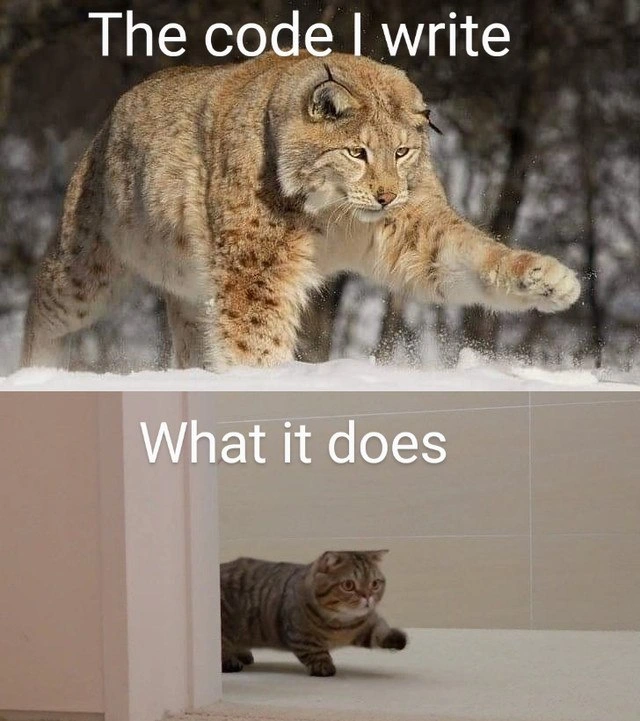
This meme highlights a well-known coding reality: the difference between what we intend our code to do and what it actually does. In the top image, the text “The code I write” is placed over a big wild lynx leaping through the snow. This represents how developers picture their code during development – strong, fast, and elegant. We think we’ve built something as sleek and powerful as a wild cat. Good code quality (meaning clean, well-thought-out code) should, in theory, make our program as mighty as that lynx. For example, you might write a sorting function or a game feature and feel it’s very efficient or brilliantly designed. You expect it to run flawlessly, slice through data quickly, or handle every user input gracefully. That’s the expectation: bold and fearless code charging ahead.

The bottom image has the caption “What it does” written over a cautious housecat peeking around a corner. This is the reality of running that code – it often behaves much more timidly or unexpectedly than we hoped. Instead of a fast, roaring success, the program might run slowly, produce incorrect results, or even freeze up, much like a shy cat that barely steps forward. This can happen for many reasons. Perhaps there’s a bug (an error or mistake in the code) that you didn’t notice. For instance, maybe you thought your function would handle all cases, but if given an empty input it breaks. That’s a bug. Or maybe your code is correct but underperforms – perhaps it works fine with 10 items, but when there are 10,000 items, it becomes very slow (like a cat taking tiny steps). This would mean the code isn’t as efficient as you thought.

When the code’s behavior doesn’t match your expectations, you enter the world of debugging (also called troubleshooting). Debugging is the process of finding out why the code (your “housecat”) isn’t doing what your design (the “lynx”) intended. It’s a bit like a detective game, but it can be frustrating. You might use tools or add print statements to check variables and program flow. For example, you might print out intermediate values to see where things go wrong, or step through the code with a debugger to find the exact spot that’s causing the trouble. Every developer, even seniors, goes through this. It’s so common that it’s basically relatable humor in programming communities – we share these stories to laugh at our own past optimism. The tag DeveloperHumor fits because only developers truly understand the mix of pride and exasperation when code doesn’t live up to its promise.

Let’s break down a simple scenario: say you write a function to calculate the average of a list of numbers. You test it quickly with a few examples and it seems fine – that’s the lynx (your confident code). But later you give it a larger list or some tricky input (like a list containing a really large number or a non-number by mistake), and suddenly the function gives the wrong answer or an error. It turns out you had a bug – maybe you didn’t initialize a sum variable to 0, so it started with some random value, or you didn’t account for an empty list. The result is the function “crawls” or outputs nonsense – that’s the housecat moment. Now you have to troubleshoot: you go back into the code, find that missed initialization or add a check for empty input, and fix it so next time it behaves more like the lynx (correct and speedy). This process is frustrating (nobody likes finding out their proud creation has flaws), but it’s how we improve our code. It’s why CodeQuality matters: if you write clearer, well-tested code, the gap between expectation and reality narrows. However, even with good practices, unexpected things still happen – maybe the environment where the code runs is different or a user tries something you didn’t anticipate. So developers become a bit humble over time, learning that code often needs refining and debugging to truly meet its original goal.

In essence, this meme uses the big-cat vs small-cat comparison to communicate developer expectations vs. reality. The top text “The code I write” with the leaping lynx conveys the ambitious vision a programmer has. The bottom “What it does” with the peeking housecat shows the often underwhelming outcome on the first try. It’s funny in a slightly painful way because it happens to everyone in programming. You can likely relate even if you’re new to coding: maybe you thought your school project code would wow your teacher, but when you ran it, it barely worked and you had to scramble to fix it. Don’t worry – this is a normal part of learning to code. Debugging frustration is real, but it leads to understanding and improvements. Over time, you’ll get better at turning that timid “housecat” code into the strong “lynx” you envisioned, through careful testing, debugging, and experience. And you’ll definitely chuckle at memes like this along the way, because they perfectly capture the journey.

Level 3: Predator in Dev, Prey in Prod

In the top panel, a lynx lunges powerfully through the snow under the caption “The code I write”. This represents the robust, apex-predator design we imagine our code has. Every senior developer has been there: you architect some module with all the best practices, believing it will pounce on tasks with sleek efficiency. Your code feels like a snow lynx – optimized, elegant, and ready to tear through data in one mighty leap. You’ve applied solid design patterns, eliminated obvious bottlenecks, and perhaps even boasted that your solution runs in linear time O(n) or uses clever concurrency. On paper (or in your head), it’s an apex hunter in the software world, embodying top-tier CodeQuality.

Now, contrast that with the bottom panel: a timid housecat peeks around a corner with the caption “What it does”. This is the code’s actual behavior when it runs – cautious, slow, maybe a bit confused. Our mighty predator code turns out to be a domesticated tabby just crawling along. The humor hits hard because every experienced developer has felt this sting. You deploy your feature expecting big-cat performance, but in production it barely moves, as if it’s afraid of its own shadow. The disparity is often caused by hidden bugs, performance pitfalls, or environment surprises. Maybe that brilliant algorithm you wrote has a sneaky edge case that halts progress, or a supposedly constant-time operation hides an expensive database call (hello, N+1 query!). Perhaps you confidently enabled multithreading to speed things up, only to discover a single giant lock in your code made all threads wait in line – turning your would-be lynx into a one-at-a-time housecat. It’s a classic senior-engineer nightmare: in theory your code leaps, in practice it barely crawls.

This meme pokes fun at DeveloperExpectationsVsReality in software development. We expect our clean code and lofty design to yield a roaring success. We picture high-throughput services, snappy UI responses, and algorithms slicing through data like claws through snow. But the reality is often much meeker: maybe the service falls over under real user load, or the UI lags due to an unoptimized loop. It’s an industry-wide inside joke that no code survives first contact with real users (akin to “No plan survives first contact with production”). The relatable humor here comes from shared pain: everyone from juniors to staff engineers has witnessed code that was supposed to be ferocious end up acting domesticated. This could be due to a memory leak that slowly strangles performance, an unexpected null pointer that makes the whole program freeze in fear, or that one configuration value in production that’s different from your dev machine (it’s always the config, isn’t it?). Seasoned developers will nod knowingly at this meme because it caricatures countless war stories: the on-call debugging frustration at 3 AM when the “perfect” code deploys and promptly hides under the couch, metaphorically speaking.

The juxtaposition of a lynx vs. a tabby cat is technically absurd yet perfectly captures software reality. A lynx should dominate its environment, just as we think our code will dominate the CPU and memory with efficient execution. But if there’s a flaw or mismatch in assumptions, the outcome is a skittish housecat tiptoeing around. The meme’s captions (“The code I write” vs “What it does”) label this contrast explicitly. It satirizes the ego we have during development versus the humility forced upon us by runtime behavior. In terms of CodeQuality, it hints that maybe our code wasn’t as good as we believed – perhaps we skipped writing enough tests or overlooked an edge case, and now the software’s true nature is revealed. Every senior dev has learned the hard way that lofty design expectations meeting real-world execution leads to a debugging grind. Hours (or days) get spent coaxing the housecat out of its hiding spot, stepping through code line by line to find why it’s not leaping as intended.

In sum, the meme resonates because it’s too real. It exaggerates the developer’s emotional rollercoaster: pride in writing something grand, immediately followed by the agony of seeing it perform in a half-broken, underwhelming way. The powerful lynx and the nervous cat create a ridiculous visual contrast, but technically they symbolize a genuine engineering challenge: bridging the gap between design and reality, and the eternal struggle to make our code’s output live up to its implementation’s promise. It’s a tongue-in-cheek reminder that writing code is one thing, but making it work as expected — well, that’s often a whole different animal.

Description

A two-panel vertical meme that contrasts a developer's perception of their work with its actual outcome. The top panel is labeled 'The code I write' and features a majestic, powerful lynx confidently striding through a snowy, wild environment. The image evokes a sense of strength, elegance, and complexity. The bottom panel, in stark contrast, is labeled 'What it does' and shows a small, timid-looking domestic tabby cat with folded ears cautiously peeking from behind a wall in a plain indoor setting. This meme humorously captures the common developer feeling of building what seems like a complex, robust, and sophisticated piece of software (the lynx), only for its actual function to be something very simple, mundane, or underwhelming (the house cat). It's a commentary on over-engineering, imposter syndrome, and the gap between effort and perceived impact
Comments

11
Anonymous ★ Top Pick My code has six layers of abstraction, a dedicated message queue, and is deployed across three regions for high availability. It solves FizzBuzz
  1. Anonymous ★ Top Pick

    My code has six layers of abstraction, a dedicated message queue, and is deployed across three regions for high availability. It solves FizzBuzz

  2. Anonymous

    Design doc: “Blazing-fast, lock-free, horizontally scalable lynx of a service.” Prod flame graph: 93 % of CPU time curled up on a single synchronized block - turns out the lynx is just a housecat napping on a mutex

  3. Anonymous

    My code in the design doc: event-driven microservices with CQRS. My code in production: distributed monolith where every service calls every other service and we pray the circuit breakers hold

  4. Anonymous

    Every senior engineer knows this feeling intimately: you architect an elegant solution with clean abstractions, optimal time complexity, and beautiful separation of concerns - then watch it lumber into production like a house cat trying to catch a laser pointer, somehow consuming 4GB of RAM to process a CSV file

  5. Anonymous

    Design doc: lock-free, event-driven lynx; production: housecat tiptoeing past feature flags, N+1 ORM queries, and the "temporary" global mutex we added in 2017

  6. Anonymous

    On the whiteboard it’s O(1) and horizontally scalable; in production it’s O('it depends') behind a feature flag, waiting on a network call and a mutex

  7. Anonymous

    Architected for exascale distributed glory; debugs as a single-node SELECT * FROM disappointment;

  8. @NiKryukov 5y

    The code I write: 💩 What it does:

    1. @wgrah 5y

      ✍✍ true

  9. Deleted Account 5y

    I just try to write

  10. @Daler_XYZ 5y

    True Story

Use J and K for navigation