Skip to content
DevMeme
1929 of 7435
Job Description Euphemisms vs. First-Day Reality
Startup Post #2144, on Oct 13, 2020 in TG

Job Description Euphemisms vs. First-Day Reality

Why is this Startup meme funny?

Level 1: Playground vs. Battlefield

Imagine your friend invites you to what they call a super fun playground where “you’ll get to run around and play games all day.” You arrive all excited, picturing swings and slides and maybe a friendly game of tag. But when you get there, it’s absolute chaos – it’s more like a battlefield than a playground! There’s a big mess everywhere, something’s even on fire, and people are running around shouting. One of the kids is wearing a firefighter hat and another grabs a cactus (ouch!) and starts using it like a water gun. You’re standing there thinking, “Wait, what is going on? This isn’t what I was told at all!”

It turns out, when your friend said “fast and fun,” they really meant “everything’s gone crazy and we have to fix it right now.” There’s literally no time to explain the rules of any game – they just hand you the nearest goofy thing (why a prickly cactus of all things?!) and shout, “Quick, help us out!” You expected a nice, organized playtime, but instead you got thrown into a wild emergency pretend-game. It’s so unexpected and ridiculous that it’s actually kind of funny.

The reason this situation is humorous (even if it would be scary in real life) is because of the huge difference between what you thought would happen and what actually happened. It’s like if someone promised you a calm afternoon of finger painting, but then you end up in a frantic paintball fight without any warning. The surprise is so big that you can’t help but laugh at how completely opposite it is. In the meme’s story, the person thought their new job would be exciting in a good way, but instead it was exciting in a crazy way – kind of like expecting a nice playground and ending up in a chaotic battle. We find it funny because we feel a bit sorry for that person, but we also recognize the silly exaggeration (I mean, who would actually tell you to grab a cactus?!). It’s a way to laugh at the idea of being caught totally off-guard when you least expect it.

Level 2: First-Day Fire Drill

So, what’s going on here? This meme humorously contrasts what a company says during an interview with what the job actually feels like on the first day. In the tech world, interviews and job postings often use phrases like “fast-paced” and “dynamic environment.” If you’re early in your career, those sound exciting – who wouldn’t want to work somewhere lively and interesting? But developers jokingly warn that these phrases can be red flags. In practice, “fast-paced, dynamic environment” might be polite code for “constant chaos and changing priorities.” It suggests that things move very quickly, perhaps without much planning, and you’ll be expected to keep up.

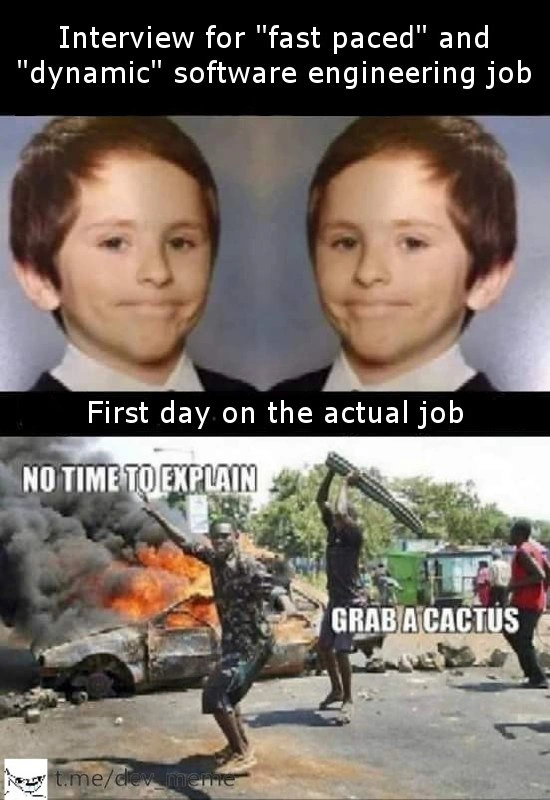
In the top half of the meme, we see a kid’s school photo with a cautious smile. This represents the job candidate during the interview. The captions say Interview for "fast paced" and "dynamic" software engineering job – implying the interviewer or job listing used those very words. The kid’s slight smirk says “I guess that sounds good… right?” It’s a bit of an awkward smile, almost like the candidate isn’t 100% sure what they’re signing up for but is trying to stay positive. This is a piece of InterviewHumor – many of us have smiled and nodded in interviews when hearing buzzwords, not wanting to appear clueless.

Now, the black bar with “First day on the actual job” signals a big shift, and then we get the bottom image: absolute chaos. It’s a real photograph of a street riot. There’s a car on fire producing thick black smoke (that’s our project or servers, metaphorically “on fire”). Debris is scattered everywhere (imagine code and tasks all over the place). There are two people running frantically in the foreground. One is lifting a chair over his head like he’s about to smash something; the other is literally holding a cactus like a weapon. And the meme text on that image, in big white letters, says “NO TIME TO EXPLAIN” (near the top) and “GRAB A CACTUS” (near the bottom).

This is representing the new developer’s first day at work. Instead of a calm orientation, it’s an emergency – a production issue or some crisis in the software that needs immediate fixing. They didn’t even get time to learn what’s going on (“no time to explain”). Someone just shouts an absurd order at them – “grab a cactus!”. Now, grabbing a cactus is a silly idea; cacti are pokey and not exactly a common tool for anything. That’s the joke! It stands for how ill-equipped and confused you can feel when you’re new and suddenly everything’s going wrong. It’s like they’re telling the poor newbie to do something crazy and painful without explaining why.

Let’s connect this to real developer life: production firefighting is a term for when developers have to urgently fix problems in the production environment (the live system that actual customers or users are using). If something breaks there – say the website goes down or a new update caused a big bug – it’s all hands on deck to fix it. We call it “firefighting” because it’s like putting out a fire in a building: urgent, stressful, and you’re trying to prevent damage. Usually, new hires aren’t thrown into firefighting on day one. Normally, a new software engineer’s first day is about setting up their computer, getting access to emails, reading some documentation, meeting the team – basically onboarding. Onboarding is the process of introducing a new employee to how things work: the codebase, the tools, the company policies, etc. It’s like a training period to get them up to speed.

But in this meme’s story, the company’s culture is so fast paced (read: chaotic) that the new dev’s first day is firefighting. Imagine walking into the office and before you can even log in, someone says “Help! The system is down, we need you to do X, Y, Z now!” That would be terrifying and overwhelming. That’s why the meme is funny to developers – it exaggerates a real fear. No one literally expects you to pick up a cactus and whack the problem, of course. The cactus is symbolic (and also part of an existing grab_a_cactus_meme format known for absurd emergency instructions). It symbolizes being told to use a tool or workaround that’s really uncomfortable. Maybe the “cactus” is a metaphor for some ugly quick hack you must use to fix the system – a hack that might solve the immediate issue but will hurt to deal with later (just like grabbing a spiky cactus would hurt your hands).

The text “NO TIME TO EXPLAIN” also tells us the new hire isn’t being given any background. In a healthy environment, someone would say “Oh no, our database crashed because of X reason, here’s how we usually handle it, can you run this script?” In the meme scenario, nobody has time to give context. They just yell out whatever action comes to mind, like “reset the server now” or “deploy this hotfix ASAP” – the equivalent of “grab that cactus and start swinging!” It captures the feeling of panic mode. If you’ve ever seen people in a real-world emergency, sometimes they’ll shout things like “No time to explain, just do it!” That’s exactly the phrasing here, but applied humorously to a developer’s first day at work.

Now, let’s decode some of those tags and concepts in simpler terms:

  • Fast_paced_job / Dynamic_environment: These mean the workplace changes very quickly and things are always moving. Projects might have tight deadlines or priorities that shift often. There’s a positive side (you won’t be bored, you’ll learn fast) but often it also means you could be scrambling a lot because nothing stays stable. In job ads, companies use these words to sound exciting and modern. But as developers joke, sometimes it’s a warning that they’re disorganized.

  • Expectation_vs_reality: This is a common theme (not just in tech) where what you think you’re getting into is very different from what actually happens. Here, the expectation was a “dynamic” but manageable job; the reality was pure chaos on day one. Memes love to use a calm image vs a crazy image to highlight this contrast – exactly like the smiling kid vs the riot scene.

  • OnboardingPain: Onboarding, as mentioned, is the process of getting a new person started. When we say OnboardingPain, we mean the onboarding process is painful – maybe disorganized, abrupt, or lacking support. This meme is a perfect example of onboarding pain: the new person is clearly having a painful introduction to the company (figuratively painful, and maybe even literally if that cactus comes into play!).

  • ProductionFirefighting: This is about dealing with emergencies in the production environment. Production means the live systems serving users (like a website or app that’s up for the public). Firefighting means urgently fixing problems there. So a production fire might be a server crash, a major bug affecting customers, or anything that’s burning down your service reliability. Developers often use fire metaphors – you’ll hear things like “the server is on fire,” “we spent all night firefighting a database issue,” or “there’s a fire drill going on with this outage.” None of that is literal fire; it just feels as urgent as one.

  • MisalignedExpectations: This phrase means what one side expects doesn’t match what the other side expects. The new developer expected one kind of job (perhaps more structured, or at least some training) but the company expected them to dive right in immediately. The expectations were misaligned. In general, this happens if during the interview the company doesn’t honestly communicate the state of things. Maybe they didn’t want to scare the candidate by saying “We have a ton of emergencies,” so they framed it as “fast-paced.” The result is the new hire is surprised (not in a good way) on day one.

  • Grab_a_cactus_meme: This refers to the specific image and caption used in the bottom panel. The “No time to explain, grab a cactus” image has floated around the internet as a meme template, symbolizing any situation where something escalates so quickly that people start doing irrational things. In developer humor, it’s now applied to scenarios like this where you have to use an awkward, ad-hoc solution under pressure.

Think of it like this: say you join what you think is a normal team, and suddenly they tell you to use some really bizarre, outdated technology or hack on your first day because “we just need it done.” That would be your “grab a cactus” moment – it wasn’t what you expected to be doing, it’s uncomfortable, but you’re thrown into it without prep.

To sum up this level: the meme is making fun of onboarding gone wrong. The top image is the promise (or the sales pitch) during the interview – shiny, happy, “you’ll love working here, it’s very dynamic!” The bottom image is the reality – “Welcome, here’s a crisis, start coding and sorry, nobody has time to help!” It resonates with developers because many of us have had jobs where the gap between how the job was described and what it actually was like turned out to be hilariously wide (at least, you have to laugh about it later). It’s a caution: next time someone says “fast-paced environment”, remember this meme and consider that it might mean you’ll be debugging a burning codebase while someone yells incomprehensibly – maybe even about desert plants 😅.

Level 3: No Time to Onboard

This meme hits a little too close to reality for experienced developers. It’s a darkly comic snapshot of how a “fast-paced” and “dynamic” job interview often translates into a chaotic firefighting first day on the job. In the top half, we see a cheerful, naive grin during the interview stage – the candidate hears buzzwords like fast-paced environment and dynamic team and assumes it means exciting projects and quick releases. Every seasoned engineer reading this knows those phrases are sometimes code for “we have no chill, everything’s on fire, and you’ll be putting out production fires from day one.”

The bottom half is pure OnCall_ProductionIssues nightmare fuel: a burning car (hello, production server meltdown), debris everywhere (scattered legacy code and urgent tickets), and panicked people sprinting around. One guy is literally wielding a chair and another is brandishing a cactus as a weapon. Why a cactus? Because in a true crisis you grab whatever tools you can find, no matter how absurd or painful. The text overlay, “NO TIME TO EXPLAIN, GRAB A CACTUS,” perfectly captures that frantic on-call vibe. There’s zero onboarding or documentation – the new developer is basically told, “We’re in deep trouble, just do something!” It’s an exaggerated metaphor for being thrown in at the deep end. The cactus is a hilarious touch: it’s spiky and painful to use, which is exactly how it feels to jump into a messy codebase unprepared. Why not a fire extinguisher or a hose? Because that would imply the company had proper tools or processes in place – nope, here you get a cactus 😜.

Behind the humor lies a common CorporateCulture issue: misaligned expectations. The interview sells you the rosy picture – “We’re a fast_paced_job in a dynamic_environment, you’ll never be bored here!” – but doesn’t mention that “dynamic” means constant context-switching and “fast-paced” means perpetual crisis mode. This is classic InterviewHumor in tech: the polite school-portrait smiles in the meme’s top panel represent the polite corporate promises. The bottom riot scene represents the DeveloperReality you actually step into. It’s a jarring instance of RealWorldVsIdeal. In an ideal world, “fast-paced” would mean efficient and exciting; in reality it often means understaffed, under-documented, and overwhelmed. The new hire’s first day turns into an onboarding pain olympics. Instead of a welcome tour and a tidy orientation folder, they get a live outage and someone yelling incomprehensible instructions – no time for explanations or training, just fix it. This scenario is way more common than it should be, which is why developers chuckle (and cringe) at this meme. We’ve either lived it or know someone who has: joining a team only to discover you’ve also joined an ongoing dumpster fire.

Let’s break down the technical comedy: when a production incident hits, normal rules fly out the window. Best practices? Git commit reviews? Unit tests? Ha! During a ProductionFirefighting situation, teams often rely on hastily written scripts, one-off fixes, and the “all-hands-on-deck” brute force approach. It’s basically chaos engineering, but not the intentional kind Netflix popularized – it’s the accidental kind caused by neglecting technical debt for too long. The meme’s riot imagery is spot-on: a team in panic mode can look like a riot squad improvising with chairs and cacti. The phrase “No time to explain” implies there’s no knowledge transfer – the senior devs are too busy screaming and coding to onboard the newbie. It’s sink-or-swim: the new dev either picks up that cactus (maybe running a gnarly hotfix or manually tweaking a database under pressure) or stands there bewildered as the system burns. It’s funny because it’s true – we laugh while remembering how utterly absurd it felt the first time we experienced an overnight server crash or a 3 A.M. call when we barely knew the system.

In this situation, MisalignedExpectations is the understatement of the century. The kid with the awkward smile in the top panel? That’s all of us in an interview when HR promises “a really dynamic environment”. We veteran devs smirk at that phrasing now – we’ve learned that sometimes dynamic just means dysfunctional. By the bottom panel, that kid’s metaphorical smile is gone; instead, he’s racing around in a mask, doing hectic triage on day one. The contrast drives the humor: expectation_vs_reality. It’s a mockery of how onboarding is handled at some places. A proper onboarding might involve reading documentation, setting up a dev environment, meeting the team, slowly taking on tasks. Here, onboarding is replaced with “Grab a seat (or a chair to smash something) and welcome to the war zone.”

To give a clearer picture, here’s a tongue-in-cheek pseudo-code of how this first day might go:

class Company:
    def __init__(self):
        self.description = "fast-paced, dynamic environment"
        self.production_status = "on fire🔥"

def first_day_on_job(new_dev, company):
    try:
        # Day 1: Ideally, do introductions and setup
        new_dev.start_onboarding(company)
    except ProductionFire as incident:
        print("NO TIME TO EXPLAIN, GRAB A CACTUS!")
        new_dev.use(tool="cactus", target=incident.fire)
        # Note: onboarding skipped, immediate firefighting mode activated

# Usage:
megaCorp = Company()
rookie = Developer(name="Junior")
first_day_on_job(rookie, megaCorp)

In the above pseudo-code, ProductionFire is our tongue-in-cheek exception for when the production environment basically explodes on your first day. Instead of calmly going through onboarding, the code jumps straight to handling the fire. The printed message “NO TIME TO EXPLAIN, GRAB A CACTUS!” is exactly the text from the meme – a stand-in for a panicky senior developer barking urgent orders. The new developer ends up using a “cactus” as a tool, which in real life could be something like a crude patch or a desperate quick-fix script – painful but maybe effective enough to stop the bleeding. The code comment # onboarding skipped, immediate firefighting mode activated is essentially the meme’s plot summarized.

When a company culture consistently operates like this, it’s often due to systemic issues: maybe they never invested time in documentation or backup plans, or they have accumulated massive technical debt that causes frequent outages. The phrase “fast-paced” in the job ad sometimes is a polite way of saying “we’re too busy putting out fires to train you.” It creates a hero culture where developers are expected to be firefighters. It’s OnboardingPain on steroids – instead of easing you in, they toss you into the blaze to see if you survive.

Let’s decode some euphemisms at play (with a side of veteran cynicism):

  • “Fast-paced environment”We have constant emergencies and last-minute pivots. Be ready to work overtime because everything’s always behind schedule or breaking.
  • “Dynamic team”Nothing is documented and priorities change daily. You’ll learn about features or bugs only when they explode.
  • “No time to explain”No documentation or mentorship. Figure it out as you go, we’re too swamped to guide you.
  • Grab a cactusUse whatever hack or makeshift solution you can think of; it’s going to hurt (and probably violate best practices), but just do it.

Seen through the lens of a battle-scarred engineer, the meme is both cathartic and a cautionary tale. It’s cathartic because it says, “Hey, you’re not alone – lots of us were sold one thing and got another. We’ve all ended up holding the cactus.” It’s a cautionary tale because it humorously warns: if you hear too many CorporateCulture buzzwords and not enough about stable processes or work-life balance during the interview, expectation_vs_reality might kick in hard. The next time an interviewer proudly offers you a role in a “fast-paced, dynamic startup”, you’ll remember this meme and maybe ask, “Fast-paced how? Do you have an on-call rotation? How’s the codebase health?” If they smirk like that kid in the photo, you have your answer.

Description

A two-panel meme contrasting the interview process with the actual job experience. The top panel has the text 'Interview for "fast paced" and "dynamic" software engineering job'. Below it is a mirrored image of a smirking young boy in a school uniform, looking smug and confident, representing the polished and perhaps deceptive nature of the interview. The bottom panel is labeled 'First day on the actual job' and depicts a chaotic, riot-like scene. A car is engulfed in flames, and a man in the foreground runs frantically, shouting 'NO TIME TO EXPLAIN'. Another man behind him is about to smash something with a large cactus, with the caption 'GRAB A CACTUS'. The meme satirizes how corporate jargon like 'fast-paced' and 'dynamic' in job descriptions often translates to a chaotic, under-resourced, and crisis-driven work environment. It's a classic representation of the 'dumpster fire' startup or a project riddled with technical debt where new hires are thrown directly into firefighting
Comments

11
Anonymous ★ Top Pick 'Fast-paced and dynamic' is just corporate speak for 'We have no documentation, the lead dev quit last week, and the main branch is perpetually broken. Here's your laptop and a cactus, you'll figure out what to do with both.'
  1. Anonymous ★ Top Pick

    'Fast-paced and dynamic' is just corporate speak for 'We have no documentation, the lead dev quit last week, and the main branch is perpetually broken. Here's your laptop and a cactus, you'll figure out what to do with both.'

  2. Anonymous

    They weren’t kidding about “fast-paced” - my first git push hit prod before my LDAP account finished syncing, and the Sev-0 runbook just said: 1) Grab cactus 2) Sprint

  3. Anonymous

    After 15 years in tech, I've learned that 'fast-paced and dynamic' is just recruiter-speak for 'our CI/CD pipeline is whoever screams loudest, our documentation is a single Post-it note from 2019, and you'll inherit three critical production systems written in languages that predate your career, all while the PM schedules your sprint planning during the only 30-minute window you had to actually fix the memory leak that's been paging you since 3am.'

  4. Anonymous

    When the job posting says 'fast-paced environment,' they're not describing velocity - they're describing the rate at which you'll be thrown into production incidents with zero context, no runbooks, and a codebase that predates Git. The 'dynamic' part? That's the constantly shifting blame for why the monolith is on fire again, and somehow you're now responsible for the Perl script from 2003 that nobody dared touch until you arrived

  5. Anonymous

    'Fast-paced and dynamic' translates to onboarding-as-incident: no runbooks, staging is prod, and the cactus is the rollback

  6. Anonymous

    Interviews: O(1) whiteboard bliss. Day one: Grab a cactus, chase CAP theorem violations in a burning monolith

  7. Anonymous

    Translation of “fast-paced and dynamic”: zero runbooks, PagerDuty on day one, and your first commit is a 3am hotfix to a Sev1 monolith while someone yells “no time to explain - grab a cactus” on Slack

  8. @rusionj 5y

    Nigga

  9. @s2504s 5y

    Жизааа)))

  10. @x_Arthur_x 5y

    Grabbing a cactus violates Dependency Inversion, grab an ICactus instead

  11. @AmindaEU 5y

    Where is the original lower one from?

Use J and K for navigation