Skip to content
DevMeme
1927 of 7435
The Agile Impostor: Waterfall in Disguise
Agile Post #2141, on Oct 12, 2020 in TG

The Agile Impostor: Waterfall in Disguise

Why is this Agile meme funny?

Level 1: Just Pretending

Imagine you have a toy car that’s old and slow. Your parents tell you about a new way to play that can make toy cars go faster and be more fun. Instead of actually changing anything about how you play or fixing the car, you just rename the game and say, “Look, it’s the Super Fast Game now!” But you’re still pushing the car in the same old way, so of course it’s not really any faster or different. This meme is joking about that kind of pretend change. It’s like calling a donkey a unicorn because you taped a horn on its head – everyone can see it’s still a donkey! In the same way, some companies say they’re using a fancy new method called “Agile,” but all they did was take the old slow method and give some parts new names. Nothing real changed in how they work. It’s funny (and a bit silly) because just calling something by a new name doesn’t actually make it better, just like dressing up doesn’t give you real superpowers. The meme makes us laugh by pointing out that this company is just pretending to be new and improved, when it’s really doing the same old thing all along.

Level 2: Fake Agile 101

For those newer to software development, let’s break down the jargon and humor. The meme is contrasting Agile and Waterfall, two different ways to manage projects in the SDLC (Software Development Life Cycle). Waterfall is the old-school method: work is done in big stages, one after the other, like water flowing down steps of a waterfall. For example, in a Waterfall project you might spend weeks or months on requirements gathering, then do all the design, then write all the code, then test it all at the end, and finally deliver the product. It’s very plan-driven: you try to predict everything up front. If something changes or goes wrong midway, well… in Waterfall that’s a big problem, because the plan was set in stone early on.

Agile, on the other hand, is a more flexible approach. Instead of one big pass through all those stages, Agile breaks work into smaller iterations. In Agile’s most popular framework, which is called Scrum, these iterations are called sprints. A sprint is a short, fixed period (usually 1 to 2 weeks) where a cross-functional team (developers, testers, etc.) works on a small set of features from start to finish. The idea is that at the end of each sprint, you should have a potentially shippable product increment – basically, something that’s tested and working, even if it’s a small piece of the whole project. Agile teams then get feedback on that increment, adapt to any changes or new ideas, and plan the next sprint accordingly. There’s an Agile saying: “Build a little, learn a little, adjust, and repeat.” Agile values being able to respond to change over sticking rigidly to a long-term plan. In fact, the Agile Manifesto (written in 2001 by industry experts) emphasizes individuals and interactions, working software, customer collaboration, and responding to change rather than extensive documentation and contract negotiations.

Now, what does the meme text mean by "Waterfall in Sprints"? It’s describing a situation often dubbed fake_agile or WaterScrumFall. That’s when a company claims to use Agile (perhaps because it sounds modern and efficient) but is actually doing Waterfall with just some Agile trappings. For example, they might call their phases “Sprint 1, Sprint 2, Sprint 3,” etc., but each “sprint” is essentially just a chunk of a Waterfall phase. A classic fake-Agile project timeline might look like this:

  • Sprint 1 – Do all the requirements analysis (collect every feature and approval up front, just like the start of a Waterfall project).
  • Sprint 2 – Do all the design/architecture work (plan everything in detail before any real product is built).
  • Sprints 3-5 – Develop all the features (coding phase – developers quietly build for several sprints with little feedback).
  • Sprint 6 – Test everything at once (testing phase happens near the end, instead of testing each piece along the way).
  • Sprint 7 – Deploy the finished product to users (big release at the end, as if it were a Waterfall big bang delivery).

Notice how that is basically the Waterfall model (Requirements -> Design -> Implementation -> Test -> Deploy), just relabeled with the word “Sprint” in front of each step. Real Agile Scrum doesn’t do that – in true Scrum, each sprint would include a mix of those activities (a bit of design, coding, and testing done together) resulting in a mini-version of the product each time. In Waterfall in sprints, on the other hand, nothing is actually delivered or shown to customers until the very end, so you don’t get the real benefits of Agile. It’s really just waterfall_in_sprints by name: smaller time boxes, but the same old sequential flow.

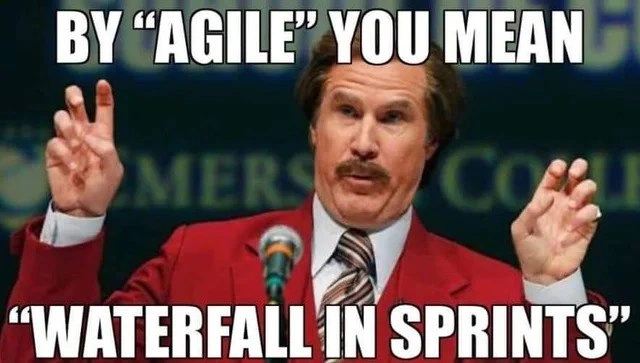
The meme shows a man doing air_quotes_meme – literally making quote signs with his fingers – around the word “Agile.” In text, they wrote "BY 'AGILE' YOU MEAN 'WATERFALL IN SPRINTS'". Using quotes like that is a way to say “you say it’s Agile, but it’s not truly Agile.” It’s signaling sarcasm or skepticism. Essentially, the meme is someone responding to a manager or executive who brags “Our team is Agile now!” by quipping, “By ‘Agile’ you mean… ‘Waterfall in sprints,’ right?” – calling out that the process hasn’t actually changed. This is a common agile_vs_waterfall frustration: people misuse the term Agile. It’s become an executive_buzzwords in some places – higher-ups want to claim they’re doing the latest and greatest process, so they relabel their existing process without adopting the real practices or mindset. This leads to process_dissonance – a mismatch between what the team says it’s doing and what it’s actually doing.

If you’re a junior developer or just learning about methodologies, this meme is basically saying: Be wary of companies that say “we do Agile” but actually behave in the old Waterfall way. It highlights a common pain point (AgilePainPoints): the frustration when teams do all the Agile ceremonies (like daily stand-up meetings, sprint planning every two weeks, review demos, and retrospectives) but don’t see any of the advantages because the organization still demands things like a fixed scope, strict phase gates, or no change in plans. For example, in true Agile, you’d welcome new requirements even late in the project if they add value; in fake Agile, any change request gets frowned upon because “we already planned everything at the start.” In true Agile, teams self-organize and decide how to get work done; in fake Agile, a manager still micromanages tasks but calls himself a Scrum Master. If you’ve ever heard the term “cargo cult Agile,” it refers to doing these rituals (stand-ups, post-it notes, calling requirements a “backlog”) without understanding why, just hoping to get the magic of Agile. The meme captures that exact concept in a humorous one-liner.

In short, Waterfall vs. Agile is like a rigid plan vs. an adaptive journey. This meme jokes about a company that wants to look adaptive (Agile) but stays rigid (Waterfall). It’s a bit like a restaurant that reprints its menu with trendy new names for the same old dishes – nothing’s changed in the kitchen, but they call the stew “deconstructed soup” now. Developers often share this meme to vent about ceremonies_without_change – all the Scrum meetings in the world won’t help if management still runs things with a waterfall mindset. If you’re new, just know that Agile is supposed to mean real change in how you work, not just new vocabulary. When a company does “Agile in name only,” it tends to frustrate teams because they get the extra overhead of meetings and jargon without the improvements in speed or flexibility. That’s why this meme is both funny and a little sad – it’s pointing out a truth that many have experienced firsthand in project management and corporate culture.

Level 3: Sprinting in Circles

At the highest level, this meme takes a cynical jab at companies that claim to be Agile but operate like Waterfall behind the scenes. The man in the red blazer is shown using exaggerated air-quotes around the word "Agile," implying a so-called Agile process that isn’t Agile at all. This situation is painfully familiar to seasoned developers: an organization loudly announces an “Agile transformation” – complete with Scrum terminology, sprints, and daily stand-up meetings – yet nothing fundamental actually changes in how projects are run. The result is something practitioners jokingly call WaterScrumFall (or Fake Agile): you get all the Scrum ceremonies (stand-ups, sprint planning, retrospectives) but the culture and execution remain Waterfall. In other words, the company is sprinting in circles: running in short time-boxed loops but still stuck in the old sequential mindset.

This contrast is humorous because Agile vs. Waterfall is a classic battle in software development methodology. Waterfall is the traditional step-by-step approach (Requirements -> Design -> Implementation -> Testing -> Deployment done in big, separate phases). Agile, on the other hand, is supposed to break those big phases into continuous, iterative cycles delivering value incrementally. The meme highlights a common corporate dissonance: they say they’re Agile (because it’s the trendy executive buzzword), but what they’re doing is just “Waterfall in Sprints.” The air-quotes in the image scream “Yeah, right, ‘Agile.’” It’s a sarcasm many developers recognize from experience – like when a manager boasts “We’re totally Agile now, we do two-week sprints!” while still demanding a full scope fixed 6-month plan upfront and allowing no changes.

Why is this funny to insiders? Because it’s Agile in name only – a superficial rebranding of the old process. Imagine a project where Sprint 1 is spent writing a 100-page requirements doc (nothing delivered to users), Sprint 2 is all about complete system design (still nothing usable released), Sprints 3-6 are heads-down coding with no feedback, Sprint 7 finally does testing, and Sprint 8 pushes to production in a big bang. That’s basically a Waterfall life cycle chopped into sprint-sized chunks, often called “Waterfall with stand-ups” or “Agile theater.” Everyone goes through the motions: daily stand-up meetings happen (now you spend 15 minutes each morning saying “I’m still waiting on QA”), sprint planning meetings happen (you plan all tasks in detail months in advance anyway), and even retrospectives happen (teams suggest improvements that get ignored). All the Agile ceremonies_without_change are there, but the mindset is still “plan everything, then do it, then test at the end.” It’s like management checked the checkboxes for Scrum (to be process-compliant and impress higher-ups with those buzzwords), yet they never empowered the team to actually adapt or self-organize. This gap between process buzzwords and real practice is exactly the punchline. Developers who have lived through a fake_agile adoption feel a mix of frustration and validation seeing it joked about: “Yep, been in those ‘agile’ sprints that felt just like mini-waterfalls!”

On a deeper level, the meme is poking at corporate culture and delivery_methodology_confusion. Many organizations want the results of Agile (faster delivery, flexibility, happier teams) but are unwilling to let go of the comfort of detailed long-term plans, rigid roles, and heavy approvals. So they end up doing what this meme describes: rebranding the old SDLC as Agile. It’s a process dissonance that every experienced developer or project manager can recognize. The humor is a bit dark: it laughs at the futility of calling something Agile when it’s not, a scenario so common there are entire rants, cartoons, and books about it in the AgileHumor space. In meetings, you might hear a weary senior dev whisper, “By ‘Agile’ they mean Waterfall with sticky notes,” exactly encapsulating this meme. The meme’s text "BY "AGILE" YOU MEAN "WATERFALL IN SPRINTS" is basically what every disillusioned team member wants to retort when higher-ups brag about their “Agile process” that in reality changed nothing. It’s satire of executive_buzzwords culture: leadership loves saying “We do Scrum!” and “We have sprints!” as if those words alone modernize a slow, rigid process.

In summary, at the expert level this meme is calling out WaterScrumFall: a fake Agile implementation where teams are ceremonially sprinting but not truly embracing agility. It resonates with senior engineers and project managers because it highlights the absurdity of going through all the motions of Scrum without reaping any of the benefits. It’s both a cringe and a chuckle, because many of us have been in those agile_painpoints meetings thinking, “We replaced our Gantt charts with JIRA boards and our project phases with sprints, but everything feels the same… something’s not right!” The meme nails that feeling with a simple image and sarcastic caption, perfectly capturing the “Agile in quotes” farce that is all too real in our industry.

Description

A popular meme featuring the character Ron Burgundy from the movie 'Anchorman,' played by Will Ferrell. He is shown wearing a red suit and standing at a podium, gesturing with his hands in a questioning or condescending manner. The image has a text overlay in a bold, white font. The top line reads, 'BY "AGILE" YOU MEAN', and the bottom line reads, '"WATERFALL IN SPRINTS"'. This meme serves as a sharp critique of a common corporate anti-pattern where organizations adopt Agile terminology, such as 'sprints,' but fail to embrace the underlying principles of iterative development. Instead, they continue to follow a rigid, sequential Waterfall process, simply broken into two-week increments. This 'Waterfall in sprints' is a source of great frustration for experienced engineers as it combines the bureaucracy of Waterfall with the relentless meeting schedule of poorly implemented Agile, resulting in the worst of both worlds
Comments

8
Anonymous ★ Top Pick We're not doing 'waterfall in sprints.' We're practicing a highly specialized, proprietary methodology called 'Iterative Sequential Phased-Gate Delivery Cadences.' It's much more agile
  1. Anonymous ★ Top Pick

    We're not doing 'waterfall in sprints.' We're practicing a highly specialized, proprietary methodology called 'Iterative Sequential Phased-Gate Delivery Cadences.' It's much more agile

  2. Anonymous

    We’re “Agile” now - same 9-month Gantt, but the milestones got copied into Jira as Sprint 1-12, and even the burndown chart filed a ticket for identity theft

  3. Anonymous

    After 15 years of 'Agile transformations,' I've learned that most companies practice Scrum the same way I practice yoga - badly, painfully, and with a fundamental misunderstanding of the core philosophy, but at least we have the expensive certifications to prove we tried

  4. Anonymous

    Ah yes, the classic enterprise 'Agile transformation': six months of upfront planning, a fixed scope locked in stone, zero tolerance for requirement changes mid-sprint, and a Gantt chart that would make a 1990s PMO weep with joy. But hey, we have daily standups and call our phases 'sprints,' so we're totally Agile now. The Agile Manifesto's authors didn't die for this - they're just watching in horror as their principles get waterboarded into two-week increments of predetermined work with mandatory status reports

  5. Anonymous

    If your sprint review is a phase-gate signoff and your DoD says "approved by PMO," you’ve containerized Waterfall into two-week images and rebranded the Gantt chart as velocity

  6. Anonymous

    SAFe “Agile” at my last gig: fixed scope and dates, stage gates rebranded as sprints, Gantt charts drawn in Jira - now we’re late in two‑week increments with a burndown to prove it

  7. Anonymous

    Waterfall in sprints: where 'agile' means slicing BDUF into velocity-tracked indigestion

  8. Red Я. 5y

    Лол или просто тикетку а джире

Use J and K for navigation