The Hollow Victory of Static Types
Why is this Languages meme funny?
Level 1: Safety Net with Holes
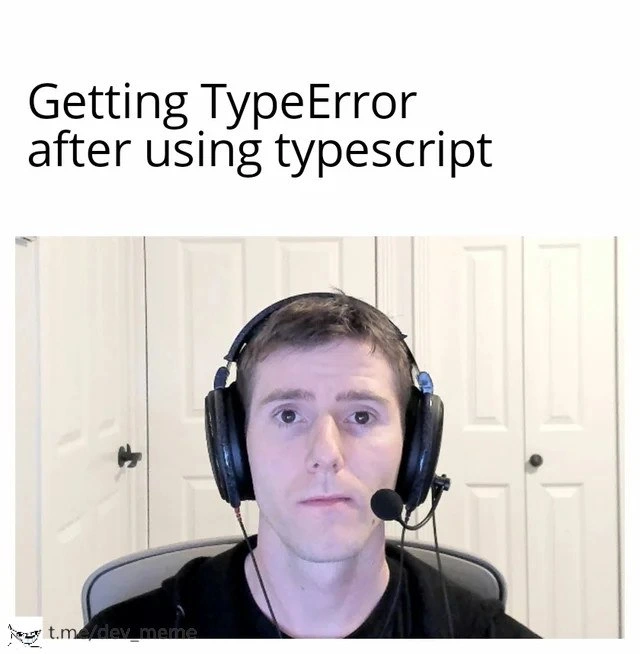
Imagine you have a big safety net under a circus trapeze – that net is supposed to catch you if you fall. You feel super safe jumping, because hey, there’s a net! But unbeknownst to you, the net has a few holes. Most of the time, it’ll catch you... but if you fall in the wrong spot – whoosh – you go right through and hit the ground. Ouch. In this analogy, TypeScript is the safety net that’s supposed to catch mistakes (bugs), and a TypeError at runtime is you hitting the ground. The developer in the meme looks blank and disappointed because he just fell through a hole he didn’t think was there. He thought he was totally protected (“I used the net!”), but there was a gap (any or some unchecked bit) that let the mistake slip by. It’s funny in the way slipping on a banana peel in a cartoon is funny – our poor developer trusted something to save him, and it mostly does, but the joke is that it didn’t this time. TypeScript can prevent a lot of accidents, but if there’s even one hole, that’s where the error will find you.
Level 2: TypeScript’s Blind Spots
Let’s break down the key concepts and why this situation happens. TypeScript is a programming language that builds on JavaScript by adding static type checking. “Static” means it does the checking before the code runs (at compile time). In theory, this helps catch mistakes like “hey, you’re calling a function that doesn’t exist on this object” or “you’re passing a string where a number is expected.” A TypeError is a common kind of JavaScript runtime error – for example, if you try to do something with a value that isn’t allowed, like calling a method on undefined or treating a number like it was a function. The meme points out the irony of encountering a TypeError even after using TypeScript. Weren’t those supposed to be gone?
Here’s why it can happen:
- TypeScript only exists at compile time: When you run your code in the browser or Node.js, it’s just plain JavaScript. All the type information is stripped away during compilation (this is often called type erasure). So at runtime, there’s nothing automatically preventing type mismatches. If you wrote something that passes the compile step but is logically wrong (like expecting an array to have an element when it might be empty), JavaScript will still throw a runtime error. TypeScript doesn’t inject extra checks unless you explicitly code them in.
- The
anytype: TypeScript has a special escape hatch type calledany. If a variable is typed asany, it basically means “opt-out of type checking for this one; it can be anything.” This is useful when you’re migrating code or dealing with something you genuinely can’t predict. But it’s dangerous: if you overuseany(hence the context tag any_everywhere), you’re telling TypeScript to not check a lot of your code. Then you’re back to classic JavaScript flexibility – and the classic JavaScript runtime crashes when something isn’t what you expected. For example:
let payload: any = fetchDataFromServer(); // fetchDataFromServer() returns JSON, but we haven't told TS what shape
// TypeScript trusts us here. We said "payload is any", so it assumes we know what we're doing next.
console.log(payload.user.name.toUpperCase());
If fetchDataFromServer() returns { user: null } or something without a name string, then payload.user might be null or undefined at runtime. Calling .name on undefined or .toUpperCase() on a non-string will throw a TypeError. TypeScript would have stayed silent because payload was any – no checks. The error only shows up when the code actually runs and hits that bad case.
- Library and definition issues: TypeScript often relies on declaration files (the
.d.tsfiles you might see) to know the types of functions from libraries. If those are wrong or if you’re using a JavaScript library without types, you might tell TypeScript “don’t worry, this function returns a string”, but at runtime it might return something else (likenullor an object). Without runtime checks, you could again see a TypeError if you misuse that value. - Optional properties and strictness: By default, TypeScript has certain strictness flags. For instance,
strictNullChecksmakes you handleundefinedandnullproperly. If that’s off, you might inadvertently treat something as definitely there while it could be missing. Example:
With strictNullChecks on, TS would force you to checkinterface User { name: string } const maybeGetUser = (): User | null => { /* ... */ return null; } let user = maybeGetUser(); console.log(user.name); // If user is null, TS might not warn if strictNullChecks is off – runtime TypeErrorif(user)beforeuser.name. With it off, TS assumes you know what you’re doing, and anullcan slip through, causing a crash when you run the code.
So, even for a junior dev or someone new to TypeScript, the key takeaway is: TypeScript helps catch many bugs early, but it isn’t foolproof. It doesn’t actually run your code in a sandbox or guarantee it’s 100% correct. Think of it as a really smart assistant that warns you about likely mistakes – but if you tell the assistant “ignore this” (any or disabling a rule), it will, and you might end up with a mistake it didn’t warn you about. The meme is funny (and painful) because the developer in the image is realizing exactly this: “I used TypeScript and still got a TypeError. What did I do wrong?!” It’s a rite-of-passage moment for many devs: understanding that compile-time guarantees have limits, and you still need good tests and careful handling of data at runtime.
Level 3: Type Safety Mirage
Seasoned developers will smirk at this scenario because it highlights the false sense of security that TypeScript can instill. We’ve all been there: after a big migration to TypeScript, touting how it’ll eliminate whole classes of bugs, you confidently run your app… and promptly hit a classic TypeError: undefined is not a function. The irony cuts deep. TypeScript’s static typing is a great tool – it catches many mistakes at compile time – but it’s not a magical force field against all runtime errors. This meme’s humor is that dead-inside look of a developer who expected TypeScript to have their back, only to discover an any type or a poorly typed library call quietly undermined those safeguards.
In real projects, frontend and full-stack engineers often introduce TypeScript to catch things like mistyped props or wrong function signatures. It generally works! But the reality in complex apps is that there are numerous escape hatches and pitfalls:
- Using
any(intentionally or inadvertently): Maybe you hit a tricky part of the code and thought, “I’ll just useanyfor now.” That’s basically telling the compiler “trust me, I know what I’m doing”. The compiler obliges and disables type checks for that value. If your assumption was wrong, aTypeErroris lurking at runtime.anyeverywhere defeats the purpose of TypeScript, but under deadline pressure or during gradual migration, it sneaks in like weeds in a garden. - Third-Party Libraries with incomplete types: You pull in a popular JavaScript library. If its TypeScript definitions (from DefinitelyTyped or the package itself) are wrong or too permissive, TypeScript might think everything is fine with your usage… until that library returns something unexpected at runtime. For example, a library function is typed to return
stringbut under certain conditions it actually returnsundefined. TypeScript won’t catch it if the type definitions aren’t accurate. Boom, runtime_typeerror. - Type assertions and
// @ts-ignore: These are like saying “Shut up, compiler, I got this.” For instance, usingsomeVar as MyTypecoerces the compiler to treatsomeVarasMyTypewithout actual proof. IfsomeVarisn’t really that type at runtime, you’ve basically told TypeScript to close its eyes. Similarly,// @ts-ignorecomments will silence errors. It’s like cutting the wire on your fire alarm – things might seem quiet, but the fire (bug) is still burning. - Unchecked runtime inputs: TypeScript can enforce types for things known at compile time (your code, config, etc.), but data coming from the outside world (user input, server responses) can’t be fully trusted just because you typed them. If you declare
let user: User = JSON.parse(someApiData), TypeScript assumessomeApiDatafits theUsershape. If reality differs (say the API sometimes omits a field or givesnull), TypeScript won’t automatically validate that at runtime. Without explicit checks, you can get an error when your code tries to treat anundefinedfield like a string or calls a method on it.
All these scenarios boil down to one thing: TypeScript is only as strong as the weakest link in the types. Its compile-time checks significantly reduce bugs, but they have limits. The experienced devs chuckle (or groan) at this meme because they know that feeling: after all the hype and effort to add types, a runtime error still finds a way. It’s comedic in a tragic way – like installing a high-tech security system and then leaving the back door open. The meme’s caption “Getting TypeError after using TypeScript” paired with that blank, betrayed expression is shorthand for a shared industry experience: TypeScript can catch a lot, but it can’t catch everything. The humor lives in that gap between expectation and reality, a hallmark of developer frustration-turned-comedy.
Level 4: Phantom Types, Real Errors
At the theoretical level of static type systems, TypeScript’s promise of safety is a bit of a mirage born from type erasure. TypeScript provides a rich compile-time type checker, but all those types are phantoms – they vanish when the code runs as plain JavaScript. In type theory terms, TypeScript’s system isn’t sound: a program that type-checks isn’t guaranteed free of type errors at runtime. Why? Because TypeScript trades strict soundness for pragmatism. It allows any, type assertions, and gradual typing to interoperate with dynamic JavaScript, which inevitably opens holes in the safety net. This is a known compromise – doing otherwise would require runtime type enforcements that JavaScript doesn’t natively have, or rejecting a lot of valid dynamic coding patterns. The result is a type system that can prove some invariants (like “this function expects a string” or “that object has a property id”), but cannot prove everything about a program’s behavior. In fact, by the Church-Turing and Rice’s theorem flavored limits of static analysis, no non-trivial property of a program (like “will it ever throw a TypeError?”) can be decided purely at compile time for all cases. So TypeScript opts to be helpful but not infallible. The meme’s dark humor comes from this academic truth: those “guarantees” are conditional. Your code might pass the type checker with flying colors and yet, when it runs, a good old TypeError can still punch through – as if the types were just friendly suggestions to the compiler, not iron-clad contracts with reality.
Description
A meme featuring a close-up shot of a man, widely recognized in tech circles as Linus Sebastian of Linus Tech Tips, wearing a gaming headset and staring blankly into the camera with a deadpan, slightly disappointed expression. Above his head, white text on a plain background reads, 'Getting TypeError after using typescript'. A small watermark for 't.me/dev_meme' is visible in the bottom left corner. The humor is deeply ironic and relatable to developers. TypeScript is a programming language that adds static types to JavaScript, with its primary purpose being to catch type-related errors during development and prevent them from occurring at runtime. A 'TypeError' is exactly the kind of runtime error TypeScript is supposed to eliminate. The meme perfectly captures the frustrating and paradoxical moment when a developer realizes that despite their efforts to ensure type safety, a type error has still managed to slip through, often due to incorrect type assertions, the use of the 'any' type, or unhandled data from an external API
Comments
7Comment deleted
The five stages of TypeScript grief: Denial (the compiler would have caught it), Anger (why does `any` even exist?), Bargaining (maybe a `zod` schema will fix it), Depression (types are a lie), and Acceptance (it was a `null` from a JSON response, of course)
After six sprints migrating to TypeScript for “guaranteed safety,” one rogue `as any` turned prod into Schrödinger’s null-pointer experiment
After years of convincing management that TypeScript would eliminate type errors, you realize you've just been writing 'as any' everywhere and the real type system was the friends we ignored along the way
Ah yes, TypeScript - the language that promises to eliminate runtime type errors by catching them at compile time, yet somehow we still manage to get TypeErrors in production. It's like having a state-of-the-art security system that locks all the doors but leaves the windows wide open. The real kicker? It's usually because someone liberally sprinkled 'any' types throughout the codebase like they're seasoning a dish, or because that third-party library you're using has type definitions written by someone who clearly thought 'Record<string, any>' was peak type safety. TypeScript giveth type safety, and JavaScript runtime taketh away - perfectly balanced, as all things should be
TypeScript: Compile-time type safety so bulletproof, it lets runtime TypeErrors sneak in undetected
TypeScript is compile-time theater; your API is still improv - TypeError courtesy of erased types and unvalidated JSON
Using TypeScript and still getting TypeError? That’s what happens when your trust boundary is an interface - types evaporate at runtime, and one “as any” turns strict mode into JavaScript Classic