When You're the Reason for the Production Outage
Why is this OnCall ProductionIssues meme funny?
Level 1: Spilled Milk
Imagine you accidentally left the kitchen sink faucet running and water spilled all over the floor. Suddenly, your parent walks in and shouts, “Oh no! There’s a huge flood in the kitchen, everything is getting soaked!” Now, you already know what the problem is – the problem is the water overflowing, and it happened because you left the faucet on. You realize immediately that it’s your mistake. So instead of freaking out or looking surprised, you just sit there calmly, maybe even finishing a cookie, thinking to yourself, “Yep, that was me. I kinda saw this coming.”
This scene is funny because usually if there’s a big mess, you’d expect the person who caused it to panic or try to hide. But here, the person who made the mess (left the faucet on) is the calmest one in the room. It’s like they’re saying, “I know, I know… I did it. No point in screaming about it. Let’s clean it up after I finish this snack.” The emotional core of the joke is that unexpected calm in the face of trouble. We laugh because it’s a reversed reaction: the one who’s guilty isn’t running around; they’re oddly at peace with the disaster. In the meme, the developer is that person – he wrote the bad code that broke the product, so when the boss yells about everything crashing, the developer’s just calmly eating his food. It’s the tech equivalent of “no use crying over spilled milk.” He knows he spilled it, and instead of crying, he’s staying cool and ready to mop up the mess (after dessert, apparently!).
Level 2: Dinner and Disaster
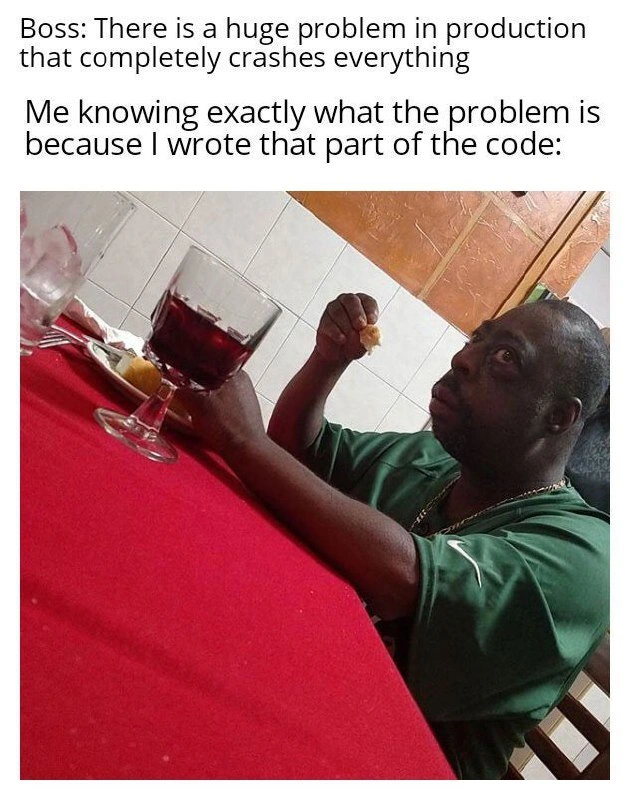
In simpler terms, this meme highlights a common production outage scenario with a twist. The “Boss” shouts that there’s a huge problem in production – meaning the live website or service is crashing and burning, everything is down. This is the kind of urgent crisis that usually has people running around in a panic. But the meme’s punchline is the second part: “Me knowing exactly what the problem is because I wrote that part of the code.” In the image, instead of panicking, the developer (the “Me” in question) is just leaning back at a dinner table, calmly eating a snack and enjoying a big glass of red wine. He looks completely relaxed, even bored, while the system is supposedly in flames. It’s a funny contrast: the boss is freaking out 😱, and the person who caused the mess is like, “Eh, I know what’s wrong. I’ll deal with it after this bite.”
Why is this so relatable for developers? Let’s break it down. Production is what we call the environment where real users interact with the software – it’s the live, real-world system. A “problem in production” means something has gone very wrong in that live system (for example, a major bug causing the website to crash). When the boss says it “completely crashes everything,” that implies a severe outage: maybe the website is entirely offline or a critical feature isn’t working for anyone. This is as serious as it gets in software operations – often termed a Sev-0 or Sev-1 incident (short for Severity Level 0/1, the highest urgency). In such moments, standard procedure is to page the on-call developer (the engineer designated to handle emergencies) to jump in and fix it ASAP. It’s all hands on deck until the issue is resolved. So normally, you’d expect the responsible engineer to be sweating bullets and rushing to debug the issue.
But here we have the opposite: the developer is totally unruffled, casually eating dinner. Why? The caption gives a clue: he knows exactly what the problem is because he wrote that code. In other words, as soon as he heard the boss describe the issue, he immediately realized, “Oh, that’s coming from the part of the system I built – and I bet I know what specifically I did wrong.” There’s no mystery, no frantic search for the cause. He probably recognized the failure from the error message or symptoms right away. For example, if he wrote a function that handles user logins and the boss says “No one can log in and the server keeps crashing,” he might think, “Ah, I bet it’s that login function I rushed and didn’t test enough.” It’s self-incriminating code – the code he wrote is essentially pointing a finger back at him.
Knowing you caused a severe bug (an error or flaw in the code) is a special kind of “oops” moment for developers. It’s both horrifying and oddly relieving. Horrifying because a bug you introduced has taken down production (every developer’s nightmare), and relieving in the sense that at least you know where to look. There’s no scrambling around in the dark; you can go straight to the offending bit of code and start fixing it. In the meme, the developer’s relaxed demeanor exaggerates this relief. He’s so unfazed that he’s literally continuing to enjoy his meal. This comes off as dark humor: the situation is very bad, but he’s acting like nothing’s wrong. It’s the kind of humor tech folks share to cope with the stress of ProductionIssues.
Let’s give some real-world context. Imagine earlier that week, this developer made a change to the system – say, he wrote a new piece of code or modified an existing one. Perhaps he was in a rush (it might have even been a Friday deployment, which is notorious in tech because if you break something on Friday, you might get called on the weekend). Maybe he skipped a few tests or he wasn’t able to simulate the exact production conditions on his own machine. On his personal computer or the testing environment, everything probably seemed fine – the code “worked on my machine” – so it got approved and released. But the production environment is a different beast: it has lots more users, real data, heavy traffic, and complex interactions. Often, production will expose the one scenario you didn’t think of. For instance, an edge case like “what if a user’s name is 10,000 characters long?” or “what if we suddenly get 1 million requests at once?” can crash code that isn’t prepared for it. Developers try to account for these, but something always slips through. In this case, his code had a flaw that only shows up under certain conditions in production, and sure enough, those conditions were met and everything came crashing down.
The moment the outage happens, an alert likely goes out. If the developer is on call (meaning he’s the one rostered to handle such emergencies at that time), his phone or pager would be blowing up. The boss is yelling about the crisis. At that point, most people would jump up from their dinner table, heart pounding, ready to frantically dig into logs and error messages. But what does our guy do? He keeps chewing, maybe rolls his eyes a little, because he already knows exactly what the alert is about. It’s as if he’s saying, “Oh, I know this problem. I kind of saw it coming. No need to panic. Let me just finish this chicken nugget and then I’ll go fix it.” This super-chill reaction is funny precisely because it’s so out of place. We expect urgency, but we see apathy (or at least calm confidence). It’s humor born from a mix of arrogance and experience – the developer might be thinking, “Yep, that one’s on me,” with a smirk of familiarity.
There’s also an element of coping mechanism here. Staying calm can be a deliberate way to handle a crisis. If you’ve ever seen firefighters or emergency doctors, they often appear calm during chaos – because freaking out doesn’t help solve anything. In tech, experienced engineers learn a similar lesson: during a production incident (outage), you need clear heads to troubleshoot and fix the issue. Panicking can lead to mistakes or oversights. Our meme exaggerates this idea to the point of comedy: the dev isn’t just calm, he’s totally indifferent, apparently prioritizing his meal over the outage. In reality, of course, he would (and should!) be working hard to fix the bug. But the image of him leisurely enjoying dinner while production burns is a comical way to show that he’s not outwardly stressed. It’s a bit of DeveloperHumor that says: sometimes, the person who broke everything is the one person in the room who isn’t surprised at all.
Let’s touch on the idea of responsibility and culture. In modern software teams, there’s a big emphasis on learning from mistakes rather than punishing people. This is often called a blame-free culture. Instead of yelling “Who wrote this garbage code?!” teams try to focus on how to fix the issue and prevent it in the future. Post-incident, they’ll do a postmortem (a meeting to analyze why it happened) without finger-pointing. The context tags mention “blame_free_culture_test,” which suggests this meme is also poking at the scenario where the developer can openly admit “Yeah, that’s my code causing the trouble” without fear of immediate retribution. The developer’s chill vibe could be interpreted as, “I know I messed up, but I also know I’m not about to be fired on the spot. Let’s just solve it.” In many real cases, the developer who caused the issue is exactly who you want to stay calm and fix it quickly, and teams recognize that. So, while the meme is funny, it also hints at a healthy dynamic: he’s owning up to his ProductionBug in such a relaxed way that it implies the team isn’t going to crucify him for it. (Or maybe he’s just so used to this that he’s past the point of fear – that can happen too in high-pressure jobs, which is another layer of the dark humor here.)
The visual of the meme adds to the humor. The man in the photo is literally chilling. He’s leaning back, holding a little snack in one hand, with a big glass of red wine on the table. The tablecloth is bright red, almost like an alarm light, but he’s completely unfazed. His expression isn’t one of terror or even concern; if anything, he looks a bit bored or annoyed at being bothered. It’s like he’s saying, “Yeah, yeah, everything crashed. I’ll get to it. Can I at least enjoy my food first?” For developers, this image is hilarious because we all aspire to be that calm when things go wrong, but rarely are. It’s an extreme portrayal of confidence (or indifference) in a crisis. And it underscores the joke: the reason he’s so calm is that he already knows exactly what went wrong. There’s no shock for him, only for everyone else.
In summary, this meme is a tongue-in-cheek look at relatable developer experiences during production incidents. The boss’s panic represents how the broader team feels when production is down – it’s a big deal, customers might be impacted, money could be lost every minute, so everyone is tense. The developer’s chill response represents that one person who caused the issue and recognized it immediately. It’s the “I broke it, I expected this might happen eventually, so I’m not even surprised” feeling. The humor comes from that role reversal: usually the culprit would be freaking out, but here he’s the calmest of all. Every developer with a few years of experience has at least one story of a time they pushed something that broke prod. It’s a kind of shared SharedPain and DebuggingFrustration we laugh about to make it sting less. This meme takes that scenario to an absurd extreme (because let’s face it, hardly anyone is truly this chill when the site is down) to remind us: sometimes you just gotta keep your cool and own the error, even if it’s a doozy that brings everything crashing down.
Level 3: Feasting on Failure
Boss: “There is a huge problem in production that completely crashes everything!”
Me (Developer who wrote the offending code): takes a sip of wine and continues eating calmly
For anyone who’s survived gnarly on-call nights, this scenario is intensely relatable. The production environment – the live system serving real users – is on fire (Sev-0 outage, meaning a top-priority, all-hands-on-deck failure). The boss is in full panic mode, announcing the catastrophe to the team. And the developer responsible? He’s sitting there with Zen-like calm, casually munching a snack and sipping a goblet of red wine as if nothing happened. It’s a jarring, darkly funny contrast. Seasoned engineers recognize that thousand-yard stare – after enough 3 AM firefights, you either panic or you learn to munch through the chaos. This meme leans into that battle-hardened, sarcastic coping mechanism: “Production’s nuked? Meh, saw that coming.”
What’s especially humorous (and a tad painful) is the developer’s nonchalance precisely because he immediately knows the root cause. The caption essentially reads, “Me, knowing exactly what the problem is because I wrote that part of the code.” Every senior dev has lived this moment. The instant the boss screams about the big crash, one specific commit or module flashes in your mind and you get that sinking feeling: “Oh no… I know exactly which piece of code did this, and it’s mine.” It’s a self-incriminating code horror. In a sense, he doesn’t even need git blame to find the culprit – he is the culprit, and he knew this day might come. This is the classic case of shipping a ticking time bomb in your code and hoping it never goes off. Well, it just went off, and our guy’s reaction is basically, “Yup… that’d be my bug. Figures.”
Now, why would a developer remain so calm during a Sev-0 outage, especially if their own code is nuking production? Experienced devs know that outward panic doesn’t solve problems; swift, methodical action does. This engineer’s chill vibe suggests he’s been through the wringer enough times to know two things: (1) exactly what broke, and (2) roughly how to fix it. There’s almost a hint of resigned acceptance here – like a mechanic hearing a loud bang from an engine and calmly going, “Ah, that’ll be the timing belt I patched with duct tape.” He might actually be internally face-palming, but externally he’s keeping it cool. In real life, that calm can be beneficial: he can focus on a fix instead of running around in circles. It’s a stark contrast to the boss’s frenzy. The boss is probably non-technical (or at least not as intimately familiar with the system) and is freaking out because “everything is down!” Meanwhile, the developer’s thinking, “I know exactly what dumb mistake I made, give me a minute to push a patch… after I finish this bite.” It’s the epitome of OnCallDuty humor – the on-call engineer so jaded that a crashing system doesn’t even ruin dinner. 🥪🔥
Let’s talk about how we likely got here. The context tags hint at a “known_bad_commit” and “friday_deployment_regrets.” Ah, deploying risky code on a Friday – the stuff of DevOps nightmares. Chances are, our calm friend merged a sketchy pull request right before the weekend. Maybe there was pressure to release a feature, or a bug fix that almost worked (“it works on my machine, I’m sure it’ll be fine in prod!”). He knew that part of the code was held together by hopes and dreams – perhaps a corner cut due to deadline pressure or an edge case he left unhandled. (We’ve all seen comments like // TODO: handle massive payload later lurking in critical code.) Call it Murphy’s Law of Software: the one thing you neglect in your code is exactly what will blow up under the worst circumstances. The developer probably told himself the change was safe enough. He might have even assured QA, “Yep, it’s good” after extensive testing running it once on his laptop. And for a while, it was fine… until real users and real data hit that weak spot like a tidal wave. Boom! Production is now a smoking crater, and he instantly knows his bug is to blame. This flavor of dark humor comes from shared industry trauma: deploying on Friday, getting paged on Saturday. The meme is basically a rite-of-passage snapshot for senior engineers.
In a way, the developer’s calm is also about ownership. In a healthy engineering culture (think blame-free postmortems and team accountability), admitting “I broke it” isn’t a career-ending event – it’s just the first step to fixing the issue. The tag “blame_free_culture_test” alludes to the idea that outages should be met with solutions, not witch-hunts. Our meme’s hero isn’t scrambling to cover his tracks or throw someone else under the bus. He’s exemplifying that ideal: staying cool, owning the mistake, and presumably preparing to fix it. (Or at least finish his wine before diving into the logs.) There’s an unwritten understanding among veteran devs: ProductionIncidents happen to everyone, and eventually you will take down something important with a dumb mistake. It’s practically a software rite of passage. The difference between a junior and a senior in that moment is often the reaction. A junior might panic, frantically searching for what went wrong. A senior, especially if they already suspect they’re the culprit, often has that grim calm – they’ve been here before, they know the drill, and they know panicking won’t un-crash the servers. As the saying goes, “Keep calm and restart the container.”
The humor here also lies in the absurd image of prioritizing a meal over an emergency you caused. The bright red tablecloth and the big glass of red wine in the photo practically scream “critical alert” — it’s as if the whole scene is bathed in the red of an incident alarm. And yet, our man is treating it like a normal lunch. It’s a perfect visual metaphor for a chill_dev_in_crisis. Senior devs chuckle at this because, honestly, sometimes that’s how it feels. When you maintain large systems, eventually something you wrote will wreak havoc. By that time, you might be so exhausted or cynical that your reaction is just to sigh, grab a bite of comfort food, and then get to work. It’s laugh or cry – and he’s choosing to laugh (and snack). There’s even a hint of “This is fine” energy here (a nod to that famous meme of a dog sipping coffee in a burning room). The developer’s face in the photo says, “I expected this chaos, and I’m at peace with it.” It’s a comedic take on DebuggingFrustration and acceptance. After all, when your own code is nuking prod, what can you do but solve it? No use running around screaming; better to have a full belly when you tackle the fix.
Underneath the humor, there’s a layer of truth about SharedPain in software development. We’ve all been there in some form: maybe not calmly eating dinner while prod is down, but that internal moment of “oh... I know what happened, and… I did it.” It’s equal parts embarrassing and oddly empowering. Embarrassing because you broke things; empowering because at least you know where to look to fix it. That’s why the meme resonates across the DeveloperHumor circles – it’s a cathartic acknowledgement that even the best of us introduce awful bugs. The difference is how we handle it. Here we see the ideal of a senior engineer: take responsibility, stay calm, fix the issue, and later, perhaps joke about it over a glass of wine (hopefully not while users are still screaming). As a final bit of cynical veteran wisdom: Production has a knack for turning any Bugs you wrote into a very public spectacle. The ability to stay cool during that spectacle is almost a superpower – one earned through hard knocks. This meme pokes fun at that superpower, portraying the developer as practically Zen while his codebase combusts. It’s funny because it’s true – sometimes all you can do is nod, say “Yep, that’s on me,” and dive in to fix your mess… right after finishing your dinner. 🍷😅
Description
A two-part meme. The top section contains text: 'Boss: There is a huge problem in production that completely crashes everything' followed by 'Me knowing exactly what the problem is because I wrote that part of the code:'. The bottom section is a photograph of Lester Green, also known as Beetlejuice, a member of the Wack Pack from The Howard Stern Show. He is sitting at a table with a red tablecloth, holding a glass of red wine and a piece of bread, looking upwards with a wide-eyed, guilty, and nervous expression. This meme perfectly captures the sinking feeling of dread and personal responsibility a developer experiences when they realize their own code is the source of a critical production failure. For senior engineers, it's a darkly humorous and highly relatable moment of internal panic, representing a rite of passage in a developer's career
Comments
7Comment deleted
That's the face you make when the PagerDuty alert hits your inbox and you don't even need to open it to know the exact commit hash responsible
When you’re both the author and the RCA: engage the proven incident-response pattern - sip, chew, wait for the stack trace to finish compiling its mea culpa
The worst part isn't knowing it's your code - it's remembering you explicitly told the junior dev reviewing your PR that the edge case "would never happen in production."
That moment when your boss describes a production incident and you instantly know it's your code because you remember thinking 'I'll fix that edge case later' three sprints ago. Now you're sitting there calculating whether you can blame it on a race condition, network latency, or cosmic rays before someone checks git blame
Incident triage is easiest when the stack trace reads like your diary - catch(Exception) { /* TODO: handle in prod */ } - it’s basically a signed confession
Fastest tracing tool is senior guilt: O(1) from PagerDuty alert to the Friday 4:59 commit titled "temporary workaround."
Senior dev perk: boss describes outage, you already know the commit SHA - it's yours from that 2am hotfix