Skip to content
DevMeme
7308 of 7435
Attackers Breach GitHub: How Did They Find an Uptime Window?
Security Post #8010, on May 20, 2026 in TG

Attackers Breach GitHub: How Did They Find an Uptime Window?

Why is this Security meme funny?

Level 1: Robbing the Store That's Never Open

Imagine a famous shop announces, very seriously, "We're sorry to report that burglars broke in last night." And a customer in the crowd shouts back, "Burglars? How did they manage that — the shop is never open!" The laugh comes from the flip: instead of being shocked by the robbery, everyone's amazed the robbers caught the place during business hours. It's the joy of watching a very serious announcement get punctured by one perfectly aimed wisecrack about the thing everybody already complains about.

Level 2: Shots, Chasers, and Status Pages

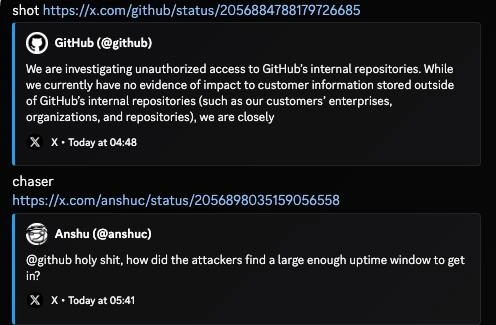
Decoding the moving parts. Unauthorized access to internal repositories means someone outside the company got into GitHub's own private code — not customer projects, which is why the statement stresses that customer "enterprises, organizations, and repositories" appear unaffected. Companies disclose this way because security incidents demand fast public acknowledgment, and the cautious phrasing ("no evidence of impact") keeps the statement true even if worse news surfaces later.

An uptime window is the joke's invented inversion of a downtime window — the scheduled period when a service is down for maintenance. Flipping it implies being online is the exception. The shot/chaser meme format works like a setup and punchline in screenshot form: the shot is the earnest original post, the chaser is the response that recontextualizes it. For early-career developers, the relatable hook is the first time GitHub goes down during your workday and you watch an entire engineering org go idle simultaneously — CI dead, reviews frozen, deploys blocked — and someone inevitably posts the status page link in Slack within ninety seconds. That shared experience is the fuel this meme runs on.

Level 3: The Attack Surface Was Briefly Online

The "shot / chaser" format — a Discord-culture staple where one screenshot sets up and a second knocks down — is deployed here with surgical timing. The shot is GitHub's official account in full crisis-communications mode:

We are investigating unauthorized access to GitHub's internal repositories. While we currently have no evidence of impact to customer information stored outside of GitHub's internal repositories (such as our customers' enterprises, organizations, and repositories), we are closely

Posted at 04:48, truncated mid-sentence by the embed — which somehow makes it more authentic, since incident statements are written to be quoted and clipped. Every phrase is from the canonical breach-PR template: "investigating," "unauthorized access," "no evidence of impact" (the load-bearing phrase of all security disclosures — note it asserts absence of evidence, not absence of impact), and the carefully scoped parenthetical reassuring enterprises their data lives elsewhere. Legal wrote this. You can tell because nothing in it is falsifiable.

Fifty-three minutes later, the chaser from @anshuc:

@github holy shit, how did the attackers find a large enough uptime window to get in?

This is a two-victim joke wearing a one-liner's clothes. Victim one: GitHub's availability record. The premise — that breaching the platform required catching it during one of its rare stretches of being up — only lands with an audience that has muscle memory of orange status pages, stalled Actions queues, and "pull requests are experiencing degraded performance" banners arriving mid-deploy. Centralizing the world's source code on one platform means its outages are everyone's outages, so the resentment pool is deep and pre-heated.

Victim two, more subtly: the corporate disclosure genre itself. A breach announcement is supposed to command gravity. The reply refuses to grant it, responding to a security incident the way one heckles a stand-up act. That's the ratio dynamic in miniature — the official statement becomes the straight man for a community punchline, and the punchline is what gets screenshotted and circulated. There's even a wry security observation buried in the gag: downtime is, technically, the ultimate security control. A system that's offline cannot be exploited. Air-gapping by incompetence. The joke posits GitHub accidentally running the most aggressive zero-trust architecture in the industry: trust no one, including users, by being unreachable.

Description

A Discord-style dark screenshot in the 'shot / chaser' format showing two embedded X posts. The 'shot' is an official GitHub (@github) statement: 'We are investigating unauthorized access to GitHub's internal repositories. While we currently have no evidence of impact to customer information stored outside of GitHub's internal repositories (such as our customers' enterprises, organizations, and repositories), we are closely' - posted at 04:48. The 'chaser' is a reply by Anshu (@anshuc) at 05:41: '@github holy shit, how did the attackers find a large enough uptime window to get in?' The joke skewers GitHub's notorious outage frequency: the platform is allegedly down so often that even attackers would struggle to find it online long enough to breach it
Comments

3
Anonymous ★ Top Pick The breach post-mortem writes itself: root cause was an unprecedented 90 consecutive minutes of availability
  1. Anonymous ★ Top Pick

    The breach post-mortem writes itself: root cause was an unprecedented 90 consecutive minutes of availability

  2. @RiedleroD 1mo

    rare member-contributed meme ^^

  3. @RiedleroD 1mo

    I always love seeing members get their memes featured

Use J and K for navigation