Production Stack Traces Chase Dev
Why is this OnCall ProductionIssues meme funny?
Level 1: The Broken Toy Report
Imagine one person builds a toy, and another person watches the toy store to make sure nothing breaks. Suddenly the watcher runs over with a giant list of every noise the toy made before falling apart. The builder runs away because they know the list probably proves they need to fix it.
Level 2: Production Is Real
Production means the live system real users depend on. Bugs there matter more than bugs on a laptop because they can affect customers, revenue, data, alerts, and team sleep. That is why the label says the stack traces are "from production" rather than from a local test.
An SRE, or Site Reliability Engineer, focuses on keeping services reliable. SREs care about monitoring, alerting, deployments, capacity, incident response, and making sure systems recover when they fail. They are not just "the people with dashboards"; they are the people who notice when the dashboards turn red at the worst possible time.
A stack trace is a report showing the chain of function calls that led to an error. It helps developers find where a program crashed. A small, clear stack trace can point directly to the bug. A huge one can feel overwhelming because it mixes useful clues with many layers of framework and infrastructure code.
The meme is relatable because developers often hope production issues are someone else's problem until the evidence points back to their service. The running Dev label captures that tiny moment of denial before opening the logs and admitting, yes, that null check probably should have existed.
Level 3: Traces Have Legs
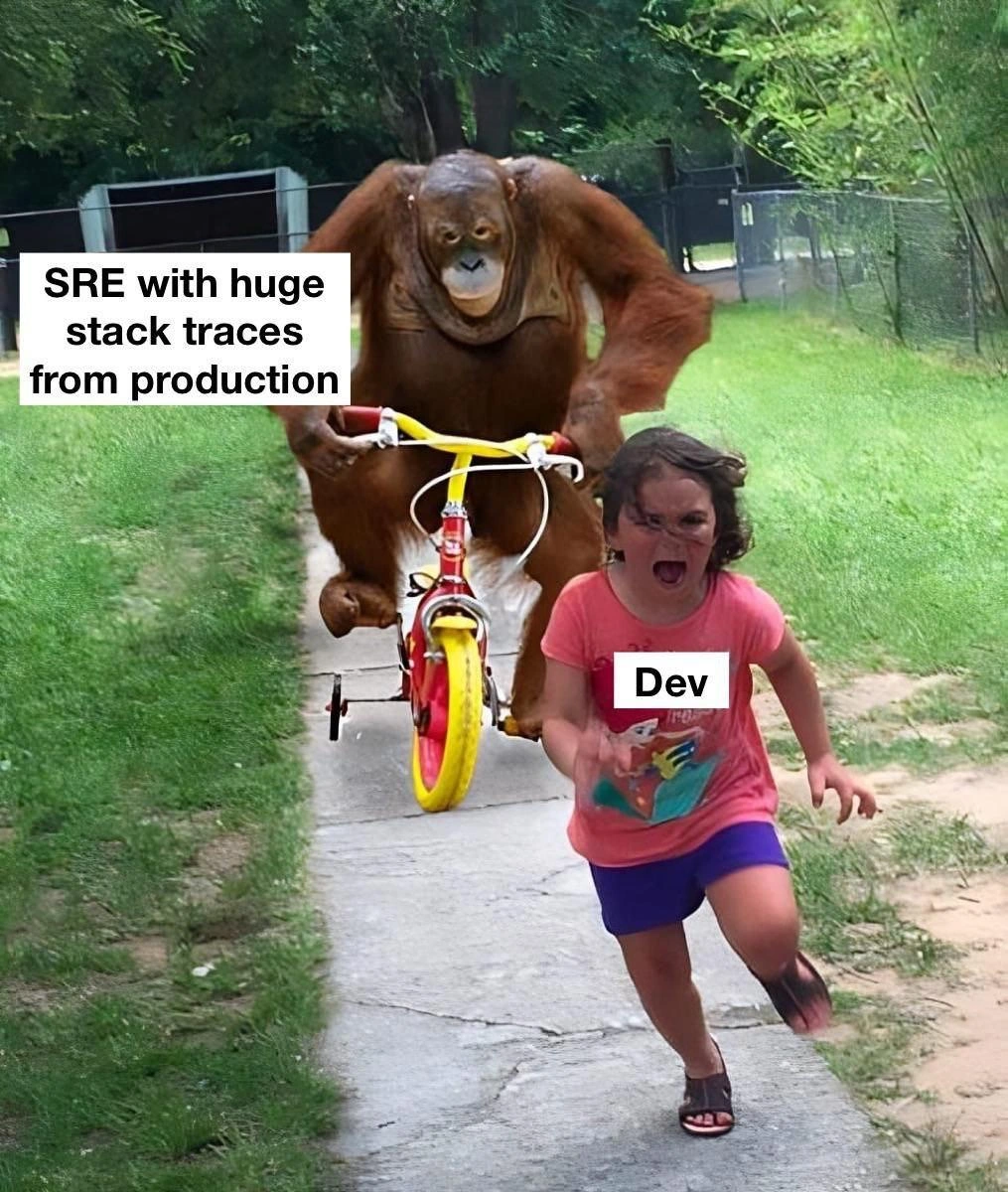
SRE with huge stack traces from production
Dev
The image turns a production incident into a chase scene: the SRE is coming in hot with a giant pile of stack traces, and the Dev is running because nothing says "collaboration" like live errors with timestamps from five minutes ago. The labels do all the work. SRE with huge stack traces from production is not asking for a friendly code explanation; it is bringing evidence.
The senior-developer humor is in the handoff between ownership models. Developers write and ship the code. Site Reliability Engineers keep the system alive, define service-level expectations, monitor error budgets, and build the operational guardrails. In a healthy setup, both sides share responsibility. In the meme version, the SRE has found a stack trace so large and so obviously connected to recent code that the conversation has become physically unavoidable.
Huge stack traces are funny because they are both useful and useless. They contain the failure path, but also every framework wrapper, middleware layer, retry adapter, generated client, async boundary, proxy call, and logging decorator that touched the request on its way to collapse. Somewhere in there is the line that matters. Around it is a cathedral of indirection built by people who all had reasonable tickets at the time.
Production error:
at PaymentService.charge()
at RetryWrapper.call()
at MetricsMiddleware.invoke()
at FrameworkAdapter.dispatch()
at GeneratedClient.execute()
at PleaseStopScrolling.now()
The real pain is observability quality. A stack trace without request IDs, deploy markers, feature flag state, input shape, tenant context, or correlated logs is just a dramatic scroll. A good incident workflow lets the team connect the trace to a release, a change, a user path, and a failure mode. A bad workflow produces a screenshot in chat and the sentence every developer fears: "Does this look familiar?"
The chase dynamic also satirizes incentive structures. Developers are rewarded for shipping features; SREs are punished by pager noise when those features fail under real traffic. If production feedback loops are weak, the first time a developer learns the edge case exists is when an SRE arrives with logs, graphs, and the facial expression of an error budget that has already filed a complaint.
Description
The image shows a dramatic outdoor chase scene where a large orangutan on a small bicycle pursues a frightened running child on a sidewalk. A white label over the pursuer reads "SRE with huge stack traces from production", and a white label on the child reads "Dev". The visual joke turns production stack traces into a physical threat chasing the developer who likely caused or owns the failure. It captures the tense handoff between software engineers and SREs when live-system errors are too large, noisy, or urgent to ignore.
Comments
1Comment deleted
Nothing improves developer velocity like an SRE arriving with 14 MB of stack trace and the expression of a failed error budget.