Skip to content
DevMeme
514 of 7435
Sexism in Tech: A Case Study
DevCommunities Post #591, on Aug 18, 2019 in TG

Sexism in Tech: A Case Study

Why is this DevCommunities meme funny?

Level 1: Don’t Judge by Looks

Imagine you have a classmate who is really into fashion – always dressed up and looking like they could be on a magazine cover. Now, you might think, “There’s no way they’re also the top math student,” right? But that’s a mistake we sometimes make when we judge by appearances. This meme is like a story of a super stylish person who is also a top coder (kind of like being the math whiz). Some other kids (the commenters) tease her, saying “Ha, I bet all you can do is the easiest homework problem!” They’re basically laughing and assuming she’s not actually smart in math, just because she looks like a model. Then she turns around and shows them her report card full of A+ grades, plus awards for helping others with homework and even a trophy for a science project. In simple terms, it’s funny because those teasing kids end up looking really silly – they judged her completely wrong. The lesson: people can be talented in more than one way, and it’s not fair (or smart) to decide what someone can do just by how they look. Don’t judge a book by its cover, because you might miss out on an awesome story inside!

Level 2: Tech Terms & Trolls

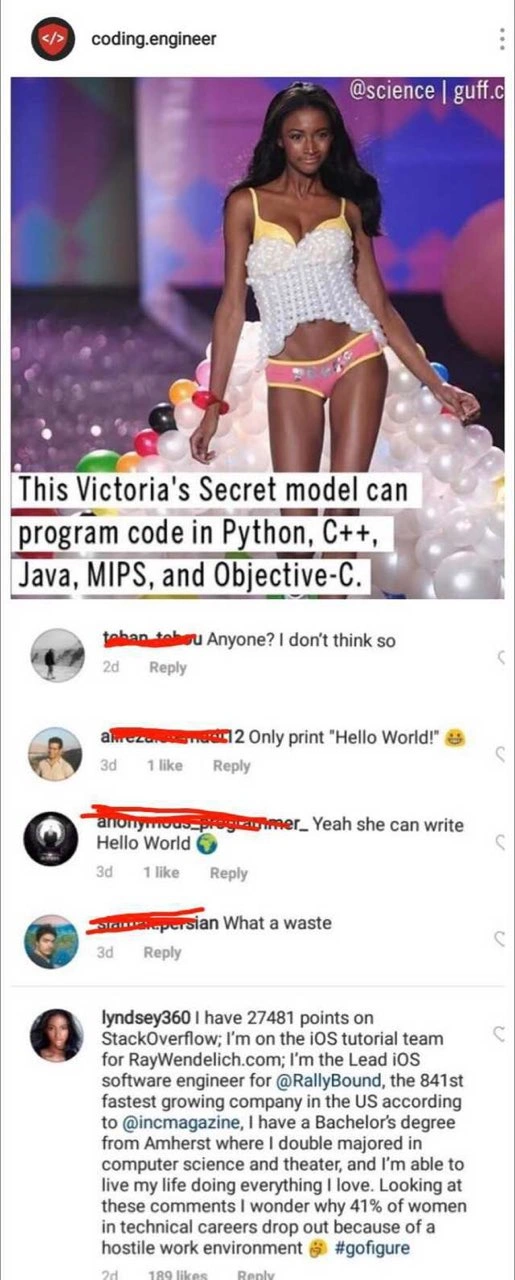
Let’s break down the elements and terms in this meme, especially for newer developers or those not deep in tech culture. First, the meme setup: it’s an Instagram post with a striking image – a Victoria’s Secret model on a runway, decked out in pastel lingerie and balloon-like accessories. This image is deliberately chosen to shatter the stereotype of what a programmer “looks like.” The text on the image claims this model can code in multiple programming languages: Python, C++, Java, MIPS, and Objective-C. For a junior developer, that list might sound both impressive and a bit random, so here’s context:

  • Python is a high-level, beginner-friendly programming language known for its simple, readable syntax. You use Python for everything from web development to data analysis and scripting. If you’ve just started coding, there’s a good chance Python might be one of the first languages you encounter because it lets you write something useful with very little code.

  • C++ is a lower-level, compiled language; it’s like a more powerful but complex sibling of C. C++ is used in performance-critical applications (game engines, certain parts of operating systems, etc.). It introduces concepts like manual memory management and pointers, which are a step up in difficulty. Hearing that someone codes in C++ suggests they’re familiar with more advanced programming concepts and aren’t afraid to get their hands dirty with the machine’s inner workings.

  • Java is a very popular object-oriented language, often used in large enterprise applications, Android app development, and anywhere reliability and cross-platform consistency are important. It runs on the Java Virtual Machine (JVM), meaning Java programs are compiled to bytecode that runs on any machine with a JVM. For many people, Java is a language they learn in school or in their early career, known for its verbose syntax but strong portability and performance.

  • MIPS refers to MIPS assembly language, which is a low-level programming language closer to the hardware. Assembly languages like MIPS are human-readable representations of the actual instructions that a CPU executes. If you write MIPS code, you’re controlling the computer at the architecture level, dealing with registers and memory addresses directly. Many computer science programs teach MIPS or a similar assembly language in courses about computer architecture so students understand how high-level code translates into machine operations. The presence of MIPS on her skill list means she’s not just doing high-level app coding; she’s also acquainted with how computers work under the hood (that’s a clue she probably had formal CS training).

  • Objective-C is an older programming language that was the primary way to write iOS applications (for iPhone/iPad) before Swift came around (Swift was introduced by Apple in 2014). Objective-C combines C with a Smalltalk-style messaging syntax. It’s known for its quirky syntax (with lots of square brackets for method calls) and was notorious for manual memory management before Apple added a system called ARC (Automatic Reference Counting). If someone knows Objective-C, it usually means they’ve been involved in iPhone or Mac development, or they maintained legacy code for Apple platforms. It’s not as commonly learned today by newbies (who often jump straight to Swift), so mentioning Objective-C signals she’s an experienced iOS developer.

Listing all those languages is meant to show that this person is a polyglot programmer – comfortable across various domains of coding. To a newcomer, that’s impressive: it’s like saying someone speaks English, Spanish, Mandarin, Russian, and Swahili fluently. It immediately counters the naive assumption that “she can’t really code.” If she genuinely knows all these, she’s well beyond “beginner” in programming.

Now, the comments in the meme are typical troll responses. Let’s decode a few: one user says, “Only print ‘Hello World!’ 😅” and another echoes, “Yeah she can write Hello World 🌍”. “Hello World” is the canonical simple program people use when learning a new language. For example, in Python it’s as easy as:

# Python Hello World
print("Hello, World!")

In C++ it’s a bit more involved:

// C++ Hello World
#include <iostream>
int main() {
    std::cout << "Hello, World!" << std::endl;
    return 0;
}

No matter the language, printing or displaying “Hello, World!” is usually the first thing you learn to do. It’s the programming equivalent of learning to say “Hola” or “Bonjour” on day one of a language class. So when the commenters sneer that she can “only” do that, they’re mocking her by implying she is a total novice who merely learned the most basic thing by rote. It’s like telling a concert pianist, “Sure, you can play ‘Chopsticks’ on the piano, big deal.” It’s rude and dismissive. This meme highlights that kind of gatekeeping behavior. Gatekeeping in tech often means setting an arbitrary bar for what makes someone a “real programmer” and excluding those who don’t fit a narrow mold. Here the gatekeepers assume that a lingerie model couldn’t possibly understand coding beyond a toy example.

Another commenter writes, “What a waste.” That one’s a bit more openly nasty – implying that it’s a waste for someone attractive or successful in modeling to also engage in programming, or perhaps that it’s a waste of time to claim she codes because they don’t believe she really does. Either interpretation is negative: it either means “what a waste of her modeling fame to bother with code” or “what a waste of our attention, as if she could code.” It’s an example of outright sexism_in_tech – the attitude that a woman (especially one in a feminine or glamorous field) doesn’t belong in software engineering.

Now, the knockout blow in the meme is the long reply by user lyndsey360. This appears to be the model herself responding. In her comment, she lists several notable accomplishments and credentials:

  • She has 27,481 points on Stack Overflow. Stack Overflow, if you haven’t used it, is a Q&A site where developers ask and answer programming questions. When you contribute a good answer and the community upvotes it, you earn reputation points. Crossing even a few thousand points is an achievement; having 27k+ points means she has likely answered hundreds of questions and helped a lot of people. It’s a strong indicator that she knows what she’s talking about. For context, many professional developers lurk on Stack Overflow for answers, but not all actively answer questions or accumulate high rep. So a 27k rep places her in the upper tier of helpful community members. This is a way of saying, “I don’t just claim I can code – the developer community has recognized my expertise.”

  • She’s on the iOS tutorial team for RayWenderlich.com. Ray Wenderlich (now the site is called Kodeco) is a well-known resource for mobile developers, especially those working on iPhone and iPad apps. They publish tutorials, books, and videos on how to develop apps. Being on the tutorial team means she helps write or review those learning materials. In other words, she’s teaching others how to code for iOS. For a junior dev, this is like finding out that person who everyone thought was a newbie is actually one of the teachers behind the scenes. It’s a huge credibility boost: she’s not just using a programming language, she’s guiding others in it.

  • She’s the Lead iOS software engineer at RallyBound. A “Lead engineer” title implies she’s in charge of significant projects or a team of developers at her company. RallyBound being noted as “the 841st fastest growing company in the US according to Inc Magazine” is thrown in to underscore that this isn’t a tiny no-name startup, but a company on a national growth list. It’s a way of saying her job is legit and high-impact. For someone early in their career, imagine being the lead developer on a popular app or at a notable tech company – it’s a big responsibility and accomplishment.

  • She has a Bachelor’s degree from Amherst College with a double major in computer science and theater. Amherst is a prestigious liberal arts college. Double majoring means she completed two sets of degree requirements. Balancing CS (which involves a lot of math, programming, and engineering courses) with Theater (creative, performance, and humanities courses) shows she’s both technically and artistically inclined. For a new developer, it’s important to note that computer science degrees are rigorous; doing that while also pursuing theater suggests exceptional time management and passion. It also busts the myth that someone can’t be into arts and science – she literally studied both at a high level.

  • She says she’s “able to live my life doing everything I love.” This line emphasizes that she hasn’t had to choose between being a model, an engineer, or a theater enthusiast – she’s combining her talents. This is a direct counter to the “what a waste” comment. Rather than it being a waste, it’s actually a success story of multi-talented career design.

  • Finally, she cites the statistic: “Looking at these comments I wonder why 41% of women in technical careers drop out because of a hostile work environment 🤔 #gofigure.” This stat – 41% – is often discussed in diversity and inclusion conversations. It refers to studies that found a large percentage of women in tech eventually leave the field (much higher than the dropout rate for men), and one of the top reasons given is the unwelcoming or hostile culture, not inability or lack of interest. The “hostile work environment” can include everything from outright harassment to subtle WorkplaceCulture issues like constantly being underestimated, passed over, or having to prove oneself repeatedly. By quoting that stat, she’s basically saying: “Gee, with comments like these, it’s not surprising almost half of women walk away from tech.” The hashtag #gofigure at the end is a bit sarcastic – it’s like saying “who would’ve guessed? (Obviously, we all can figure why).”

For a junior developer or someone new to the industry, this meme is a crash course in some unfortunate realities of tech culture. DeveloperHumor isn’t always just silly code jokes; sometimes it highlights real biases or problems by presenting them in a stark, meme-sized nugget. Here we see TechIndustryIrony: an industry that prides itself on logic and skill can sometimes be very illogical and prejudiced about who has skill. GatekeepingInTech is when individuals act like bouncers at the club of programming, setting arbitrary tests (like “write a real program, not just Hello World”) or stereotypes you must pass to be accepted. It’s often seen on internet forums, comments sections, or even in interviews, unfortunately. Recognizing it is the first step for a new developer to not be discouraged by it.

In simpler terms: the meme is telling a mini-story. A talented software engineer also happens to be a fashion model, but some people can’t wrap their heads around that combination and make fun of her, assuming she’s dumb. Then she responds with basically her tech résumé and a pointed fact about how their attitude contributes to women leaving the field. The “joke” exposes the trolls as ignorant, and it educates the reader at the same time. If you’re new in the field, take this as a lesson that coding skill isn’t something you can gauge from stereotypes. Also, StackOverflow rep is a thing – a very tangible (if imperfect) indicator of peer-acknowledged expertise – and 27k is seriously high! And yes, even a single comment on social media can encapsulate issues you might encounter in your career: skepticism because of who you are, and the importance of standing your ground with facts and confidence.

Level 3: Beauty is Not a Bug

At first glance, this meme sets up a clash between glamour and code. We see a Victoria’s Secret model on the runway with a caption bragging she can program in Python, C++, Java, MIPS, and Objective-C. The Instagram comments below reek of classic GatekeepingInTech: a series of jeers doubting her skills—“Only print Hello World!” and “What a waste.” These commenters assume that because she looks like a fashion model, there’s no way she’s a real developer. It’s a textbook case of DeveloperStereotypes colliding with reality. Experienced engineers recognize this absurd scenario immediately. We’ve sat through enough misguided DeveloperCommunity attitudes to know that appearance has zero correlation with programming talent. Here, the joke’s on the cynics: their smug disbelief is so out-of-touch that it becomes laughable, especially when the final comment drops a massive truth bomb.

What makes this funny (and painful) for senior devs is the stark TechIndustryIrony. The trolls in the comments reach for the lowest-effort taunt in programming: the “Hello World” trope. Every coder knows Hello World is usually the first, simplest program you write in any language. By sneering that she can “only print Hello World,” they imply she’s just a beginner who memorized a trivial example. It’s the same tired gatekeeping that says if you don’t fit my narrow image of a coder, you must be a fraud. Seasoned developers have seen this movie before: someone (usually a loud brogrammer) demands “proof” of a newcomer’s abilities, only to be floored when proven wrong. The humor is in how spectacularly these commenters misjudged the situation. The final response by lyndsey360 (who is actually the model-coder herself, Lyndsey Scott) is the ultimate clapback. She itemizes her credentials like an expert witness testifying in the Court of Code: 27,481 StackOverflow points (that’s a huge reputation score on the most famous programming Q&A site), membership on a well-known iOS tutorial team, Lead iOS engineer position at a fast-growing company, a CS degree from Amherst plus a theater degree, and a life filled with work she loves. It’s a mic-drop moment: she basically says “I’ve compiled far more impressive things than you can imagine.” The comment even cites a statistic – 41% of women in tech leave because of hostile environments – calling out the ugly truth behind those snide remarks. That turns the meme from a simple roast into a pointed critique of WorkplaceCulture and sexism in tech. Senior folks reading this are nodding along because we know that culture too well. The humor has layers: it’s satisfying to see trolls schooled with facts, but it’s also darkly funny (in a cringey way) that such schooling is needed at all in 2019.

Behind the laughs is a real industry lesson. The sexism_in_tech shown here isn’t just hypothetical – it’s a real barrier that pushes talent away. Those commenters exemplify the “bro culture” that treats programming as an exclusive club for stereotypical nerdy guys. For decades, this attitude has been the source of unwelcoming jokes, doubts, and condescension toward anyone who doesn’t match the expected profile (be it women, people of color, or even just outgoing personalities). The veteran engineers among us remember that computing wasn’t always a boys’ club: back in the mid-20th century, many of the earliest programmers were women, and DeveloperCommunities only later evolved the toxic macho atmosphere as tech gained prestige (fun fact: the term "computer" originally referred to women who manually computed equations). So this meme also hints at that sad historical flip – from Ada Lovelace and Grace Hopper to today’s need for hashtags like #WomenInSTEM to remind folks that yes, women belong here. The victorias_secret_coder_meme shows how far we still have to go. The irony is rich: a field built on logic and facts still struggles with illogical biases. The final commenter’s accomplishments are objectively stellar, yet she had to prove herself in a casual Instagram thread because a few guys defaulted to “pretty girl can’t code.” That scenario is all too familiar to senior devs who have championed diversity or mentored juniors from underrepresented groups. It’s both gratifying and frustrating: gratifying to see ignorance shut down, frustrating that it keeps popping up.

In true engineer fashion, Lyndsey’s rebuttal uses data and concrete achievements as ammo. StackOverflow reputation is a particularly clever metric to flaunt – it’s like street cred in the coding world. A 27k rep means she has answered many questions to help other developers, earning upvotes from her peers. That’s not something you get by just printing "Hello, World!" a couple of times; it reflects deep knowledge and a willingness to contribute. Mentioning Ray Wenderlich’s iOS tutorial team signals that she’s not just consuming knowledge, she’s teaching it – shaping the very learning resources other devs rely on. And being a Lead iOS engineer at a high-growth startup (one recognized by Inc. Magazine no less) tells any senior engineer that she’s leading teams and shipping real products at scale. The double major in CS and theater might seem like an odd combo to the trolls, but any experienced dev will see it and think: Wow, strong technical foundation and communication/creative skills – no wonder she excels. It’s a one-two punch that dismantles the notion that she’s some dilettante who only learned a few buzzwords. As for the “what a waste” comment – implying that her modeling success somehow negates her coding talent – every senior dev with a sense of irony cringes at that. That logic doesn’t compile. Why can’t someone be great at two things? It’s like saying a Swiss Army knife is useless because it’s not just a knife. In reality, being multifaceted is often an asset in engineering: creativity, empathy, and diverse experiences lead to better problem-solving. The DeveloperCommunity loses out when it discourages people with different backgrounds. The meme drives that home by highlighting a worst-case example of how talented folks (especially women) are driven away.

Ultimately, this meme resonates in senior engineering circles because it condenses a whole saga of tech culture into one Instagram screencap. It’s got the blatant GatekeepingInTech, the undermining of achievements (“anyone? I don’t think so”), the trivialization of skills (“Only print Hello World 😂”), and the casual sexism (“Yeah she can write Hello World 🌍” as if that’s all). Then it flips the script with an evidence-based smackdown and a sobering statistic that forces everyone to confront the problem. The humor isn’t just in the absurdity of gatekeeping a Victoria’s Secret coder – it’s also in the poetic justice. The trolls accidentally summoned a senior engineer’s worst nightmare: someone who actually knows what they’re doing and won’t put up with nonsense. It’s the kind of post you share in Slack with the caption, “TechIndustryIrony at its finest.” Experienced devs appreciate the nuance: we’re laughing at the trolls’ ignorance, cheering for the well-qualified heroine, and shaking our heads that this WorkplaceCulture hostility still needs calling out. In a way, this meme is both a roast and a rallying cry: roasting the narrow-minded gatekeepers, and rallying the community to say “enough – coding is for anyone willing to put in the effort, whether they’re in hoodies or high heels.”

Description

A screenshot of an Instagram post from the account 'coding.engineer'. The top half features a picture of Victoria's Secret model Lyndsey Scott on a runway, with overlaid text stating, 'This Victoria's Secret model can program code in Python, C++, Java, MIPS, and Objective-C.' The bottom half displays a series of comments. The initial comments are dismissive and sexist, such as 'Only print "Hello World!"' and 'What a waste.' The final, powerful comment is a direct reply from Lyndsey Scott herself (handle lyndsey360), who calmly lists her extensive credentials: high StackOverflow reputation, being on the RayWenderlich.com iOS tutorial team, serving as the Lead iOS software engineer for a fast-growing company, and holding a double major in computer science and theater from Amherst. She concludes, 'Looking at these comments I wonder why 41% of women in technical careers drop out because of a hostile work environment 🤔 #gofigure.' The meme is a stark illustration of the prejudice and stereotypes successful women in technology face, and it highlights the cultural issues that contribute to a lack of diversity in the field

Comments

7
Anonymous ★ Top Pick Some devs can't fix a simple bug in their own logic that throws an `UnsupportedOperationException` whenever they encounter a woman who is `instanceof Engineer`
  1. Anonymous ★ Top Pick

    Some devs can't fix a simple bug in their own logic that throws an `UnsupportedOperationException` whenever they encounter a woman who is `instanceof Engineer`

  2. Anonymous

    The real vulnerability here isn’t her MIPS skills - it’s the bro-culture buffer overflow every time a résumé comes with both 27k rep and a fashion week photo

  3. Anonymous

    The same guys who mock her for "only printing Hello World" are the ones who've been copy-pasting that same Stack Overflow answer for the last decade and still can't explain why it works

  4. Anonymous

    When your Stack Overflow reputation has more points than most people's GitHub star count, but you still get asked if you can do more than print 'Hello World' because you don't fit the hoodie-wearing stereotype. Turns out the real bug in tech isn't in the codebase - it's in the pattern matching algorithm some developers use to identify 'real' engineers. Maybe we need to refactor our industry's type system to accept that competence doesn't inherit from appearance

  5. Anonymous

    The comment section tried type inference: Person -> 'HelloWorldOnly'; runtime cast threw SeniorIOSDevException - with a stack trace of 27,481 SO rep, shipped apps, and a pinch of MIPS

  6. Anonymous

    Amazing how the 'she can only print Hello World' crowd ships a 700k line Objective-C view controller and still needs StackOverflow to remember selector syntax

  7. Anonymous

    Polyglot Hello Worlds in five langs? Cute. Try scaling that to a monolith where MIPS legacy won't stop 'growing only' in incident volume

Use J and K for navigation