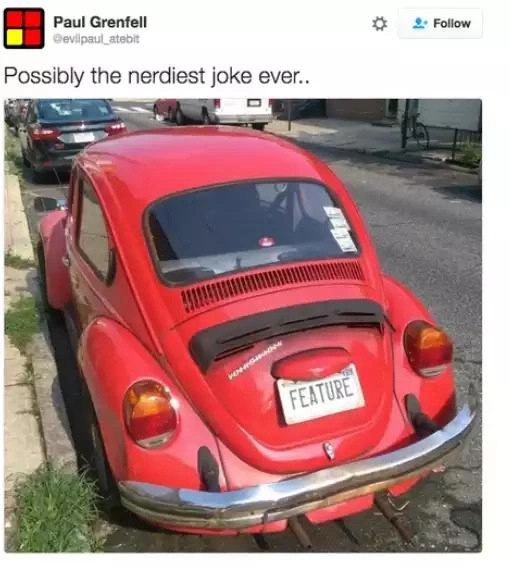
Volkswagen “Bug” with FEATURE plate - classic dev punch-line in the wild
Why is this Bugs meme funny?
Level 1: I Meant To Do That
Imagine you’re drawing a picture and you accidentally spill a blob of red paint on the paper. Uh-oh! But instead of calling it a mistake, you smile and say, “I meant to do that — it’s a special sun in the sky!” You’ve just turned your oopsie into a feature of your artwork. In simple terms, that’s the whole joke here: taking something that went wrong (a bug) and pretending it was supposed to happen (a feature). The funny car is like if a ladybug could talk and said, “I’m not an accident, I’m a design!” It’s silly because we know a mistake is usually just a mistake. But calling a mistake a “feature” is a way to laugh it off. So the red “Bug” car with the “FEATURE” name tag is basically saying, “I’m not a goof-up, I’m fancy on purpose!” And that playful little lie is what makes all the programmers laugh.
Level 2: FEATURE on a Bug
So, why is a red VW Beetle with a “FEATURE” plate so amusing to programmers? To unpack the joke, let’s break down the key terms and references:
Bug (software bug): In developer lingo, a bug is an error or flaw in a program that causes something to go wrong. For example, if clicking a button in an app causes it to freeze, that’s a bug. (Fun fact: the term “bug” originally got popular after engineers found a real moth inside a computer in 1947, causing a malfunction!) In everyday terms, a bug is like a mistake in the code – the software isn’t behaving as it should. Programmers track and fix bugs to make the software work correctly.
Feature (software feature): A feature is a planned piece of functionality, an enhancement, or a cool new thing the software is supposed to do. If a developer adds a dark mode to your favorite website, that’s a new feature. Features are intentional and usually documented. They’re the things users actually want or the selling points of the application.
Now, in software development, there’s a well-known inside joke: “It’s not a bug, it’s a feature.” This is a cheeky phrase devs use when something in the software behaves oddly or wrong, but they playfully pretend it was intentional. Essentially, they’re saying: “We didn’t mess up; we meant to do that!” It’s a sarcastic way to deflect blame or just have a laugh when a bug is discovered. For instance, imagine a game where an enemy suddenly freezes — a developer might joke, “That’s a feature to give players a breather,” rather than admitting the enemy AI got stuck. It’s developer humor at its finest: turn the mistake into a pretend feature.
Now let’s connect this to the car in the meme. The car in the photo is a Volkswagen Beetle, a very famous old-style car that many people simply call a “VW Bug.” (Yes, just like a software bug, the car’s nickname is literally “Bug” – how perfect is that?) The owner of this particular Beetle has a custom license plate that says “FEATURE.” License plates are the tags on a car, and depending on the country or state, car owners can sometimes pay extra to choose a custom word or phrase. Here, someone deliberately chose FEATURE as their plate. So, this person essentially labeled their Bug as a Feature! It’s a direct play on the phrase “It’s not a bug, it’s a feature.” The car is a Bug, and they’re tongue-in-cheek declaring it to be a Feature.
For a junior developer or someone new to coding, this is like a perfect visual pun combining cars and code. In software projects (maybe you’ve seen this in issue tracking tools like Jira or GitHub issues), every problem or suggestion gets classified either as a bug (something broken) or a feature request (a new thing to add). There’s often debate about which is which. Sometimes users report something and the dev team says, “Actually, that’s how it’s supposed to work,” meaning they see it as a feature, not a bug. This can be funny or frustrating, depending on the situation. The meme plays on exactly that tension: calling a Bug a Feature.
Think of it this way: imagine a scenario in a software team – a tester finds an odd behavior and asks, “Is this a bug or a feature?” If the developers cheekily reply, “Of course it’s a feature!” then everyone might crack a smile, because often that reply is a running joke. It’s a way to lighten the mood around the never-ending bug fixes. Developer communities love this kind of joke because it’s super relatable humor; even if you’re new, you’ll soon encounter a senior dev joking that some glitch is “just a feature.” It’s practically a rite of passage in learning software development: the first time you report something and your teammate winks and says that classic line.
The Volkswagen Beetle with a FEATURE plate is like a billboard for that joke. Even outside a computer screen, out on a normal street, the universe (or rather, a witty car owner) has created a perfect license plate joke for developers. The car itself (the Bug) represents a software bug, and the plate’s text (FEATURE) declares it to be a feature. It’s such a straightforward but brilliant visual metaphor that even a code newbie can appreciate it after a moment’s thought. The reason Paul Grenfell (the person in the tweet) called it “the nerdiest joke ever” is because you’d have to know the software phrase to get why it’s funny. That makes it a bit of an inside joke: if you’re part of the programming or tech crowd, you instantly recognize the classic “not a bug, a feature” line and you’ll probably laugh when you see this car. If you’re not familiar with that phrase, you might just see a red Beetle with a weird plate and not think much of it.
In summary, for a junior dev or someone learning tech, this meme is a playful introduction to a common slice of programmer culture. It teaches you about the bug vs. feature dichotomy in a humorous way. The car’s “FEATURE” plate is basically saying: “Hey, this isn’t a Bug at all – it’s something awesome and intended!” — which is exactly what a programmer might jokingly say about their code’s unexpected behavior. Once you learn the context, you’ll never forget this classic phrase, and you might even crack the same joke yourself the next time you encounter a tricky bug in your code. After all, every newbie will eventually learn that sometimes in development meetings, calling it a feature is the easiest way to stop an argument about a pesky bug!
Level 3: Working as Intended
At first glance, we see a bright red Volkswagen Beetle (a car affectionately nicknamed a "VW Bug") parked on a sunny street. What immediately grabs a developer’s attention is the car’s novelty license plate boldly reading “FEATURE” in all caps. This clever combination is a real-life embodiment of the classic software excuse: “It’s not a bug, it’s a feature.” The original tweet sharing this sight even gushed, “Possibly the nerdiest joke ever...” – and experienced engineers couldn’t agree more. It’s the kind of developer humor that makes you do a double-take and then nod in geeky appreciation.
This meme brilliantly mashes up automotive wordplay with an inside joke from dev culture. The Volkswagen “Bug” literally has a FEATURE plate, turning the well-worn bug vs feature gag into a tangible sight gag. In the software world, labeling something a feature instead of a bug is an age-old tongue-in-cheek maneuver. Seasoned devs have all been there: an unexpected behavior pops up during testing or in production, and someone quips, “Oh that? That’s a feature, not a bug!” We laugh because it hits close to home – how many times have product managers or sysadmins tried to spin a flaw as “working as intended” to avoid calling it an error? This meme takes that scenario and parks it right on the curb for everyone to see.
Underneath the humor is a nugget of truth about software development realities. Bugs (unintended errors in code) are supposed to be fixed, while features (intended enhancements) are celebrated – but in practice the lines can blur. Deadlines loom, legacy code misbehaves, and teams sometimes choose the “not a bug, won’t fix” route for minor issues. Every senior developer has witnessed a bug ticket that gets closed with a resolution like “Won’t Fix – By Design,” meaning the quirky behavior is being accepted as a feature. It’s a coping mechanism and a bit of office folklore: calling something a feature makes it feel less of a failure and more of a quirky characteristic. This meme’s FEATURE license plate is basically the physical version of marking a Jira bug as “Closed: Not a Bug.” It’s hilariously relatable because we’ve all seen software release notes where a glitch is reworded as a “known feature” or “quirk.”
To an experienced eye, the image also hints at how developer communities cherish inside jokes and shared experiences. The fact that someone went to the trouble of getting a “FEATURE” vanity plate on a VW Bug is like an easter egg for programmers driving down the street. It’s a nod to the tribe — only those in on the software joke will get why this is funny. In dev circles, there’s even a saying: “Software doesn’t have bugs, only undocumented features.” This car is practically a mascot for that exact joke. Just as a real bug (insect) famously got into an early computer and gave us the term bug, here a real Bug (car) carries the word FEATURE to flip the meaning. The owner of this car is likely a programmer or tech enthusiast who knows our communal pain and humor, proudly displaying their nerdy wit on the bumper. It’s a little piece of hacker culture out in the wild, the kind of thing that would make any coder do a double take and then snap a photo for Reddit or Twitter. Seeing a “FEATURE” Bug on the street turns an abstract programming quip into a concrete tableau — a street spot meme that perfectly captures the eternal bug vs feature debate with one visual pun.
In true developer fashion, this joke also pokes at the way organizations handle bugs. Often, whether something gets labeled a bug or a feature can be as much about politics or perception as about code. If a client finds an odd behavior but the dev team can’t fix it in time, sometimes the tongue-in-cheek response is, “Actually, that’s an intended feature.” Everyone involved knows it’s a thin excuse, but it lightens the mood. This tactic has saved many a programmer’s pride in front of non-technical stakeholders. After all, nobody likes admitting their code has bugs, but touting a mysterious feature sounds much better! The humorous truth running through this meme is that in software development, reality is often bent by clever labeling. A car called a “Bug” proudly wearing a “FEATURE” label mirrors that exact bending of reality. It’s as if the car itself is saying, “I’m not an error on wheels; I’m a value-added functionality!”
Developers with years of experience are likely chuckling at this image because it satirizes a universal scenario in our field. We’ve all sat through that bug triage meeting or code review where someone argued that an obvious flaw was “intended behavior.” Perhaps a web page’s weird glitch gets rationalized as “easter egg feature,” or a slow-loading screen is spun as “gives users time to reflect.” The humor is both cathartic and self-deprecating — we laugh at ourselves for the times we’ve stretched the definition of feature to cover a mistake. This meme resonates particularly in dev communities because it reminds us of those war stories where a bug lived on in production so long that it practically became a feature users depended on. (There are even real cases in tech history, like a spreadsheet “bug” in early software that had to be kept because customers relied on it — turning a bug into a de facto feature!).
To highlight how developers jokingly rebrand bugs as features, imagine the kind of comment you might find in a code review diff when someone’s feeling witty:
- // BUG: Program crashes on invalid input
+ // FEATURE: Program self-terminates on invalid input for safety
Instead of admitting the program crashes (bug!), the revised “feature” comment claims the program is proactively quitting to protect the user, as if it were intentional design. This tongue-in-cheek rewrite is exactly what the FEATURE license plate on the Bug is doing: re-framing a problem as a feature. Seasoned engineers appreciate this dark art of spin-doctoring in software. It’s funny because it’s true — calling a crash a “self-termination safety feature” is about as flimsy (and humorous) as calling an automotive Beetle a Feature. In both cases, we’re witnessing the age-old engineering habit of using humor to soften the blow of imperfection.
In summary, the meme’s punchline lands so well with veteran developers because it’s a perfect storm of relatable content: a literal Bug labeled as a Feature, combining wordplay with the shared understanding that half the battle in software is deciding whether something is a defect to fix or a quirk to document. It’s a playful reminder that in the tech world, just like on that car, sometimes the bug is the feature.
Description
Screenshot of a tweet by Paul Grenfell (@evilpaul_atebit) that reads: “Possibly the nerdiest joke ever..”. Below the tweet is a photo of a bright-red, classic Volkswagen Beetle parked at the curb on a sunny residential street. The rear of the car fills most of the frame; visible chrome bumper, round tail-lights, and air-cooling vents on the engine lid. The novelty license plate on the Beetle unmistakably says “FEATURE” in all capital letters. The humor relies on the well-known software engineering line “It’s not a bug, it’s a feature,” exploiting the fact that this particular car model is colloquially called a “Bug.” The meme playfully contrasts software defects versus intended functionality, making it instantly relatable to developers who spend their days triaging bugs and debating whether unexpected behavior is actually ‘working as designed’
Comments
6Comment deleted
Saw the PM’s ride today: a Bug with a “FEATURE” plate - suddenly their habit of resolving Sev-1 tickets as “roadmap-aligned behavior” makes perfect sense
After 20 years in tech, I've finally found the one bug that actually deserves to be called a feature - and it even comes with its own rollback mechanism (reverse gear) and crash recovery system (bumpers)
When your feature branch has been running in production for so long it's now a classic - complete with vintage plates and a few dents from hotfixes. At least it's not still called 'feature/temp-fix-will-delete-later' after three years of faithful service
Enterprise triage in one image: rename the bug to “FEATURE,” close as Won’t Fix, update the spec, declare GA, and watch the SLO dashboard stay green
A Bug with a “FEATURE” plate: the PM’s preferred Sev1 remediation - reclassification. RCA: requirements
The ultimate legacy refactor: promote Bug to Feature, deploy to streets, and never patch again