Skip to content
DevMeme
4360 of 7435
Image not processed
Post #4767, on Aug 11, 2022 in TG

Image not processed

Why is this developer meme funny?

Level 1: Waiting for a Miracle

Imagine you set up a game that you’ll play forever and it only has one way to win: if something almost impossible happens. For example, you say, “I’ll stop dancing only when a unicorn walks into my room.” Since unicorns aren’t real, you’re basically going to dance forever and never stop. This code is doing the same kind of silly thing. It’s stuck in an endless loop, and it will only stop and say "cosmic ray detected." if a tiny magical event from outer space occurs (like a little space particle zapping the computer in just the right way). In real life, that event is so unlikely that it’s pretty much like waiting for pigs to fly or a unicorn to show up.

The reason this is funny is because it’s obviously a ridiculous plan. We know the program will never actually detect a cosmic ray this way, just like we know you’ll never meet a real unicorn. The code is basically waiting for a miracle to happen. It makes us laugh because it’s taking an everyday programming situation (an infinite loop bug) and giving it an absurd twist (blaming or waiting for cosmic rays). Even if you don’t understand all the tech details, you can appreciate that this “cosmic ray detector” will never succeed. It’s like a joke promise: “I’ll do my homework when the stars magically align!” — in other words, not gonna happen. The humor is in how overly dramatic and improbable it is, which even a non-programmer can find silly. So, this meme is funny because it shows a coder waiting forever for an almost impossible event, all for the sake of a punchline: detecting a cosmic ray that will probably never come.

Level 2: Infinite Loop, False Hope

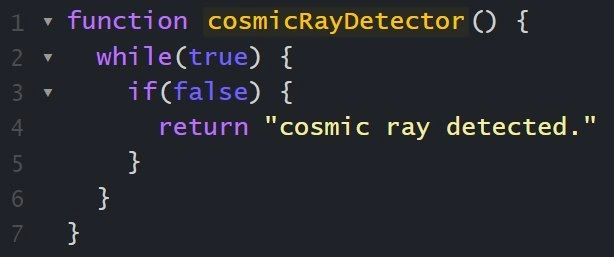
Let’s break down what’s actually happening in this tiny piece of code. It defines a function in JavaScript (as the syntax coloring suggests) called cosmicRayDetector(). Inside the function, the code looks like this:

function cosmicRayDetector() {
    while (true) {
        if (false) {
            return "cosmic ray detected.";  // This line never runs under normal conditions
        }
    }
}

Here’s what each part means in simpler terms:

  • while(true) { ... } – This is an infinite loop. true is a condition that never turns false, so the loop will run forever unless something inside it makes the function stop (like a break or a return). In this case, there's no regular break condition, which means once this loop starts, it’s intended to spin endlessly.
  • if (false) { ... } – This is a conditional check that will always fail. The condition literally is the boolean value false, which means the code inside the curly braces { } will never execute during normal operation. It’s like a permanently closed door; the program will never go through that door because the key (false) is always saying “don’t enter.”
  • return "cosmic ray detected." – This line would make the function stop and output the string "cosmic ray detected.". However, because it’s inside that if(false) block, the function can only reach this return if the if condition somehow becomes true. Given that the condition is literally false, there is no logical path for the code to ever hit the return. So under ordinary circumstances, this function will loop forever and never return anything.

So why put a return in an unreachable if(false)? This is where the joke comes in: the only way the code could ever execute that return is if something utterly bizarre happens – like a random bit flip in the computer’s memory. A bit flip means a single binary digit (0 or 1) spontaneously changes to the opposite value. In this context, imagine the stored value for false (which might be represented as 0 in the system) got flipped to 1 by some external influence. Suddenly if(false) would behave as if(true) because the bit that held the constant false became true! One fanciful cause for such a flip is a stray cosmic ray from outer space hitting the hardware. That’s why the function is humorously named cosmicRayDetector() – it’s implying “we'll know a cosmic ray hit the computer if this function actually returns.” It’s a parody of a detector, because the normal way to detect cosmic rays would be with special sensors, not a piece of code waiting on an impossible condition.

This scenario is not a typical software bug at all; it’s showcasing an almost mythical kind of bug. In programming, most bugs come from human mistakes in code, but here the imagined bug stems from physics messing with us. If cosmicRayDetector() ever did return "cosmic ray detected.", it would mean something went wrong outside the program’s logic (like a memory error or cosmic interference). Developers have a term for bugs that seem to defy explanation and can’t be consistently reproduced: Heisenbug. A Heisenbug might vanish or change when you try to debug it, making it feel like it’s influenced by some unpredictable external force. A cosmic-ray-induced error is the ultimate example of that – you can’t replicate it on demand, and adding logging or debugging won’t help because it’s not caused by the code itself.

Importantly, in real life, computers do occasionally experience random single-bit errors (especially older systems or those without protective memory). But it’s extremely rare in a personal computer – so rare that we joke about it rather than plan for it. Hardware-induced bugs from cosmic rays are more a concern in supercomputing, servers, or avionics. Regular developers don’t actually write code like this to catch cosmic rays! This meme is poking fun at the idea of waiting for an impossible event. It’s like a programmer’s tall tale or an inside joke: “Our program will only break out of this loop when the universe literally glitches in our favor.” In terms of good coding practice, relying on an infinite loop with a never-true condition is obviously a bad design – it’s the opposite of robust error handling. In fact, you could say this is defensive programming taken to a ridiculous extreme: the coder prepared for an event that basically never occurs.

To put it simply, this code will run forever and do nothing, unless a one-in-a-billion cosmic occurrence flips that false to true by pure chance. The humor and insight for a junior developer here is understanding both the code constructs and the absurdity:

  • Infinite loop: generally something to avoid unless absolutely needed, because it can freeze your program.
  • Always-false condition: means the code inside is dead code (it will never run). Having a return inside an always-false if makes the function effectively non-functional.
  • Cosmic ray bit flip: a playful reference to real-world physics affecting computers, highlighting that computers, though deterministic machines, still operate in a physical world where random things (like radiation) can happen.

Once you grasp all that, you see why this is funny to developers: it’s a perfect storm of an impossible loop, an unreachable output, and a totally absurd rationale for how it could work. It’s both a bit of educational humor (reminding us that hardware issues exist) and a wink at how far we’ll go to explain an inexplicable bug.

Level 3: Heisenbug Detector

For seasoned developers, this snippet immediately evokes the legendary Heisenbug – those bugs that seem to disappear or change behavior when you try to investigate them. We often joke that when a bug defies all explanation, “maybe a cosmic ray hit the computer” is as good a guess as any. This code takes that debugging quip and turns it into a literal program. The function cosmicRayDetector() sets up an endless loop (while(true)) and hides the only return inside an if(false) block. In normal operation, if(false) will never execute its body. It’s a classic example of an impossible condition guarding an unreachable piece of code. So if, against all odds, the return "cosmic ray detected." ever runs, it implies something nearly supernatural occurred – essentially using a one-in-a-billion hardware glitch as a signal. It’s as if the developer said, “I have no logical way to break out of this loop, so I’ll wait for the universe to break it for me.”

This resonates with experienced engineers because it mocks the experience of chasing down an unusual bug. There are times in debugging when every logical cause is ruled out, and one is left baffled, half-jokingly blaming cosmic radiation or gremlins in the hardware. Real bugs in software usually have a logical explanation (a missed null check, an off-by-one error, a race condition, etc.), but Heisenbugs are the ones that elude explanation, coming and going unpredictably. By explicitly coding if(false) (which can never be true by design), the snippet exaggerates that idea: any occurrence of the bug (i.e., reaching the return) would be so inexplicable that it must be something outside the system’s normal operation – like a flipped bit from a cosmic ray. It’s a brilliant bit of developer humor that turns a hardware failure into a feature: the function ostensibly "detects cosmic rays" by using an infinite loop that only breaks on a cosmic-induced anomaly.

Furthermore, this highlights a kind of defensive programming gone wrong. Generally, defensive programming involves writing code to handle unlikely errors or edge cases proactively. But here the developer defended against nothing realistic – the check if(false) is guarding a scenario that cannot happen unless our fundamental assumptions (like the reliability of boolean logic) break down. It’s a satirical nod to over-engineering and absurd safety checks. No senior dev would seriously write logic that depends on a bit flip from space; instead, this is a wry commentary on how, after exhausting all normal explanations for a bug, our minds wander to the absurd. Seasoned troubleshooters chuckle because they've been in that hopeless situation where, after eliminating the impossible, whatever remains – however improbable – must be the truth (to paraphrase Sherlock Holmes). In this case, the “truth” left on the table is literally a cosmic ray flipping a bit.

Ultimately, the humor is in the sheer absurdity and shared understanding: hardware humor about cosmic rays is a coping mechanism for the inexplicable in debugging. This “cosmicRayDetector” will almost certainly loop forever, doing nothing – but on the off chance it returns, it vindicates every joke about cosmic rays causing our production outage last night. It’s the coding equivalent of saying, “I’ll fix that bug when pigs fly.” Here, the flying pig is a high-energy particle from outer space causing an if(false) to act true. Every experienced developer recognizes the mix of frustration and amusement in that notion, which is why this meme gets a knowing, slightly exasperated laugh.

Level 4: Cosmic Bit Flip Conundrum

At the extreme end of technical humor, this code snippet plays on the concept of a single-event upset – essentially a cosmic-ray-induced bit flip. In theoretical terms, the function is leveraging a freak hardware event as its only exit condition. The if(false) creates a branch that is never supposed to execute (a literal never executing branch): by all conventional logic, it’s impossible for the code to ever reach that return statement. However, if a high-energy particle from space (a cosmic ray) were to strike a memory cell or CPU register at just the right moment, it could flip a bit and magically turn that false into true. In other words, a random cosmic particle could invert the boolean condition and allow the code to proceed to return "cosmic ray detected.". This is a tongue-in-cheek reference to a hardware-induced bug triggered by radiation – an event so rare and random that it borders on science fiction in everyday computing.

From a computer engineering standpoint, cosmic ray bit flips are a real (if uncommon) problem. They’re known as soft errors because they don’t stem from any flaw in the software or permanent hardware damage, but from transient radiation effects. For instance, a stray neutron from cosmic radiation can alter a single bit in RAM or a CPU cache, causing bizarre behavior. High-reliability systems employ safeguards against this: ECC memory (Error-Correcting Code memory) can detect and correct single-bit errors, and aerospace electronics are often radiation-hardened to withstand constant cosmic bombardment. Historically, researchers discovered in the 1970s that background cosmic rays were behind mysterious memory errors in early computers. Ever since, we've known that even our perfectly logical code isn't truly running in a perfectly controlled universe – physics can introduce a random glitch when you least expect it.

By writing while(true) { if(false) { ... } }, the code is effectively saying "loop forever until an impossible event occurs." It’s a humorous illustration of the limits of deterministic computing. Under normal circumstances, the output can never be reached – the loop is infinite and the condition is always false. Only a violation of assumptions at the hardware level (like a flipped bit or some undefined behavior) could break the loop. In a way, it’s exploiting cosmic uncertainty as a feature: a bit flip from outer space becomes the only key to unlock the return. This deep-cut joke tickles those who know their computer architecture and reliability theory: it’s a cosmic twist on how even rock-solid logic can be upended by subatomic saboteurs. The humor comes from recognizing that such a “cosmic ray detector” is both ridiculously ingenious and completely impractical. It highlights an underlying truth in computing – sometimes the universe has a say in our program’s behavior, but counting on it is, of course, absurd.

Description

This image could not be processed due to an error
Comments

7
Anonymous ★ Top Pick I'd make a joke about this image, but I can't see it. Maybe it's a 404 error?
  1. Anonymous ★ Top Pick

    I'd make a joke about this image, but I can't see it. Maybe it's a 404 error?

  2. Anonymous

    Our new cosmicRayDetector() satisfies both the zero-false-positive policy and the “don’t wake me at 3 AM” SLO - PagerDuty only fires after a bit flip has already rewritten the incident runbook

  3. Anonymous

    Finally, a monitoring solution that makes our 99.999% uptime SLA look aggressive - though I've seen production code where this would somehow still get triggered twice a week

  4. Anonymous

    This is the only acceptable use case for 'if(false)' in production code - because when you're running mission-critical systems at 35,000 feet or in orbit, you learn that 'impossible' is just a probability distribution with a very long tail. The cosmic ray that flips your bit doesn't care about your code coverage metrics or that your static analyzer flagged this as dead code. Senior engineers know: in high-reliability systems, you don't just handle the expected failures - you handle the physics-defying ones too. Though if this code ever executes, your bigger problem isn't the bug report, it's explaining to management why you need ECC memory and radiation shielding in the budget

  5. Anonymous

    SRE-grade monitoring: pages only when a single-event upset flips false to true; perfect for error budgets, disastrous for incident response

  6. Anonymous

    The ultimate SRE monitor: zero false positives, eternally awaiting that muon to flip the bit

  7. Anonymous

    CosmicRayDetector(): if(false) inside while(true). If it returns, physics flipped a bit and your ECC budget didn’t; root cause: the universe

Use J and K for navigation