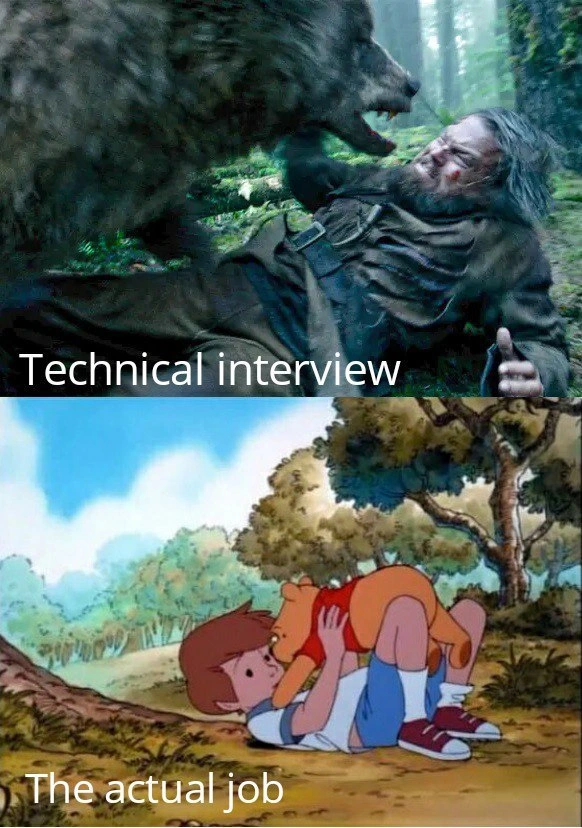
Bear-attack interview versus cuddly job: hiring process in a nutshell
Why is this Interviews meme funny?
Level 1: Bear Attack vs Bear Hug
Imagine someone made you fight a wild bear before they let you have a job where you spend your day hugging a teddy bear. Sounds silly, right? The top of the meme is like the scary test – it’s big, loud, and feels dangerous (just like wrestling a wild bear). The bottom of the meme is the reward – it’s calm, safe, and friendly (like snuggling your favorite teddy bear). The joke here is that the test (interview) is much harder and scarier than the actual job! It’s funny because it’s like making you do something extreme to get to do something easy. In real life, many people feel super stressed in a coding interview (as if they’re in danger), but when they start the job, they find the work is comfortable and team-oriented (even fun, like playtime). The meme makes us laugh by showing this huge contrast in a very simple way: terrifying challenge up front, cozy reality afterward. It’s basically saying the hiring process can feel like a fierce battle, even though the daily job turns out to be as gentle as a hug.
Level 2: Gentle Day Job
This meme jokes about the difference between technical interviews and the actual software development job. In the tech hiring process, a technical interview is usually a special test for candidates. Companies often ask you to solve programming puzzles or algorithms on the spot, sometimes by writing code on a whiteboard or in a simple online editor. These are called whiteboard interviews, and they’re famous (or infamous) for being tough and a bit unrealistic. For example, an interviewer might ask you to write a function that finds the shortest path in a maze or to explain how to reverse a linked list from memory. Many candidates prepare for these challenges by practicing on websites like LeetCode, which offer hundreds of algorithm questions (think of things like sorting numbers, searching through mazes or trees, dynamic programming puzzles, etc.). It’s a lot like doing brain teasers under pressure. The top panel of the meme, showing a man being attacked by a roaring bear, humorously represents just how intense and scary these technical interviews can feel. You’re in a high-pressure situation, trying to “survive” tricky questions without any help – no search engine, no team, just you and the problem. It’s not literally violent, of course, but emotion-wise, candidates often describe InterviewProcess pressure as an “all-out fight” to get the right answer. That’s why the text on that panel says “Technical interview,” matching the feeling that you’re wrestling with something formidable.
Now contrast that with the actual job. The bottom panel shows a gentle cartoon scene: Winnie-the-Pooh being warmly hugged by Christopher Robin. The caption there says “The actual job.” This is pointing out that once you get hired, the daily work of a software developer is usually much more friendly and manageable. In a real job, you rarely have to invent complex algorithms from scratch on a blank whiteboard. Instead, you might be working with a codebase (the existing collection of code for the project) that already has lots of utilities and libraries. Need to sort some data or find a route on a map? There’s probably a built-in function or an API for that, so you don’t have to write it all yourself like you did in the interview. Also, on the job you have tools: you write code in an IDE (Integrated Development Environment) or text editor that can highlight errors, and you can run and test your code to see if it works. You’re allowed (actually, encouraged!) to use the internet – searching on Google or Stack Overflow for solutions or documentation is a normal part of a developer’s day. And importantly, you have a team to help. If you get stuck, you can ask a co-worker, and you usually work together through code reviews and pair programming. All these things make the actual job environment more forgiving. It’s not a timed exam anymore; it’s more like a group project.
So the meme is funny because it’s comparing these two extremes. The “technical interview” feels like a trial by fire – you might have felt like you were wrestling a wild problem alone, heart pounding, similar to how facing a wild bear would feel! But “the actual job” often turns out to be calm and pleasant – you’re gently collaborating and doing more straightforward tasks, kind of like hugging a friendly bear (a teddy bear) in a sunny field. In real life, most programming jobs involve a lot of learning from existing code, fixing bugs, and adding small improvements gradually. It’s generally far less intense than the interview process made you think. The meme falls under tech InterviewHumor because so many developers have experienced this mismatch. We prepare for the worst during interviews (staying up studying complex algorithms, practicing coding by hand), and then once we start the job, we realize we didn’t need 90% of those whiteboard tricks in day-to-day work. It’s a light-hearted way to say: “Isn’t it ironic how the hiring process put me through something crazy, even though the job itself is pretty chill?” Anyone who’s gone through tough TechnicalInterviews and then worked in a real dev job will relate to this laughable difference.
Level 3: Whiteboard Wilderness
The meme highlights a brutal disconnect between how developers are hired and what they actually do on the job. In the top panel, a man is literally fighting off a bear – a perfect bear_attack_metaphor for the technical interview process. This isn’t just any bear attack; it evokes the infamous scene from The Revenant, capturing how a high-pressure WhiteboardInterview can feel like a life-or-death struggle. Candidates often describe these TechnicalInterviews as a survival gauntlet: you’re thrown into the wild, armed only with a marker or a shared editor, and expected to wrestle complex algorithms from scratch. No frameworks, no Google, just you versus a snarling data structure problem. It’s a core piece of modern HiringHumor because so many of us have felt that adrenaline spike of interview_pain, facing a snarling algorithmic question under the unblinking eye of an interviewer. The meme’s hiring_practice_satire lands because it exaggerates a truth every developer knows: technical interviews can feel ridiculously over-the-top compared to actual coding work.
By stark contrast, the bottom panel shows young Christopher Robin literally hugging Winnie-the-Pooh – the gentle_day_job embodied as a cuddly cartoon moment. It’s a scene of total comfort and safety, labeled “The actual job.” In real developer life, after you survive that bear of an interview, your day-to-day work might feel as cozy as a teddy bear picnic. Instead of constantly inventing new algorithms solo, you’re typically collaborating with your team, using well-established libraries, and googling errors over coffee. The interview_vs_job_gap is hilariously wide: one moment you’re optimizing a custom graph traversal on a whiteboard like it’s an Olympic sport, and the next you’re in a codebase mostly doing code reviews, writing unit tests, or tweaking UI padding. The meme nails this expectations_vs_reality_meme format – expectations set by hiring are wild and ferocious, but reality is friendly and tame. Seasoned devs smirk at this because it’s RelatableDevExperience: we’ve all known brilliant colleagues who could architect a balanced BST in an interview (fighting that bear), yet on the job they mostly adjust API endpoints or configure CI pipelines (cuddling that Pooh bear). It’s not that real development is trivial; it’s that interviews often crank the difficulty to “bear attack” mode for tasks you’ll almost never encounter under such conditions again.
Why does this happen? Partly, it’s legacy InterviewProcess culture. Tech giants popularized puzzle-like WhiteboardInterviews decades ago to test general problem-solving. Over time, it became an arms race of leetcode_vs_production_code challenges: companies ask tougher algorithm riddles, so candidates spend months grinding LeetCode problems (dynamic programming, anyone?) to survive. But once hired, developers find a supportive environment where teamwork, maintainability, and incremental progress matter far more than hacking out a perfect solution in 20 minutes. It’s a classic case of hiring expectations vs work reality. Solving a tricky Algorithm under pressure demonstrates theoretical knowledge and nerves of steel, but day-to-day coding leans on practical skills and collaborative problem-solving. The meme uses an absurd extreme (bear mauling!) to spotlight this absurdity in the HiringProcess. Even HR and engineering managers often admit the mismatch: the interview is like a filter set to “ultra-hard” to sift through many applicants, whereas the job is about steady, cooperative growth. Hence, the top panel’s gritty forest fight feels DeveloperHumor-absurd, because actual development usually isn’t a constant fight for survival – it’s more like building things with friendly bears... er, peers.
To summarize the contrast, here’s how TechnicalInterviews often differ from the actual job:
| Technical Interview (Bear Attack) | Actual Job (Pooh Hug) |
|---|---|
| Write code on a whiteboard from memory | Write code in an IDE with Google & docs |
| Emphasis on algorithm puzzles (e.g. invent a new sort) | Emphasis on maintaining & integrating (e.g. use existing sort functions) |
| Timed, high-pressure, solo performance | Slower pace, collaborative team effort |
| One-shot correctness (no errors allowed) | Iterative fixes (debugging and reviews are normal) |
| Tests theoretical knowledge (Big-O, edge cases) | Requires practical skills (reading legacy code, using frameworks) |
This stark side-by-side says it all: the interview is a bear-fight challenge, the job is more of a friendly DeveloperExperience hug. The humor works because it’s true enough to sting a bit: most of us have prepared to slay a proverbial bear (perhaps by memorizing how to invert a binary tree or calculate O(n log n) complexities) only to end up in a role where our biggest daily battle is naming variables or untangling some honey legacy code with teammates. The meme lets out a collective chuckle (and maybe a groan) at the hiring_practice_satire: it feels like being tested on wilderness survival just to sit in a cozy office and build software with friends. In short, technical interviews often channel our inner Leonardo DiCaprio fighting a bear, while the real job might channel our inner Winnie-the-Pooh happily working with his pals. The contrast is so extreme and ironic that you can’t help but laugh – it’s a bear-sized exaggeration of a very real feeling in the tech InterviewProcess.
Description
The meme is split horizontally into two panels. The top panel is a gritty live-action shot of a man on a forest floor being attacked by a roaring bear; across this panel, white sans-serif text reads "Technical interview". The bottom panel is a bright cartoon still of Christopher Robin lying on grass while happily hugging Winnie-the-Pooh, with white text at the bottom that says "The actual job". The stark visual contrast highlights how algorithm-intensive, high-pressure technical interviews can feel brutally hostile compared with the far gentler realities of everyday software engineering work. Seasoned developers will immediately recognize the satire of leetcode survival mode versus collaborative, low-stakes production coding
Comments
6Comment deleted
Interview: hand-optimise a red-black tree while a grizzly demands amortised proofs; Job: convince the 12-year-old monolith to stop logging “hunny not found” and everyone calls you a wizard
They made me implement a distributed consensus algorithm on a whiteboard, and now I spend my days arguing whether that button should be 4px or 6px from the left margin
The technical interview process: where you're expected to implement a red-black tree on a whiteboard while being mauled by algorithmic complexity, only to spend your actual job writing CRUD endpoints and attending standup meetings in your pajamas. It's the industry's way of ensuring you can survive in the wilderness of CS fundamentals you'll never use, while the real predator - production incidents at 3 AM - waits patiently in the shadows
Interview: whiteboard a lock-free skip list under a stopwatch; job: wrap a feature flag around a CRUD endpoint and negotiate an API change - proof we optimize hiring for variance, not production value
Interviews: Wrestle grizzly CAP theorem bears. Job: Cuddle legacy systems while Pooh requests 'just one more feature'
Interview: implement a lock-free queue while a grizzly quizzes your Big-O; the job: hugging Winnie-the-Monolith and toggling a feature flag until prod stops growling