Skip to content
DevMeme
3687 of 7435
Monitor Curvature: The Full Circle of Tech Evolution
Hardware Post #4026, on Dec 13, 2021 in TG

Monitor Curvature: The Full Circle of Tech Evolution

Why is this Hardware meme funny?

Level 1: Screen Hugs

Imagine you used to watch TV on a big curved glass bowl – that was normal long ago. Then screens became flat like a picture frame, which looked super sharp and modern. Now people are making screens curved inward like a giant gentle hug for your eyes. This meme jokes that in the future, the screen might even wrap all the way around you, like you’re inside a high-tech cocoon. It’s funny because it’s like we went from a big bump to flat to a big bowl. Think of it this way: first your screen was like a balloon sticking out, then it was a flat poster, and now it’s like the inside of a curved fishbowl. The meme is using these shapes to make us laugh at how each new generation of monitors changes shape – maybe one day your entire room will be a screen! The core joke is that developers (people who write computer code) keep getting bigger and curvier screens to work on, to the point where the screen might completely surround them in the future. It’s a silly way to show how technology changes over time, sometimes looping back in unexpected ways, and it makes us smile because of how exaggerated that future screen idea is – almost like the computer giving you a warm hug of light!

Level 2: Learning Curves

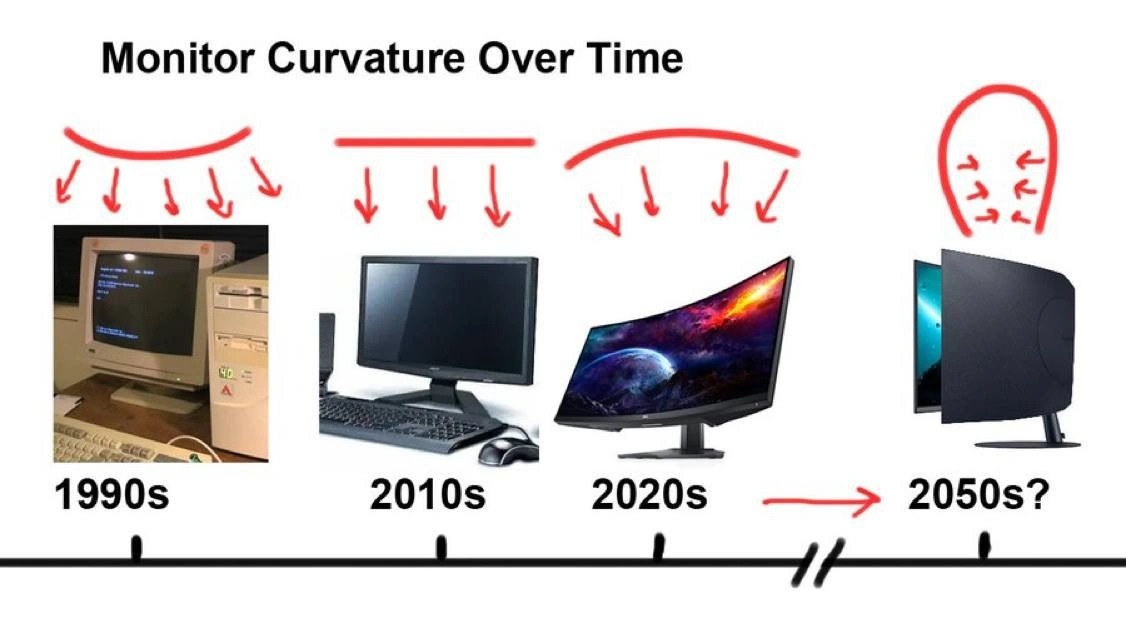
Let’s break down what’s happening with these monitors over time, in case you’re newer to the HardwareEvolution scene or not familiar with the old tech terms. The meme shows four stages in a timeline:

  • 1990s – CRT Monitor (Convex Screen): In the 1990s, most computer monitors were CRTs, which are big, boxy televisions like the ones you see in old movies. CRT monitors have a thick glass screen that is slightly curved outward (convex shape). That curved red line drawn above the 1990s monitor in the meme indicates the screen is bulging towards you. Why? CRTs work kind of like old tube TVs: there’s a tube firing electron beams at the back of the screen to light it up. It was hard to make that work on a perfectly flat surface, so the screen ended up a bit rounded. The picture in the meme even shows a black-and-white DOS prompt on the screen – that’s a text-only interface from the MS-DOS operating system, super common in the late 80s and 90s. This era’s monitor was heavy (often 30-50 pounds), deep (taking up a lot of desk space), and had relatively low resolution by today’s standards. But that was the cutting edge back then! If you ever see one in real life, it looks like a chunky box with a glass bubble in front.

  • 2010s – LCD Monitor (Flat Screen): Jump to the 2010s in the timeline – now we have a sleek LCD monitor. LCD stands for Liquid Crystal Display. These screens are flat as a pancake (the meme draws a straight red line above it to show no curve). The 2010s PC monitor in the image is thin, black, and sits next to a keyboard and mouse, showing a typical modern computer setup. For a junior dev today, this looks totally normal. Flat screens became standard in the mid-2000s and by the 2010s just about everyone had one. They’re lightweight and much thinner because they use flat panels and tiny components (no big tube). The display quality improved a lot too – higher resolution, color, etc. So basically, the 2010s were the era of “flat is best.” Most offices upgraded to flat monitors not just for looks but also because your workspace_setup could be much more efficient (you could even mount them on arms, have dual monitors side by side, etc., which was hard with giant CRTs).

  • 2020s – Curved Ultrawide Monitor (Concave Screen): Now in the 2020s panel, the meme shows a fancy ultrawide monitor with a vibrant galaxy image, and a red curve drawn above it that bends inward towards the user (concave). This represents the newer trend of curved monitors. Unlike the old CRT’s outward bulge, these modern screens bend towards you at the edges. The term ultrawide means it’s really long horizontally (wider than a typical screen), often with a 21:9 aspect ratio or similar, so you get a lot of horizontal space. Developers and gamers like ultrawides because you can see a ton of stuff at once – for coding, maybe multiple files side by side, for gaming, a more immersive view. The curve helps by ensuring the ends of this very wide screen angle a bit inward, so you don’t have to swivel your head as far to see the corners and so the image stays more consistent to your eyes. In simpler terms, if a flat screen is too wide, the edges feel “far away” or look washed out; curving it makes the whole screen feel like it’s facing you more directly. The meme is highlighting how funny it is that after going flat, we decided to bend screens again, only opposite direction. It’s no accident – this concave curve is a feature meant to make using such a wide monitor more comfortable and cool-looking. A lot of current developer workstation photos on Reddit or dev blogs show off these big curved screens – it’s kind of an enviable setup for some!

  • 2050s – Full Wrap-around (Speculative): The last stage has a “2050s?” with a question mark because it’s making a joke about the future. The drawn red shape is basically a half-circle all the way around a little head – implying the monitor might completely wrap around the user. The photo even shows a super curved panel from the side. This part is not a real product (at least, not yet) but an exaggeration. It’s saying: who knows, by 2050 maybe our monitors will be so curved that you sit inside them! It brings to mind VR headsets or those sci-fi setups where someone is surrounded by screens 360 degrees. The humor is that each step we got more curve, so the ultimate extreme is a full circle, like being in a bubble of screen. It’s a playful guess – in reality by 2050, we might be using holograms or direct brain interfaces, but hey, a wrap-around monitor is a funny visual way to imagine the “next big thing” in future_monitor_design.

Throughout this timeline, the term “Monitor Curvature” just refers to how the screen’s shape curves. Convex means bulging outwards (like the back of a spoon), concave means curving inwards (like the inside of a bowl). So the meme charts a kind of back-and-forth: bowed out (90s) → flat (2010s) → bowed in (2020s) → all the way around (future). It’s a lighthearted take on TechHistory: each era had its distinctive look and feel for a developer’s monitor. If you’re a newer dev, you might not have used a CRT, but trust me, many of your mentors did – and seeing that picture gives them TechNostalgia (and maybe some back pain flashbacks from carrying those things!). The meme is funny because it’s basically saying “monitors changed a lot, but we might end up right back where we started, just inverted.” It’s half joking about how trends can be circular and half just marveling at how far display technology has come and might go.

Level 3: The Curvature Arms Race

This meme nails a HardwareHumor timeline that senior devs and IT veterans can appreciate instantly. It’s poking fun at how developer workstations (and consumer tech generally) seem to chase trends in a cyclical way. In the 90s, every coder’s desk had a beige CRT monitor – heavy as a mini-fridge, deep as a microwave, with a screen that bulged outwards. That convex curve wasn’t a feature, it was a byproduct of the technology. A lot of us remember trying to fit those monitors on a small desk, maybe praying it wouldn’t slide off when we bumped the table. Back then, nobody called it “monitor curvature” – it was just the default, and if anything we complained about glare and distortion at the edges. TechNostalgia kicks in when we see that DOS prompt on the CRT in the meme’s 1990s section; it’s a reminder of simpler times (C:> and blinking cursors) and of hardware that needed its own weight class.

Move to the 2010s: flat screens everywhere. This part of the timeline shows a flat LCD monitor and rightly so – by the 2010s, flat panels had utterly taken over. For those of us who lived through it, the first time you got rid of the CRT and put a flat LCD on your desk, it felt like stepping into the future. No more 50-pound glass beast, hello sleek widescreen! The meme’s straight red arrow in the 2010s segment emphasizes that flatness was the hot thing. And developers didn’t stop at one – we started seeing the multi-monitor setups blossoming in this era. A typical senior dev’s battle station might be two, three, even four flat screens angled around them (the initial stage of the workspace_setup enveloping idea). There’s a bit of DeveloperCulture pride in having lots of screen real estate: you’d hear folks brag, “I’ve got my code on one screen, docs on another, and Stack Overflow on the third.” It’s both a productivity strategy and a status symbol in office culture. Flat screens were also easier on the eyes with less distortion, so it was universally seen as an upgrade. This meme plays it totally straight (pun intended) in that middle timeline image: flat is normal, nothing to joke about there – the humor is in what comes after…

Now the 2020s: we have pivoted (literally) to curved monitors, especially those massive ultrawide_monitors. Suddenly the monitor market said, “Hey, what if your screen hugged you rather than poking out?” The meme’s third panel with a vivid galaxy displayed on a curved monitor typifies this TechTrends shift. It’s a concave curve with the red arrow arching above it to show the inward bend. For seasoned devs, this is both exciting and a bit ironic. After years of chasing flatness, we’re now intentionally curving our screens! The difference is purpose: a concave curve is marketed for immersive experience and ergonomic viewing. Gamers love it for that wrap-around feel, and developers… well, many devs adopted ultrawides too, claiming it helps them see more code or timelines at once without turning their head as much as multiple flat monitors. The industry is in a kind of arms race for the most immersive workstation. First it was resolution (1080p -> 4K -> 5K), then size (24" -> 32" -> 49"), and now it’s curvature. We’ve started spec-ing monitors by how bent they are (e.g., 1000R being very curvy). On social media and dev forums, you’ll find plenty of HardwareHumor flexing: someone posts their new 49-inch curved screen that practically wraps around their keyboard, and quips about living in a “code cockpit”. It’s partly practical and partly just cool-factor. There’s also jesting about issues: ultra-wide curved monitors sometimes cause OS UI quirks or screenshot weirdness (try taking a full-screen screenshot on a 32:9 display!). And heaven forbid you want to share your screen with a colleague in person – if they’re not sitting right in the sweet spot, the colors and view angle might look off. So while curved monitors promise a lot, they come with their own funny drawbacks in real life (like “where do I put my coffee mug on this narrowed desk now?”).

Finally, the 2050s? Now we’re fully tongue-in-cheek. The meme draws an absurdly extreme curvature – basically a cylinder that the poor developer sits inside, indicated by that red semicircle encircling a stick-figure head. This is the logical (and hysterical) conclusion of the curvature race: a monitor so curved it’s all the way around. It’s a playful jab at our tendency to think more is always better. If some curve is good, by 2050 we’ll have ALL the curve! It hints at a future monitor or future_monitor_design that might physically surround us, or effectively be an AR/VR situation where the code editor floats in 3D space around your head. Seasoned developers see the humor: by 2050 maybe we won’t even need physical monitors – we could have brain implants or retinal displays – but here we’re joking that instead we’ll just build bigger, badder curved screens until they swallow us whole. It’s making fun of workspace setup evolution taken to a ridiculous extreme. And underlying this humor is a gentle ribbing of developer habits: we often obsess about getting the “ultimate” gear to boost productivity or comfort. Standing desks, ergonomic keyboards, 8K monitors – why stop? So the meme asks, what’s next, a monitor that literally wraps around you?

In essence, the joke resonates on multiple levels with experienced tech folks. It’s historical (remember those CRTs?), it’s observational (flat to curved trend), and it’s satirical (imagine the lengths we’ll go to in the future). It captures the TechHistory arc of monitors while poking at our never-ending quest for the perfect developer workstation. Anyone who’s been in this field for a while can chuckle at both the accuracy (yes, monitors did go convex → flat → concave) and the absurd projection (maybe by 2050 we really will code inside a 360-degree wrap-around holodeck). It’s funny because it’s a caricature of real trends – a DeveloperHumor staple of taking something to the extreme to highlight how far we’ve already come.

Level 4: Curvature by Design

In the 1990s, monitors were governed by the physics of the CRT (Cathode Ray Tube). A CRT is essentially a deep glass vacuum tube where an electron gun fires beams at the inside of the screen. Because aiming electrons accurately at corners is tricky, CRT screens naturally adopted a convex shape (bowing outward) to maintain equal distance from the gun to all screen points. This curvature helped focus the beam and reduce distortion like pincushion and barrel distortion. Early CRT monitors often had a pronounced bulge; the glass was thicker at the center and edges for structural integrity under vacuum pressure. Engineers and TechHistory buffs will recall attempts at “flat CRTs” in late 90s/early 2000s – these used clever masking and lensing to appear flat, but internally they still had a slight curve to handle beam geometry.

Fast forward to the 2010s and we see the dominance of LCD (Liquid Crystal Display) panels. LCDs are fundamentally flat: they sandwich liquid crystal layers between glass plates and shine a backlight through them. Because there’s no single “beam” to aim, the panel can be completely planar – finally a flat screen (represented by that straight red line in the meme). Flat LCDs eliminated the geometric warping issues of CRTs and gave us perfectly rectangular, edge-to-edge images. From a hardware standpoint, this was a huge milestone in the hardware evolution of displays: no more bulky vacuum tubes, and the era of slim screens began. The flatness was both an engineering feature and a marketing boast (“flat-screen TV” became synonymous with modern).

Enter the 2020s with the rise of curved monitors – but this time the curve is concave (bending inward towards the user). This design is intentional to match the curvature of the human field of view. Widescreen monitors, especially ultrawide monitors, can stretch so long that the edges appear far from the viewer’s center of vision. By curving the panel (with radii specs like 1800R meaning a 1.8 meter radius curve), manufacturers ensure the screen’s surface remains at a more uniform distance from your eyes. This reduces viewing angle issues, minimizes color shift on the sides, and creates a more immersive experience. There’s real display tech going on: these modern panels often use flexible substrates or segmented LED backlights to achieve the curve without image distortion. In essence, display design has come full circle – but flipped: the old convex bulge was a limitation of CRT hardware, whereas the new concave wrap is a luxury feature of advanced LCD/OLED hardware. We’re effectively bending light to our convenience now rather than because we have to.

Projecting into the 2050s (as the meme’s question mark teases), we hit speculative design. If current trends continue, we might get fully immersive displays that envelop the developer. This could mean a complete 180-degree or even 360-degree curved screen, forming a cocoon of pixels around the user’s head. The meme humorously sketches a cylinder or wrap-around screen encircling a person. While fanciful, this idea isn’t pure sci-fi: think of VR domes or CAVE systems, or even modern VR headsets that already provide wrap-around visuals with twin screens. By 2050, who knows – perhaps flexible OLEDs or holographic projectors will let us work inside a seamless sphere of code. At that extreme, we face new “curvature” problems: how to render UIs on a continuous 3D surface without making the developer dizzy, and how to manage ergonomics when the workspace setup literally surrounds you. It’s a playful extrapolation, but rooted in the real pattern of display tech pushing towards greater immersion. In summary, the monitor_curvature timeline here isn’t just a funny shape-shifting story – it’s a reflection of display technology advancing (with some detours) to better suit human vision. Each shift from convex to flat to concave has both HardwareEvolution reasons and human factors reasoning behind it.

Description

A four-panel timeline meme titled 'Monitor Curvature Over Time' illustrating the evolution of computer monitor shapes. The first panel, labeled '1990s', shows a bulky beige CRT monitor with its characteristically convex (outwardly bulging) screen, indicated by a red curved line above it. The second panel, '2010s', displays a standard black flat-screen monitor, with a straight red line above it symbolizing its flatness. The third panel, '2020s', features a modern, sleek, curved gaming monitor with a concave (inwardly curving) screen, again depicted by a corresponding red arc. The final panel, humorously labeled '2050s?', extrapolates this trend to a logical extreme, showing a monitor so deeply curved it almost fully encircles the viewer's head, with a U-shaped red diagram above. The humor stems from observing the cyclical nature of technology trends - moving from curved, to flat, and back to curved again, highlighting how engineering solutions for one era's problems (like CRT screen distortion) can be ironically reintroduced as premium features (immersive curved displays) in another

Comments

17
Anonymous ★ Top Pick We spent the 2000s celebrating the death of geometric distortion in CRTs, only to spend the 2020s paying a premium to get it back as an 'immersive feature'. Can't wait for 2050s VR headsets that simulate the authentic 15-inch 4:3 CRT experience
  1. Anonymous ★ Top Pick

    We spent the 2000s celebrating the death of geometric distortion in CRTs, only to spend the 2020s paying a premium to get it back as an 'immersive feature'. Can't wait for 2050s VR headsets that simulate the authentic 15-inch 4:3 CRT experience

  2. Anonymous

    Monitor curvature is just Conway’s Law rendered in 3-D: every extra microservice bends the display a few more degrees - by 2050 the screen will be a full Kubernetes ring around the last dev still tail-f-ing the logs

  3. Anonymous

    After 30 years of arguing about optimal viewing angles and color accuracy, we've successfully reinvented the CRT's curve but with 10x the power consumption and a subscription service for the RGB lighting

  4. Anonymous

    By 2050 the monitor wraps all the way around - congratulations, the display industry spent 60 years and billions in R&D to ship a CAVE with worse ergonomics than a VR headset

  5. Anonymous

    We've come full circle - literally. After spending decades flattening CRT bulges into sleek panels, we're now paying premium prices to curve them back. By 2050, we'll have reinvented the sensory deprivation tank, but with RGB lighting and a 240Hz refresh rate. The real question isn't whether your monitor will wrap around you, but whether your IDE will finally support cylindrical coordinate systems for code navigation

  6. Anonymous

    Curvature full circle: like resurrecting callbacks in a functional world, but for hiding that second monitor nobody admits to

  7. Anonymous

    Curvature tracks team topology: 4:3 CRT for the monolith, 16:9 flats for SOA, 21:9 1000R for microservices - by 2050 the IDE will be 360° so you can rotate to find the owner of that orphaned Helm chart

  8. Anonymous

    We refactored convex CRTs into flat LCDs, then reintroduced curvature as 1000R ‘immersion’; 2050 roadmap: a torus monitor that finally matches our circular dependencies

  9. @chupasaurus 4y

    it would be a cable into nerve system

  10. @AndoroidP 4y

    There is still no curve 4K displays

    1. @Stepan_Poznyak 4y

      https://www.e-katalog.ru/ek-list.php?katalog_=157&save_podbor_=1&minPrice_=&maxPrice_=&sc_id_=810&pr_%5B%5D=14177&pr_%5B%5D=37653&pr_%5B%5D=15073 There are. Even for 500$

      1. @SpYvy 4y

        It's just stupid. Curved monitors don't exist for nothing

  11. @yarmoliq 4y

    It's going to be 360

  12. @yarmoliq 4y

    Oh wait

  13. @CEMEH_CBAJIOB 4y

    Boomer joke

    1. @tarasssssssssssssss 4y

      Agree

  14. @callofvoid0 4y

    2050: panorama

Use J and K for navigation