Skip to content
DevMeme
3689 of 7435
The Self-Inflicted Wounds of a Hasty Cloud Migration
Cloud Post #4028, on Dec 13, 2021 in TG

The Self-Inflicted Wounds of a Hasty Cloud Migration

Why is this Cloud meme funny?

Level 1: Tripping Yourself Up

Imagine a kid who never keeps track of his toys and has a super messy room. One day he decides to solve it by getting a fancy new toy box. Without cleaning anything up, he just throws all his toys into this box and even tells his older brother (who usually helps him organize) to leave because “I don’t need you, I have a new solution!” But the new box doesn’t magically sort the toys – it quickly overflows and even breaks some toys because everything was just jammed in. Now the room is an even bigger mess than before, and the kid has nobody around to help him fix it. He sits on the floor upset, confused about why his plan didn’t work. It’s funny because it’s so clear what went wrong: he ignored the simple step of cleaning up and even got rid of the help he needed. In trying to skip straight to the “easy fix,” he ended up causing a crash and making things worse, just like the guy on the bike who caused his own fall and then wondered why he was hurt.

Level 2: Cloud Sticker Shock

Think of a company whose IT setup was already on shaky ground. They didn’t even keep a basic asset inventory – essentially a list of all the computers, servers, and software they have. That’s like not knowing what toys you own; it’s hard to manage a bunch of systems if you don’t know what you’ve got in the first place. On top of that, their IT budget was so tight that the tech team could barely keep things running. This is the scene in the first panel: the company admits “we don’t have an inventory of our gear and we don’t have enough money to run IT properly.” In other words, they’re disorganized and underfunded from the get-go.

Instead of addressing those issues (like, say, actually listing their assets or increasing the IT budget to hire people and replace old equipment), the higher-ups decide to adopt a “cloud-first” policy. Cloud-first means they want to use cloud services for everything possible, rather than buying new hardware or continuing in their own data center. Now, the cloud basically means using someone else’s computers over the internet. For example, instead of running your website on a server in your office, you rent a server from a company like Amazon, Google, or Microsoft and run it there. Microsoft Azure is one of these cloud providers – it’s Microsoft’s giant collection of data centers and services that people can use on-demand. If you need a server, Azure gives you a virtual one. Need a database? Azure has database services. You pay for what you use, like a utility. So, a cloud-first strategy usually sounds modern and flexible: use cloud services whenever you can, and stop worrying about your own physical machines.

So our hapless company goes all-in on Azure. They migrate, which means they take all their applications, data, and servers that were running in their own building (on-premises) and move them into Azure’s cloud. This kind of move is a big project – often called a cloud migration. Done properly, it involves planning: you map out what you have (hence the need for that inventory), figure out how to move each piece, and perhaps adjust things to avoid wasting money. But in the meme, it’s implied they did this haphazardly. The caption “put everything in Azure” suggests they just shoveled all their systems into the cloud without much forethought, a approach often nicknamed a “lift-and-shift” – you lift the system as-is, and shift it to the cloud, without redesigning it for the new environment.

To make matters worse, management also fires the sysadmins as they do this. A sysadmin (system administrator) is the person who takes care of servers, networks, and IT infrastructure. These are the folks who know how everything in the old setup fits together. Firing them is like saying, “We moved to the cloud, so we won’t need our mechanics anymore because we bought a new car that supposedly doesn’t break.” It’s a huge misunderstanding. Cloud services still need oversight – you have to configure them, secure them, update them, and handle any issues. Yes, you’re not physically replacing hardware disks or power supplies (the cloud provider handles that part), but there are plenty of software and setup tasks that don’t go away. By letting the sysadmin team go, the company loses the people who understand the nitty-gritty details of their technology stack. It’s as if a restaurant switched to a new high-tech kitchen and then fired the chefs, assuming the new equipment would cook meals by itself.

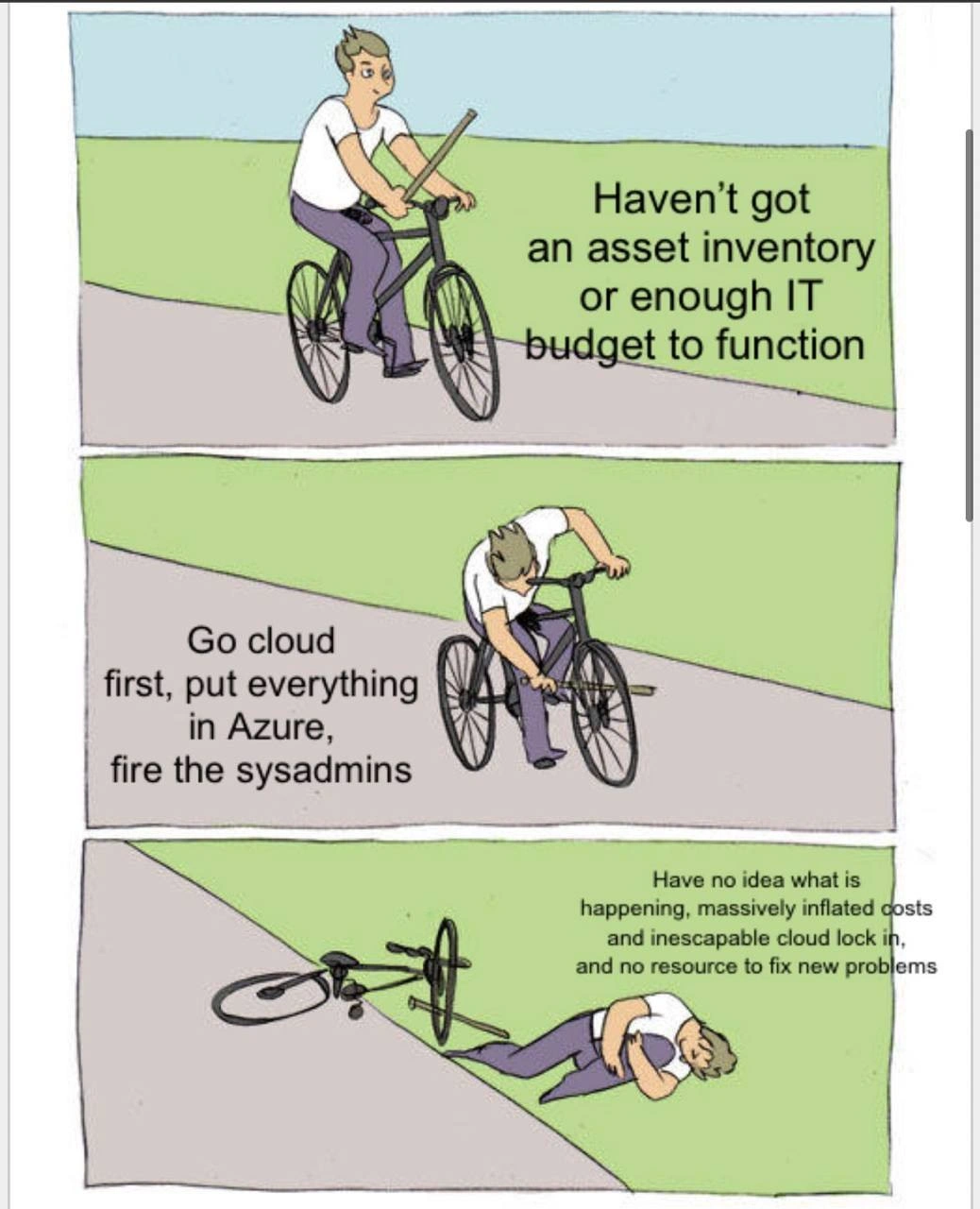
Now, look at panel 3 of the comic. The result of these decisions is utter chaos – the equivalent of the bike crash. The text says: “Have no idea what is happening, massively inflated costs, inescapable cloud lock-in, and no resource to fix new problems.” This is exactly what you’d expect to happen:

  • “No idea what is happening”: After moving everything to Azure, they’ve lost visibility and control. In their old setup, maybe a sysadmin had a big dashboard showing the status of each server, or at least they could walk to the server room and see if a machine’s light was blinking. In Azure, if you haven’t set up proper monitoring (and who’s going to do that now that the IT staff is gone?), things can fail silently or behave unpredictably and you won’t immediately know why. It’s like suddenly flying a complex plane with no gauges or instruments. They literally have servers and services in the cloud, and issues are popping up, but management and the remaining team are in the dark about the root causes. Did something crash? Is a database overloaded? Is there a network outage or a configuration mistake? Without preparatory work, nobody knows; hence “no idea what is happening.”

  • “Massively inflated costs”: They expected the cloud to save money, but the bills are coming in much higher than before. In Azure, you get charged for all sorts of things by usage – CPU time, memory, storage space, data transfer, you name it. If you don’t optimize, it can cost more than running your own hardware. Say on-prem they already owned 50 servers (paid for and depreciated over years); keeping them on might have cost mostly electricity and cooling. When they moved those 50 servers’ workloads to Azure, now they are paying hourly for each virtual machine. Imagine each costs a few hundred dollars a month – it adds up fast. Plus, there are often surprise costs like data egress (charges for data leaving Azure, for example when users download files or when you transfer data to another system). This company clearly didn’t account for all that. It’s akin to renting a car thinking it’s cheaper than owning, but then getting a huge bill because you drove it non-stop and didn’t realize fuel and mileage were extra. The meme’s phrase “massively inflated costs” is pointing out that their cloud expenses blew up beyond expectations. They’re likely saying, “Why are we paying so much? This is way more than before!” The humor is that this was predictable if anyone had done the math — cloud can be more expensive if you just copy-paste your IT setup without adjustment. They basically got a case of cloud sticker shock – the shock you feel when you see the price tag (or bill) is much higher than anticipated. And because they fired the people who might have monitored or optimized these costs, nobody noticed the meter running hot until the bill arrived.

  • “Inescapable cloud lock-in”: This means they are now stuck with Azure, whether they like it or not. Vendor lock-in happens when you use a service in a way that makes it hard to switch providers. For instance, if they used an Azure-specific database service, all their data is now formatted for and stored in Azure. Moving that data out to another cloud or back in-house might be technically complex and very expensive (Azure will charge for the huge data download, and you’d have to rearrange the data for a new system). Additionally, they likely don’t have their old hardware anymore (they might have sold it off or shut down the data center) and they certainly don’t have the staff anymore to run it. So even if they wanted to “undo” the cloud move, they can’t easily do so. They have no choice but to keep paying Azure and dealing with Azure’s way of doing things. It’s “inescapable” in the sense that they built a cage for themselves. This is ironic because often managers jump to cloud to increase flexibility, not realizing if you go all-in on one platform without precautions, you actually reduce your flexibility. The meme is pointing at that irony: they’re complaining about being trapped (“cloud lock-in”) when they dug the trap themselves by not planning a multi-cloud or exit strategy.

  • “No resource to fix new problems”: Now they have a ton of new problems (all the things that come with running in the cloud that they never dealt with before) and nobody on deck to solve them. They didn’t retain or replace their human resources with cloud expertise. If a web application is suddenly running slowly on Azure, diagnosing that might require a different skillset (could be a database throughput issue, or a misconfigured load balancer, etc.). If they encounter a security issue, like “Oops, we accidentally left a storage bucket open to the internet,” who is there to even notice or correct it? The phrase also implies they might not have money (“resource” can mean budget) to throw at the problem either, because their funds are tied up paying those high cloud bills. It’s like they have a leaky boat but already let go of the crew and spent all their money repainting the boat, so now they can’t plug the leaks. In simpler terms: no experts + no extra cash = no solution. They are stuck watching the problems grow.

All of this together paints a picture of a disastrous cloud migration strategy. The company ignored the preparation (no inventory, no budgeting), jumped into Azure hoping for a miracle, and actually weakened their position by firing their knowledgeable staff. The meme is funny in a facepalm way because the outcome was so predictable. It’s using the bike analogy to show how silly it was: the company essentially tripped itself. Just like a rider who shoves a stick in his own wheel and then cries that he crashed, the executives made a series of bad decisions and then acted baffled by the wreckage.

For a junior engineer or anyone new in tech, the lesson here is important: plan and get the basics right first. If your house is built on a shaky foundation, moving it into the cloud won’t magically stabilize it – in fact, it might make things worse if you’re not careful. The cloud is powerful, but it’s not a set-and-forget magic fix. You still need to know what you have, control your costs, and have skilled people to manage it. Otherwise you could end up like this company: with bigger bills, lots of confusion, and nobody left to call for help. The humor makes it memorable: it’s a cartoonish exaggeration of a real-world mistake, reminding everyone that “look before you leap” applies in IT just as much as anywhere else.

Level 3: Cloud-First Faceplant

In the tried-and-true tradition of IT blunders, this meme shows a company executing a spectacular self-own in the cloud. It's a textbook case of executive mismanagement: neglect the boring basics like maintaining an accurate asset inventory or allocating a realistic IT budget, then suddenly chase a trendy cloud-first strategy. The rider happily pedaling in panel 1 represents leadership coasting along without insight into what infrastructure they actually have or need — no list of servers, no clue which applications run where, and definitely not enough budget to keep things healthy. Instead of addressing those foundational issues (like, you know, actually documenting assets or funding IT above a shoestring), they decide to leap onto the cloud bandwagon as a cure-all.

Enter panel 2’s folly: the rider jamming a stick into his own wheel, captioned “Go cloud first, put everything in Azure, fire the sysadmins.” This stick-in-spokes move is pure self-sabotage. Management leaps headlong into Microsoft Azure, believing the vendor hype that cloud computing will magically solve all problems and cut costs. Azure is a major cloud platform (one of the big players alongside AWS and Google Cloud) offering virtual machines, databases, and all kinds of managed services. But treating it as a silver bullet is a recipe for disaster. Here the execs probably did a rushed lift-and-shift migration – taking all their messy on-prem systems and plopping them into Azure with minimal changes. In effect, they just moved their chaos from a data center they own to a data center they rent. When you “put everything in Azure” without a proper game plan, you inherit all your previous issues plus some brand new cloud-specific ones.

And the kicker: firing the sysadmins. In their cloud euphoria, they lay off the very people who understand the company’s infrastructure, thinking those roles are now obsolete. This is painfully common in misguided corporate culture shifts: leadership hears “cloud = no maintenance,” so they conclude they can eliminate the entire ops team. It’s the flawed idea that “we don’t need our old IT folks, the cloud provider will handle it all!” Sure, Azure operates the physical servers behind the scenes, but it doesn’t magically configure your applications, secure your data, or watch for weird errors at 2 AM. The veteran sysadmins carry tons of tribal knowledge about how systems interconnect (often informally, since there was no asset inventory documentation!). By ousting them, the company loses critical know-how and any chance of a smooth transition. The humor here is dark and cathartic: management believes they’ve saved the day and the budget by cutting staff, not realizing they also cut the parachute before jumping out of the plane.

Panel 3 shows the inevitable result: the rider (the company) sprawled on the ground, clutching his hurt leg next to a wrecked bike. The caption lists the aftermath: “Have no idea what is happening, massively inflated costs and inescapable cloud lock-in, and no resource to fix new problems.” This perfectly encapsulates cloud humor meeting grim reality. Because they skipped maintaining an asset inventory, suddenly they have no idea what’s happening in their new cloud setup. Servers and services are malfunctioning or misconfigured, but without proper monitoring or documentation, the IT team is flying blind. It’s 3 AM and something mission-critical is down – guess what, the people who knew those systems inside-out were the ones fired last month. The on-call team (if there even is one now) is scratching their heads, unsure if the issue is a code bug, a misrouted network, or an Azure service limit being hit. Been there, seen that — it’s not fun.

Then we have those massively inflated costs. One big selling point for moving to cloud is the promise of cost savings: “We’ll only pay for what we use, so it’ll be cheaper!” But without a careful plan, “what we use” can spiral out of control. In Azure, every virtual machine, database, and load balancer has a meter running on your credit card. On-premises, a server running idle was just a sunk cost; in the cloud, an idle server still racks up fees by the hour. Without governance, companies experience sticker shock – that first Azure bill might be 2x or 3x what the old data center cost. Perhaps they cloned every server to the cloud without rightsizing, or left test environments running 24/7, or chose pricey managed services they didn’t actually need. I’ve seen a forgotten cloud instance left running over a holiday become a four-figure surprise. This is a classic case of budget constraints meeting reality: they were penny-pinching with on-prem upgrades, and now they’re burning cash in the cloud because the meter is always on. And since the seasoned sysadmins who knew how to optimize infrastructure are gone, nobody is doing cloud cost optimization (like shutting down unused resources or using bulk pricing options). The result? Finance is now freaking out at the soaring Azure bills.

Next, inescapable cloud lock-in. By dumping everything into Azure in one swoop, they’ve tied their entire operation to one vendor’s ecosystem. In cloud architecture terms, they went all-in on proprietary Azure services – maybe they rehosted databases to Azure SQL, rewrote apps for Azure Functions, stored tons of data in Azure Blob storage. Those choices can make it very hard to move later (say, to AWS or back on-prem). Want to leave? Azure will charge massive data egress fees to pull your data out, and you’d have to rewrite parts of your systems to fit a new environment. They’ve effectively handcuffed themselves to Microsoft. It’s the Hotel California of cloud: you can check out any time you like, but you can never leave (easily). The irony is that leadership is now acting surprised Pikachu about this lock-in — as if it wasn’t utterly predictable when you decide to “put everything” into a single vendor’s basket. Complaining about vendor lock-in at this point is like sticking your hand in a jar and then whining that it’s stuck.

Finally, no resource to fix new problems. The company now faces a slew of new cloud-related issues (performance bottlenecks, security misconfigurations, mysterious outages in services they barely understand) and has no one available to address them. They lost their in-house experts, and likely didn’t budget for hiring new cloud gurus or consultants (remember, they thought they were saving money). “Resource” here means both people and budget. So when something breaks or needs tuning in the Azure environment, they’re short on skilled staff and also short on cash to throw at the problem. It’s a dire situation: like having a fancy new car that’s sputtering, but you fired the mechanic and spent all your money on gas. The infrastructure might have changed, but the need for expertise didn’t go away; in fact, it’s more acute because this cloud setup is unfamiliar territory. The result is a helpless, facepalm-inducing scenario: the company is floundering, problems piling up, and the execs are bewildered about why this “cloud thing” isn’t working out. Seasoned engineers find this scenario painfully funny because it happens a lot — a big tech shift without groundwork is basically self-sabotage.

In short, the meme highlights a classic IT folly: skipping basic homework (like knowing what you have and budgeting realistically) and then making a drastic cloud-first move is akin to sticking a rod in your own bike wheel. The crash that follows shouldn’t surprise anyone, yet here we are with leadership looking baffled in the debris. It’s both comical and cringe-worthy because the cause of the pain is so obviously self-inflicted. Every grizzled sysadmin and cloud architect who sees this meme can only smirk and say, “Yep, seen this movie before,” as the executives on the ground moan, “Cloud lock-in and high bills are killing us!” – conveniently forgetting it was their own decisions that led them there.

Description

This meme uses the three-panel 'bicycle fall' comic strip to illustrate a common corporate IT failure. In the first panel, a man riding a bicycle represents an organization with existing problems, captioned: 'Haven't got an asset inventory or enough IT budget to function.' In the second panel, the man deliberately shoves a stick into his own bike's front wheel, a metaphor for a self-destructive decision, captioned: 'Go cloud first, put everything in Azure, fire the sysadmins.' The final panel shows the man lying injured on the ground after crashing, with the outcome described as: 'Have no idea what is happening, massively inflated costs and inescapable cloud lock in, and no resource to fix new problems.' The meme is a sharp critique of the 'cloud as a panacea' mindset. It satirizes leadership that, instead of addressing foundational issues like asset management and proper budgeting, rushes into a poorly planned cloud migration. Firing the system administrators - the very people with the operational expertise needed to manage complex infrastructure - is the height of this folly, predictably leading to chaos, uncontrolled spending, and vendor lock-in, a scenario all too familiar to experienced architects and operations engineers

Comments

8
Anonymous ★ Top Pick Some companies treat 'cloud-first' as a strategy. More experienced engineers recognize it as a resume-generating event for the entire SRE team, followed by a nine-figure invoice from Microsoft
  1. Anonymous ★ Top Pick

    Some companies treat 'cloud-first' as a strategy. More experienced engineers recognize it as a resume-generating event for the entire SRE team, followed by a nine-figure invoice from Microsoft

  2. Anonymous

    Turns out if your CMDB is an Excel file named “final_final.xlsx” and your migration plan is “rename VMware tags to ‘Azure-ready’ and pink-slip the ops team,” the only thing that scales elastically is the invoice

  3. Anonymous

    Nothing says 'digital transformation success' quite like replacing your entire ops team with a cloud provider, then discovering that auto-scaling applies to your AWS bill more reliably than your application performance - but hey, at least you're 'cloud-native' now, even if nobody knows what's actually running up there

  4. Anonymous

    They fired the sysadmins to afford the Azure bill, then discovered the sysadmins were the only ones who knew what was in the inventory they never had

  5. Anonymous

    Ah yes, the classic enterprise cloud strategy: Step 1 - Ignore decades of accumulated infrastructure knowledge. Step 2 - Lift-and-shift everything to Azure without understanding your workloads. Step 3 - Fire the only people who knew where anything was. Step 4 - Discover that 'cloud' doesn't mean 'magic' and that egress fees are Microsoft's favorite revenue stream. Step 5 - Realize you've traded CapEx for OpEx at 3x the cost, with none of the institutional knowledge to optimize it. But hey, at least the CIO got to check 'cloud transformation' off their LinkedIn profile before moving to their next role, leaving you to explain why the monthly Azure bill now exceeds the GDP of a small nation

  6. Anonymous

    Cloud-first without CMDB, IaC, or FinOps is just CapEx-to-OpEx laundering plus a surprise egress tax

  7. Anonymous

    Calling it cloud‑first without a CMDB just turns your estate into a distributed invoice; firing the sysadmins guarantees 99.9% uptime on surprise costs

  8. Anonymous

    Cloud migration: swap CAPEX certainty for OPEX roulette, then fire the only folks who could read the bill

Use J and K for navigation