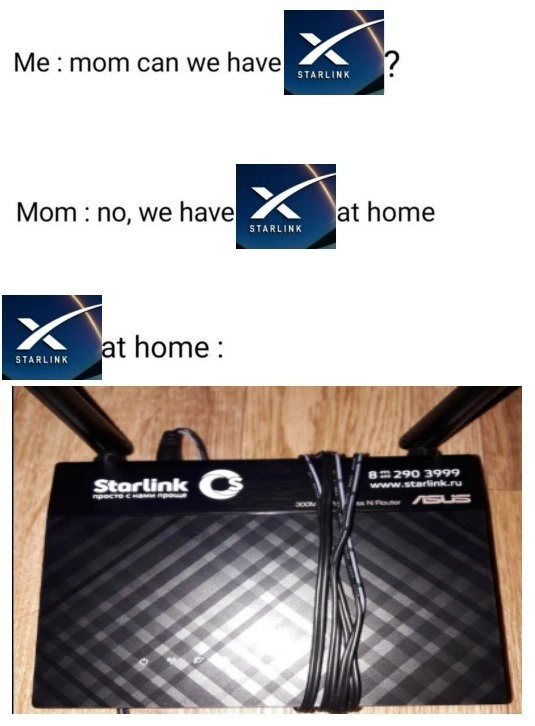
When your Starlink dreams become a budget router reality at home
Why is this Networking meme funny?
Level 1: Not the Real Deal
Imagine you ask your mom for a cool new toy everyone’s talking about – let’s say a high-tech remote control rocket that can actually fly into the sky. 🚀 But your mom says, “No, we have that at home.” Then you get home, and she pulls out a plain old toy with the word “Rocket” scribbled on it. It can’t fly; it’s just a regular toy she found on sale. You’d probably giggle or groan, right? Because it’s clearly not the amazing thing you hoped for.
That’s exactly the joke here. The person wanted Starlink, which is like the super cool “rocket ship” way to get internet (from satellites in space!). But Mom’s “Starlink at home” turned out to be just an ordinary internet box (a Wi-Fi router) with a similar name. It’s like craving the fancy brand-name cereal and getting a generic box that kinda looks the same but definitely isn’t as exciting. The humor comes from that letdown and the play on the name: two things called Starlink, but one is extraordinary and the other is totally ordinary. It’s a funny reminder that what you have at home might share the name of something awesome… but that doesn’t mean it is the awesome thing. 🥣💻
Level 2: Starlink in Name Only
Let’s break this down in simpler terms. First, Starlink (the real one) is a service by SpaceX that provides internet access using satellites. Imagine dozens of small satellites orbiting the Earth, all working together to send internet data down to a special dish you install at your house. That’s satellite_internet in action – no need for traditional cables or phone lines; it’s all beamed through space. Starlink is famous in tech circles because it’s networking on a literally global scale and uses advanced hardware (like that UFO-on-a-stick looking dish) to connect people in rural or remote areas where regular high-speed internet (like fiber or cable) isn’t available. So when someone says “I want Starlink,” they’re talking about this futuristic way of getting online via satellites.
Now, the meme format “Mom, can we have X? – No, we have X at home” is a joke where “X at home” turns out to be a crappy or funny makeshift version of whatever the person wanted. In this meme, X is Starlink. So, the top text is essentially someone (the Me in the meme) asking, “Mom, can we get Starlink?” – picturing that cool SpaceX internet dish and all the possibilities of fast internet from space. The mom’s reply: “No, we have Starlink at home.” Cue your expectations deflating. The bottom part shows what “Starlink at home” actually refers to. And it’s… an old Wi-Fi router on a wooden table.
This router is an ASUS model (a common consumer router brand) that has been stickered or branded with the name “StarLink.” You can even see the website starlink.ru on it, which suggests this device was given by a local Russian internet provider called “StarLink” (probably unrelated to SpaceX’s Starlink, just the same name by coincidence or cheeky marketing). In plain terms, a router is that box in your house that takes the internet from the modem (the modem is connected to the wider internet through cable, fiber, etc.) and shares it wirelessly with all your gadgets. The Wi-Fi router usually has antennas (like the two black sticks in the picture) to broadcast the Wi-Fi signal (radio waves your phone/laptop uses to get online). This particular one says “300M Wireless N Router” – which refers to Wireless-N (802.11n), a Wi-Fi standard from around 2007 that can theoretically support up to 300 Mbps speeds on Wi-Fi. It’s a pretty normal piece of home networking gear, nothing special or high-performance by today’s standards (newer Wi-Fi standards like 802.11ac or 802.11ax are much faster).
So, what’s happening in the meme is a comparison joke: The person wants the exciting new SpaceX Starlink (imagine wanting the newest iPhone), but the parent offers a substitute (an old flip phone with “iPhone” written on it kind of situation). The “Starlink at home” router does technically provide internet at home, but in a boring, ordinary way using an ISP’s regular service. It’s the knockoff version in this scenario – literally just sharing the name. For someone not super into tech, it’s like confusing two things that share a name: one is a revolutionary satellite system, the other is a run-of-the-mill home Wi-Fi box. The meme highlights that mix-up for comedic effect.
In simpler meme terms: It’s saying, “You wanted that fancy space internet? Too bad, you’re getting this cheap router instead.” We often see this meme with kids asking for something popular and parents offering a cheaper alternative. This one is funny to folks in tech because Starlink is such a buzzword, and seeing the name on a dusty old router is just ironical. It also lightly pokes at how parents (or bosses, or anyone holding the purse strings) might not see the difference between the premium tech and the budget option. After all, both are called “Starlink,” right? 😜 For anyone who’s started working in IT, you quickly learn these terms: satellite internet vs. Wi-Fi router, fancy new solutions vs. tried-and-true older hardware. This meme wraps those lessons in a joke format that junior devs and network newbies can appreciate once they know the context. It’s basically a reminder that names can be misleading – what you think you’re getting isn’t always what you end up with, especially when cost is a factor.
Level 3: SpaceX vs ASUS
For any seasoned techie, the punchline here lands immediately: it’s a play on the “Mom, can we have X? No, we have X at home” meme format, applied to internet hardware. Starlink – Elon Musk’s high-flying satellite internet service – represents the shiny new thing everyone’s talking about in Networking and Infrastructure circles. People hype it up as a game-changer for global connectivity, especially in remote areas with poor internet. It’s the kind of ambitious tech project that TechIndustrySatire often pokes fun at because of the hype vs. reality gap. In this case, the “hype” is dreaming of hooking up your home to fancy satellites zooming overhead.
But then comes the comedic rug-pull: “We have Starlink at home.” The Starlink at home turns out to be a clunky black ASUS Wi-Fi router with a couple of antennas and some tangled cables. It literally has “StarLink” written on it (in Cyrillic no less, СтарЛинк), along with an ASUS logo and a support number. This suggests that some local internet provider or reseller branded their routers as “StarLink” (pure coincidence or cheeky knockoff). To an experienced developer or IT professional, this scenario is hilarious because it screams knockoff_router — the classic tale of a cutting-edge product versus an older, unrelated thing that only shares the name. It’s like a networking hardware humor version of buying a “Polystation” console instead of a PlayStation.
The humor digs into a shared experience in tech: the mismatch between what we want and what we actually get, especially due to budget constraints or availability. Ever been in a company that says, “We’re implementing state-of-the-art cloud infrastructure,” only to find they just set up an old PC in the closet as a “server”? That’s the vibe here. Starlink (the real one) is expensive and not available everywhere yet – plus you need a clear view of the sky and a hefty subscription. So if a kid or a geek asks, “Can we get Starlink?” a budget-conscious parent (or manager) might respond, “We have something just as good at home!” And that turns out to be an ordinary router connected to the same old DSL line. It’s a gentle jab at how budget networking decisions get made in real life.
This is a form of tech humor that anyone who’s dealt with mismatched expectations in IT will recognize. The meme takes advantage of the identical branding to exaggerate the let-down. The official Starlink logo appears in the request, as if the kid is pointing to SpaceX’s glossy marketing. When mom says “we have Starlink at home,” the final panel reveals the less glamorous truth: a budget router with the same name. It’s basically a nerdy twist on bait-and-switch. The audience is in on it because we all know the Mom, can we have… trope and we know Starlink is something futuristic and cool. Seeing that name slapped on a dusty old router instantly evokes a facepalm and a chuckle.
To break down the contrast, here’s a side-by-side glance that senior devs will appreciate:
| Dream: SpaceX Starlink 🛰 | Reality: "StarLink" Router 📶 |
|---|---|
| Global satellite network in low Earth orbit | Local Wi-Fi network in your house |
| Requires rocket launches & space lasers | Requires an Ethernet cable to the wall |
| Phased array dish on roof tracks satellites | Two antenna rabbit-ears on a router blinking away |
| Promises high-speed internet in the wilderness | “Up to 300 Mbps” in the living room (on a good day) |
| New hotness everyone’s hyped about | Old device your ISP gave you years ago |
Reading this, a seasoned engineer might nod and think: Yep, that’s about right. It’s a wry commentary on how we often dream of the latest tech (be it a new framework, a powerful server, or satellite internet), but end up making do with whatever is on hand (legacy code, an old machine, or a dusty router). The meme resonates because behind the humor is a truth: In tech, expectations often collide with practical reality. The Networking and Infrastructure folks especially get this – it’s like being promised fiber optics and discovering it’s actually just copper wire, or planning for a microservices architecture and ending up with a monolith. Here, it’s space internet vs. a home router: both give you Wi-Fi, but one does it with space-age flair and the other… well, it just gets the job done.
Level 4: Cosmic vs. Copper Infrastructure
At the most granular level, this meme juxtaposes two network infrastructures that could not be more different. On one side, we have SpaceX’s Starlink, a cutting-edge satellite internet constellation. This system involves hundreds (eventually thousands) of satellites whizzing around in low Earth orbit (LEO), using advanced phased array antennas to beam internet data from space down to users. It’s basically a distributed network in the sky. Each Starlink satellite communicates with ground stations and (in newer versions) even laser-links to other satellites, routing internet traffic through space. The latency (delay) is impressively low for satellite service (often ~30-50 ms), since these LEO satellites orbit at around 550 km altitude instead of the 36,000 km of traditional geostationary satellites. Starlink’s infrastructure is true rocket science: launches on Falcon 9 rockets, orbital mechanics to cover the globe, high-frequency Ku/Ka-band signals, and dynamic hand-offs as satellites move across the sky. It’s a marvel of modern networking and infrastructure engineering, aiming to deliver broadband to even the most remote areas on Earth. 🌐🚀
Now contrast that with the device labeled “StarLink” at home in the meme’s bottom panel. Despite the similar name, this is not a satellite dish or anything cosmic – it’s an ordinary ASUS Wi-Fi router rebranded by a local ISP. It likely operates on the 2.4 GHz or 5 GHz bands, broadcasting a standard 802.11n wireless network for your house. The label shows “StarLink.ru” and a phone number, hinting that it’s a regional internet provider’s router (possibly in Russia) cheekily named “StarLink” long before SpaceX’s system became famous. Technically, this little box is hardware for a Local Area Network: it probably plugs into a cable or DSL modem via an Ethernet cable (that bundle of black wires on top), and then shares that connection wirelessly with devices at home. Its antennas are simple dipoles, providing maybe a 30-meter coverage radius. There’s nothing space-age about it – it’s the kind of budget router that might come free with a basic broadband plan.
From a pure engineering standpoint, comparing SpaceX’s Starlink and this home router is like comparing a spaceship to a bicycle. Starlink (SpaceX) requires a massive investment in orbital infrastructure, global ground stations, custom silicon for beamforming antennas, and careful coordination to avoid signal interference. The router at home, meanwhile, adheres to consumer Wi-Fi standards (802.11n was introduced back in 2009), and its biggest challenges are maybe channel congestion with the neighbor’s Wi-Fi and hoping you don’t put it behind a thick concrete wall. Starlink’s network has to contend with the speed of light and atmospheric attenuation as data travels through space; the home router deals with how far your laptop is from the living room. One system means low-latency global coverage; the other means “you get internet in the kitchen and maybe out on the porch if the signal is strong enough.”
It’s a bit of a tech reality check: the meme highlights the absurd gap between a futuristic satellite constellation network and a plain old Wi-Fi router. Yet, amusingly, both are pieces of networking hardware that provide internet connectivity – just on wildly different scales. The humor lives in that extreme contrast. An enthusiast imagines the thrilling complexity of Starlink’s space-age solution, but reality delivers the mundane simplicity of an ISP’s no-frills hardware. In essence, we’re looking at satellite_vs_wifi in the most exaggerated way possible. The meme winks at the fact that, under the hood, networking can range from literal rocket science to a dusty router with blinking LEDs – and sometimes, our lofty dreams get answered with the latter.
Description
The meme uses the classic 'Mom, can we have X? - We have X at home' template on a plain white background. Top line: "Me : mom can we have" followed by the official Starlink logo image. Middle line: "Mom : no, we have" plus the Starlink logo again "at home". After a blank space and another small Starlink logo, the bottom caption reads "at home :" and shows a photograph of a black ASUS wireless router on a wooden surface. The router is labeled in Cyrillic and English as "StarLink" with a phone number and website, clearly a local ISP-branded device, and several cables are haphazardly wrapped across its diamond-patterned case and two antennas. Technically, the joke contrasts the hype around SpaceX’s satellite internet service with the mundane reality of a cheap consumer Wi-Fi router, poking fun at networking hardware expectations versus household budget constraints
Comments
26Comment deleted
Leadership wanted Starlink-level low-earth-orbit latency; procurement just slapped a “Starlink” sticker on the office ASUS, and now the only thing in orbit is our packets doing endless NAT hairpin turns
After 20 years in tech, I've learned that every 'revolutionary' infrastructure solution eventually gets replaced by someone's janky homebrew setup that somehow achieves 99.9% uptime while violating every best practice known to mankind - and yes, it's probably running in production somewhere right now
When your DNS resolution returns the wrong Starlink: one promises gigabit speeds from LEO constellation with 42,000+ satellites and sub-50ms latency, the other delivers 150Mbps from a $40 ASUS router that's been firmware-locked since 2011. Both solve the 'last mile problem' - just with very different interpretations of what constitutes a 'mile' and whether it should be measured vertically or horizontally
When the requirement says “add Starlink for WAN failover” and procurement delivers an ASUS router from starlink.ru - turns out high availability can be undone by variable shadowing at Layer 8
The X that serves infinite bandwidth without rate-limiting your deploys - unlike certain APIs
Needed Starlink for LEO backhaul; procurement did a string match and shipped a router labeled “StarLink.” Nominally compliant, structurally useless - fails every NFR
Musk do good satellite 🛰️ but ukrain arms use them for navigation for own drones attack Comment deleted
Ruzzians are new nazi. Ukraine don’t have any other option than defend agains uzzian barbarians. Comment deleted
but the fact that the Nazis are held in high esteem in Ukraine and why they killed my uncle in the Donbas when there was peace? Comment deleted
^ what propaganda does to a mfer Comment deleted
I'm very sorry for your uncle, but these things are happening to both sides of conflict, and Russian government was the one who had provoked this war through military intervention in Donbass. It's been verified by countless journalists around the world, and that's why democracy is playing on Ukrainian's side. Comment deleted
Democracy, LoL Comment deleted
I'm not against the Ukrainians, I'm against the Nazis and Bender who are now in Ukraine. Comment deleted
azov is a far-right nationalist group that's unfortunately very handy in war. Ukraine right now has better things to do than weed out Nazi members. And most of Ukraine isn't nazi-aligned, it's just that every country has their fair share of assholes. Comment deleted
regarding donbas: Russia has been sending unmarked private militia to there to "help the breakaway regions" - unfortunately those were also mostly assholes and made themselves look like Ukrainians. Comment deleted
I've talked with many Ukrainians and one half of them are literal Nazis while the other half hates their government but can't do anything with this dictatorship. Comment deleted
ok but who asked Comment deleted
Jeez, so many vatniks in this group Comment deleted
Cause you believed russians, that a skinny guy who was recruited by russians to film their propaganda about "Azov nazis" - is an Azov fighter, lol. Go google to see how average Azov fighter looks like Comment deleted
the guardian has been known to report …questionable stuff. Still, it's somewhat reputable, so I'll give you that Comment deleted
Anyway, living in Ukraine for all of my life - and haven't seen by myself or haven't seen any signs of so-called "neo-nazis" there 🤷 Instead, we all have seen what can do an average russian soldier Comment deleted
In the most cases they don't, google "idea of nation, Azov" Comment deleted
Wtf, the Latin alphabet is a Nazi?? Comment deleted
Naзi Comment deleted
Naßi Comment deleted
probably just east Ukraine and they're all imported from Russia :P Comment deleted