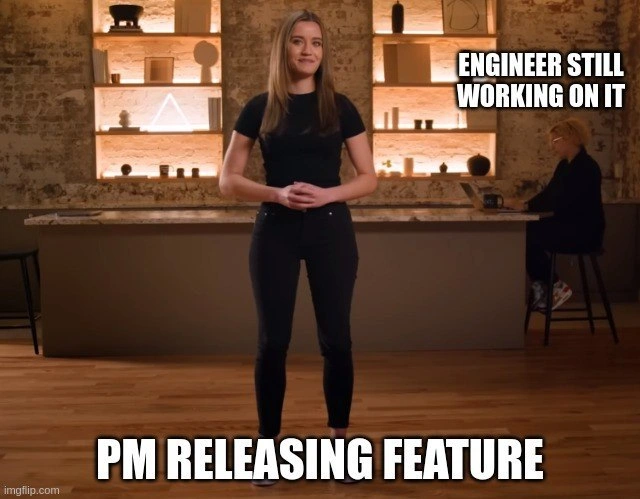
When PMs launch while the last unit test is still red
Why is this Management PMs meme funny?
Level 1: The Half-Baked Cake
Imagine you’re baking a cake for a party, and the recipe says it needs 30 minutes in the oven. Now, suppose the party host (let’s call them the PM, like the boss of the cake) decides to take the cake out at 20 minutes and start serving it to guests even though it’s still gooey and uncooked in the middle. You, the baker (that’s like the Engineer), are standing there with oven mitts on, saying, “Wait, it’s not done yet!” but the host is already announcing, “Dessert is ready, everyone!”
This is exactly what the meme’s situation is like in simple terms. The product manager is the host who’s eager to stick to the schedule (the party started on time, so cake must be served on time). The engineer is the baker who knows the cake (the software feature) isn’t fully baked (the code still has a problem – that’s the “red unit test”). It’s funny in a kind of silly way: one person is proudly showing off something as finished, while the person who actually made it is panicking because they know it’s half-finished.
Everyone can understand that serving an uncooked cake is a bad idea – guests might make faces or get sick. In the same way, releasing software that isn’t ready can make users unhappy or cause things to break. The humor (and frustration) comes from that common human experience: being rushed to present something that you know isn’t quite ready. It’s like your teacher telling the class how great your science project is and asking you to come up and show it, but you’re still in your seat feverishly gluing the last pieces together. You’d probably give a nervous, forced smile while thinking “oh no, please not yet!”
So, the meme is basically a tech version of that story. One person focuses on the deadline (“we said we’d do it now, so here it is!”), and another is concerned with the quality (“but it’s not done correctly yet!”). It’s funny to developers because we’ve all seen that happen, and it usually leads to some messy results – just like cutting a cake too early and having batter ooze out. In simple words: the joke is about launching something too early and the silly bravery (or foolishness) of acting like everything’s fine when clearly it isn’t.
Level 2: Deadlines vs Reality
For a junior developer or someone new to software teams, let’s break down what’s happening in this meme. We have two key characters here: the Product Manager (PM) and the Engineer. The Product Manager is like the coach or planner – they decide what features the product should have and when to release them. The Engineer is the person actually building those features (writing the code) and making sure they work correctly. In the image, the PM is confidently announcing a feature release (think of it as saying, “Hey everyone, our new feature is live!”). But in the background, you see the Engineer still typing frantically away on a laptop, meaning they’re still working on the feature. And there’s a crucial detail: the last unit test is still red, which means one of the automated tests for the code is failing.
Let’s clarify some terms:
- Unit test: A unit test is a small, focused program or script that checks one piece of the code (one “unit”) to make sure it behaves as expected. Developers write these tests as they code new features. If a unit test is red, it means it failed – the code didn’t produce the expected result for that test. A green test means everything passed and is working for that scenario.
- Release: In software, “releasing a feature” means deploying it or making it available to users. It’s like publishing your changes so real people can use the new feature.
- Feature flag: This is a technique used in software deployment. Think of a feature flag as a switch or toggle in the code that can turn a new feature on or off without having to deploy new code. If a feature isn’t fully ready, developers can keep it turned off (hidden from users) even if the code is deployed, and then turn it on later when it’s ready. In our scenario, it sounds like there’s no feature flag for this new feature – meaning if the code is deployed, users will see it immediately, whether or not it’s working correctly.
- Definition of Done: This is a term from agile development. It’s a clear list of criteria that a team agrees on for when a task or feature is truly “done”. For many teams, that includes things like “Code completed”, “Peer-reviewed”, “All tests (unit tests, integration tests) passed”, and “Deployed to staging and approved by QA”. In the meme, the PM and Engineer seem to have a different idea of what “done” means. The PM is acting like it’s done because the date arrived, but the engineer sees that a test is failing, so from a developer standpoint it’s definitely not done yet.
Now, the situation: ReleasePressure is at play. Perhaps there was a hard deadline (maybe a promise to a client or a marketing event scheduled for that day). The PM is likely under pressure from stakeholders – maybe bosses or customers – who expect this feature to be out now. This leads to a MisalignedExpectation: management expects the feature ready by today no matter what, but engineering knows it’s not fully ready. This can happen in real life development teams, especially if communication isn’t great or if the schedule was too optimistic.
Imagine you’re a new developer and it’s your first big project. You’ve been writing code and you have tests that check if the code works. You find out on launch day that one test is still failing – maybe there’s a bug. Normally, you’d say “Hold on, we can’t release it yet, there’s a problem.” But now picture a manager or PM saying “We have to release it now because we promised.” It’s a stressful feeling! You might be thinking, “Uh oh, what if users find that bug? This could break things.”
In a healthier process, the release would be delayed a bit until that test passes (meaning the bug is fixed), or the incomplete feature would be toggled off using a feature flag so that users don’t see a half-finished thing. But here, it seems the PM just launched it. The phrase “launch while the last unit test is still red” is essentially describing a premature release – shipping software that hasn’t fully passed its checks.
For a junior dev, this is a situation you might not have seen yet, but it’s unfortunately common enough that it’s a shared joke. It’s reflecting ManagementVsEngineering tension: the management side cares a lot about hitting the date, and the engineering side cares about the product working correctly. When a PM charges ahead and releases a feature with known failing tests, it often results in DeveloperFrustration. The developer is frustrated because, from their perspective, they’re being asked to present unfinished work as finished. It’s like turning in an assignment that you know is only 90% complete because the teacher insists on collecting it now.
Remember, in software teams, usually everyone agrees that quality and working tests matter. This meme is poking fun at the moments when that agreement breaks down under pressure. If you’re new to the field, the key learning is: deadlines are important, but ignoring obvious problems (like failing tests) can lead to bigger troubles after release. There’s a common saying, “fix it in post” or in software, “fix it in production”, which is said jokingly (meaning we’ll deal with the bugs after we release, hopefully quickly). It’s generally tongue-in-cheek because no one really wants to do that – it’s risky! But sometimes people feel they have no choice due to business pressure.
So, this meme is both a joke and a gentle warning. It’s funny because it exaggerates a real scenario: a PM stands there all triumphant announcing a new feature, while the poor dev is sweating bullets because they know something’s not right yet. If you’ve ever had a teacher or boss announce something you’ve done before you actually finished it, you know the mix of panic and “this isn’t going to end well” feeling. In tech, this translates to deployments and launches. Misaligned expectations and deadline pressure can cause releases that skip some steps, like ensuring all tests pass. For a junior dev, it’s a lesson that sometimes you’ll need to communicate clearly about what “done” really means – and that it’s okay to speak up if a release isn’t ready (though it can be hard if the pressure is high!). And if you ever find yourself in a team that regularly ignores failing tests to push releases... well, now you’ll know why experienced engineers chuckle grimly at this meme. It means you’re living the joke – time to implement some better process, or at least brace yourself for some late-night bug fixing!
Level 3: Ship First, Test Later
From a senior engineer’s perspective, this meme is painfully relatable and darkly funny. It captures that “oh-no-not-again” moment when a Product Manager (PM) proudly announces a feature launch while the developer is literally still coding and seeing failing tests. The image shows the PM standing confident and camera-ready – “PM RELEASING FEATURE” – as if at a polished product launch event. Meanwhile, in the background, the software engineer sits at a laptop furiously typing – “ENGINEER STILL WORKING ON IT”. The humor comes from the absurd mismatch in timing and expectations: the PM’s world of slides, deadlines, and shiny promises colliding with the engineer’s reality of incomplete code and a red CI build. It’s a classic case of MisalignedExpectations between management and engineering.
Why do experienced devs smirk (or cringe) at this? Because it lampoons a common anti-pattern: premature release under pressure. Many of us have been in war-room scenarios where a higher-up says, “We promised this feature by today, so we’re launching today,” even if the latest build is held together with duct tape. The tags like ReleasePressure and StakeholderPressure hint that someone up the chain (stakeholders, sales, executives) demanded the feature by a certain date, and the PM is determined to deliver something come hell or high bugs. The engineer’s panicked posture in the meme suggests there’s no feature flag to simply disable the not-yet-working feature – if there were, the PM could flip the switch later when it’s truly ready. Instead, likely due to missing_feature_flags, the launch is binary: either ship all of it now or break the promise. The result? The PM chooses to ship, effectively saying “We’ll fix it in prod” with a big smile. DeveloperFrustration ensues, because the developer knows that launching with a failing unit test is just asking for a Sev-1 incident at 3 AM (and guess who will be on call to clean up that mess? Not the PM sipping celebratory coffee, that’s for sure).
This situation also underscores a definition_of_done_gap. In agile teams, “Definition of Done” is a shared checklist of what must be completed before a feature is considered truly done – typically including code complete, code reviewed, *all unit tests and integration tests passing, QA verified, and documentation updated. Here, the PM’s definition of done seems to be “code exists on GitHub and we reached the deadline”, whereas the engineer’s definition is “the code actually works and tests pass”. That gap is where nightmares breed. It’s management saying “It’s done, because we said so” versus engineers saying “It’s not done, the tests prove it.” This tension is a rich source of ManagementHumor in tech because it happens more often than anyone likes to admit.
Real-world scenarios echo this meme’s joke. Think of a mobile app update forced out to meet a marketing launch, only for users to discover half-baked features and crashes because QA was cut short. Or a web release on Friday evening (the classic “Friday deploy” doom) because someone high up promised a client that date – the team spends the weekend firefighting as misaligned expectations hit reality. In well-run projects, release management would dictate that a red build never goes live; there’d be emergency triage, possibly a “go/no-go” meeting to decide if the launch should be postponed. The meme implies that in this case, the “go/no-go” sanity check was skipped or steamrolled by a confident PM proclaiming, “Go!”
It also slyly nods to the absence of a safety net like staging sign-offs or incremental rollout. No one did a final review to say “Hold on, our last test is failing.” The engineer still working on it might represent someone hurriedly writing a last-minute bug fix or completing a unit test that’s red – clearly too late because the PM is already live. The consequence is usually a frantic set of hotfix commits right after launch or a quick version 1.0.1 patch — essentially saving face. Seasoned developers know the pattern: ManagementVsEngineering friction where business deadlines trump engineering realities. It’s funny in that gallows-humor way: you laugh to keep from crying, because you remember being that engineer, frantically coding as the release was announced, feeling that knot in your stomach.
The meme resonates because the characters are performing a well-known office drama. The PM front-and-center suggests confidence and presentability – perhaps reporting to stakeholders or users, “We did it, feature X is out!” The engineer in the dimmer corner underscores that the work was literally still ongoing as the announcement happened. It highlights MisalignedExpectations: The PM might genuinely believe “it’s basically done, just minor tweaks left,” whereas the dev knows those “minor tweaks” could be hours or days of work and critical for stability. This comedic contrast calls out a systemic issue: often PMs are incentivized to show prompt delivery (they promised a roadmap, and their performance might be measured by hitting dates), while engineers are incentivized to ensure product quality and stability. When those incentives clash, you get the “launch now, debug later” antipattern. For veteran devs, it’s a scene that’s all too familiar, evoking a mix of sympathy and “facepalm” laughter.
As a final note on why this is ManagementHumor gold: nobody is explicitly the villain in the meme, but the scenario jokes about a process failure that many tech teams have experienced. It’s a lighthearted jab at PMs who are so focused on the launch timeline that they might ignore red flags (or red tests) that engineers cannot in good conscience overlook. A senior engineer sees both the humor and the hazard: it’s funny because it’s true, but also slightly traumatic remembering the production bugs that likely followed such stunts. In essence, “PM launching with last test red” symbolizes a premature_release – a tale as old as software projects, where hope and pressure triumph over caution, at least until reality (and bug reports) catch up.
Level 4: Iron Triangle Ignored
At the deepest engineering process level, this meme highlights a violation of the classic project management triple constraint (often visualized as an Iron Triangle of scope, time, and quality/cost). In theory, if you lock in a fixed scope (the promised feature set) and a fixed time (the launch date), quality is bound to suffer – and here it’s bleeding in real-time. The PM (Product Manager) has essentially prioritized schedule and feature commitments over code quality. This flies in the face of agile principles and continuous integration practices. In a properly tuned CI/CD pipeline, merging code with a failing unit test (a test that’s currently red) should block deployment. By launching with red tests, the PM is overriding a fundamental safety mechanism – akin to bypassing an emergency brake on a train because the train must arrive at 5:00 PM sharp.
From a software engineering theory perspective, this situation accumulates technical debt. That debt occurs because every known failing test is a known bug or incomplete piece of work being pushed forward. Just as taking on financial debt incurs interest, shipping a bug now means paying interest later in the form of urgent hotfixes, customer support headaches, and loss of user trust. It’s reminiscent of Brooks’s observation in The Mythical Man-Month that "Nine women can’t make a baby in one month." Here, no amount of optimism or managerial willpower can magically turn failing tests green by decree. Hofstadter’s Law ("It always takes longer than you expect, even when you take into account Hofstadter’s Law") looms in the background: software often needs more time than initially planned. By ignoring that and launching anyway, the PM is effectively defying empirical law in favor of a calendar date.
There’s also a hint of irony against modern best practices like feature flags (a key concept in continuous delivery which decouples deployment from release). With feature flags, incomplete features can be deployed to production but kept inactive for users until they’re truly ready. The meme’s scenario implies missing feature flags: instead of safely dark-launching an unfinished feature, they apparently went full send. This is a pathological inversion of continuous delivery ideals – rather than “release when ready”, it’s “release now, ready or not”. In formal terms, one might compare it to failing open: the system (release pipeline) should fail closed (stop the launch on test failure), but management forced it open. The fundamental definition of done – typically a checklist that includes all tests passing – has been ignored, indicating a breakdown in process discipline. In summary, the meme exposes a scenario where theoretical frameworks (project management constraints, CI/CD gating rules, agile “done” criteria) are cast aside, with predictably perilous implications for software quality.
Description
The meme shows a well-lit modern office set with rustic brick walls and a back-lit shelving unit full of geometric décor. In the foreground, a woman (face blurred) stands confidently, hands clasped; white caption at the bottom reads: “PM RELEASING FEATURE.” In the upper-right background a person sits at a laptop, clearly still typing; over their head the text says: “ENGINEER STILL WORKING ON IT.” The visual joke contrasts the polished product-launch posture of a product manager with an engineer still hammering out code, illustrating the all-too-familiar scenario where release dates ignore implementation reality. Senior engineers will recognize the implicit absence of feature flags, staging sign-offs, or proper DONE-criteria, highlighting classic friction between roadmap promises and deployment readiness
Comments
7Comment deleted
Sure, the sprint isn’t over, but according to the roadmap we already shipped - Schrödinger’s release: simultaneously in prod and still in development
The PM's definition of 'done' is when the JIRA ticket moves to the right column, while the engineer's definition involves actual working code. But hey, who needs complete features when you can just rebrand bugs as 'iterative improvements' in the next sprint retrospective?
This perfectly encapsulates the classic PM-engineering temporal paradox: in the PM's reference frame, the feature shipped three sprints ago and is already generating revenue projections, while in the engineer's reference frame, they're still debugging race conditions in the authentication middleware and haven't even started the integration tests. It's like quantum superposition, except the feature is simultaneously 'done' and 'not even close' until a production incident collapses the wave function
GA apparently means Generally Announced - the feature flag’s still off, but the slide deck hit 100% rollout
PM flips the feature flag for the keynote while the engineer’s still writing the migration - Schrödinger’s deploy: shipped and rolled back until PagerDuty opens the box
PM: 'Feature live!' Engineer: 'Live? It's still buffering in dev - hope stakeholders like loading spinners.'
Literally my team last week! Comment deleted