Lion King Meme: Never Look at the Chinese Smarthome VLAN
Why is this IoT meme funny?
Level 1: The Stranger's Room in Your House
A dad shows his kid their beautiful house and yard: "All of this is ours, and it's safe." The kid points at a creepy shed in the corner: "What about that?" The dad goes quiet and says, "We don't go there." The shed is where the family keeps all the cheap talking gadgets — the lamp, the vacuum, the doorbell — that secretly call their faraway factories every night to chat about who knows what. The family can't stop the gadgets from gossiping, so they locked them in the shed where they can't hear anything important. It's funny because every tech-savvy household really does have that shed, and really does pretend it isn't there.
Level 2: Salt Circles and Subnets
A VLAN (Virtual Local Area Network) lets one physical network behave as several logically separate ones: your router and a managed switch tag traffic so devices on VLAN 20 can't talk to devices on VLAN 10 unless a firewall rule explicitly allows it. It's the standard tool for network segmentation — splitting a network into trust zones so a compromised device can't pivot to your laptop, your NAS, or your password manager's sync box.
The reason smart-home devices earn their own quarantine zone: they're small Linux computers with WiFi, built to a brutal price point. Security updates are rare; many "phone home" — maintain persistent connections to manufacturer cloud servers (very often in China, hence the caption) — for app control and telemetry. You can't see inside the firmware, so the safe assumption is hostile-until-proven-otherwise. The common setup: a main VLAN for trusted machines, an IoT VLAN that can reach the internet but not the main network, and narrow one-way exceptions so your phone can still command the lights.
A homelab is the hobbyist version of enterprise infrastructure people run at home — and setting up exactly this segmentation is a rite of passage. The first time you watch your smart plug's traffic logs is the moment the meme stops being abstract: this is the same instinct as not plugging a found USB stick into your work laptop, applied to devices you willingly mounted on your ceiling.
Level 3: Everything the Light Touches, Except That Subnet
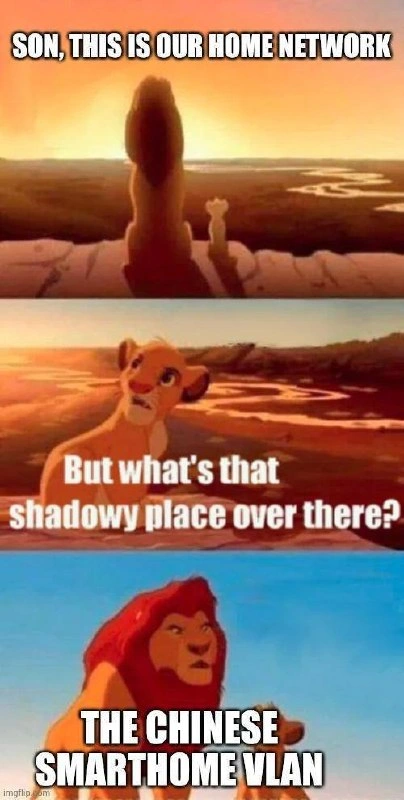
The classic Lion King "shadowy place" template, deployed with surgical accuracy. Mufasa and young Simba survey the sunlit kingdom from Pride Rock:
SON, THIS IS OUR HOME NETWORK
Simba, troubled, asks the canonical question — "But what's that shadowy place over there?" — and Mufasa delivers the answer every homelab operator already knew was coming:
THE CHINESE SMARTHOME VLAN
In the film, the shadowy place is the elephant graveyard: part of the kingdom, technically, but forbidden, dangerous, and explicitly not ours. That maps one-to-one onto the defining ritual of modern home network segmentation: cheap IoT gear — smart bulbs, plugs, robot vacuums, cameras, most of it built on Tuya or similar Chinese cloud ecosystems — gets herded onto an isolated VLAN with firewall rules that amount to you may reach the internet, you may never reach us. The devices work fine. They also chatter constantly with cloud servers you can't audit, run firmware that hasn't seen a patch since manufacture, ship with telnet daemons of mysterious provenance, and occasionally appear in botnet writeups. Mirai taught the industry in 2016 what a few hundred thousand unpatched cameras can do to the internet; the IoT VLAN is the domestic scar tissue from that lesson.
The sharpest part of the joke is Mufasa's tone. He doesn't say "we firewalled it" or "it's mitigated" — he says, in effect, never go there. That's the real posture: not confident security engineering but ritual containment. The packet captures from that subnet are technically available and nobody opens them, because what would you even do with the knowledge that your robot vacuum uploads your floor plan at 3 AM? You bought the lamp for $11; auditing it is not part of the deal. The firewall rule is deny inter-vlan, but the operational policy is plausible deniability. Network engineers run the same play at industrial scale — OT networks, guest WiFi, DMZs — and the meme's honesty is admitting that at home, segmentation is less zero-trust architecture and more drawing a salt circle around the gadgets and agreeing not to make eye contact.
Description
A three-panel Simba/Mufasa 'Lion King' meme. Top panel: Mufasa and young Simba stand on Pride Rock overlooking sunlit savanna, captioned 'SON, THIS IS OUR HOME NETWORK'. Middle panel: Simba looks worried and asks 'But what's that shadowy place over there?'. Bottom panel: stern Mufasa replies 'THE CHINESE SMARTHOME VLAN'. An imgflip.com watermark is visible. The meme captures the homelab/network-security practice of quarantining cheap IoT smart-home devices (often phoning home to Chinese cloud servers) into an isolated, untrusted VLAN that no sane administrator ever inspects or allows near the main network
Comments
1Comment deleted
It's not a DMZ, it's a containment zone - the firewall rule isn't 'deny all' so much as 'we don't make eye contact'