Our entire software empire balanced on the systemd everyone loves to hate
Why is this OperatingSystems meme funny?
Level 1: Elephant on a Stool
Imagine a huge elephant balancing on a tiny little stool – it looks funny because you’d wonder, “How is that stool not breaking?” This meme is like that, but with computers. The giant elephant represents all the big stuff our computers do (the entire internet, apps, programs – the whole world of software). The tiny stool represents a small piece of core software called systemd (which is basically the first thing that runs when a computer starts and helps everything else to launch). Now, many tech folks like to complain about systemd (kind of how people grumble about a creaky stool), but here’s the catch: that “stool” is holding everything up! If it wobbles or breaks, the poor elephant (our tech world) could tumble down. The meme is funny because it’s a bit absurd – who would put an elephant on a little stool, right? – yet it’s saying that in real life, we sort of did exactly that with our software. We built a towering “software empire” and balanced it on systemd, which not everyone trusts. It’s a mix of silly and true: silly, because it’s a crazy picture to imagine, and true, because a lot of important computer systems really do depend on this one little thing. We laugh at the idea to cope with the slight scariness of it. After all, it’s a reminder that in technology (just like in a circus), sometimes the most important piece is a small, unfancy thing doing a hard job — and you’d better hope it keeps steady, or the whole show might come crashing down.
Level 2: Turtles All the Way Down
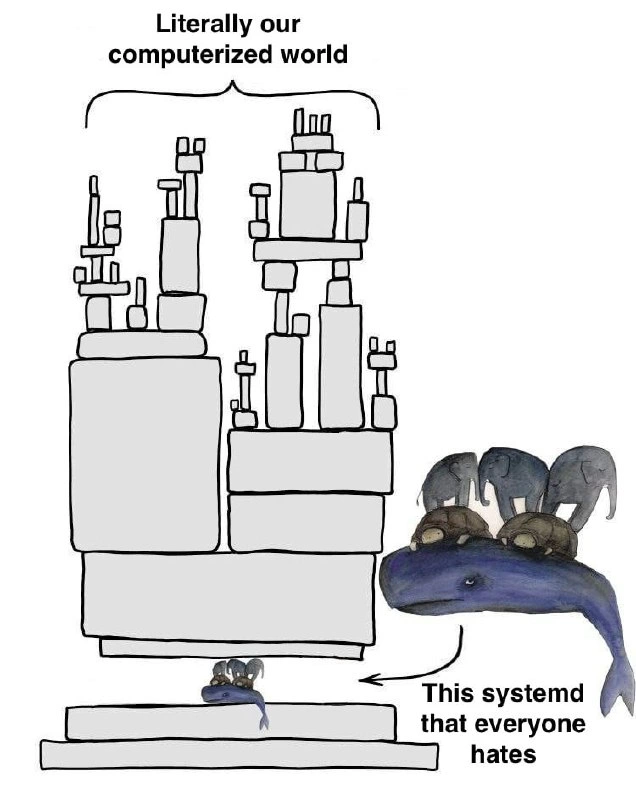
Let’s break down the meme in simpler terms. The cartoon shows a huge stack of grey blocks (imagine skyscrapers) labeled “Literally our computerized world.” This represents all the software we use – from websites and apps to databases and the cloud – basically all of modern computing. And what is that massive digital world standing on? At the bottom of the stack is a small platform (the foundation). The meme labels that platform as “This systemd that everyone hates.” In other words, the artist is saying: our entire software world is balanced on top of systemd. To drive the point home (and add humor), the drawing uses a famous metaphor of a world supported by mythical creatures. Beneath the platform, there’s a tiny blue whale carrying some turtles, which in turn carry a few elephants on their backs. This is a reference to the joke phrase “turtles all the way down,” which comes from an old myth about what holds up the Earth (in some tales, the world sits on elephants, which stand on a giant turtle, and when asked what the turtle stands on, someone quips “It’s turtles all the way down!” implying an endless stack of turtles). The meme borrows this imagery to be playful: it’s as if systemd is the ultimate turtle at the bottom holding everything up (with a whale and elephants thrown in for good measure to match the legend and add absurdity). In Terry Pratchett’s fantasy novels (Discworld), for example, a flat world rests on four elephants standing on a giant turtle. Here, we’ve got a whale and three elephants – the specifics aren’t as important as the idea of a stack of creatures supporting a tremendous weight. It’s illustrating hidden complexity: there are layers and layers of stuff underneath our everyday technology that we normally never see.
Now, what exactly is systemd? Simply put, systemd is a crucial piece of a Linux operating system that kicks off and manages all the background services. When you power on a Linux computer or server, the sequence goes like this: the kernel (the core of the OS) boots up and then launches one special program to set everything else in motion. That special program is the init system, and on most modern Linux systems the init is systemd. Think of systemd as the conductor of an orchestra. When a computer starts (the concert), systemd comes on stage first and starts cueing all the musicians (various services and processes) to begin at the right time. It makes sure, for instance, that the networking service is started, your disks are mounted, the graphical interface (or text logins on a server) begins, scheduled tasks are set up, and so on – all in the proper order. In older days, a script called init would just run a list of other scripts one by one (imagine an orchestra where each musician starts playing one after the other, which isn’t very efficient). Systemd is more sophisticated – it can start many things in parallel (our conductor cues whole sections of the orchestra at once) because it knows what depends on what. For example, it knows the database server should start after the storage is ready, but the logging service can start any time and the network can come up in parallel with other things. This makes booting much faster and more organized. Systemd also keeps an eye on services after they start, kind of like a stage manager ensuring everyone keeps playing: if a web server process crashes, systemd can restart it automatically. It provides a uniform way to configure and manage these processes (with commands like systemctl start <service> or journalctl for logs). In short, systemd is the behind-the-scenes init system making sure a Linux system’s show runs smoothly from the moment you hit the power button.
So why does the meme say “everyone hates” systemd? Well, that’s an exaggeration for effect – not literally everyone hates it, but it has been controversial in the tech community. Systemd was a big change from how things were done before, and many engineers are resistant to big changes, especially in foundational systems. Before systemd, Linux used simpler, text-based init systems (like one called SysV init, which used plain shell scripts to start services, or another called Upstart). Those were more basic and arguably easier to understand piece by piece. Systemd came along and did things very differently – it’s technically more complex (with all those parallel starts, configuration files, and background daemons). Some people felt it violated the classic Unix philosophy of “do one thing and do it well” because systemd is one program that does a lot (perhaps too much in their view). There were also concerns about dependency bloat – systemd introduced its own way of logging, its own rules, and other systems started depending on systemd’s features. Detractors joke that it’s trying to be “the one service to rule them all.” They gave it nicknames like “init system from hell” or say it causes dependency hell because once your software expects systemd, you can’t easily run it without systemd. On the flip side, many developers like systemd because it standardized and unified a lot of the boot process across different Linux distributions and made certain things (like enabling/disabling services at boot) much more convenient and consistent. Whether you love it or hate it, if you’re working with modern Linux, you have to deal with systemd – it’s just everywhere now. It became the default in most major Linux distros around the early 2010s, so virtually all Linux servers and devices you encounter today will be running systemd under the hood.
The meme’s joke, therefore, is a mix of astonishment and anxiety: “Can you believe our entire high-tech world relies on this one piece of software that so many geeks gripe about?” It’s highlighting a dependency risk in a tongue-in-cheek way. All those grey towers (think of them as huge applications or even industries like finance, tech, healthcare that run on computers) are standing on a single slender pillar named systemd. There’s also a truth about technical debt here: we built a lot on top of systemd very quickly because it solved some immediate problems, but now we’re kind of “stuck” with it. Replacing it would be extremely hard since everything has grown around it (that’s what technical debt means – making a choice that is convenient now but might cause difficulty later). It’s similar to constructing a giant Jenga tower; systemd is a block near the bottom. You might not love that particular block (maybe it’s oddly shaped and makes the tower wobble), but removing or changing it is risky because the whole structure could collapse. In real terms, if systemd were to fail or have a serious bug, it could bring down lots of services at once. And indeed, there have been moments where a bug in systemd caused trouble across many systems – when those happen, the jokes and memes about “see, told you this was a bad idea!” flare up again among admins. For a newcomer, the important concept is this: dependencies make our technology like a big stack of blocks. We usually focus on the top blocks (the apps we directly use), but the bottom blocks (the low-level stuff like systemd) carry all the weight. This meme humorously reminds us of that fact by literally drawing the bottom block as a tiny creature straining under an immense load.
To really see systemd’s role, here’s a tiny experiment on a Linux system: you can actually check what process has PID 1 (process ID 1). It’s almost always systemd nowadays. For example:
$ ps -p 1 -o comm=
systemd
This command asks “what is the command/name of the process with ID 1?” and the answer will come back as “systemd.” That shows that systemd is the first process (the init) running, which then launches everything else. So, the meme isn’t exaggerating — your Linux machine truly starts from that one process. All the fancy things you do on a computer, from browsing cat videos to running a web server, ultimately rely on that first step being successful. When people joke about hating systemd, it’s a bit like programmers teasing the plumbing of a house: you only notice it when it acts up, and because it’s complicated, when it breaks it’s a pain to fix. But we also know we can’t do without it. Thus, “our entire software empire” is tongue-in-cheek phrasing to say we’ve built so much, and it’s all resting on this one backend piece, ha ha (gulp). The humor comes from that mix of “isn’t it crazy?” and “yep, that’s our reality.” Even if you’re new to this, you can appreciate the idea: big, important things can depend on small, unseen things. And in tech, those small things can be both a blessing (when they work) and a source of collective groaning (when they don’t). The meme wants you to be in on that joke.
Level 3: One init to Rule Them All
If you’ve been around the block (or around the server room) a few times, this meme probably makes you smirk and shudder at the same time. It captures that familiar “house of cards” feeling in tech: an enormous system balanced on one often-criticized component. In daily practice, we don’t think about systemd much — it’s just there, PID 1, quietly launching all our daemons and services whenever a Linux machine boots. But the moment something goes wrong with it, every Dependency up the chain collapses. Experienced developers and sysadmins have learned (sometimes the hard way) that almost everything in a Linux environment ultimately traces back to systemd. The meme’s giant grey tower (“Literally our computerized world”) resting on a minuscule base is a perfect visualization of that dependency pyramid. It’s funny in that laugh-cry way because it’s true: we’ve seen incidents where a single mis-configured systemd unit prevented an entire fleet of servers from coming online. Suddenly, microservices, databases, and web apps – all those towering blocks – are frozen because the init system at the base hiccuped. It’s the textbook definition of a single point of failure. One veteran jokes over coffee, “We replaced a dozen init scripts with one systemd, and now when it breaks, it breaks a dozen things at once. Progress!” – a cynical quip born from real experience.
The phrase “this systemd that everyone hates” in the meme isn’t much of an exaggeration in certain circles. Systemd is a bit of a celebrity villain in the Linux world. Seasoned Unix folks often rant about it violating the old-school ethos. Under the Unix philosophy of small, sharp tools, init was supposed to be a tiny program that kicked off some scripts and stayed out of the way. Systemd said “Nah, I’ll handle everything: service management, logging (journald), device events (udev), scheduled tasks (timers), network configuration — you name it.” To many, this felt like Windows-style bloat creeping into Linux. They joke that systemd is trying to absorb the entire userland. Words like “monolithic” and “bloated” get thrown around. There were flame wars on mailing lists, distro maintainers resigning in protest, even a fork of Debian called Devuan purely to avoid systemd. That’s the “hate” part – or at least strong technical disagreement. People love to hate on systemd the way developers might gripe about a language or a framework that’s popular but has warts. It’s almost a meme unto itself: “Oh, it’s probably systemd’s fault” – said only half-jokingly when some obscure boot or service issue arises.
And yet… we all use it. That’s where the humor doubles back on us. Technical debt isn’t just old spaghetti code in a corner of your app; sometimes it’s a giant decision the whole industry made, which we can’t easily undo. Adopting systemd everywhere solved a lot of short-term headaches (faster parallel boots, unified configuration, consistent behavior across distros), so we ran with it. Over the years, we’ve piled more and more on top of it – every distribution, every software package assumes systemd’s presence now (with few exceptions). Backing it out would be a herculean effort; basically nobody wants to rewrite hundreds of SystemdServices as something else unless absolutely forced. So here we are: our OperatingSystems rely on this intricate init system that some folks grumble about continuously. It’s an ongoing industry in-joke and a cautionary tale: the thing we swore we’d never use is now the thing we can’t live without. The meme nails this irony by depicting the TechnicalDebt as literal weight on systemd’s back. Think of all the scripts, services, and tools intimately tied to systemd now – that’s the weight. We’ve effectively locked ourselves in; whether systemd was the best design or not, it’s the cornerstone we’ve cemented in place.
For those of us who have been paged in the dead of night due to some weird systemd issue, the image also triggers a touch of PTSD (the dark humor kind). Picture a frantic late-night scenario: an update to a systemd unit file on dozens of servers goes wrong — and now none of those machines boot properly. You’re sweating bullets trying to debug an initramfs console, basically spelunking into the bowels of the OS because one tiny detail in the base system broke everything above. Dependency hell? This is it in living color. It’s the classic “small error, big impact” situation. The meme is essentially our collective, weary observation: “Yup, one blue whale (Docker? systemd? both!) and a stack of turtles is all that’s beneath our skyscraper of tech. Kinda scary, huh?” We laugh because acknowledging the absurdity is healthier than panicking about it. As senior engineers, we’ve learned to respect that fragile base, even if we poke fun at it. After all, every time a Linux box cleanly boots in seconds, that’s systemd quietly doing its job. We might curse its name in forums and rants, but we’re also secretly relieved it functions. In a way, we gripe about systemd precisely because it’s so fundamental — it’s the plumbing of our digital world. And if the plumbing backs up, everyone notices (and someone’s spending their weekend fixing it). The meme gets a knowing chuckle because it’s a portrait of our infrastructure’s reality: big ambitions, towering systems, and one little-understood process at the bottom holding it all up. It’s equal parts amusing and terrifying, a feeling every seasoned dev understands all too well.
Level 4: Bootstrapping an Empire
At the deepest technical level, this meme highlights a core truth of operating system architecture: everything in a modern system ultimately starts from a single bootstrap process. In Unix-like systems (like Linux), after the kernel finishes its low-level hardware setup, it launches one process with PID 1 – the init system. systemd (short for system daemon) is the dominant init on Linux today. It’s literally the first userspace program the kernel runs, and it remains running as the foundation for all other processes. The entire computing stack – from your web servers to container fleets – is precariously perched atop this single process. The meme accentuates this by drawing “Literally our computerized world” as a colossal tower resting on a tiny base labeled “this systemd that everyone hates.” It’s a nod to the classic metaphor of “turtles all the way down” – except here the regress isn’t infinite. It stops at one critical turtle: systemd. In other words, our software empire ultimately bootstraps from one init process. If that single point of failure falters, everything above it can come crashing down.
But systemd is no simple turtle; it’s more like a mega-turtle with jetpacks. Under the hood, systemd brings hidden complexity to the boot process in exchange for power and speed. Unlike its simplistic predecessors (which ran one script after another in a fixed sequence), systemd treats boot-up as a parallelizable, dependency-driven operation. It defines a directed acyclic graph of units (services, mounts, targets, etc.), expressing “A must start after B,” “C depends on D,” and so on. Booting then becomes an exercise in graph theory: systemd computes an execution order that satisfies all these dependencies, launching as much as it can concurrently. This is essentially a topological sort of the init sequence, unlocking significant speed-ups through parallelism. For example, instead of waiting for one service to fully finish before starting the next, systemd might start networking, logging, and database services in parallel as long as their prerequisites (like filesystem mounts or hardware initialization) are met. It even employs socket activation — a clever trick where systemd pre-listens on ports and kicks off the actual server daemons on-demand — so that services don’t need to launch preemptively and yet nothing misses a network request. To manage all these processes robustly, systemd leverages Linux kernel features like cgroups (control groups) to isolate and track service processes. Every daemon runs in its own cgroup slice, and if it misbehaves, systemd can throttle or restart it in a controlled way. These are sophisticated mechanisms, far beyond the scope of the old /etc/init.d shell scripts. From a software design perspective, systemd is applying modern concurrency and scheduling techniques to what was once a straightforward (if slow) sequential init process. It’s as if the humble init has evolved into an entire sub-operating-system devoted to starting and supervising the real operating system.
However, with great power comes great complexity. The very idea of putting so much logic into PID 1 makes old-school Unix folks uneasy. In system design theory, critical components that everything depends on are best kept as simple and minimal as possible – fewer moving parts mean fewer things can break. systemd brazenly challenges that rule. It’s a single binary (with many modules), around which orbit dozens of auxiliary binaries and configuration files, all tightly coupled to get the job done. If any part of this orchestration goes wrong (say a misordered dependency or a bug in the init logic), the fallout is immediate and widespread. A traditionalist might quip that systemd is monolithic and violates the “do one thing well” philosophy – making it *one big thing that tries to do everything. Academically, one could view this as a trade-off between software complexity and control: systemd’s designers argue that integrating these tasks under one umbrella leads to a more dependable and predictable boot process (no ad-hoc scripts racing each other). Detractors counter that this umbrella is too large and catches fire in too many new and exciting ways. It’s a bit of a paradox: by stuffing more logic into the foundation, you can prevent many routine failures (like race conditions at boot) and provide uniform management, but you also risk DependencyHell within PID 1 itself. If you’ve ever dug into a gnarly systemd issue, you know it’s like untying a massively tangled knot deep in the OperatingSystem’s guts. Yet, here we are – practically every modern Linux distribution has bet the farm on this approach. For better or worse, industry practice has made systemd the single init to rule them all. And to its credit, it usually works astonishingly well, silently handling the chaos of boot every time you power up. The meme’s dark humor comes from that tiny margin of error: we’ve piled our towering cloud of applications on this intricate, critical piece of software that many engineers rant about. It’s the ultimate irony in infrastructure: the code we love to hate is the one holding up the world. (What could possibly go wrong, right?)
Description
Cartoon-style drawing: on the left, a huge stack of grey rectangular blocks and thin pillars forms skyscraper-like towers. Above it, bold text reads “Literally our computerized world,” with a bracket indicating the whole towering structure. Beneath this massive stack is a narrow grey platform. Far below, a tiny blue whale supports three brown turtles, which in turn carry three small grey elephants; a curved arrow points from the whale toward the base of the skyscraper, accompanied by the caption “This systemd that everyone hates.” The humor highlights how the vast, intricate layers of modern software depend on a single low-level init subsystem (systemd) that many engineers criticize, illustrating hidden complexity, dependency risk, and technical debt in contemporary Linux infrastructure
Comments
36Comment deleted
We’ve got multi-region self-healing K8s, four layers of service mesh, and a weekly chaos-monkey drill - yet the whole empire still hinges on one 600-k-line PID 1 written by a guy whose vacation isn’t in the runbook
After 15 years in the industry, I've accepted that systemd is like that one microservice that accidentally became a distributed monolith - it started as an init system and now it's your network manager, DNS resolver, boot loader, and probably your therapist if you enable the right unit file
Ah yes, systemd - the architectural equivalent of discovering your entire microservices empire is actually running on a single whale in the ocean. Everyone complains about its monolithic design and scope creep, yet somehow it's become the load-bearing mammal of the Linux ecosystem. The real joke? We spent decades arguing about init systems, and now we're all riding the same whale, pretending we have better alternatives while secretly knowing that migrating away would require rewriting half the infrastructure documentation ever written. At least it's not running in a Docker container... or is it?
We love to hate systemd, but the whole cloud is balanced on its PID 1 - when it hiccups, Kubernetes doesn’t self-heal so much as self-host a postmortem
We fawn over the K8s-orchestrated elephant-turtle-whale zoo scaling to infinity, but one peek at that stable COBOL fish triggers migration PTSD
Five nines, multi‑cloud, service mesh - then one bad systemd unit hangs boot; turns out our global architecture has a single critical box labeled PID 1
fixed Comment deleted
based Comment deleted
I mean, not really Comment deleted
Containers are easily the best thing since sliced bread package managers in SE Comment deleted
Docker as a tool is amazing, the only problem is how damn inefficient and ugly it is at times Comment deleted
I literally had to reimplement a slice of Podman for my usecase because even Podman couldn't start a thousand hello-world containers in parallel without consuming 16 GB of RAM Comment deleted
But why. That is decidedly not what containers are for. Comment deleted
I needed to start lots of isolated environments for a CTF challenge Comment deleted
hate docker luv vagrant simple as Comment deleted
Layers goes brrrr Comment deleted
i dont hate docker because i dont even know what it really is Comment deleted
Who hates systemd? Comment deleted
i do Comment deleted
Why? Comment deleted
People who want to shutdown systems properly Comment deleted
Can't you build your kernel without it? Comment deleted
Can't you disable it? Comment deleted
Didn't have any problem shutting down my system with systemd lol Comment deleted
for me 50% chance it waits for termination of a process FOREVER Comment deleted
That’s more of a most desktop Linux programs don’t close properly when asked to problem than a systemd problem lol Comment deleted
I do. I'd prefer init.d. Comment deleted
sysvinit FTW! 💪 Comment deleted
A thousand is a ridiculous number though. It's not really particularly reasonable to expect that to be less than 16GB Comment deleted
Well, those guys think otherwise. https://xkcd.com/619 Comment deleted
I mean… Linux is used by supercomputers, there's a genuine need for a feature like that Comment deleted
I am not very familiar with supercomputer design, so may be mistaken, but always thought that such systems are formed by a large number of regular nodes with 1 to 16 processors in each, and fast interconnect between nodes, but not that fast for external resources to be treated in the same way that local processors and memory is controlled by OS, — that is, they are just regular [multiprocessor] nodes connected in a cluster, much like in enthusiast grid computing but very tighly coupled. Comment deleted
Aaa, yes, Lennart "fucking" Poettering Comment deleted
Docker and 3 postgresql instances Comment deleted
It can’t predict when or if they’re gonna close at all Comment deleted
But I believe you can just configure it to kill them outright like most other inits do, instead of asking them nicely to close Comment deleted