Skip to content
DevMeme
7230 of 7435
Strait of Hormuz as a Layered Firewall Network Diagram
Networking Post #7928, on Apr 15, 2026 in TG

Strait of Hormuz as a Layered Firewall Network Diagram

Why is this Networking meme funny?

Level 1: Three Gatekeepers on One Bridge

Imagine your neighborhood pool has exactly one gate, and to get in or out you must pass three separate guards standing in a row — one hired by your family, one by the neighbors across the street, and one by the family that doesn't get along with either of them. Each guard checks your bag, writes down everything you're carrying, and waves you to the next guard. This picture does that with a real piece of ocean: the calm water on the left is "our safe pool," the open sea on the right is "everywhere else," and the narrow passage between them has three flag-wearing checkpoints. It's funny because calling the pool "safe" is a stretch when three different gatekeepers — who don't trust each other — are all reading your diary on the way through.

Level 2: Reading the Diagram

The vocabulary, mapped from screen to sea:

  • A LAN (Local Area Network) is your internal network — office machines, home Wi-Fi — conventionally drawn as the safe "inside" zone. Here, it's an entire gulf.
  • A firewall (FW) sits at the network edge and decides which traffic may pass, inspecting packets against rules. Tankers passing the strait under the gaze of coastal powers map onto packets passing inspection.
  • Cisco is the dominant American maker of enterprise network equipment; Huawei is its Chinese counterpart. In real deployments you'll see one or the other guarding an internet edge — seeing both in series, plus a homegrown "Domestic FW", parodies organizations that layer redundant gear from mutually suspicious vendors and call it strategy.
  • Defense in depth means multiple independent security layers, so one failure doesn't expose everything. The meme pushes it to absurdity: three layers, three flags, three sets of geopolitical interests.

If you're new to networking, the green arrow is the detail to appreciate — it's the classic "permitted traffic flow" annotation from a thousand architecture slides, except the traffic is presumably an oil tanker. Once you've drawn your first network diagram with trusted zones and ingress points, you'll never look at a strait, toll booth, or airport security line the same way again.

Level 3: Defense in Depth, Sponsored by Your Adversaries

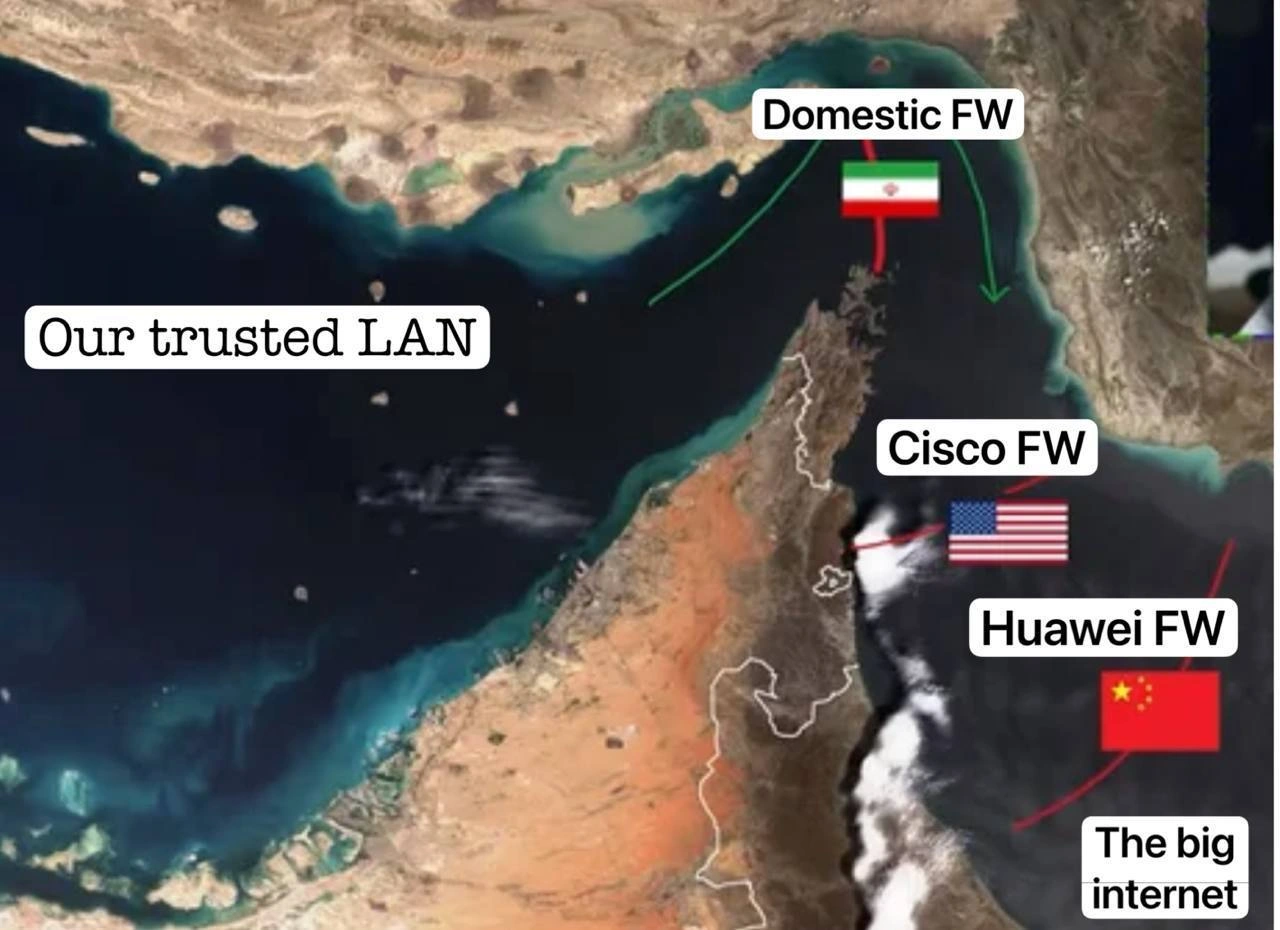
Take a satellite photo of the Strait of Hormuz, the planet's most famous maritime chokepoint, and annotate it like a perimeter security diagram: the Persian Gulf becomes "Our trusted LAN", the Gulf of Oman becomes "The big internet", and the narrow strait between them gets three stacked inspection layers along red boundary lines — "Domestic FW" under an Iranian flag, "Cisco FW" under a US flag, "Huawei FW" under a Chinese flag — with a green arrow tracing the permitted egress route. The geography does half the comedy: roughly a fifth of the world's oil really does squeeze through this strait, every tanker subject to whoever can project power over it, which makes it the physical world's best approximation of a default gateway.

The sharper joke is about the firewall stack itself, and any security engineer winces in recognition. Chaining Cisco and Huawei appliances in series is a real pattern in some networks, justified with defense-in-depth logic: a vulnerability in one vendor's box presumably won't exist in the other's. But the meme's flag choices expose the uncomfortable subtext — both vendors have spent a decade accusing each other's governments of baking surveillance into network gear. Huawei was banned from US and allied infrastructure over espionage fears; the Snowden-era disclosures showed NSA interdiction of Cisco shipments to implant beacons. Running both in series doesn't mean nobody can read your packets; it arguably means everybody can — deep packet inspection as a multinational consortium. Your "trusted LAN" is trusted by three intelligence services, minimum.

There's also a quiet jab at how perimeter thinking ages. The castle-and-moat model — pure inside, hostile outside, one fortified chokepoint — is exactly what the zero-trust movement spent years dismantling, because real breaches stroll laterally through the "trusted" zone once they're past the strait. Labeling an entire gulf bordered by half a dozen rival states "our trusted LAN" is the geopolitical version of flat internal networks with any/any rules: the perimeter is magnificent and the inside is a handshake agreement.

Description

A satellite photo of the Strait of Hormuz region annotated like a network topology diagram. The Persian Gulf is labeled 'Our trusted LAN'; at the strait's chokepoint, three stacked firewall layers are marked along red boundary lines: 'Domestic FW' with an Iranian flag, 'Cisco FW' with a US flag, and 'Huawei FW' with a Chinese flag; the open Gulf of Oman beyond is labeled 'The big internet'. A green arrow shows traffic routing through the layers. The meme maps geopolitical chokepoint control onto defense-in-depth network architecture, joking that the perimeter is a stack of mutually distrusting vendors' firewalls between the 'trusted' internal zone and the wider internet

Comments

1
Anonymous ★ Top Pick Three firewalls from three adversarial vendors in series: guaranteed packet inspection by everyone except your own security team
  1. Anonymous ★ Top Pick

    Three firewalls from three adversarial vendors in series: guaranteed packet inspection by everyone except your own security team

Use J and K for navigation