A Developer's True Love: Bugs and Fixes
Why is this Bugs meme funny?
Level 1: Fixes over Kisses
Imagine a kid who pushes away a big warm hug, but then jumps up and down with excitement to clean up a mess or fix a broken toy. That seems pretty silly, right? Normally, you’d expect someone to want the hug (hugs are nice and comforting) and not be thrilled about dealing with a problem. That role-reversal is exactly why this picture is funny. It takes the usual idea of “hugs and kisses” – which means love and affection – and swaps it with “bugs and fixes,” which means having problems in your computer program and solving them. It’s like saying this person (a software developer) would rather tackle a pesky problem than get love and cuddles. The humor comes from the surprise: they’re choosing a trouble (a bug) and the work needed to fix it over something as sweet as a hug and a kiss.
Of course, in real life people like affection! The joke is just playing with an extreme scenario to get a laugh. It shows how a programmer’s world can sometimes seem upside-down to others. Developers get so used to bugs (little glitches or mistakes in code) and fixes (repairing those mistakes) that dealing with those becomes very normal – maybe even something they take pride in. So this meme is a goofy way of saying, “I spend so much time fixing computer bugs, it’s as if I enjoy that more than getting hugs.” It’s funny because it’s an exaggeration that turns our expectations on their head. Even if you’re not a tech person, you can understand the silly contrast: someone liking a hard, nerdy task more than a warm, fuzzy hug. It’s just a playful cartoonish exaggeration, showing love for one’s work in a comically over-the-top way to make us smile.
Level 2: Why Bugs, Not Hugs?
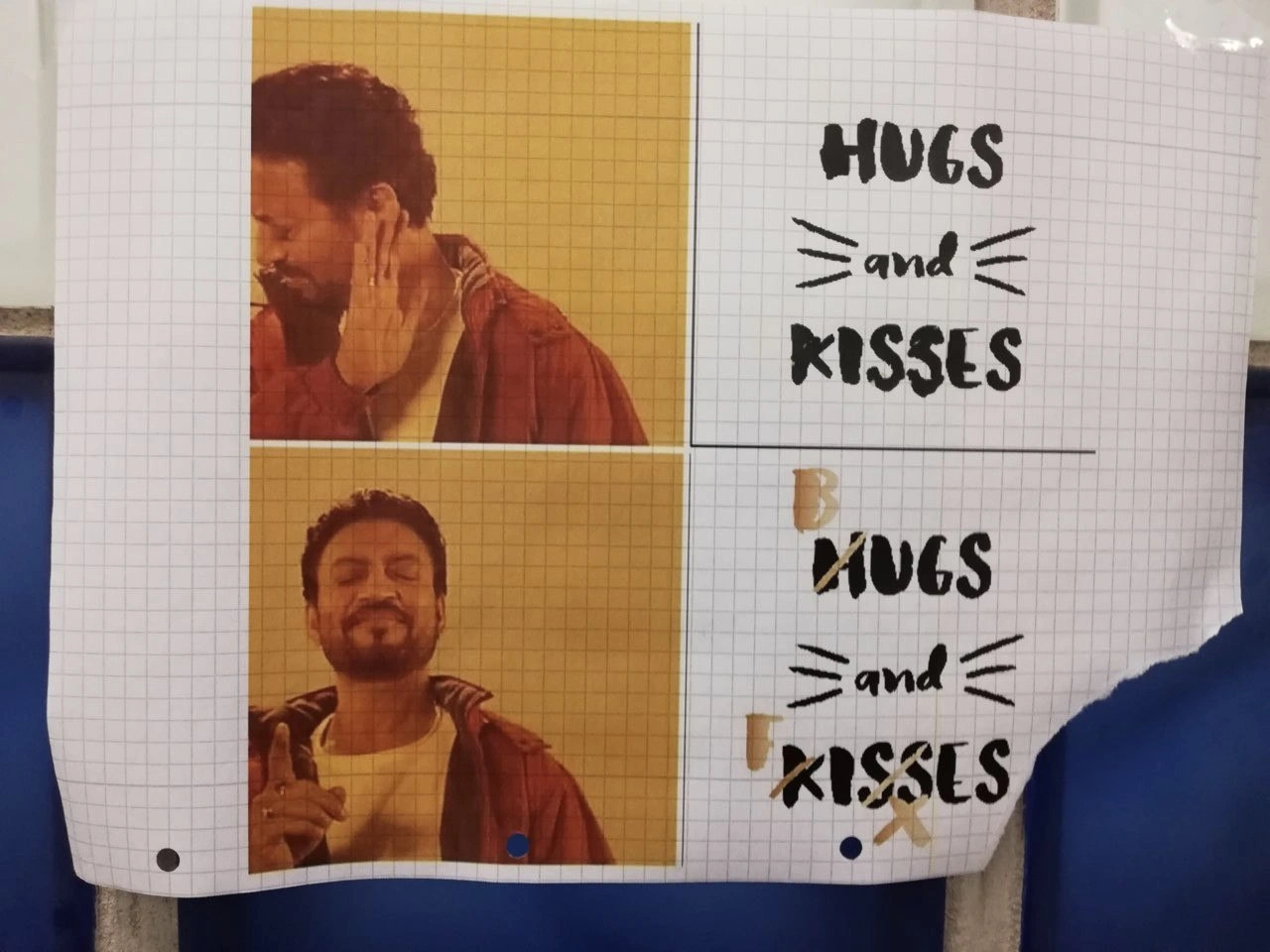
Let’s break down the meme in simple terms. It uses the familiar Drake meme format: two panels stacked vertically. On the top, you have Drake (the rapper from the "Hotline Bling" video) with a hand up, making a disgusted face to reject something; on the bottom, you see him smiling and pointing as if saying "Yes, this is good!" People use this format to show a preference by contrasting two labels. In our case, the top label says "HUGS and KISSES" (next to the rejecting Drake), and the bottom label says "BUGS and FIXES" (next to the happy Drake). So it reads like: Drake doesn’t want hugs and kisses, but he’s thrilled about bugs and fixes.
Now, why would anyone prefer "bugs and fixes"? Of course, it’s not literal! This is a bit of CodingHumor playing on words. "Hugs and kisses" is a common phrase representing love, affection, or a warm friendly greeting (people often write it as “XOXO” in letters). By changing just a couple of letters, it becomes "bugs and fixes," which is a phrase that sums up a lot of a programmer’s daily work. A bug in software is a mistake or error in the code that causes something to go wrong. It's like when a toy has a broken gear that makes it not work right – in software, a bug is the glitch that makes a program act funny or crash. And a fix is the solution that corrects that error (repairing the gear, so to speak). So "bugs and fixes" refers to the ongoing cycle of finding problems in code and fixing them.
For a new developer (or anyone learning to code), it might be surprising how much time is spent on this cycle of debugging and fixing. Debugging is the process of identifying why a bug is happening and then resolving it. It's a huge part of programming: you write code, something breaks or doesn’t behave as expected, and you have to track down the cause. In fact, beginners quickly discover that programming isn’t just typing out new features in a magical flow – a lot of it is like detective work, combing through error messages or testing different inputs to find where the bug is hiding. This can be frustrating (hence tags like DebuggingFrustration), but it’s also really satisfying when you finally get it right. Think of debugging as solving a puzzle or mystery: you have clues (error logs, weird app behavior), and you methodically figure out what’s wrong. When you solve it, it feels great, like putting the last piece in a jigsaw puzzle.
So the meme jokingly suggests that a developer might actually want those puzzles (bugs to fix) more than they want affection. It’s poking fun at the stereotype that developers can be so absorbed in their work that they neglect their social or romantic life. Of course, it’s an exaggeration – nobody genuinely hates hugs! – but there’s a grain of truth that many coders have been in situations where they were more focused on fixing code than on chilling with friends or family. The meme exaggerates this dedication by implying a programmer would say "no thanks" to human affection but "yes, please!" to a list of bug reports. That’s what makes it a relatable developer experience – most programmers have had nights where they're more focused on bug fixing than anything else, even if they didn’t really prefer it that way. It’s funny because it flips our normal priorities upside down for comedic effect.
Let’s also notice how the meme text itself was crafted. It looks like someone printed out the phrase "HUGS and KISSES" on paper, then literally overlaid or wrote extra letters – a "B", an "F", and an "X" – to turn it into "BUGS and FIXES". It's a playful visual way to show the transformation. It highlights how just one or two letters can completely change the meaning of a phrase (Hugs → Bugs, Kisses → Fixes). In coding terms, it’s almost like doing a find-and-replace on a string. For example, imagine we had a little script to do this conversion:
phrase = "Hugs and Kisses"
dev_version = phrase.replace("Hugs", "Bugs").replace("Kisses", "Fixes")
print(dev_version) # Bugs and Fixes
See what we did? By substituting "Hu" with "Bu" in "Hugs", and "Ki" with "Fi" in "Kisses", we get the cheeky developer-themed version of the phrase. The code above is essentially what the meme creator did with markers or cut-out letters on that graph paper! This kind of letter play is a classic pun. It visually connects the two ideas – love vs. coding – with just a small tweak.
One more bit of trivia: developers call errors "bugs" because of a famous anecdote. Back in 1947, engineers working on an early computer literally found a moth stuck in the machinery, causing an error. They taped the moth into their logbook and jokingly wrote that the system had a "bug". Ever since then, the term bug has meant a glitch or defect in a system, and the process of fixing it became known as "debugging" (like you’re getting rid of the bug). Modern bugs usually aren’t caused by insects, but the terminology stuck around for tradition. This little story is part of programmer culture, and it shows how long we’ve been joking about bugs – literally from the earliest days of computing! So, hunting for bugs and fixing them isn’t new; it’s a fundamental part of writing code. A lot of developer humor (like this meme) comes from that shared struggle. We have other jokes, like the classic "It works on my machine!" (blaming environment differences when a bug can’t be reproduced) or "It’s always DNS." (joking that mysterious outages are inevitably due to DNS configuration). These jokes might sound gibberish to outsiders, but to anyone who’s coded, they hit home because we’ve all been there.
Finally, the tag DeveloperExperience (DX) refers to the overall experience of being a developer – in other words, what it’s like day-to-day writing and maintaining code. Part of that experience is using good tools and having efficient processes, but a huge part is also the human side: how it feels to deal with constant bugs, deadlines, and the little joys and frustrations of the job. Chasing "bugs and fixes" is a massive part of that experience. It might not sound glamorous, but discovering a nasty bug and fixing it can be one of the most rewarding feelings in coding. It’s a mix of frustration and triumph that every programmer becomes familiar with. This meme is a lighthearted way to acknowledge that reality. It basically says: “Haha, my life as a coder involves so many bugs that I act like I love them more than hugs!” It’s just tech folks laughing at the fact that dealing with errors is routine. In short, “bugs and fixes” are to developers what practice drills are to athletes – not always fun, sometimes tiring, but absolutely fundamental. And we’ve learned to smile (and make memes) about it.
Level 3: Bugs Over Hugs
At the senior developer level, the humor in this meme hits close to home. It’s riffing on the well-worn reality that a huge chunk of a developer’s life is spent on maintenance: triaging issues, troubleshooting weird errors, squashing bugs, and deploying fixes. The meme uses the famous Drake Hotline Bling format to compare two options: personal affection vs. professional obsession. Drake turns away from “HUGS and KISSES” (the symbol of love or a normal life) and instead gives a big satisfied grin to “BUGS and FIXES.” It’s an absurd contrast that any seasoned programmer smirks at because, honestly, how many of us have sacrificed evenings, weekends – even Valentine’s Day – to chase down a pesky bug?
This resonates as a form of DeveloperHumor precisely because it’s painfully relatable. In the tech industry, we joke that debugging is the real 90% of coding. New features might get the glory, but it’s the endless parade of bug tickets in the backlog that truly dominates our time. The phrase "bugs and fixes" captures that daily grind. We've all had sprints where "romance" meant finally closing a Jira issue that’s been haunting us, and the only hugs we got were the self-congratulatory pats on the back after a 2 A.M. deployment. It’s a tongue-in-cheek way to admit we sometimes show more excitement for a resolved bug than for social niceties. (After all, a tough bug finally fixed can give a rush of joy – a bit like the butterflies others get from a crush, albeit of a nerdier sort.)
The physical presentation of the meme adds an extra layer of inside-joke. It’s printed on graph paper – the kind with square grids you find in every engineer’s notebook. The print-out even has binder holes and a torn edge, as if someone hastily ripped it from a notebook to slap on the team corkboard. That scrappy authenticity is a reminder that even in today’s digital offices, a bit of low-tech silliness can boost the team’s morale. Perhaps this was even dreamt up as a quick Valentine’s Day office joke, replacing candy hearts with code commits. The very act of overlaying letters to change "HUGS" into "BUGS" and "KISSES" into "FIXES" is reminiscent of a quick-and-dirty patch. It's like the meme creator debugged the phrase "hugs and kisses" by literally patching in a B, F, and X. This analog letter overlay pun playfully mirrors how we often handle bugs under pressure – slap on a fix and hope it holds, at least until the next deploy. It’s intentionally low-fi and ironic, much like taping a printed stack trace to the office fridge for laughs.
Seasoned devs also appreciate the deeper truth under the joke: software is never finished. There are always more bugs lurking, so fixes become a daily routine. We’ve come to accept that our relationship with code is a love-hate affair. One popular quip goes, “If debugging is the process of removing bugs, then programming must be the process of putting them in.” In other words, every time we write new code (especially under time pressure or unclear specs), we’re probably introducing new glitches we'll have to fix later. So Drake’s enthusiastic approval of "bugs and fixes" feels like a cathartic, self-aware chuckle at our own expense. We don’t truly prefer bugs over actual human affection (most of us do enjoy a good hug, honestly!), but considering how often we end up neck-deep in debugging sessions, we joke that we’ve made peace with it. It’s a bit of Stockholm syndrome for developers: after being held hostage by so many bugs, you almost learn to love the fight.
In practice, this meme also hints at how developers bond and commiserate. Trading war stories of monstrous production bugs over coffee is our version of socializing. The victorious feeling of deploying a critical fix at 2 A.M. can be oddly more memorable than a dozen uneventful afternoons. So when we see Drake smugly pointing to “daily bugs and fixes,” we laugh in recognition. It’s saying: “Yep, this is our life. We gripe about it, but we also live for these moments.” The meme charms us by turning shared frustration into a badge of honor. At the end of the day (sometimes literally at midnight), chasing down a production bug and emerging with a fix can feel more satisfying than any cheesy Valentine’s card – and that’s why Drake (standing in for all of us devs) looks so darn pleased about it.
Level 4: The Bug-Free Myth
In theoretical computer science and software engineering, bugs are not just accidents – they're practically a mathematical inevitability. There’s a deep reason a developer’s life revolves around "bugs and fixes": creating a completely bug-free program of significant size is considered almost impossible. In fact, some fundamental principles explain why:
Undecidability of Perfection: Thanks to concepts like the halting problem, we know it’s impossible to write a general algorithm that can catch all infinite-loop bugs or errors in every program. This sets a theoretical limit on fully automating bug detection – there's no magical tool that can guarantee a program has zero bugs for all possible inputs. Every codebase hides edge cases that no one can foresee, which means debugging and troubleshooting aren’t phases you can eliminate; they're baked into the reality of programming.
State Space Explosion: As software grows, the number of possible states and interactions increases exponentially. Testing every scenario becomes intractable. Even a seemingly simple feature can combine with others in unpredictable ways. The complexity behind this is daunting – covering all execution paths is often $O(2^n)$ or worse relative to program size. So developers inevitably miss some cases. The result? More BugsInSoftware creeping out in production.
No Silver Bullet: Frederick Brooks famously wrote about the "No Silver Bullet" in software – meaning no single tool or practice will instantly eliminate complexity (and thus bugs). Modern techniques like formal verification, static analysis, and advanced type systems (think of languages like Ada or Rust that aim for safety) do reduce certain classes of bugs by design. But even these have limits. Formal proofs of correctness require specifying every requirement and behavior mathematically, which is extremely labor-intensive and only feasible for small, critical modules. Most everyday apps and websites are built under tight deadlines, evolving specs, and shifting tech stacks – an environment where bugs breed like rabbits.
This meme’s punchline – that a developer prefers “bugs and fixes” over “hugs and kisses” – winks at this reality. It’s an exaggerated embrace of the endless bug-fixing cycle that every programmer inevitably lives in. On a fundamental level, it's acknowledging a truth: software is never truly finished or flawless; it’s just iteratively debugged. The humor works because even the most mathematically minded engineer knows that beyond all the elegant algorithms and proofs, real-life coding means rolling up your sleeves to fix one more bug. (As the tongue-in-cheek Lubarsky’s Law of software puts it: “There is always one more bug.”) No matter how advanced our tools get, the myth of a perfectly bug-free program remains just that – a myth. And so, the developer’s daily reality of chasing bugs and deploying fixes continues, almost as reliably as gravity. It’s a bit of deep, even philosophical irony: the thing this meme shows devs jokingly choosing over hugs is something they can’t escape anyway, by law of both man and mathematics.
Description
A two-panel meme, presented on a piece of graph paper, using a format similar to the 'Drake Hotline Bling' meme, but featuring the late actor Irrfan Khan. In the top panel, Khan is shown looking away with a dismissive gesture, placed next to the text 'HUGS and KISSES'. In the bottom panel, he smiles and points upward in approval, alongside the same phrase which has been messily altered: 'HUGS' is crossed out and replaced with 'BUGS', and 'KISSES' is crossed out and replaced with 'FIXES'. The meme humorously portrays the reality of a software developer's life, rejecting the conventional pleasantries ('hugs and kisses') in favor of the never-ending, core professional cycle of identifying and resolving software defects ('bugs and fixes'). It's a wry, relatable commentary on how a developer's satisfaction and daily reality are defined by technical problem-solving rather than typical workplace comforts
Comments
7Comment deleted
My relationship status? It's complicated... by a continuous integration cycle of bugs and fixes
In our architecture, hugs and kisses are optional dependencies; bugs and fixes are hard-coupled singletons in every microservice
After 20 years of regex patterns and Unicode normalization, you start seeing XOXO as a perfectly valid encoding scheme - it's just hugs and kisses with better compression ratios and no ambiguous character boundaries
Every senior engineer knows that true intimacy isn't measured in hugs and kisses, but in the dopamine rush of finally squashing that race condition that's been haunting production for three weeks. Romance fades, but a well-crafted bug fix? That's forever in the git history
Senior dev love language: bugs and fixes - those actually have SLAs, acceptance criteria, and a rollback plan
Senior love language: not hugs and kisses, but bugs and fixes - with repro steps, a failing test, and a rollout plan that won’t dent the SLO
Hugs are synchronous callbacks; bugs spawn async hell, kissing you forever