Skip to content
DevMeme
2974 of 7435
The Perils of Requesting a 'Meaningful' Commit Message
VersionControl Post #3284, on Jun 18, 2021 in TG

The Perils of Requesting a 'Meaningful' Commit Message

Why is this VersionControl meme funny?

Level 1: Say What You Did

Imagine you’re cleaning up your room, and every time you finish, your parent asks, “What did you do?” If you always answer, “I did some stuff,” they’ll have no idea if you made your bed, put toys away, or threw out the trash. It’s so vague that it’s not helpful at all. So one day, your mom says, “Next time, give me a meaningful answer.” Now, instead of saying something simple like “I put all my books back on the shelf and folded my clothes,” you pause and think very hard. You want to give a really meaningful answer... and you end up reciting a deep poem about the meaning of life! 😆 The result? Sure, your mom hears a beautiful line of poetry, but she still has no clue what you actually did in your room.

In this meme, Bob was doing something similar with his code. Every time he saved his work (a commit in coding terms), he labeled it just as “small changes” – like saying “some stuff.” That didn’t help his team know what changed. When his colleague told him to use a meaningful message next time (like describing the change), Bob took it the wrong way and wrote a meaningful poem instead of a useful description. It’s funny because Bob did exactly what he was told, but in such an over-the-top, literal way that it didn’t solve the problem. The simple idea: when you finish some work, say what you did in a clear way. If you only say “I did things” or respond with a random quote, nobody knows what happened!

Level 2: Commit Messages 101

Let’s break down what’s happening in this VersionControlHumor comic for those newer to Git. First, recall that Git is a popular tool for tracking code changes (a version control system). When you make a change to your code, you commit those changes, which saves a snapshot of your files. Along with each commit, Git lets you include a commit message – a short text explaining what the change was. Developers use commands like git commit -m "Your message here" to do this (the -m flag means “message”). Ideally, that message should be descriptive and meaningful: it should summarize the change or the reason for the change, so that you and others can understand the project history later. For example, if you fixed a bug where the login button didn’t work, a meaningful commit message might be "Fix login button not responding by re-enabling event handler". This gives anyone reading the history a clear idea of what that commit contains.

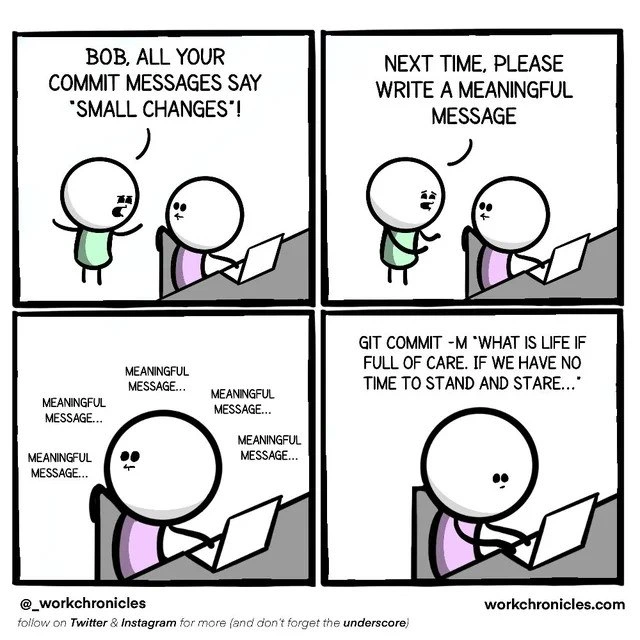
In the comic, Bob has a bad habit: every time he commits code, he uses the same generic message "small changes". That’s like writing Git commit messages that say nothing specific about the changes – an anti-pattern in CodeQuality. If you ran a git log --oneline on Bob’s project, it might look like this:

$ git log --oneline
3f1e2d4 small changes
2d3c4b5 small changes
1a2b3c4 small changes
9e8d7c6 What is life if full of care. If we have no time to stand and stare...

You can see how the first three commits tell us nothing unique – they all say "small changes". A junior developer might do this thinking, "Well, it was just some minor tweaks," but over time, a bunch of "small changes" messages makes the history really unhelpful. If another developer (maybe Bob’s teammate or future self) tries to find out when a specific change was introduced or what was changed, those identical vague messages are useless. This is why Bob’s colleague is upset and yells: “Bob, all your commit messages say 'small changes'!” They’re basically telling him: "You need to be more clear about what each commit does." The request “please write a meaningful message” means “please write a message that actually describes the code changes in a useful way.” In other words, instead of saying "fixed stuff" or "updated code", say something like "Optimize image loading logic" or "Add unit tests for user service" – something that gives a hint about the content of the commit. This is considered good practice for both DeveloperExperience_DX (it’s nicer for your teammates and your future self) and CodeQuality, since a well-documented change log helps maintain the project.

Now, Bob’s reaction is where the humor kicks in: Panel 3 shows him staring blankly at his screen with “MEANINGFUL MESSAGE...” repeated all over, implying he has writer’s block. This is a relatable moment – even experienced devs sometimes pause thinking “How do I summarize this change?” It can be oddly hard for a coder to step back and describe their changes in plain English. (There’s a saying: “Always code as if the person who ends up maintaining your code is a serial killer who knows where you live.” Perhaps we need a version for commits: “Always write commit messages as if the person debugging your code at 3 AM is you.” 😅) Bob is overthinking what a "meaningful message" should be. Instead of simply writing about his code changes, he ends up going on a bit of a tangent. In the final panel, we see the command git commit -m 'What is life if full of care. If we have no time to stand and stare…'. Bob literally commits with a famous poetic line! This line is from a poem (it’s meaningful philosophically), but it has nothing to do with the code. It’s as if Bob thought his boss wanted something profound or artistic rather than something informative about the code.

To put it plainly: Bob’s boss/colleague wanted him to stop using meaningless messages like “small changes” and instead write meaningful_commit_messages that describe the code edits. But Bob misunderstood (or maybe played a joke) and typed out a deep quote about life as his commit message – which is meaningful in a general sense, but completely unhelpful for understanding the software update. It’s a playful jab at the sometimes confusing expectations in the developer world. Everyone says “write good commit messages”, but if you’re a newbie, you might not have a clear idea of what that looks like. Bob did write a "meaningful message" – just to the wrong audience. Instead of meaningful to other developers, it was meaningful like literature!

The lesson for junior devs: when someone asks for a meaningful commit message, they mean relevant and specific to your change. For example:

  • Bad: git commit -m "small changes" – This doesn’t tell anyone anything (what was changed? small in what way?).
  • Good: git commit -m "Improve password validation to include special characters" – This clearly states what changed in the code.
  • Funny but unhelpful: git commit -m "What is life if full of care..." – It’s a poetic commit_message_writers_block moment, but your team will be scratching their heads.

In summary, commit messages are not supposed to be novels or poems; they’re short descriptions for humans about code. Bob’s story humorously exaggerates what happens when advice like “make it meaningful” is given without context – it can confuse people. If you ever find yourself writing only “fixed bug” or “update stuff” in every commit, take a cue from this meme: aim to say what you changed in a way others (and you, later on) will understand. But also, maybe leave the Shakespeare or motivational quotes out of your Git history (unless your code truly adds life meaning, in which case, go for it 😉). The DeveloperHumor here also hides a genuine tip: clear communication in commit messages is part of being a good collaborator in a team.

Level 3: Commitment Issues

At first glance, this comic dives into a classic VersionControl dilemma: the quest for a meaningful commit history and the unintended consequences of taking guidelines too literally. Every seasoned developer has seen a Git log full of repetitively vague messages like "small changes" – it's a nightmare for CodeQuality and DeveloperExperience_DX. The humor here is that Bob is being chastised (likely by a senior or team lead) for writing the same throwaway commit message over and over. This is a real DeveloperPainPoints scenario: commit messages like "misc updates" or "fixed stuff" provide zero context about the actual code changes (the diff). They're essentially the version control equivalent of labeling every book on a shelf as "Book" – completely useless when you need to find information. Experienced developers know that good commit messages are crucial: they serve as a historical record of what was changed and why. So when Bob’s colleague yells, “ALL YOUR COMMIT MESSAGES SAY ‘SMALL CHANGES’!”, it’s a cry of frustration many of us have uttered after looking at a messy repo history.

Now, the twist: “Next time, please write a meaningful message.” This is well-intentioned advice, but also dangerously open to interpretation. In the comic, Bob takes it over-literally – he hears "meaningful" and thinks, “Okay, I'll write something profound.” Cue the poetic_commit punchline: Bob commits with a full-on existential quote instead of a technical description. It’s a brilliant instance of malicious compliance in tech humor: Bob followed the letter of the request (“make it meaningful”) while completely missing its spirit (provide useful info about the code). The commit command shown, git commit -m "WHAT IS LIFE IF FULL OF CARE. IF WE HAVE NO TIME TO STAND AND STARE…", is an absurdly meaningful_commit_message in the human/philosophical sense but utterly meaningless regarding the code changes. This exaggeration highlights a truth: merely saying you want more meaningful messages without concrete guidance can backfire. Bob’s poetic line (a riff on W.H. Davies’ poem about life’s meaning) is ironically as unhelpful as “small changes” in explaining the code – neither tells your teammates anything about what the commit contains. The gag satirizes that senior-level frustration: when told to improve, an overly literal dev might comply in a way that technically satisfies the words of the request while still completely failing the DeveloperHumor intent of good commit practices.

From a senior dev perspective, the comic underscores why commit message quality matters. In real projects, a commit message like "Implement OAuth2 token refresh to fix session timeout (issue #123)" is meaningful in context, whereas "small changes" or a random poem would make any code archeology task painful. We’ve all been in Bob’s colleague’s shoes: trying to debug or understand history using git blame or git log, only to find a trail of useless notes. It’s funny here, but in practice it’s a minor tragedy – you end up diffing each commit manually to figure out what changed. The DeveloperExperience suffers because the commit log fails as documentation. There’s even a known joke among programmers: the three hardest problems in IT are caching, naming things, and off-by-one errors – writing a good commit message is basically a naming things problem. Bob’s story is a comic exaggeration of that: naming his commits meaningfully proved so hard that he resorted to flowery literature. Senior devs reading this will chuckle and cringe because it rings true. It reminds us that improving CodeQuality isn’t just about the code diff; it’s also about the meta-data we attach to changes. And if you don’t mentor juniors on how to write a good commit message (beyond “be meaningful”), you might end up with a repository that reads like a bad poetry slam. In short, the meme humorously nails a real engineering truth: GitCommands and version control practices work best when humans communicate clearly – and miscommunication or over-literal interpretation can lead to commit history that’s as frustrating as it is funny.

Description

A four-panel webcomic by 'workchronicles' illustrating a common developer interaction. In the first panel, a manager figure tells a developer named Bob, 'BOB, ALL YOUR COMMIT MESSAGES SAY *SMALL CHANGES*!'. In the second panel, the manager requests, 'NEXT TIME, PLEASE WRITE A MEANINGFUL MESSAGE'. The third panel shows Bob at his computer, contemplating this, with the words 'MEANINGFUL MESSAGE...' repeating in his thoughts. In the final panel, Bob is seen typing out his new commit message: 'GIT COMMIT -M 'WHAT IS LIFE IF FULL OF CARE. IF WE HAVE NO TIME TO STAND AND STARE...'. The comic humorously depicts a developer's malicious compliance. Instead of writing a technically descriptive message, Bob opts for a philosophically 'meaningful' one, quoting a poem. This joke resonates deeply with experienced engineers who understand the critical importance of clear, concise commit histories for maintainability, and who have likely witnessed or perpetrated similar acts of passive-aggressive adherence to vague feedback

Comments

10
Anonymous ★ Top Pick The fastest way to get a developer to write a novel in a commit message is to ask them for a 'meaningful' one
  1. Anonymous ★ Top Pick

    The fastest way to get a developer to write a novel in a commit message is to ask them for a 'meaningful' one

  2. Anonymous

    Careful - commit-lint will still reject that stanza for not using the imperative mood

  3. Anonymous

    After 15 years of reviewing PRs, you realize Bob's original 'small changes' commits were actually more informative than the junior dev's 500-word essays explaining why they renamed a variable - at least Bob's commits didn't trigger the CI pipeline's character limit warnings

  4. Anonymous

    This perfectly captures the senior engineer's response to vague feedback: technically compliant, philosophically profound, and absolutely useless for `git bisect`. Bob's commit message passes every linter check for 'meaningful' while simultaneously making future code archaeology impossible - a masterclass in malicious compliance that will haunt the next developer trying to understand why that critical bug fix was buried under existential poetry. At least 'small changes' was greppable

  5. Anonymous

    Conventional Commits, not Romanticism - without intent in the subject, git bisect becomes archaeology and the changelog turns into verse

  6. Anonymous

    PMs demand 'meaningful commits'; devs deliver verse - good luck bisecting that monorepo at 3AM

  7. Anonymous

    Nothing like running git bisect at 3am and landing on commit 'What is life...' - accurate, but not exactly a changelog

  8. @nuntikov 5y

    Who's author of that quote?

  9. @nuntikov 5y

    http://googleitfor.me/?q=what+is+life+if+full+of+care

    1. @JAUD1LA 5y

      Oh god, thanks! I forgot about this site and tired of linkin real google for each lazy man

Use J and K for navigation