Skip to content
DevMeme
3508 of 7435
My love for you is immutable
CodeQuality Post #3844, on Oct 21, 2021 in TG

My love for you is immutable

Why is this CodeQuality meme funny?

Level 1: Written in Permanent Ink

Imagine you have a notebook where you write down names. Most of the names you scribble in pencil, so you can erase them and replace them whenever you want. But one name – a very special name – you write in permanent marker and never erase. In this story, the boyfriend did something like that with his coding. He used a bunch of different names for things that could change (like the pencil-written names that can be erased), but for his girlfriend's name, he reserved a spot that never changes (like the permanent marker name). The girlfriend was mad at first because she saw all those other names and felt jealous – kind of like if you found your friend’s notebook full of other people's names. But when he showed her that her name was the only one written in a non-erasable way, it made her feel special. It's a super nerdy way of saying "others might come and go, but you're the one name I won't ever erase." People think it's funny and cute because he's using a geeky idea from coding as a metaphor for love. It's like mixing a love note with a math homework problem – a bit silly, but also kind of sweet in its own way.

Level 2: Variable Jealousy

Let's break this down more simply. In programming, we use variables and constants to store information:

  • A variable is like a box you can put a value in, and later you can open the box and put a different value in. The value inside can change over time (that's why it's called a "variable"). For example, if you have a variable named score, it might start at 0, and later you could set score = 10. The value held by score has changed, which is normal for a variable.

  • A constant is like a box that, once you put a value in it, you lock it and never change it. The value stays the same whenever you check it. If you set a constant MAX_USERS = 100, it will always be 100 throughout the program – the program won't let you change that value later on.

Now, what's happening in the meme? The girl saw that in her boyfriend's code, he gave a bunch of variables the names of different girls from their class. For instance, maybe his code had lines like let emma = 5; or let jacqueline = "hello";. Seeing all those other girls' names in his code made her upset. (Who wouldn't be a bit annoyed to find lots of other girls' names sprinkled throughout your partner's project? 😠) It looks like he's referencing a bunch of classmates in his work, and naturally she gets jealous.

But then he points out that she should notice the one constant in his code. And surprise: that constant is named after her. In code terms, that means he chose her name for the value that never changes. All the other names (the variables) can change or get reassigned to different data, but her name is on the one thing meant to remain fixed. It's his geeky way of saying, "You are the one thing in my code (life) that stays constant."

To illustrate, here's a tiny pseudo-code example similar to what this scenario implies:

const girlfriendName = "Alice";   // a constant: once set to "Alice", it won't change
let jessica = "projectIdea";      // a variable named after another girl; this value can change
let lily = jessica;               // another variable (also a classmate's name)

// We can change a variable's value:
jessica = "newIdea";              // 'jessica' was updated from "projectIdea" to "newIdea"

// But the girlfriendName constant is special:
girlfriendName = "Carol";         // 🚫 Error! (In many languages, constants can't be reassigned)
// The constant stays "Alice" no matter what – it refuses to change.

In this snippet, girlfriendName is a constant (suppose the girlfriend's name is Alice). No matter what, girlfriendName will always remain "Alice" because the program will prevent any change. Meanwhile, jessica and lily are regular variables (we imagined they were two other classmates' names). We successfully changed jessica's value from "projectIdea" to "newIdea" — that's allowed because jessica is a variable. But if we try to change girlfriendName, the program throws an error: it's not allowed because girlfriendName was declared as a constant.

So, the boyfriend's code basically did that: lots of variables with other girls' names that might change or hold different values, but one single constant with his girlfriend's name which stays untouched and unchangeable.

Why is this funny (or cute)? It's a big programming pun. In everyday life, calling someone your "constant" isn't a typical romantic phrase. But in code, a constant is literally something that never changes, which makes it a perfect nerdy way to say "my feelings for you will never change." He's taking a technical idea and turning it into a love note.

There's also a lesson here about naming things in code. Usually, when coding, we're supposed to use clear, descriptive names for our variables — names that hint at what the variable is for. For example, instead of naming a variable emma or lily (which don't tell us anything about what the variable does), a programmer would normally use a name like userName or totalItems or tempValue depending on what that variable represents. And constants often have names like MAX_SCORE or PI (for the number 3.14), which tell you exactly what that fixed value stands for.

So seeing random human names in code is pretty unusual and can be confusing. Imagine you opened a program and saw: alice = 10; bob = alice * 2; carol = bob + 5;. If you don't know the context, you'd probably scratch your head wondering "Who or what are Alice, Bob, and Carol supposed to be here?" That's why we have naming conventions – basically agreed-upon guidelines – to keep code readable. Clean, sensible naming is part of good code quality because it makes life easier for everyone working on the project. If another programmer had to maintain that code, they'd be baffled by all those personal names with no explanation. It would make their job a lot harder. So while this naming scheme is used here as a joke, it's not something you'd do in real production code if you care about your teammates' sanity (and your girlfriend's feelings!).

In the end, this meme is a lighthearted coding inside joke. The girlfriend was angry at first because it looked like he's giving attention to other girls (in his code!), but the boyfriend found a nerdy way to prove she's the special one: by making her name the only thing in his program that never changes. It's basically a programmer's way of writing "You're my one and only" into his code. Once you understand what variables and constants are, the humor and sweetness of it become clear. It's like a tiny love letter hidden in a program, and that's why we find it both funny and endearing.

Level 3: Constantly Yours

In this meme, coding jargon meets a cheesy romance line. It lands squarely in DeveloperHumor territory by turning a dry programming concept into a flirtatious joke. Let's unpack why it's funny on a technical level.

First, naming variables has always been an art (and a headache) in software development. NamingThings well is so notoriously challenging that there's a famous saying:

"There are only two hard things in Computer Science: cache invalidation and naming things."

Every experienced dev nods knowingly at that. VariableNaming isn't just a tag—it's a daily struggle. Good names make for good DeveloperExperience when reading code. Poor names, on the other hand, can confuse coworkers and spark unintended drama... like this scenario!

Here our love-struck programmer clearly skipped the usual identifier_naming_conventions. He named all his variables after girls in their class. That's a huge no-no in professional code (and apparently in relationships too) 🤦‍♂️. In clean code guidelines, variable names should describe their purpose, not which classmate they remind you of. Seeing a bunch of identifiers like sophia, emma, olivia in a code file would make any senior engineer raise an eyebrow. It screams "inside joke" rather than meaningful context. If this were a code review, the feedback might well be: "Rename these to something indicative of their function!" (along with a side-eye from the reviewer).

Now, the punchline: he asks if she noticed the one constant in his code, which is named after her. In programming, a constant is a value defined once and never meant to change. Many languages enforce this: try to modify a constant and you'll get a compile error or runtime exception. It's the one stable thing in a sea of changeable variables. By naming that constant after his girlfriend, he's slyly saying "Look, you're the one thing in my code (read: life) that never changes." All those other names might come and go (variables can be reassigned new values any time), but her name stays put forever in the code. It's a nerdy way to express unwavering affection using code logic.

This contrast between variables and constants is the core of the variable_vs_constant_pun. Seasoned developers immediately recognize that juxtaposition. Variables are meant to vary (today x = 5, tomorrow x = 10), whereas a constant might be defined as, say, const MAX_VALUE = 100; and remain 100 for the program's duration. So declaring something like const girlfriendName = "Ana"; and never altering it is a symbolic commitment. It's like engraving her name in stone in the codebase, while the other variable names are written in sand. Anyone with a few years of coding under their belt appreciates how literal and geeky that metaphor is, which is why it draws laughs.

The humor here also plays on real-world coding antics. We've all seen code where the naming scheme goes a bit off the rails for a laugh. Some devs use theme names (planets, fruits, movie characters) as placeholders when they can't think of better ones or when writing examples. It's fun in a tiny script or during a hackathon. But using actual classmates' names in a serious codebase? That’s bold. It's the kind of thing only a smug newbie or a prankster might do. Any veteran developer reading that would chuckle, then perhaps gently remind them that code is read far more often than it's written. Imagine the next engineer maintaining that code, trying to figure out what rachel or monica represent in a calculation! It's confusing at best and unprofessional at worst.

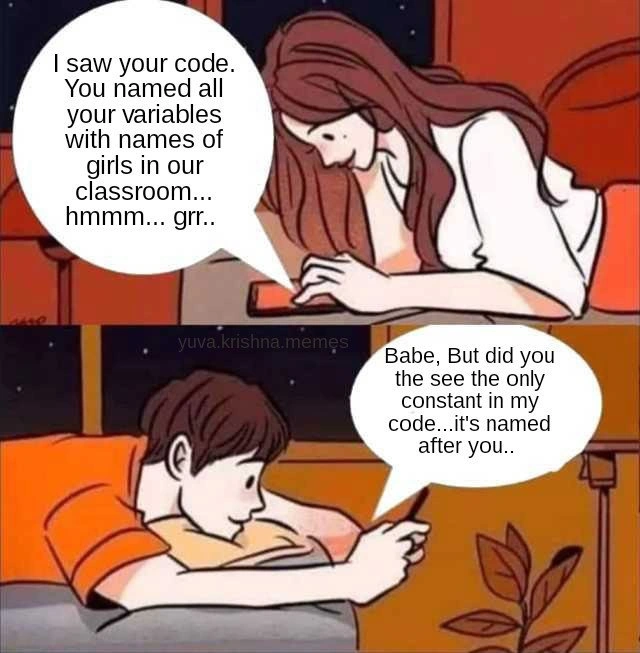
From a code quality perspective (CodeQuality matters!), this is obviously terrible practice in real life. But as a meme setup, it perfectly tees up the joke. The girlfriend's annoyed reaction in the first panel ("You named all your variables with names of girls in our classroom… hmmm... grr...") is totally understandable both emotionally and technically. It's jealousy meets code review. And the guy's comeback is a classic cheesy_coding_pickup_line: he flips a potential argument into a geeky declaration of love, banking on the technical meaning of "constant" to win points. It's the kind of logical-yet-adorable twist that only a programmer would think to use as sweet talk.

Speaking of programmer life, notice the setting in the images: both characters are texting at night, bathed in the soft glow of their screens with the night sky outside. This detail nods to developer culture’s screen-centric life. Many devs are no strangers to late-night coding or chatting online into the wee hours. Here, that nocturnal, techy vibe sets the stage for a nerdy romantic exchange. Even their flirtation happens through a screen with a code metaphor – it's a little wink at how being a techie can color every aspect of life, even relationships. When you're dating a coder, don't be surprised if heartfelt compliments come in the form of code jokes at 2 AM!

For those of us in the coding world, this gag hits on multiple levels. It's truly something a DeveloperMemes page lives for: combining a mundane relationship spat with a niche programming reference. We get an inside joke about code readability colliding with a lover’s quarrel, all in one. And honestly, there's a grain of truth hidden in the humor. Mixing personal life with your code can backfire (plenty of devs have accidentally left a silly comment or secret message in code and gotten in trouble for it). In this case, he did it quite intentionally. Risky move! But he executed it with a clever safeguard: making her the constant factor. It's basically an Easter egg of devotion embedded in his program.

In summary, the meme cleverly merges romance and coding. It's essentially a romantic_programmer_joke where a straightforward coding concept (variables vs. constants) doubles as a love language. The result is equal parts CodingHumor and cringey sweetness. Any seasoned dev can read between the lines (or lines of code, in this case): many things in a program (and in life) may change, but true love is constant — and this guy literally wrote that truth into his code.

Description

A two-panel comic strip depicts a text message exchange between a couple. In the top panel, a young woman with long brown hair is looking at her phone with a displeased expression. A speech bubble from her says, 'I saw your code. You named all your variables with names of girls in our classroom... hmmm... grr..'. The bottom panel shows a young man in an orange shirt lying down, smiling as he texts back. His reply in a speech bubble is, 'Babe, But did you the see the only constant in my code...it's named after you..'. The meme uses a clever programming analogy for a romantic gesture. In programming, 'variables' can change their value, while a 'constant' is immutable and cannot be changed once set. The joke is that the programmer cleverly deflects his girlfriend's accusation by implying that while other girls are transient and changeable like variables, his girlfriend is the one stable, unchanging, and permanent fixture in his life, like a constant
Comments

12
Anonymous ★ Top Pick His code is probably a mess of global variables, but at least her name is declared with 'const' and not 'let'. Let's hope she doesn't find out he's reassigning her to 'null' in a 'finally' block
  1. Anonymous ★ Top Pick

    His code is probably a mess of global variables, but at least her name is declared with 'const' and not 'let'. Let's hope she doesn't find out he's reassigning her to 'null' in a 'finally' block

  2. Anonymous

    Declaring FOREVER_EMILY as the sole const feels romantic - right up until leadership adds white-label support and you’re refactoring true love into a row in ConfigDB while git blame documents the breakup

  3. Anonymous

    After 20 years in tech, I've seen codebases with variables named after ex-girlfriends, Pokemon, and Norse gods - but the real red flag is when someone names their singleton after their manager

  4. Anonymous

    Ah yes, the classic defense: 'It's not poor variable naming, it's a type system for my social life.' Bonus points if the constant is actually mutable in JavaScript, making this relationship metaphor uncomfortably accurate. At least he didn't use Hungarian notation - imagine explaining why she's prefixed with 'str' or 'obj'

  5. Anonymous

    “I named the only constant after you” - classic JavaScript romance: the binding won’t change, but the object (and the relationship) will mutate in place until GC

  6. Anonymous

    Variable flings are mutable; only the const survives every girlfriend refactor

  7. Anonymous

    Hard-coding your relationship as a const is just tight coupling; inject it via config or expect a breaking change at runtime

  8. @deerspangle 4y

    What

  9. @fie_n 4y

    Me who isn't in relationship:

  10. @sylfn 4y

    you can change constants with const_cast

  11. @pixelsex 4y

    nigga wat, mgimo finish?

  12. @cptnBoku 4y

    C r i n g e

Use J and K for navigation