Skip to content
DevMeme
3507 of 7435
The developer's gauntlet: from CI to the final boss demo
SDLC Post #3843, on Oct 20, 2021 in TG

The developer's gauntlet: from CI to the final boss demo

Why is this SDLC meme funny?

Level 1: Presentation Panic

Imagine you cleaned your room and felt super proud – you think you’re completely done with chores. But then your mom walks in (she’s like the first big monster) and says, “Nice, but now you also need to clean the living room.” You sigh and clean the living room. Then your dad comes home (an even bigger monster) and he says, “Good, but did you also clean the garage like I asked?” Now the garage is an even bigger job. Finally, the next day at school there’s a show-and-tell (the ultimate giant monster) where you have to show everyone the work you did, and the principal is watching. That nervous feeling you get is huge – much bigger than how you felt about cleaning your room in the first place!

This meme is just like that. The developer felt like a hero for a minute after finishing a small task (cleaning his “room”). But suddenly, bigger challenges appeared one after another, each one making the last victory feel tiny. By the time he has to do the weekly demo (the big presentation), he realizes that was the hardest job all along. The picture makes it funny by showing each next task as a giant monster sneaking up behind the little coder. It’s saying: in real life, finishing the code is just the beginning – bigger challenges are waiting right behind!

Level 2: Review Rampage

Let’s break down the scenario in more straightforward terms. The developer in the meme finishes a task (writes some code) and initially feels great – who doesn’t love that “I fixed it!” moment? He even calls himself a “rockstar dev,” which is tongue-in-cheek; it’s a myth that one developer can single-handedly conquer everything easily. In reality, software development is a team sport with many steps after coding. The meme labels the next challenges as CI, Review, and Weekly demo, showing them as successively larger monsters. These correspond to real stages a code change goes through:

  • CI (Continuous Integration): This is an automated build and test process that runs whenever you integrate new code into the main codebase. Imagine you push your code to GitHub or your company’s repository; a CI system (like Jenkins or Travis CI) automatically compiles the code, runs all the tests, and checks for any problems. It’s like a robot tester that never gets tired. For a new developer, seeing a big green “✓ All checks passed” is the goal, but often you get a dreaded red “✗ CI failed” message instead. Maybe you forgot to run tests locally, or there’s a subtle bug, or your code doesn’t work in the shared environment. For example, you might have “fixed” a bug in your dev environment, but on the CI server an automated test is failing because of that change. The CI monster in the meme is huge and carrying a bat because a CI failure can really smack down your celebration. It forces you back to fix things before anyone even looks at your code.

  • Code Review: After your code passes CI, it goes to human reviewers – usually senior developers or peers on your team. They will review your Pull Request (PR) on platforms like GitHub or GitLab, looking at the changes you made. Code review is all about maintaining quality and shared understanding. Reviewers might catch mistakes, point out better ways to do something, or ensure you followed the team’s style guidelines. For a junior dev, getting a bunch of code review comments can be overwhelming. It might feel like every line you wrote has some issue. But this feedback is normal – everyone’s code gets critique. One comment might say, “Can we rename this variable for clarity?” (small change), while another might be bigger, like “This function has a bug if the input is empty, you need to handle that.” The meme shows “Review” as an even larger monster because sometimes code review can be more intimidating than the CI. A test failing is straightforward to fix, but a senior dev might challenge your whole approach, meaning more work. It’s depicted with a spiked club likely because those review critiques can sting, even though they’re meant to help. Every developer remembers the first time their seemingly perfect code came back with a long list of improvements – it’s a humbling rite of passage.

  • Weekly Demo (Stakeholder Demo): This refers to a regular meeting (often weekly or at the end of a sprint in Agile methodology) where developers demonstrate new features or completed tasks to stakeholders, managers, or clients. It’s basically show-and-tell for what the team accomplished. The reason the “Weekly demo” is a gigantic alien monster in the meme is that presenting your work can be the scariest part of all. Stakeholders are less concerned with the code quality and more concerned with whether the feature meets their needs and works as expected. Even if your code passed tests and got approved in review, the demo is where you find out if it actually solves the right problem and if you understood the requirements correctly. Many developers feel meeting anxiety here – what if the app crashes during the live demo? What if the stakeholder isn’t impressed or changes their mind? It can sometimes feel like all your effort is about to be blasted by a surprise change of heart or an unexpected bug. That’s why in the meme, the weekly demo monster dwarfs the others: the pressure is on, and the consequences of failure seem dire (at least to the developer’s nerves).

In summary, the meme is a funny exaggeration of a real development cycle: you code something (small win), then continuous integration tests it (often finding issues), then code review scrutinizes it (asking for changes), and finally you have to present it (hoping it meets expectations). Each step can feel bigger and tougher than the last, especially when you’re new. It highlights developer frustration in a playful way. A junior developer might relate to finishing a coding task and thinking “Yes, done!” only to recall, oh wait, now I need to push and run the CI, then ask for a review, then prepare for the demo meeting – the task isn’t truly done until all these stages pass. The “monsters” are just cartoon versions of these stages making the poor dev’s life harder. It’s like leveling up through a game: each level (CI, then review, then demo) is harder than the one before.

Level 3: Pipeline Punishment

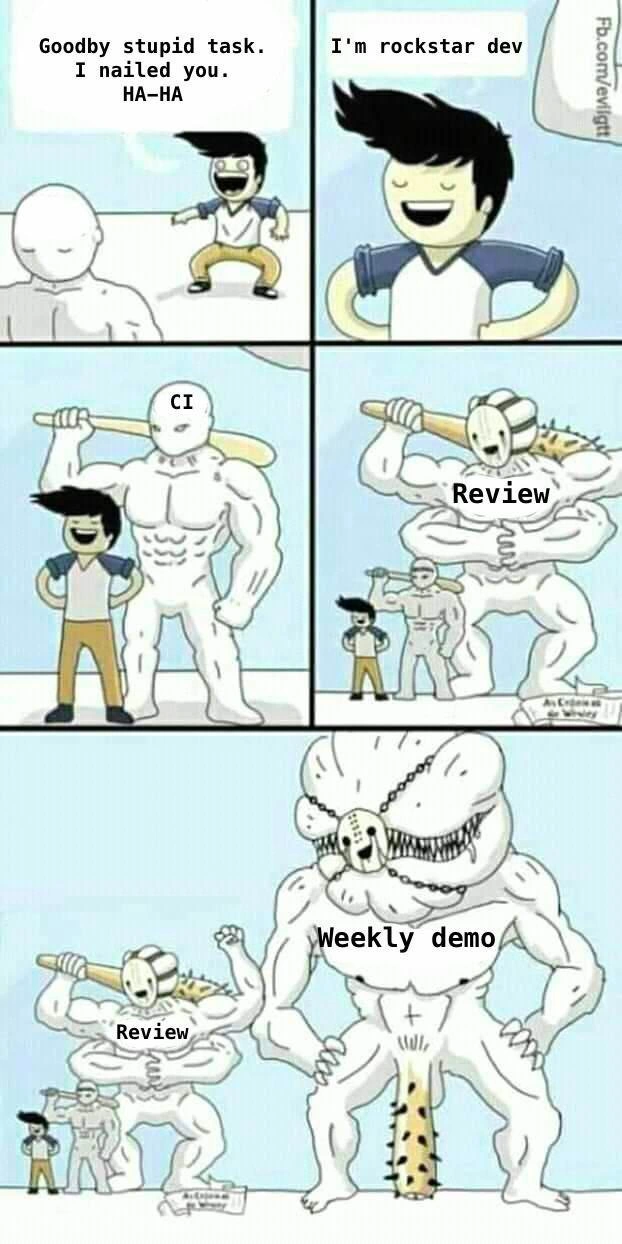
The meme humorously dramatizes a painful truth of software development: finishing the code is just the first mini-boss. In the first panel, our overconfident developer proclaims:

“Goodbye stupid task. I nailed you. HA-HA. I’m rockstar dev.”

He’s celebrating a small victory – completing a coding task – and momentarily feeling like a “rockstar developer.” But looming right behind him is the next giant foe labeled CI (Continuous Integration), a muscular enforcer with a spiked bat. This represents the often jarring reality check when your code hits the CI/CD pipeline. In real projects, after you push your code, an automated build system (like Jenkins, GitLab CI, or GitHub Actions) kicks in to run tests, linters, and builds. That hulking CI monster symbolizes how a seemingly trivial change can trigger build failures, unit test breakages, or other integration issues you didn’t foresee. It’s a pipeline ambush: everything was green on your machine, but the CI environment might uncover a missing dependency, a failed test, or a misconfigured build script. The dev’s triumphant smirk vanishes as this ci_failures beast swings its bat – perhaps a failing test suite or a lint error smashing his “rockstar” ego.

Now, behind the CI beast stands an even larger mutant labeled “Review.” This is the code review process, embodied as a swole creature wielding another spiked bat. Even if the build passes, now your peers (or tech lead) scrutinize your code. Experienced devs know that a pull request can unleash a code_review_comments onslaught: nitpicks about code style, suggestions for edge cases, questions about architecture. The meme magnifies “Review” as bigger than CI because code reviews can be an even tougher hurdle. CI might catch objective issues (failing tests or style violations), but reviewers will challenge subjective issues like readability, maintainability, and whether your solution fits the bigger picture. Our once-cocky coder is tiny in comparison, realizing he’s not such a rockstar when the CodeReviews monster starts a review rampage on his precious code. It’s common in teams for a newbie to think a task is “done” only to receive a page of PR feedback: “Refactor this function for clarity,” “handle null inputs here,” or “we prefer using async/await over callbacks.” Each comment can feel like a spiked bat whack to the ego, but it’s actually how we maintain quality. This panel satirizes that humbling “back to the drawing board” moment every dev faces when their my code is perfect bubble gets popped by a thorough review. It’s a shared industry pattern: the rockstar_developer_myth (that coding alone is king) gets shattered by collaborative quality control.

Finally, the top predator appears in the last panel: a colossal alien creature labeled “Weekly demo.” This monstrosity towers over both the CI and Review beasts, making them look small. Here the meme escalates the joke: even after surviving CI and code review, the developer must face the Meeting to showcase the feature to stakeholders or product owners. The “weekly demo” represents those high-pressure sprint review meetings or demo presentations where the real stakeholderPressure hits. In practice, this could be the Friday demo for your team’s Agile sprint or a weekly client check-in. It’s the final boss where technical success meets business expectations. You might have squashed all bugs and satisfied the reviewers, but now the feature has to impress non-technical folks who might have entirely new criticisms: “This isn’t what I envisioned,” or “Can it also do X?” or worse, a live bug appears exactly during the demo. That feeling of being a tiny, defenseless figure in the face of a gigantic, scaly Weekly Demo beast is so real: your confidence shrinks as the meeting approaches. The meme’s scale exaggeration – from a smug dev over a tiny task, to CI as a brute, to Review as a giant, to Demo as a gargantuan alien – nails the exponential growth of challenges in the software development cycle. Each stage in the SDLC (Software Development Life Cycle) can eclipse the last. Seasoned developers laugh (perhaps a bit bitterly) at this comic because they’ve lived it: you merge code thinking the hard part is over, and suddenly you’re hit by a chain of ever-bigger “monsters” of process and expectation. It highlights an unwritten truth in tech: writing code is often the easiest part; the real battles are integration, collaboration, and proving its value. The humor lands because of that shared “too real” progression – just when you think you’ve won, another boss fight begins.

Description

This is a five-panel comic meme illustrating the escalating challenges in a developer's workflow. In the first two panels, a confident cartoon developer celebrates finishing a task, declaring himself a 'rockstar dev'. In the third panel, this developer is protected by a large, muscular figure labeled 'CI' (Continuous Integration) holding a baseball bat. In the fourth panel, an even larger monster labeled 'Review' (Code Review) stands behind and protects both the developer and 'CI'. The final, large panel reveals the ultimate threat: a terrifying, colossal monster labeled 'Weekly demo' looms over everyone, wielding a massive spiked club. The joke is about the developer's naive sense of completion. For experienced engineers, it's a deeply relatable depiction of the software development lifecycle (SDLC), where finishing the code is just the first step. You must then pass the automated gauntlet of CI, the subjective scrutiny of code review, and finally, face the high-stakes judgment of stakeholders in the weekly demo, which is often the most unpredictable and fearsome challenge
Comments

8
Anonymous ★ Top Pick CI says my code works on my machine. Code review says my code makes sense to other humans. The weekly demo is where I find out my code doesn't solve the problem they actually had
  1. Anonymous ★ Top Pick

    CI says my code works on my machine. Code review says my code makes sense to other humans. The weekly demo is where I find out my code doesn't solve the problem they actually had

  2. Anonymous

    You know you’ve entered senior mode when finishing the code is the tutorial level - then CI fails on a transitive CVE, review turns into a 60-comment bike-shed about naming, and the Friday demo crashes because the staging cert expired four minutes ago

  3. Anonymous

    The only thing that scales better than microservices is the exponential growth of imposter syndrome from local success to production demo - where your 'rockstar' status gets garbage collected faster than a dereferenced pointer in C++

  4. Anonymous

    The classic developer's journey: You think you're done when the tests pass locally, but then CI reminds you about that one flaky integration test, code review surfaces the architectural concerns you've been avoiding, and the weekly demo reveals that what you built isn't actually what the stakeholders envisioned three sprints ago. It's not shipping code that's hard - it's surviving the gauntlet of modern software delivery processes that transforms a simple 'task complete' into a multi-week odyssey through the seven circles of DevOps hell

  5. Anonymous

    I love that moment after you “nail” a ticket - then CI proves the tests only pass on your laptop, review asks why you reimplemented half the platform, and the weekly demo asks why we built it at all

  6. Anonymous

    PMs crown you rockstar dev; CI, reviews, and demos ensure you're forever the piñata

  7. Anonymous

    CI is deterministic, review is stochastic, and the weekly demo is Byzantine - consensus fails the moment the VP joins the Zoom

  8. @nuntikov 4y

    Oh so you are a Rockstar® dev? Then you gotta fight an Eva-sized "Crunch".

Use J and K for navigation