The golden handcuffs of a tech lead
Why is this Career HR meme funny?
Level 1: No Superpowers Allowed
Imagine your favorite superhero, Superman, who is super strong and can fly. Now picture his boss saying: “Hey Superman, you’ve been doing such a great job saving people that we’re making you the boss of the other heroes. But there’s one thing: as the boss, you’re not allowed to use your powers anymore. You have to sit in the office while the other heroes go on missions.”
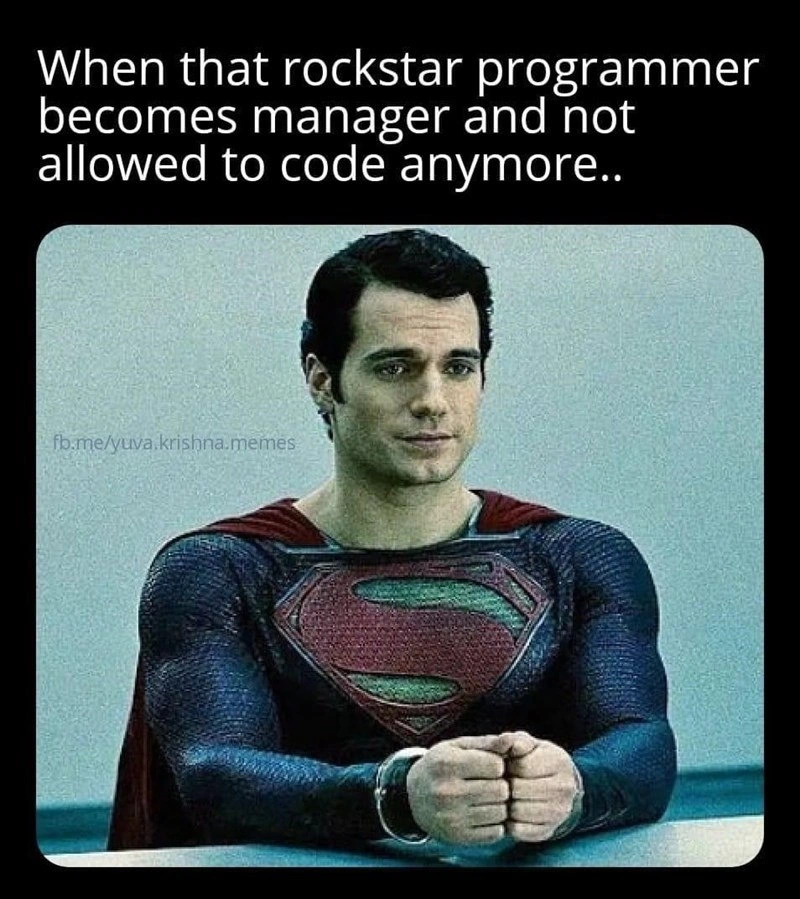
How would Superman feel? Probably a bit frustrated or sad. He knows he could rescue someone in seconds, but he’s not allowed – he has to let others do it. In the meme’s picture, that’s why Superman is sitting at a table wearing handcuffs. It’s a funny way to show that his abilities are being held back. He’s still in his superhero suit (he’s still Superman), but he’s not free to act like Superman right now.
Now, think of a super talented coder (a person who writes computer programs). This person was the best at fixing problems and creating cool new apps – coding was their superpower. One day, the company says, “You’re so good at this, we want you to be a manager and lead a team of coders.” Being the manager is like being the team’s boss. It’s a compliment and a new responsibility, but here’s the twist: as the manager, they’re told not to do the coding themselves anymore.
That’s like telling the fastest kid in school who always wins races, “You’re now the coach, so you can’t race anymore. You just watch and guide others.” It might make the kid proud to be coach, but also a bit itchy to run because running is what they love and do best.
So this meme is funny and relatable because it shows Superman looking a bit helpless, which is odd and amusing, and compares it to a real-life situation where an awesome programmer feels “tied up” by a new manager role. It’s basically saying: even heroes can feel powerless if they’re not allowed to do what they love. And that mix of feelings – both proud and frustrated – is something many people recognize when they move from doing the work they love to managing others who do that work. It’s a simple, almost childlike analogy: a superhero asked to sit still. That’s why we smirk at the image – we know Superman could break those cuffs, just like we know that coder could still write great code, but in this story, they’re choosing to follow the new rules… no super-coding allowed!
Level 2: From Hero to Manager
Let’s break this meme down more simply. It’s pointing out what happens when a top-notch coder becomes a manager and suddenly isn’t coding anymore. The top text sets the scene: “When that rockstar programmer becomes manager and not allowed to code anymore...” Below it, we see Superman in handcuffs at an interrogation table. Superman’s iconic suit (blue tights, red “S” logo) is unmistakable, though his face is pixelated (a meme-y way to say “this could be any person”). The whole thing equates a super programmer with a superhero, and then shows the hero tied up.
Some terms and context for those newer to the tech world or corporate life:
Rockstar programmer: Slang for an extremely good developer. Imagine someone in a dev team who’s a superstar: they write code that works flawlessly, they fix bugs super fast, and they might even pull off “miracles” like saving a project at the last minute. Companies sometimes exaggerate by calling such people “rockstars” or “ninjas.” It’s a compliment (though kind of a cheesy one). In short, a rockstar programmer is to coding what Superman is to fighting villains — the very best.
Becomes manager: In a lot of companies, if you’re really good at something, they eventually ask you to lead others doing that thing. So a rockstar developer might be promoted to an Engineering Manager or Team Lead. That means instead of writing code all day, they now manage people and projects. They hold meetings, decide who works on what, mentor junior devs, talk with other managers about deadlines and features, etc. It’s a different kind of job. You go from being responsible for your code to being responsible for your team’s output.
Not allowed to code anymore: This sounds like a strict rule – and sometimes it is explicitly stated, but often it’s just the reality of the role. When you become a manager, you usually don’t have time (or official permission) to delve deeply into coding tasks because you have a ton of other responsibilities. Some companies even remove managers from the code contributor list. For instance, a manager might no longer be assigned tasks in Jira that involve coding, or they might not have their account set up with access to commit to the main code repository. The idea is: “Your team codes, you supervise.” It’s not meant as a punishment; it’s to help the manager focus on their new duties and let the developers take ownership of the technical work. But to someone who loves coding, it can feel like being “not allowed to code.”
Now, the image of Superman in cuffs: Why Superman? Because he’s the go-to symbol of amazing abilities. Putting Superman in handcuffs is an obvious visual gag — it looks absurd because we all know handcuffs can’t really hold Superman. He’s pretending to be powerless. In the movie scene referenced, Superman surrendered to show goodwill, even though he could break free anytime. In the meme, this represents our “rockstar programmer” who’s now a manager. He still knows how to code like a champ (just as Superman still has his strength), but he’s choosing (or forced by role) not to. Those handcuffs = the new manager job keeping his hands off the keyboard.
This is relatable humor in the software world. A lot of developers fear or joke about the day they might have to trade writing code for writing emails. For a newer developer, it might be surprising: “Wait, being promoted means you can’t code?” It sounds counterintuitive, right? Promotions are supposed to add responsibilities, not take away what you love. But in tech, there are generally two tracks as you grow: one keeps you coding (technical track) and one moves you into managing (management track). This meme highlights the tug-of-war between the two.
Here are some real-life reasons behind the “no coding for managers” idea, explained simply:
- Time: A manager has meetings, planning sessions, hiring interviews, etc. Those can fill up an entire day. If they also had to implement features, they’d probably slow the team down or burn out. There are only so many hours.
- Team Growth: If the manager jumps in to do the coding, the team members lose the chance to learn or prove themselves. A manager’s job is often to enable the team, not compete with them.
- Quality and Consistency: Strangely, if a manager doesn’t code often, their code might not follow the latest patterns or the team’s agreed style because they’re out of practice or context. I’ve seen cases where a manager submits some code and the team gently says, “uh, this doesn’t actually pass our tests…” and it’s awkward. So many managers leave coding to the people who do it every day.
By using Superman, the meme also sneaks in the emotional angle. Superman loves helping people with his powers; it’s what he does. Similarly, passionate developers love creating software; it’s why they became developers. Take that away, and it can feel like telling a painter to supervise other painters but never touch a brush. Sure, some will adapt and even enjoy guiding others, but a part of them misses the direct work. When you’re new in the industry, it’s useful to realize that moving up isn’t always straightforward – you might gain authority but lose some daily joys.
One more thing: notice the watermark fb.me/yuva.krishna.memes. This tells us the meme was shared on Facebook by a meme page, meaning lots of people in the community found it funny/true enough to like and share. So the scenario isn’t just a one-off; it resonated widely. It’s almost a little piece of tech culture: the rockstar coder turned reluctant manager is a character many of us recognize, maybe even in our own workplaces.
In summary, the meme uses Superman-in-chains as a metaphor for a superstar coder who gets promoted and then can’t code. It highlights a classic situation in tech companies with a mix of humor and truth. The “rockstar” (hero) becomes “management” (the guy in cuffs). It’s funny to those in the know because it captures the irony that a promotion, which should be empowering, can sometimes feel like it’s tying your hands, at least regarding coding.
Level 3: Shackled by Promotion
"When that rockstar programmer becomes manager and not allowed to code anymore..."
This meme humorously captures a bittersweet truth in tech workplaces: the moment a star developer – the one with virtually superhuman coding powers – gets promoted to a management role and suddenly can’t do what they excel at: write code. The image choice is perfect: Superman (the ultimate symbol of raw power) seated at an interrogation table, wrists locked in shiny metal handcuffs. It’s as if our legendary coder, once able to solve any bug or build any feature at lightning speed, is now handcuffed by corporate policy. The mighty “S” on his chest is still there, but his commit rights have been revoked.
For seasoned developers, this hits home. Companies often label their top engineers as “rockstar programmers” (some even say “10x developers” or “code ninjas”, indulging in the superhero metaphor). These are the folks who debug in minutes what takes others days, who architect entire systems solo, who have an almost mythical status on the team. Naturally, in many corporate cultures, being that good leads to a promotion to management – framed as a reward and a new challenge. But here’s the catch (and the joke of the meme): by becoming a manager, this tech superhero gets effectively stripped of their coding superpowers.
The transition from individual contributor (IC) to manager often comes with an unspoken rule: managers shouldn’t be cranking out code every day. The reasoning is sensible on paper – a manager’s job is to coordinate projects, mentor team members, plan sprints, handle stakeholders, and generally keep the ship sailing. If they tried to write all the code too, they’d be doing two jobs (and probably bottlenecking the team). So companies encourage, or even mandate, that new managers step away from the IDE. In some teams, managers lose direct push access to the code repository. It’s like telling Superman: “We know you can fly and smash through walls, but from now on, please sit in meetings and write status reports instead.” The meme exaggerates this to “not allowed to code anymore” – as if there’s a literal no-coding policy, which to a passionate coder is akin to wrapping Kryptonite cuffs around their wrists.
Why is this funny to experienced devs? Because we’ve seen it (and maybe lived it). The once unstoppable coder is now spending their days wrestling with Excel and Jira instead of code. They went from deploying builds to deploying meeting invites. That blank, resigned look on Superman’s face in the meme – it says, “I could break these cuffs and deploy a hotfix in 10 seconds, but… I’m not supposed to.” It’s a mix of pride in the new role and the itch to do the old one. Every senior engineer recognizes that itch. In fact, many of us joke about “graduating” from writing code to writing emails – it’s funny because it’s true.
This image also nails a common misstep in corporate culture: assuming the best engineer will make the best manager. There’s even the Peter Principle in management theory — people get promoted until they reach a role they’re not competent (or happy) in. Here, our rockstar programmer might turn into an average manager, all while the team loses its best coder. It’s a well-known pitfall. That’s why modern tech companies often offer dual career tracks: you can become a Staff Engineer or Principal Engineer (staying hands-on with tech) or move up to Engineering Manager and beyond. Not every company gets this right though; some still practically force the promotion if you want to advance, which leads to scenes exactly like this meme.
Let’s talk about the handcuffs in a bit more depth, since that’s the crux of the visual joke. In the actual Superman movie scene, those cuffs are symbolic – everyone knows they can’t truly hold Superman. Similarly, taking away a veteran coder’s keyboard doesn’t mean they can’t code anymore. It means they shouldn’t. The hero dev still possesses all that knowledge and ability, but now they have to exercise restraint. They might watch a junior struggle with a problem and, instead of swooping in like before, they must coach from the sidelines. That’s tough! If you’ve ever pair-programmed with a very senior dev, you might’ve seen them practically sit on their hands to avoid just taking over the keyboard. As a manager, that self-restraint is their new job. The meme dramatises that feeling: the cuffs are self-imposed (or company-imposed) limits on the manager’s actions. Superman is playing along with the authorities; our ex-coder is playing along with the new job expectations.
From a senior perspective, the humor also has a touch of dark realism: we’ve all known a colleague who was amazing at coding and then–poof–they’re in endless meetings about budgets and timelines, looking a bit like a caged lion. The caption “not allowed to code anymore” resonates because in many tech teams, managers pushing code to production is seen as a big no-no. It can bypass code reviews or best practices, and it can demoralize the team (“Why is my boss fixing all the bugs? Does he not trust us?”). So even if the manager is Superman-level, they have to hold back. It’s the classic hero-to-leader transformation, and not every hero loves being a leader.
To illustrate in code-terms, it’s almost like:
// Pseudo-code for a promotion
if (employee.title === "Rockstar Engineer") {
promote(employee, "Engineering Manager");
repo.revokeAccess(employee, "push_to_production"); // remove coding powers
employee.tools = ["Confluence", "PowerPoint", "Excel"]; // new tools instead of IDE
}
Suddenly, our rockstar’s GitHub account is read-only for core repos. Instead of VS Code or IntelliJ, they’re living in PowerPoint slides and HRIS systems scheduling performance reviews. Ouch! The code comment “remove coding powers” sums it up – it’s a power shift.
In essence, at this level we appreciate the meme’s clever layering of a career reality onto a pop-culture reference. It’s funny and a little tragic: even Superman looks kind of bummed to be benched, and so does that once-happy coder who now has to file TPS reports instead of writing Python scripts. The meme winks at us, saying: “Remember, every promotion can be a pair of golden handcuffs – even for a coding Superman.” And every experienced dev or tech manager chuckles (or winces) in agreement.
Description
The image features a still of Henry Cavill as Superman, sitting at a table in what appears to be an interrogation room. He is wearing his full Superman suit but has his hands bound in heavy-duty handcuffs. His expression is one of calm resignation and powerlessness. Above the image, white text on a black background reads, 'When that rockstar programmer becomes manager and not allowed to code anymore..'. A faint watermark on the left says 'fb.me/yuva.krishna.memes'. This meme captures a common career dilemma for senior software engineers. A highly skilled developer (a 'rockstar') is often promoted to a management position as a reward for their technical excellence. However, the new role often prohibits them from coding, forcing them into meetings, planning, and people management, effectively handcuffing their primary and most powerful skill, much like Superman being physically restrained
Comments
7Comment deleted
The reward for being the best person at closing tickets is a promotion to a job where your primary IDE is now Outlook Calendar
They revoked my git push rights and filled my calendar with 1-on-1s - congrats, I’ve officially been refactored into a mutex
The cruel irony of tech careers: spend 15 years mastering distributed systems and performance optimization, only to be 'rewarded' with a calendar full of sprint planning meetings and PowerPoint decks about quarterly OKRs. Meanwhile, your muscle memory still tries to open vim every time you see a text field
The cruel irony of tech career progression: you finally get good enough at coding that they promote you to a role where your primary output is calendar invites and performance reviews. It's like training to become a Michelin-star chef only to be promoted to restaurant manager where you're not allowed near the kitchen - just endless inventory spreadsheets and staff scheduling. The 'rockstar programmer' becomes the person who writes 'Let's take this offline' in Slack instead of elegant algorithms, their IDE gathering dust while their calendar becomes a Tetris game of back-to-back syncs. Welcome to the management track: where your pull requests are replaced by pull-up reports, and your most complex problem-solving involves finding a meeting time that works for 12 people across 4 timezones
From O(1) hotfixes to O(n²) status meetings: the promotion where superpowers hit context switch hell
I used to push to prod; now the only thing I merge is calendars - and even that needs CAB approval
Promotion to manager: they revoke your commit bit and grant admin on calendars - RBAC working as designed; the S on your chest now stands for Status Update