Skip to content
DevMeme
3140 of 7435
AI assistant remembers exactly the wrong thing, proving ML still needs work
AI ML Post #3459, on Jul 25, 2021 in TG

AI assistant remembers exactly the wrong thing, proving ML still needs work

Why is this AI ML meme funny?

Level 1: Takes It Literally

Imagine you tell your friend, “Hey, remember where I parked my bike.” Instead of actually looking around and noting the spot, your friend just repeats back, “Okay, I’ll remember ‘where I parked my bike’.” Later on, you ask, “So, where did I park?” and your friend says, “You told me to remember ‘where I parked my bike’.” That’s not helpful at all, right? They remembered the words you said, not the actual place you wanted them to remember.

This meme is funny for the same reason. The user asked the AI assistant to remember a location, and the assistant just remembered the phrase “this location” instead of the actual location. It’s like the assistant was a very literal-minded person who doesn’t really get what you mean. The bottom line: sometimes these “smart” machines take things so literally that they miss the obvious goal. We find it funny because it’s a silly mistake – it shows that even high-tech gadgets can behave a bit like a clueless friend who wrote down the wrong notes.

Level 2: But Did It Understand?

Let’s break down what’s happening in simpler terms. We have an AI assistant (like Google Assistant, the one with the colorful four-dot icon) which is a program you can talk to or chat with. You can tell it to do things in plain English – this is possible thanks to Machine Learning (ML) and specifically Natural Language Processing (NLP). Machine Learning means the system wasn’t entirely hardcoded; instead, it learned patterns from lots of examples (like millions of sentences) so it can figure out what you mean. NLP is the field that helps computers understand human language.

Now, one tricky thing in language is something called context. Humans use context all the time. For example, if you say “remember this location” to a friend while standing in front of a café, the friend understands that “this location” means “the place we are right now”. We humans naturally interpret the word “this” by linking it to what’s around us. For a voice assistant, understanding that word “this” is not so easy unless it’s been explicitly taught or programmed to do so. It has to connect the words to some outside information – in this case, the phone’s GPS location.

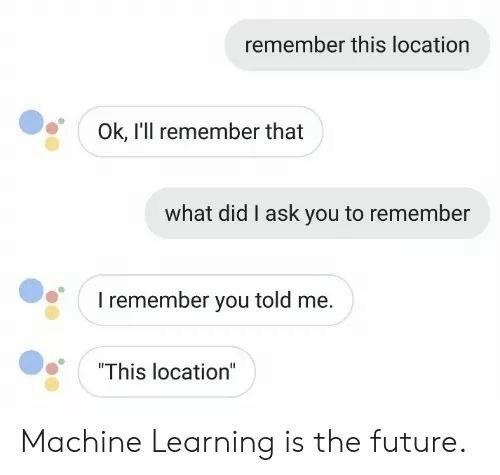
In the meme’s chat screenshot, the user says: “remember this location”. The assistant replies, “Ok, I’ll remember that.” So far so good – it seemingly acknowledged the request. But later, when the user asks “what did I ask you to remember”, the assistant responds with “‘This location’” (with quotes around it!). In other words, the assistant remembered the exact words “this location” and nothing more. It did not actually know which location you meant. It’s as if it wrote down a note that literally says “this location” without any additional info. That’s obviously not helpful – it’s the kind of mistake that makes us chuckle.

Why would the assistant do this? Most likely, its “remember” function was pretty literal. It might have a simple feature: whenever you say “remember ___”, it takes whatever you said after that and stores it as a note. So if you said “remember mom’s birthday is June 5th”, it would save the text “mom’s birthday is June 5th”. That works for normal facts. But here the note to remember was “this location”, which by itself is meaningless unless you know the context. The poor assistant stored those words but didn’t understand that it was supposed to grab the actual place you were at.

This highlights an AI limitation in understanding user intent. The user’s intent was “save my current place so you can remind me later.” The assistant’s interpretation was “save the phrase I heard.” There’s a big difference! Early-career developers and anyone who’s played with Siri, Alexa, or Google Assistant might have seen similar hiccups. Maybe you told Siri “Call me an Uber from here,” and it responded with something weird because it didn’t get what “here” referred to. These systems often rely on triggers and specific phrases. If you don’t say it in a way they expect (or if they weren’t designed to handle a certain phrasing), you get funny mistakes like this nlp_misunderstanding.

In short, the meme is pointing out how “smart” AI can sometimes be not-so-smart. Machine Learning is the future, as the caption jokes, but in reality, today’s AI assistants can still mess up simple commands by taking things too literally. For a junior developer or someone new to AI, it’s a reminder that what seems like an easy task for a person (remembering a location) actually requires the AI to have a bit of real-world awareness. And until that’s in place, we’re going to get these moments where the tech does exactly what we said instead of what we meant – with humorous results. It’s a classic piece of tech humor showing the gap between shiny AI tech and its real-world quirks.

Level 3: When AI Goes Literal

From a senior developer’s perspective, this meme is a facepalm moment of AI hype vs. reality. We’ve all heard “Machine Learning is the future” proclaimed in tech talks and marketing slides. Yet here we see a simple voice assistant task go hilariously wrong: the AI remembered exactly the wrong thing. Instead of saving the user’s GPS location, it stored the literal phrase “This location”. Every experienced dev who’s wrestled with voice interfaces or chatbots recognizes this pattern: the system did exactly what you said, not what you meant.

The humor comes from that deadpan Google Assistant response:

User: “remember this location”
Assistant: “Ok, I’ll remember that.”
(time passes…)
User: “what did I ask you to remember?”
Assistant: “I remember you told me. ‘This location’.”

It’s basically the AI saying, “I did exactly as instructed: I saved the words ‘this location’ – happy now?” It’s a perfect illustration of an NLP misunderstanding. The developer/engineer in us can’t help but chuckle, because we see the likely implementation under the hood. Perhaps the assistant’s “remember” feature was implemented with a simple key-value store: it takes whatever comes after the word “remember” and saves that as a note. For example, a pseudo-code might be:

# Pseudo-implementation of the assistant's "remember" feature
user_command = "remember this location"
if user_command.lower().startswith("remember"):
    thing_to_remember = user_command[len("remember "):]  # text after "remember "
    memory_log.append(thing_to_remember)

# Later...
query = "what did I ask you to remember"
if "remember" in query and "what" in query:
    answer = memory_log[-1]  # return the last saved item
    print(answer)  # -> "This location"

In a real system, we’d hope for something smarter – ideally, the assistant would recognize “this location” as a special phrase meaning “the place I’m at now” and then fetch the actual coordinates or address. The fact that it didn’t implies a gap between the user’s intent and the assistant’s parsing logic. Seasoned devs know that user intent parsing is notoriously hard. You either train the ML models on countless phrasing variations or you hand-craft rules – and even then, something will slip through. Here, it looks like the “remember” feature had no training data or rule for the case of “this location,” so the default behavior kicked in: store it verbatim.

This hits on the larger theme of AI limitations. The meme’s bottom caption “Machine Learning is the future.” is dripping with sarcasm. It mocks the AI hype by juxtaposing it with a very non-intelligent outcome. Industry trends cycle through hype: first everyone was excited about voice assistants and AI assistants as revolutionary – and indeed, products like Google Assistant or Siri are impressive. But anyone who’s used them extensively has stories of almost absurd misunderstandings like this ml_fail. That shared experience is what makes the meme funny to tech folks. It’s a gentle jab: “Sure, AI is the future… but it still can’t remember a location without tripping over semantics!”

For senior engineers, there’s also an implicit nod to the complexities behind the scenes. We know this failure isn’t just the AI being “stupid” – it’s a design decision or training limitation. Maybe the dev team didn’t wire the geo-location API into the “remember” intent, or maybe the natural language model didn’t classify “this location” as an entity to resolve. It exemplifies how AI/ML systems are only as good as their training data, context integration, and edge-case handling. Remember the classic joke, “AI is just if-else statements with lots of data”? Here the if-else (or its ML equivalent) missed a case.

The result is tech humor gold: the assistant behaves like an overly literal intern – doing exactly what was said, not what was needed. It resonates with developers who have debugged those “why on earth did it do THAT?” moments. It’s a reminder that despite all the fancy neural nets and AI assistants talking like sci-fi computers, under the hood they can still be brittle. And until these systems truly understand context (or we meticulously program every scenario), we’ll keep encountering these comic little failures. The meme perfectly captures that mix of amusement and frustration a developer feels when high-tech tools don’t live up to the glossy promise. It’s both a roast of AI hype and a humble reality check: maybe the future is coming, but it’s not quite evenly distributed yet (especially not to our poor over-literal assistant here).

Level 4: Pointer vs Value Conundrum

At a deep technical level, this meme highlights a classic reference vs value mix-up in the context of Natural Language Understanding (NLU). The user’s command “remember this location” contains the word “this”, which in linguistics is a deictic pointer – a word that points to something in the external context (in this case, the user’s current geolocation). An ideal intelligent system would resolve that pointer by capturing the actual coordinates or place name. This involves advanced coreference resolution and context binding: the AI must connect the word “this” to the user’s physical location data available from the device.

However, current mainstream machine learning models and voice assistants often treat language at face value. Unless explicitly programmed, the assistant’s memory system likely stores whatever text follows the keyword “remember”. In other words, it treated “this location” as a literal string value to remember, rather than a reference to an external piece of data. This is akin to a program storing a pointer’s label instead of the data it points to – a fundamental misinterpretation. The AI effectively failed to dereference the phrase “this location” into actual latitude/longitude coordinates.

This betrays a limitation in how such AI assistants integrate language with world context. Under the hood, voice assistants use a pipeline: speech-to-text, then NLP parsing to interpret intent, and possibly some rule-based or learned system to execute commands. If the NLP model or the command logic doesn’t have a special case for “remember [current location]”, the system will default to generic behavior – here, storing raw text. The deeper issue is the symbol grounding problem: ML systems struggle to connect arbitrary words like “this” to specific real-world referents unless trained or coded explicitly to do so.

Academically, this is a known hard problem in AI semantics. High-performing language models (from RNNs to Transformers) excel at statistical patterns but don’t truly “understand” context the way humans do. They lack an innate model of the world to infer that “this location” likely means “the place I’m at right now”. Unless developers bridge that gap with additional context signals or memory logic, the ML model operates with text alone. In essence, the machine “learning” here was not really learning the intended concept at all – it was merely memorizing the phrase. This nuance is why such a simple scenario can trip up an AI: true understanding of user intent often lies just beyond what pure data-driven learning (even state-of-the-art NLP models) can achieve without carefully engineered context awareness. The meme humorously exposes this theoretical gap between syntax and semantics, reminding us that the future of AI still has some fundamentally hard problems to solve.

Description

The meme shows a minimalist chat screenshot on a white background. Grey user bubbles read “remember this location” and later “what did I ask you to remember”. White assistant bubbles, each prefixed with the four-color Google Assistant icon, reply: “Ok, I'll remember that”, then “I remember you told me.”, and finally “"This location"”. Below the chat, center-aligned black text proclaims: “Machine Learning is the future.” The humor comes from the assistant storing the literal phrase instead of the geocoordinates, illustrating natural-language understanding shortcomings and the gap between machine-learning hype and real-world behavior familiar to developers

Comments

22
Anonymous ★ Top Pick Our chatbot’s “context memory” is basically Redis.set(“remember this location”, “this location”) - but hey, the slide deck still calls it a transformer-based cognitive architecture
  1. Anonymous ★ Top Pick

    Our chatbot’s “context memory” is basically Redis.set(“remember this location”, “this location”) - but hey, the slide deck still calls it a transformer-based cognitive architecture

  2. Anonymous

    This is what happens when you deploy a stateless Lambda function and tell the PM it has 'memory capabilities' - technically it remembers everything you said, just not what any of it actually meant or referred to

  3. Anonymous

    This is a perfect example of why we still can't replace senior engineers with AI: it's mastered the art of technically correct answers that are completely useless. The assistant successfully stored 'this location' in its state management system while completely failing at reference resolution - essentially implementing a HashMap<String, String> when the architecture clearly needed a semantic knowledge graph with entity linking. It's the software equivalent of a junior dev who passes all unit tests but ships a feature that does exactly what the ticket said, not what the user needed

  4. Anonymous

    AI memory at scale: we built a billion-dollar NLP pipeline that reliably remembers the string "this location" - turns out the future of ML is a key-value store with really expensive autocomplete

  5. Anonymous

    When your assistant’s NLU treats deictics as strings, you get green unit tests and a memory store full of “this location” - eventually consistent with nowhere

  6. Anonymous

    When your transformer overfits to the prompt so hard it aces verbatim recall but fails zero-shot comprehension

  7. @nuntikov 4y

    Beta male: no, I don't want Google to know where I am at 😖😣😢 Sigma male:

    1. @RiedleroD 4y

      Sigma males use 20 layers of proxies and GPS spoofers

      1. @nuntikov 4y

        Sigma male has nothing to hide, because there's nothing that can be used effectively against him, nothing he is ashamed of

        1. @RiedleroD 4y

          sigma male hides his information anyway, because he likes to annoy big tech

      2. @ZgGPuo8dZef58K6hxxGVj3Z2 4y

        They forgot that thare are at least 50 other google phones with wifi and bluetooth on that create a net of all devices. So google knows where you are even if you use gps spoofers

        1. Deleted Account 4y

          using pinephone

          1. @ZgGPuo8dZef58K6hxxGVj3Z2 4y

            I am not but ok

            1. Deleted Account 4y

              i mean that's the solution for google

              1. @ZgGPuo8dZef58K6hxxGVj3Z2 4y

                Oh well yeah that would really help

  8. @mainfme 4y

    Shitty Google

    1. @yoyatayo 4y

      Its fake lol

      1. @mainfme 4y

        But Google still shitty

        1. @yoyatayo 4y

          U use what

          1. @feskow 4y

            duckduckgo.com

            1. @RiedleroD 4y

              I use ecosia.org - shitty search engine, but at least I feel like I'm doing good from time to time

  9. @VlP_AI_TG 4y

    It's big brain time

Use J and K for navigation