First user immediately hits the banana-shaped edge case you skipped
Why is this Testing meme funny?
Level 1: Banana in the Toaster
Imagine you invented a nice toaster that’s supposed to toast bread. You tested it with all kinds of bread – white bread, brown bread, bagels – and it worked great. Now you give it to someone to try out. What’s the first thing they do? They try to toast a banana. 😮🍌 You never thought anyone would do that, right? A banana isn’t bread – it’s wet and mushy – so your toaster might get all messy or even stop working because it wasn’t designed for that. The result is kind of silly and tragic at the same time: the person is standing there with a hot squished banana, and you’re slapping your forehead because it broke your machine.
This is funny because it shows how people can use things in unexpected ways. You worked hard to make something that toasts bread perfectly, but someone immediately did the one crazy thing (putting in a banana) that you didn’t plan for. It’s like a rule of life: if something can be used differently or “wrong,” someone will eventually try it. We laugh at the situation, because we can all imagine that “uh-oh” moment. In simple terms, the meme is saying: “I didn’t think of that, and of course that’s exactly what happened!” It’s a reminder that when you make or design anything – an app, a gadget, or even a toaster – real people might surprise you with what they do. And their very first try might show you a problem you didn’t know was there. It’s a funny way to learn that we should try to think of the silliest, craziest uses of our creations, just in case, because sometimes the first user will do something as wacky as toasting a banana.
Level 2: Did We Test This?
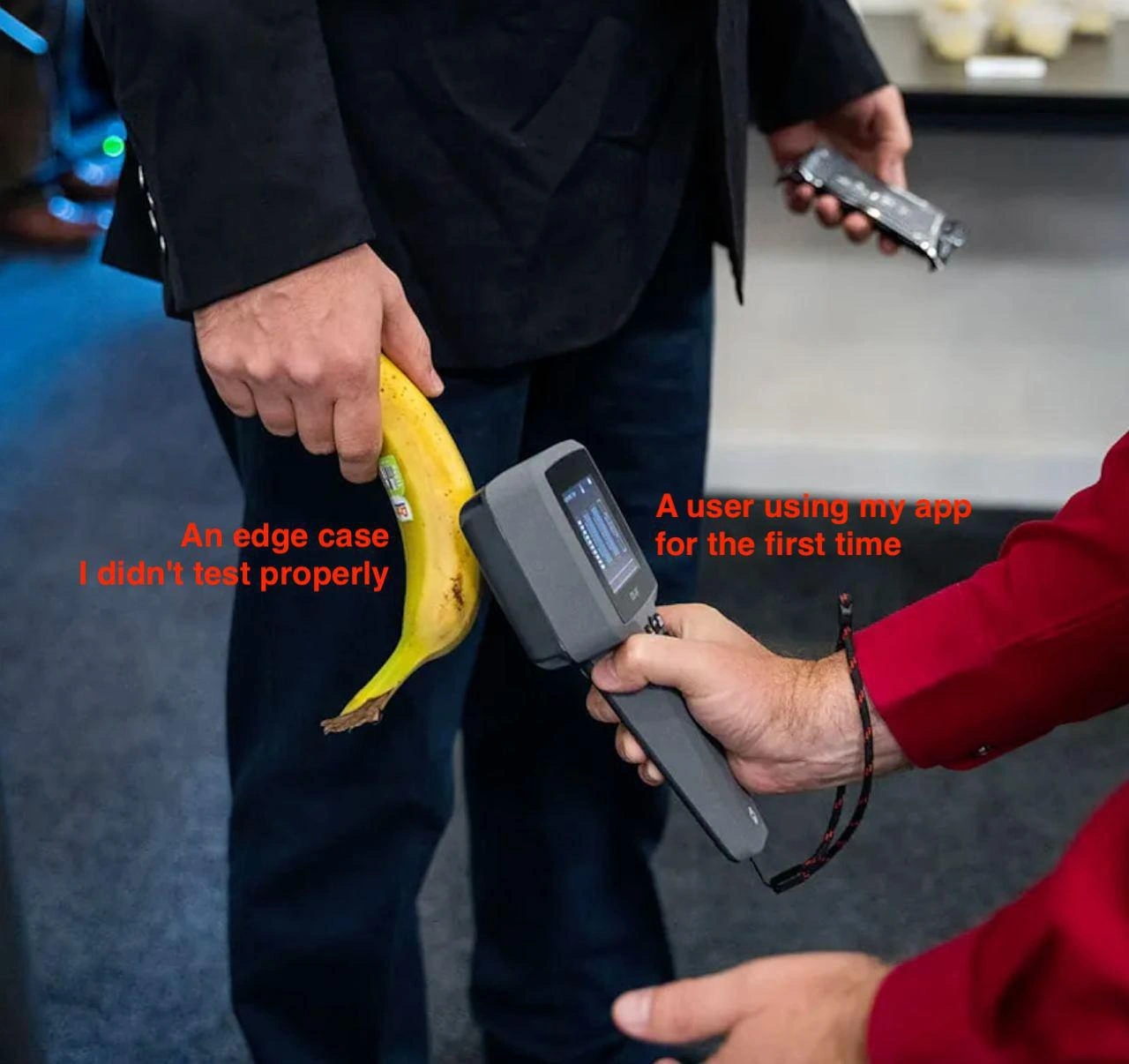
Let’s break down the meme in simpler, practical terms. On the left side, there’s a banana labeled “An edge case I didn’t test properly.” In software, an edge case is a situation that’s unusual, rare, or at the extreme “edge” of what’s expected. It’s like an input or action that’s technically possible but not typical. For example, if you made an app for scanning barcodes on products, a normal case would be scanning an actual product barcode. An edge case might be scanning something odd like a banana without a barcode – something the app wasn’t really designed for. Developers try to think of edge cases when testing, but we often miss a few. “Did we test this scenario?” is a common question in a project meeting – and if the answer is “no,” that scenario can turn into a real bug when a user tries it. A bug is basically a flaw or error in the software that causes it to produce a wrong or unexpected result (like crashing or giving nonsense output). Bugs often show up when the app gets input it wasn’t prepared to handle. In the meme, the banana is a stand-in for any odd input that wasn’t tested – hence it’s labeled as something the developer didn’t test properly.
On the right side of the image, a person is holding what looks like a handheld scanner (the kind you’d see at a store or trade show) up to the banana. This person is labeled “A user using my app for the first time.” This hints at a frustrating reality: often the very first time a real user tries your app, they do something you didn’t expect. Here the user is essentially testing the app in a way the developer or QA team didn’t. The joke is that real users sometimes behave like wildcard testers – through curiosity or accident, they’ll try inputs that feel completely random (like trying to scan a banana). This is classic TestingHumor among developers. We laugh (a bit nervously) because it’s common: you think your program is solid, you hand it to someone new, and immediately they stumble on a problem you overlooked. It’s as if the user is doing QA (Quality Assurance) on your app, even though that’s supposed to happen before release!
The categories are Bugs, Testing, QA, which is exactly what’s happening here. The developer skipped testing this “banana” scenario (the untested_input), so a bug appears when it happens. During proper QAProcess (the systematic testing phase where a QA team tries to find issues), testers try many cases, but they might not think of the banana-level crazy case unless they have a very detailed test plan or a really imaginative tester. There’s even a term “monkey testing,” where testers (or automated tools) will input random garbage or do unpredictable things to the software to see if it breaks – kind of like a monkey banging on a keyboard or someone literally scanning random objects. It’s a fun way to catch those weird bugs. However, not every team does heavy monkey testing, so some unexpected_user_behavior slips by. That’s why when the app goes live, the first user might effectively become a monkey tester without meaning to. They immediately hit that one weird scenario (“the banana-shaped edge case”) that wasn’t covered.
In summary, the meme uses a funny picture to convey a real software lesson: always expect the unexpected from users. The banana is a goofy placeholder for any outlandish input or action, and the scanning device represents your application facing that input. The first-time user has no preconceived notion of how the system “should” be used, so they might do something that reveals a flaw. Developers find this meme so relatable because it’s practically a cliché: the one thing you don’t test is exactly what a user will try. It emphasizes the importance of thorough testing – including those oddball cases – and having good error handling for when something truly strange happens. After all, we want our apps to be foolproof, but as the saying goes, “build a system that even a fool can use, and only a fool will want to use it in that way” – and then we discover new kinds of fool 😅. It’s a lighthearted nod to the challenges of building robust software.
Level 3: Edge Cases Unpeeled
Every experienced developer has that scarred memory: the first user (or the first production customer) did something with your software that you never saw coming. Maybe they imported a 500MB CSV, used an emoji in their name, or set their birth year to 0001 – and boom, your app went bananas. This meme nails that feeling with a literal banana as the symbol of a wild edge case. On the left, Person A casually holding a banana labeled “An edge case I didn’t test properly” represents the weird, out-of-spec scenario lurking in your code. On the right, Person B with the scanner labeled “A user using my app for the first time” is that unwitting beta tester in the wild. The comedy comes from the inevitability: despite all our unit tests and QA checklists, the very first real user manages to aim a banana at our barcode scanner. It’s a perfect storm of BugsInSoftware and TestingHumor: the one thing we skipped is exactly what they try first.
Why is this so relatable? Because in software development, unexpected user behavior isn’t the exception – it’s the rule. We developers often test the “happy path,” those straightforward scenarios we expect. We assume users will scan a valid barcode or fill a form with sensible data. But real users? They’ll scan a bruised banana just to see what happens. It’s practically a rite of passage in QAProcess tales: the time a seemingly absurd input crashed the system. Senior engineers have a term for it: Murphy’s First Law of Software: if there’s a weird way to use your app, someone will try it immediately. In fact, seasoned QA engineers train themselves to think like mischievous users or downright destructive monkeys – a practice known as monkey testing – to catch these issues. Have you ever heard of “Little Bobby Tables” from that famous XKCD comic? It’s a joke about a child’s name being Robert'); DROP TABLE Students;-- which is actually an SQL injection attack. It’s hilarious (and horrifying) because it’s another banana-shaped edge case: an input so ridiculous (who would name their kid that?!) that it breaks the system if you didn’t anticipate it. This meme fits that tradition of developer humor, highlighting how even QA might miss something that, in hindsight, seems obvious (“Why on earth didn’t we test a banana?!”).
From a senior perspective, there’s also commentary here on planning and assumptions. Perhaps the developer thought, “No user would ever do that” – famous last words in the world of bugs. The QA process might have been rushed or had a manual testing gap, so nobody tried a truly oddball scenario. Maybe the spec was incomplete: if you don’t explicitly tell QA “try scanning random objects,” they might stick to known test cases (scan actual product codes). Meanwhile, the new user isn’t trying to break things; they just have a different mindset or maybe they’re curious. And sure enough, the app crashes or behaves bizarrely, betraying a bug the team missed. It’s both funny and painful: funny because it’s absurd (scanning a banana with professional equipment – who does that?), and painful because it rings true (users do feed bananas into our perfectly engineered systems, metaphorically speaking).
What really drives the humor home is that bright red meme text labeling the obvious-in-retrospect components of the failure. It’s like the meme is shouting what every developer thinks in that moment: “I can’t believe the edge case I skipped is happening RIGHT NOW!”. The DeveloperHumor subtext here is also a bit of a coping mechanism – better to laugh than cry when your “pristine” test suite crumbles. Senior devs share these memes as war stories: “Yep, I’ve been there – shipped an app, and Day 1, a user found the banana I didn’t account for.” It underscores the importance of expecting the unexpected. Robust software has to handle even nonsensical inputs gracefully. Maybe the scanner should pop up “Unrecognized item – please try a valid code” instead of, say, throwing an exception that crashes the checkout system. The meme implicitly reminds us of best practices like defensive programming (never trust the input, always validate it) and thorough testing. But it does so with humor: picturing that one serious user who earnestly tries to scan a banana, while the developer facepalms somewhere.
Ultimately, “First user immediately hits the banana-shaped edge case you skipped” resonates because it compresses a whole software testing saga into one image. It’s a comical validation of every senior dev’s paranoia: no matter how ready you think you are, real users will find the one thing you overlooked. As a community, we laugh at this to share the pain and to remind each other – write tests, include edge cases, and maybe toss a banana or two at your app before release, because someone else surely will!
Level 4: The Infinite Monkey QA Theorem
In theory, testing every possible input a user might throw at your app is a combinatorial explosion – essentially impossible for anything non-trivial. This meme hints at the classic QA dilemma: you can’t anticipate every edge case because the input space is practically infinite. If you had an army of monkeys (or users) randomly using your app, by the Infinite Monkey Theorem one of them would eventually try the digital equivalent of scanning a banana. Formally, ensuring your code handles all such cases verges on formal verification territory – using mathematical proofs or exhaustive model checking to prove correctness for all inputs. Most everyday software isn’t developed with full formal methods (that’s more common in spacecraft or crypto code) because it’s incredibly labor-intensive. Instead, we rely on a combination of unit tests, integration tests, and QA – but even thousands of tests are still a finite subset of all possibilities. The result? Untested input lurking just beyond our coverage. The moment a real user strays outside the “happy path,” they effectively perform an impromptu fuzz test.
To a theoretical computer scientist, this scenario evokes the limits of what testing can guarantee. It’s a bit like the Halting Problem of QA: a program can’t easily detect all the situations that will make another program crash or misbehave. We can approximate with static analysis or symbolic execution – tools that explore many paths automatically – but even those have limits. For example, a fuzzing tool might generate millions of random inputs (the digital equivalent of hurling bananas, pickles, and kitchen sinks at the code) to find crashes. Security engineers do this to uncover weird bugs. Yet, despite these advanced techniques, some truly bizarre “banana-shaped” edge case often slips through. The humor here is that the very first user found one – a tongue-in-cheek reminder that Murphy’s Law lurks in software: if a bug can happen, it will, and usually sooner than you expect. The meme’s absurd scanner scenario illustrates the gap between the theoretical ideal of exhaustive testing and the practical reality that real-world usage will always surprise you. Even with rigorous QA processes, the space of possibilities is so vast that something as outlandish as a banana input is not just possible but almost inevitable given enough users or enough time.
Description
The photo shows a trade-show scenario where Person A (left) casually holds a banana at waist level while Person B (right) aims a handheld barcode-like scanner at it. In bright red meme text, the banana is labeled “An edge case I didn’t test properly,” while the scanning hand is labeled “A user using my app for the first time.” The absurdity - a fruit being scanned with professional equipment - mirrors how real-world users inevitably supply inputs no test suite anticipated. The visual joke resonates with senior engineers who have watched pristine unit coverage crumble the moment production traffic deviates from happy-path assumptions
Comments
13Comment deleted
CI was green - until the very first customer piped a banana into /dev/api and triggered undefined fruit behavior
After 20 years in tech, I've learned that no amount of defensive programming can protect against users who think your enterprise POS system should handle organic produce like it's running GPT-4 with computer vision. The real edge case isn't the banana - it's assuming users read error messages instead of just trying harder
This is the exact moment when you realize your comprehensive test suite with 95% code coverage somehow missed the 'user attempts to pay with produce' scenario. Your integration tests covered Visa, Mastercard, Apple Pay, and even cryptocurrency - but nobody on the team thought to add a fixture for tropical fruit. The banana represents every production bug that makes you question whether your QA environment exists in the same universe as your users. It's the physical manifestation of that Jira ticket titled 'Unexpected behavior in payment flow' that gets escalated at 2 AM, and when you finally reproduce it, you just stare at your screen wondering if you're being pranked by the universe itself
First-time users are basically AFL with a credit card - they’ll scan a banana through your onboarding wizard and invalidate your 99% test coverage
Your happy-path onboarding is great - until a first-time user behaves like a fuzzing harness and discovers the banana-shaped state transition you left untested
Developers cover 99% of inputs; users always find the banana that slips through validation
what is it? Comment deleted
Banana Comment deleted
Bananfc Comment deleted
Poor hans hahah Comment deleted
Explanation squad? Comment deleted
This is a picture from the US chess tournament. A grandmaster Hans Neiman (I hope I spelt his name right) was accused my Magnus Carlsen (the current world chess champion) of cheating in over-the-board chess using vibrating anal beeds. Security was tightened ... You can see how tight it got 🤣 Comment deleted
Was accused for cheating, by him, but not really for using sex toys during the tournaments. I think that rumor came just straight off of a streamer lol. (Not sure tho) Comment deleted