Senior dev likens the codebase to a sausage factory wall-of-shame
Why is this CodeQuality meme funny?
Level 1: Just Eat the Sausage
Imagine you have a hot dog that you really enjoy eating. It’s tasty and it fills you up. Now, if someone took you to the factory where they make hot dogs and showed you everything that goes into it – all the bits and pieces of meat, the machines grinding stuff up, the yucky mixing process – you might feel a bit sick and not want that hot dog anymore. You’d probably be happier just enjoying your lunch without seeing all that gross stuff, right? This meme is saying the same thing about software, like the games or apps you use. The idea is: the app you use is fun and looks nice on the outside (just like the yummy hot dog), but the way programmers had to make it might be really messy or complicated (like the weird ingredients and messy process in the factory). The quote jokes that everyone will be happier if they just enjoy using the software without knowing about all the crazy things in the code that make it work. It’s funny because we usually don’t think of computer programs like food, but the comparison makes sense – sometimes it’s better not to know how something is made, so you can keep enjoying it. So, the advice is kind of: “Don’t ask too many questions about how that app works under the hood, just have fun with it!”
Level 2: Don't Peek Inside
The meme plays on the well-known sausage-making analogy, which warns that if you love something (like sausages... or software), you’re better off not seeing how it’s created. In software development, that translates to “just use the app and don’t inspect the source code too closely.” Why? Because the creation process can be messy! Let’s break down the terms and ideas here for a newer developer:
Code Quality: This refers to how clean, well-structured, and maintainable the code is. High code quality means the code is easy to read, has clear organization, and follows good practices. Low code quality (what our senior dev is hinting at) means the code might be disorganized, overly complex, or full of hacks. A hack in coding slang is a quick-and-dirty solution – it solves a problem fast, but often in an ugly or non-ideal way. For example, hardcoding a password in multiple places is a hack (and a bad one), because it works initially but causes trouble later. In an ideal world, all code would be elegant and high quality. In reality, time pressure can lead to "just make it work" code that nobody’s proud of, but everyone relies on.
Technical Debt: This is a metaphor likening messy code to financial debt. When developers take shortcuts to meet a deadline (like skipping tests or copying a snippet from StackOverflow without fully integrating it), they incur technical debt. Just like financial debt, it “accrues interest” – meaning the consequences hit later. Code with high technical debt might cause bugs, be hard to modify, or require significant rework in the future. The quote implies the codebase has a lot of these IOUs under the surface. An example: imagine a startup hard-codes every webpage URL for speed. It works initially, but later on, changing one URL means combing through hundreds of files – that’s the interest being paid on the earlier shortcut. A junior developer encountering this will likely think, “Why did they do it this way?!” Answer: they took on technical debt to ship faster.
Legacy Code: The word legacy in tech refers to older software or modules that are still in use but no one really wants to touch. Legacy code might have been written 5, 10, or 20 years ago, possibly by developers who have since left the company. It often lacks documentation (no one wrote down why or how it works) and might use outdated techniques. Yet, it’s crucial to the product: if that code runs the payment processing or user login, you can’t just throw it away. The meme hints that such legacy modules are like mysterious sausage ingredients – they’re in there, doing something, but better not to ask too many questions. A junior dev might be tasked to add a feature and discover a file with a giant function from 2009. It’s intimidating; the code is fragile and dense. The senior dev’s advice would be: unless you absolutely must, maybe don’t dig too deep into that! It’s functioning now, so approach with caution.
Hidden Complexity: This phrase means there’s more going on under the hood than meets the eye. A piece of software might seem simple to a user or a new developer (“Click button, get result”), but behind that button could be thousands of lines of code juggling edge cases, data formats, network calls, and whatnot. That complexity is often hidden behind a clean interface. In our analogy, the final sausage looks like one unified thing, but hidden inside are many different spices, meats, and fillers. In a codebase, hidden complexity might be things like a chain of 10 microservices all coordinating to serve one request, or a single function that handles 50 different scenarios. Newer developers learn quickly that even if a code snippet looks small, it might call on many other systems or contain subtle bugs—there’s a lot going on beneath the surface.
“Black Box” Development: A black box is a system where you can see the input and output, but not the inner workings. Often software components are treated as black boxes – you trust that if you give input X, you’ll get output Y, without needing to know exactly how X became Y. This meme’s senior dev essentially suggests treating the software like a black box: enjoy what it does, but don’t peek at the messy code inside. For a junior dev, this is a bit humorous because it’s basically saying “Move along, nothing to see here” about the code. In practice, developers sometimes abstract away messy parts behind a clean API or interface. That way, other team members can use it without enduring the confusion of how it’s implemented internally. It’s like saying: we know this module is ugly inside, so we encapsulated it – just call the function and trust us. Early in your career, you might be curious and open that black box module to see how it works... and then wish you hadn’t when you find a 500-line function full of bizarre conditions!
Now, why compare it specifically to sausage making? The saying “Laws are like sausages: it’s better not to see them being made” has been around for a long time. Engineers adopted it because it fits so perfectly. Sausage factories historically would toss all sorts of leftover bits into sausages – the result is tasty, but if you saw the process (grinding odd parts, mixing in fillers, preservatives, who-knows-what), you might be grossed out. Similarly, software can involve weird solutions (like a script that only runs if the server’s clock is a few seconds ahead, or a function named doEverything() that no one fully understands). To outsiders or new developers, seeing that can be jarring. It’s a form of developer folk wisdom to say, “Don’t look too closely at how we solved it, just be glad it works.”
To illustrate the analogy, here’s a light-hearted comparison between sausage production and software production:
| Sausage Making | Software Development |
|---|---|
| Mystery meat and scraps thrown in | Legacy code and quick hacks incorporated |
| Factory floor is messy and greasy | Codebase is chaotic with tangled dependencies |
| Final sausage looks neat and tasty | Final app or feature appears polished to users |
| You’d lose appetite seeing the prep | You’d lose confidence seeing the raw code |
| “Don’t ask, just eat it.” | “Don’t ask, just use it.” |
As a junior developer, you might find this both funny and a bit unsettling. It’s funny because it exaggerates something real – yes, sometimes code really is held together with proverbial chewing gum. It’s unsettling because it breaks the idealistic image of clean, perfect code that you see in textbooks or tutorials. Over-engineering can also play a part in this: occasionally, in trying to avoid one big mess, developers create an overly complex design – essentially a different kind of mess. You could end up with many layers of abstraction or unnecessary patterns that make the code hard to follow (like adding too many fancy ingredients to a simple sausage).
The core lesson for a newcomer is understanding why this happens. It’s rarely because developers are lazy or don’t know better. It’s because of real-world constraints: deadlines, pressure, changing requirements, and sometimes sheer survival mode during an outage. These forces can push even a good engineer to write a kludge (a clunky workaround) at 2 AM and promise to “refactor later,” which doesn’t always happen. That’s how you get a codebase with oddities nobody wants to claim. When you hear senior devs joking like this, it’s their way of saying, “We’ve all been there. We’ve all written something embarrassing to just make it work.” It’s both a cautionary tale and a camaraderie-building joke. So if you ever inherit a project and find parts that look like a Frankenstein monster of code, just know: that Technical Debt was probably a conscious trade-off at one point. And until you can safely improve it, maybe treat it like a sausage – use it, but try not to think too hard about what’s inside.
Level 3: Mystery Meat Modules
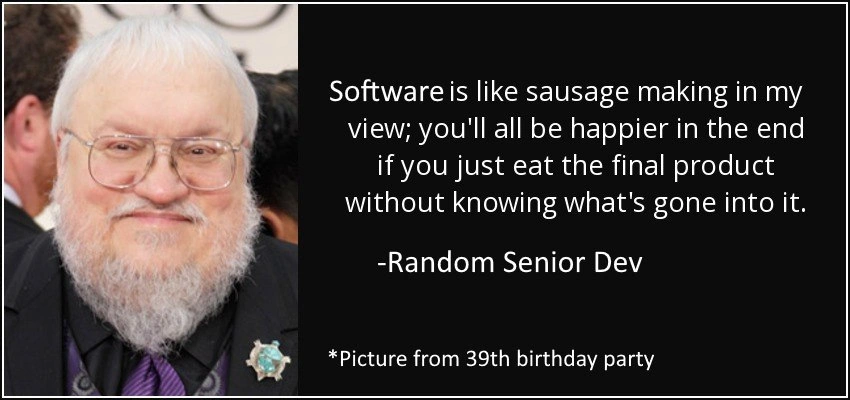
"Software is like sausage making in my view; you'll all be happier in the end if you just eat the final product without knowing what's gone into it."
– Random Senior Dev at a 39th birthday party
This seasoned engineer isn’t exaggerating – some codebases truly feel like sausage factories of shame. The quote riffs on the classic “laws and sausages” analogy with a dark developer twist. In a veteran dev’s experience, a polished app often hides hidden complexity: horrifying build scripts, magic shell commands held together by duct tape, undocumented hacks, and legacy modules so frightening that no one dares peek inside. It’s a slice of Developer Humor wrapped in Developer Cynicism. We laugh (maybe with a groan) because we’ve all seen that monolithic project or janky script that miraculously works yet would make any code quality evangelist cringe.
On the surface, the software “sausage” (the final product) looks tasty and user-friendly. But behind the scenes? Absolute carnage. Technical Debt has been ground up and stuffed into that program over years of quick fixes and engineering trade-offs. Deadlines loom, so developers cobble together solutions out of whatever’s on hand – much like a butcher throwing scraps into the grinder. The result is a product that works, but the code implementation is a gnarly mix of old and new parts. Every senior dev has stumbled upon things like: a 5,000-line singleton class that everyone is afraid to touch, a build.sh script that only Bob from IT truly understands, or comment sections that read like a horror story:
# WARNING: Here be dragons
def process_data(data):
try:
result = formal_parse(data) # Try the proper method first
except Exception as e:
# Sausage-making: fallback to the old hack if the fancy method fails
log.error(f"Parser failed, resorting to legacy fix: {e}")
result = legacy_fallback(data) # Ugly hack, but it works (most of the time)
return result
Above: A realistic peek inside the grinder. When the “proper” approach blows up, a secret quick-and-dirty fix takes over. Such code is the digital equivalent of adding filler and mystery meat to keep the sausage intact. No one is proud of it, but at 3 AM during an outage, you do what you must. Veteran engineers carry these battle scars – they’ve written and inherited code that just barely holds the system together. They use humor as a coping mechanism, joking about “mystery meat code” because confronting the reality head-on is both hilarious and terrifying.
The humor lands because it’s painfully relatable. Most developers eventually encounter a codebase that looks fine from the outside (the app works, customers are happy) but internally is a tangled mess. Think of a decade-old monolith where half the team’s mantra is “if it ain’t broke, don’t fix it.” Over years, features get bolted on like extra pipes and gears, until the whole engine is an overstuffed jumble. When something breaks, poking around that mess feels like sticking your hand into a meat grinder – you’re going to lose a finger (or your sanity). Hence the folk wisdom: maybe it’s better if others don’t see what’s inside. Code Quality ideals say we should refactor and clean up, but in reality, bosses want new features yesterday. Refactoring a gnarly module might introduce new bugs or downtime, so the team quietly agrees to leave the nightmare legacy code running as a black box. They’ll tell the Product Manager, “Yup, it’s all fine!” while exchanging knowing glances about the monstrosity hidden in the code. It’s a form of professional courtesy – saving others from the ghastly details.
This meme also satirizes how software complexity accumulates. The “sausage” quote acknowledges that making software often involves messy compromises. Over time, quick fixes layer on top of quick fixes. The codebase becomes a big ball of mud (or in this case, a big ball of meat) – an architecture so unstructured that even the simplest change might cause something to explode elsewhere. Senior devs have an internal “wall-of-shame” tracking these worst offenses: maybe a function that’s 1000 lines long, or a config file with secret credentials hardcoded because someone was in a rush. Ironically, parts of the system might also be over-engineered – too many abstraction layers or design patterns added in an attempt to organize the chaos, which only made it harder to follow. It’s the equivalent of adding exotic spices to a bad sausage recipe: it doesn’t really fix the core issue, just masks it a bit.
Why don’t we just clean it up properly? Ah, welcome to Engineering Trade-offs 101. In theory, we all want clean, maintainable code. In practice, rewriting a stable but ugly component is risky and time-consuming. There’s pressure to deliver features, so the ugly parts remain hidden under the casing. Management often lives by metrics and user stories – as long as the features work and users aren’t complaining, the inner quality doesn’t get attention. Developers know that showing non-engineers the gnarly innards would only cause panic (“You did WHAT to make the payment system work?!”). So instead, devs joke among themselves and document just enough to keep things running. It’s a form of black-box development: shield others from the gory implementation details and just serve the output. The senior dev in the meme is basically saying, “Trust me, you do not want to know how the sausage (software) was made.” And honestly, he’s right – for many of us, ignorance is bliss when the alternative is losing your lunch over the codebase.
Description
The meme is a two-panel composite on a black background with a thin white border. Left: a suited, grey-bearded man at a party; his face is intentionally blurred for anonymity. Right: white sans-serif text reads, “Software is like sausage making in my view; you'll all be happier in the end if you just eat the final product without knowing what's gone into it. - Random Senior Dev” followed by a smaller footnote, “*Picture from 39th birthday party”. The joke riffs on the classic ‘laws and sausages’ analogy, hinting at horrifying build scripts, undocumented hacks, and legacy modules nobody wants to see. It resonates with veteran engineers who have patched decade-old monoliths while shielding product managers from the gory implementation details
Comments
6Comment deleted
If you think seeing the code would ruin your appetite, wait until you read the 4-page Jenkinsfile that actually cooks this ‘sausage’ in prod
The git history alone would violate several Geneva Convention articles, but at least the API returns 200 OK
This perfectly captures the senior engineer's dilemma: we've seen enough production incidents, emergency hotfixes at 3 AM, and 'temporary' workarounds that became permanent to know that the pristine facade users see is held together by duct tape, prayer, and a surprisingly fragile chain of deprecated dependencies. The real wisdom isn't in the clean architecture diagrams we present to stakeholders - it's in knowing which skeletons to leave in the closet and which technical debt to never, ever mention in sprint retrospectives
APIs are the sausage casing: pristine interface hiding the grind of legacy guts and rushed refactors no stakeholder should witness
It’s not secrecy, it’s Parnas‑compliant charcuterie: a clean API on the plate, a Makefile that looks like a crime scene behind the counter
We call it 'encapsulation' when the customer sees a polished API; internally it's a labyrinth of migrations, flaky tests, and a cron-driven grinder called prod_sausage.sh