When you refuse to add emojis to commits and face lethal feedback
Why is this VersionControl meme funny?
Level 1: No Emojis, Big Trouble
Imagine you and your friends have a special way of doing things together – say everyone in your group chat likes to start their messages with a funny little picture (an emoji) to set the mood. Now picture that one day, you decide not to use those emojis at all. You just send plain text because you feel the pictures are unnecessary. Suddenly, all your friends get really upset with you. They start bombarding you with angry replies – it’s so intense it feels like they’re throwing knives made of words at you!
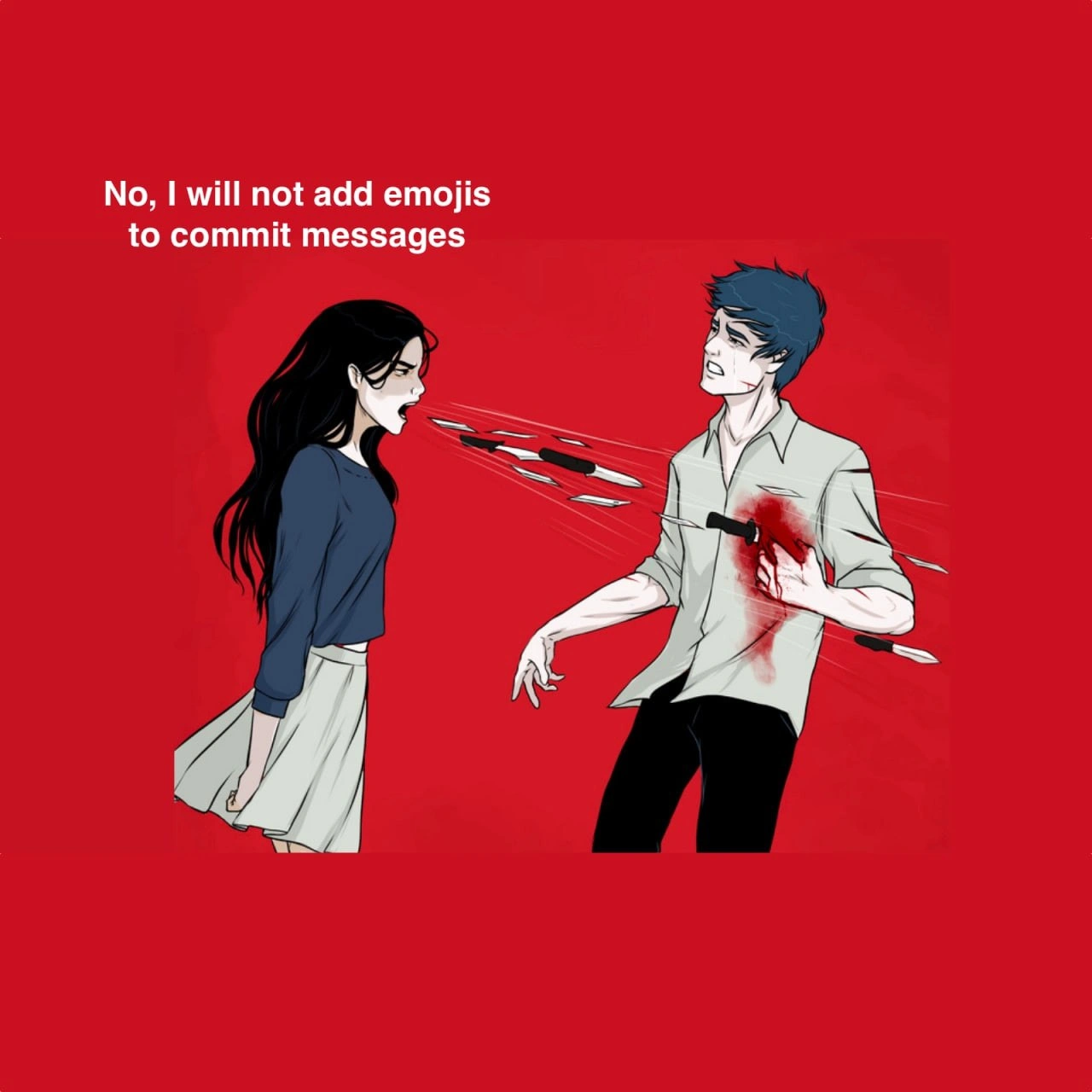
That’s exactly what this meme is joking about, but in a programming world. One programmer said “I’m not going to use those cute emojis in my notes,” and the others reacted as if he did something terribly wrong. The cartoon shows the upset friend literally hurling knives, which is a silly way to show how hurtful or sharp the backlash felt. In simple terms, not following the group’s tiny rule (using emojis) caused a big, dramatic fight. It’s funny because it’s an exaggeration: in real life nobody would actually throw knives over smiley faces in a message, but it can feel like a big deal when all your teammates gang up and scold you. The lesson? Even small things (like a little emoji) can cause big trouble if everyone else cares about it and you don’t. And seeing that overreaction drawn as a wild anime battle is what makes it humorously relatable, even if you’re not a coder.
Level 2: Commit Message Flair
So what’s actually happening here in simpler terms? The image shows an argument about Git commit messages – those little descriptions you write every time you save changes in source code using Git (a system developers use to track changes, kind of like a save history for code). One developer is refusing to follow a quirky team rule: adding emojis to the commit message. An emoji is a small icon like 😀 or 🚀 that people often use in texts or chat to express emotions or represent ideas in a single character. Here, some programming teams use emojis in commit messages as a form of shorthand or decoration. For example, instead of writing “BUGFIX: resolve issue with login,” a team might ask developers to put a 🐛 bug emoji at the start for any bug fix, or a ✨ sparkles emoji to mark a new feature. This practice is sometimes called Gitmoji (git + emoji) – basically a specific set of emojis that categorize the type of change made. It’s a part of the team’s workflow and communication style.
Now, not everyone likes this idea. Some developers prefer what we call semantic commits or just plain descriptive messages. Semantic here means meaningful: they want commit messages to be very clear and standardized using words, not icons. An example of a semantic, standardized commit message would be something like:feat: add user profile page
This follows a format (like Conventional Commits) where feat indicates a new feature. No frills, no pictures, just the facts. It’s all text so that tools and humans can easily read it and maybe even generate automatic release notes from it.
In the meme’s scenario, the person saying “No, I will not add emojis to commit messages” is standing up for this plain, no-nonsense style. Maybe they think adding a 🙂 or 🐛 is unprofessional or unnecessary. They might feel “Why should our commit history look like a WhatsApp chat? Let’s keep it strictly informative.” On the other side, we have presumably their colleague or team who love adding emojis as a bit of flair. Perhaps the team lead introduced it to make the commit log more fun or to help spot the type of change quickly (like seeing a little bug icon for bug fixes could be faster to identify). It might also be about team culture – a way to make everyone feel a bit more light-hearted about their work.
What’s with the knives and the blood in the image? Don’t worry – this isn’t literal, of course! It’s a metaphor (a visual way to represent an idea). The woman on the left isn’t literally stabbing her coworker; it symbolizes how harsh the feedback or peer pressure can feel. When the guy refuses to follow the group’s commit message convention, his peers react very strongly – in the meme that strong criticism is illustrated as a flurry of knives. Those knives flying out from her face basically stand in for very sharp words or a fierce argument. It’s as if every knife is a biting remark like, “Come on, follow the rules!”, “Your commits ruin our style!”, “Why are you being difficult?” Each one “hits” him (the guy on the right) and leaves a mark (hence the cartoonish blood). Peer pressure in code reviews or team meetings can truly feel like that: lots of pointed comments that leave you feeling attacked or wounded, even though it’s just text on a screen. The red background amplifies this intense, hostile feeling – red is the color of danger, after all.
This joke falls under DeveloperHumor and DeveloperCulture. In many programming teams, there are unwritten (and sometimes very much written) rules about how to do things – not just writing the code, but also things like how to format commit messages, how to name branches, what your pull request description should look like, etc. These are team code conventions: agreed-upon styles that make the project consistent. Often, new developers (juniors) learn about these the first time in a professional setting. It can be surprising how strongly people might enforce them. For example, you might submit some code changes and your senior developer or a bot in the repository checks your commit message and says “Hey, you need an emoji at the start of the message,” or “Please use the format TYPE: Description for your commits.” It can feel a bit strict or even petty if you’ve never encountered it before.
In this meme’s case, the strict rule is about adding an emoji. The guy refused, likely thinking “this is silly, the code works regardless!” The “lethal feedback” he faces is basically his team’s outraged reaction. Think of it like getting yelled at by a supervisor or getting dozens of angry comments in a code review for something that seems minor. The humor is that developers often experience this kind of scenario with different specifics. Maybe you forgot a newline at end of file, or used tabs instead of spaces, or wrote a commit message that says “Update stuff” when your team expects a full detailed sentence – and someone overreacts. It’s an exaggeration of those tense moments where a colleague’s reaction makes it feel like you committed a serious crime, when in reality you just didn’t put a smiley face in a commit text.
Key terms explained:
- Git: A tool developers use for version control, which keeps track of changes in code over time. When you save a set of changes in Git, that’s a commit, and you must give it a commit message.
- Commit Message: A short text that describes what change was made in that commit. Everyone on the team can read these messages to understand the history of the project.
- Emoji in Commits (Gitmoji): A practice of starting commit messages with an emoji symbol to categorize the change. For instance, 📝 might denote a documentation change, 🎨 could mean code style improvements (like “art” for beautifying code), 🔥 might indicate removing code (because fire, it’s gone!), and so on. There’s even an online guide for “gitmojis” that lists which emoji to use for what. This is essentially commit message flair – decorative but informative icons.
- Semantic/Conventional Commits: A more formal style of writing commit messages using predefined types (
feat,fix,chore, etc.), sometimes with scopes and descriptions, all in text. It’s aimed at making commit history consistent and machine-readable (tools can generate changelogs or bump version numbers based on these). No emojis required here – just words and punctuation in a specific format.
So the conflict boils down to communication style. One person’s thinking, “We should communicate changes with clear words, nothing fancy.” The other person (and the team backing her) is thinking, “We agreed to communicate with this fun visual system, and you’re not playing along.” Neither approach is inherently wrong – it’s a preference and convention issue. But in a team, consistency is important. If everyone is following a convention except one person, it can cause friction. From a junior developer’s perspective, the takeaway is: when you join a team, pay attention to these little conventions (even the fun or weird ones like emoji usage). Not following them might annoy your teammates more than you expect! And if you think a rule is odd (like “must include a unicorn emoji in every commit” 😜), it’s usually best to ask why the rule exists or politely discuss it, rather than outright refusing. Otherwise, you might end up feeling attacked, much like our poor guy on the right side of the meme.
In summary, this meme uses an over-the-top cartoon scenario to highlight a real-world lesson: even in software development, social norms and team agreements (like commit message styles) can be a big deal. Communication in coding isn’t just about the code itself, but also how we document and talk about changes. And yes, sometimes that even includes tiny pictures in our commit history – whether you love them or hate them!
Level 3: Commit Conventions Clash
At first glance, this meme dramatizes a version control culture clash taken to the extreme. A developer firmly states "No, I will not add emojis to commit messages" and is instantly met with a barrage of metaphorical knives from a teammate. In real life, those “knives” are the sharp code review comments or heated Slack messages hurled their way. It’s poking fun at how something as small as a commit message style can trigger outsized reactions in a development team.
In the world of Git (the popular distributed version control system), every commit has a message describing the change. Some teams adopt a playful convention of using Gitmoji – little emoji icons at the start of commit messages – to categorize changes. For example, a bug fix commit might start with a 🐛 bug emoji, or a new feature might begin with a ✨ sparkles emoji. Other teams or developers prefer a more semantic commit style (like the Conventional Commits format), using plain text prefixes such as fix: or feat: to tag the nature of the change. Here, the developer in the meme is a commit message purist: they insist on keeping the history clean and free of pictographs, focusing on clear, textual descriptions. But their team (or at least one very passionate colleague) has embraced the emoji trend as part of the team code conventions. The result? A seemingly trivial disagreement escalates into a comedic holy war over commit aesthetics.
Why is this funny to experienced developers? It’s the absurd exaggeration and relatability. We’ve all seen minor technical debates blow up disproportionately. The red background and anime knife-throwing imagery comically represent the intensity of the peer pressure in code reviews. The woman’s expressionless face flinging knives from her mouth is basically a visual metaphor for cutting remarks. It’s a callback to those PR comments or internal discussions that feel like, “Whoa, they’re really throwing knives at me over an emoji!” This meme is satirizing how developers can be sticklers for conventions. In an industry where CodeQuality and consistency matter, even commit messages become a battlefield. The humor hits home because commit message etiquette is normally a quiet, nerdy topic – yet here it’s portrayed as a life-or-death showdown.
Why do some developers refuse to add emojis to commit messages? For one, they might consider commits part of the formal project history, meant to be parsed by tools and other programmers without distraction. Emojis could be seen as noise or unprofessional in a serious codebase. There’s also practicality: not everyone’s terminal or continuous integration tooling handled Unicode perfectly in the past (imagine older systems where an emoji might show up as ?? or a blank box). Some veteran devs just find it gimmicky – after all, in older version control systems like CVS/SVN, commit messages were plain ASCII text (with 72-character line length recommendations) since emojis didn't exist Unicode support was minimal. On the flip side, proponents of emoji in workflows argue that a tiny icon can convey the type of change at a glance, adding communication clarity and a bit of fun. It’s like tagging each commit with a little flag: a bug, a feature, a doc update, etc. When scanning git log, those colorful symbols can pop out and make the history easier to navigate for humans (and certainly more cheerful to read). Plus, it’s a form of team culture – agreeing on a set of emojis (a gitmoji standard) is a lighthearted way to enforce commit consistency.
Let’s compare the two commit styles being clashed over:
git commit -m "🐛 Fix null pointer exception in auth flow" # commit message with a bug emoji indicating a fix
git commit -m "Fix null pointer exception in auth flow" # commit message with no emoji, a plain description
In both cases the developer is recording a bug fix, but the first one uses the 🐛 emoji as a categorical label, whereas the second sticks to a straightforward text message. Neither is wrong – it’s purely a convention decision. The meme humorously frames this decision as a matter of personal pride and group loyalty: break the convention and face the consequences! It reflects a real dynamic in software teams: team conventions (be it bracket style, naming conventions, or commit formatting) often take on almost tribal importance. Rejecting the agreed-upon Git workflow norm (here, the norm being “always include a fun emoji in your commit message”) can be seen as bucking the team culture, sometimes drawing ire or at least annoyed comments. The “lethal feedback” in the title refers to those harsh responses a developer might get when they push back on a trivial-seeming team rule.
This meme also hints at the emotional undercurrent in many tech discussions. Underneath the laughter, there’s a nugget of truth: developers pour a lot of identity and emotion into their work processes. A DeveloperCulture quirk is that even commit messages – which outsiders might think of as boring one-line notes – are imbued with ideology and preferences. The clash between clean, semantic commit discipline and expressive flair is a microcosm of a broader tension: efficiency and convention vs. personalization and fun. For a senior engineer, the joke lands because we’ve all experienced those code review battles or Slack wars over something incredibly small. The knives could just as easily represent nitpicks in a pull request: each one by itself is minor, but a flurry of them can leave you feeling absolutely attacked. It’s funny in hindsight (and in this cartoon) because we recognize the pattern:
- A developer thinks, “This rule is unnecessary, why are we doing this?”
- The team (or the rule’s champion) responds with disproportionate force, as if the very sanctity of the codebase depended on adding a 😅 or 🤖 to a commit.
- The argument becomes far more heated than the issue warrants — leading to drama over something that doesn’t actually affect the runtime behavior of the software at all.
The communication gap is what fuels the humor. The resister isn’t trying to be difficult; they likely just care about clarity or are unaware why the emoji convention matters to others. Meanwhile, the emoji advocates see not using 😜 or 🔧 in commits as a break from team unity or a missed chance at expressive, categorized history. Each side wonders, “why is this other person making such a big deal?” – and yet there they are, making a big deal. It’s classic developer humor because it exaggerates a real workplace situation to ridiculous proportions. The next time you see a commit log full of little icons and one lone text-only outlier, you might chuckle and remember this meme: that poor soul who said “no” and got metaphorically skewered for it. In reality, hopefully nobody’s getting literal knives thrown, but socially it can sure feel like it when you’re on the receiving end of intense pull request feedback for something so trivial. This meme perfectly captures that blend of CodeQuality ideals, rigid VersionControl etiquette, and the sometimes vicious feedback culture in tech – all rolled into one dramatically over-the-top image.
Description
Meme with a solid red background and anime-style art. On the left, a woman in a navy sweater and knee-length white skirt stands calmly. On the right, a man in a light button-down shirt staggers backward, half-turned, with half a dozen silver throwing knives stuck in his torso; vivid blood stains his shirt. His attacker’s expression is hidden, but the motion lines show all the knives originated from her face area, implying she hurled them in rapid succession. White text at the upper left reads: "No, I will not add emojis to commit messages." The scene dramatizes the social violence sometimes inflicted on developers who resist adding Gitmoji or other decorative conventions to commit history, highlighting the clash between clean, semantic commit discipline and team pressure for expressive flair
Comments
6Comment deleted
If your diff needs a 🔥 icon to mark a breaking change, the real fire is probably your branching strategy
Twenty years in, and the hill I'm dying on is defending "fix: resolved null pointer exception" from becoming "🐛 fix: resolved null pointer exception 💀" while the same team can't agree if it's a microservice or a distributed monolith
This developer's stance on emoji commits is so hardline, they make Linus Torvalds' email rants look diplomatic. While the rest of the team debates whether 🐛 or 🔥 better represents their latest hotfix, this engineer is out here defending the sanctity of `git log --oneline` like it's the Geneva Convention of version control - because nothing says 'professional codebase' quite like commit messages that won't render correctly in half the terminals still running in production
Gitmoji is cute until your incident RCA pipeline, audit scripts, and grep all declare UTF-8 bankruptcy
I’ll allow emojis the day semantic-release, commitlint, and our awk/sed changelog all agree on the byte length of '🚀'
Emoji-less commits: the only git violation that skips the hook and goes straight for the jugular