The Perils of Refactoring: An Ambush from the Past
Why is this Refactoring meme funny?
Level 1: When Code Attacks
Imagine you’re cleaning up your older brother’s room that hasn’t been touched in years. You’re calmly putting things in order, thinking it’s going to be easy. Suddenly, from the back of the closet, a huge dusty box (that someone stuffed in there 13 years ago) falls out and nearly knocks you over! It’s a complete surprise — you didn’t even know it was there — and now you have a big mess and maybe a bump on your head. In this meme, the programmer is like you cleaning the room, and the old code (that three-dimensional array thing) is like that hidden heavy box. Everything was going fine, and then boom, an unexpected old thing jumps out and causes chaos. It’s funny in the way a prank is funny: you feel startled and a bit annoyed, but you can’t help laughing because of how perfectly it ambushed you. The core idea is simple: sometimes in old projects, something from long ago can suddenly surprise the person working on it now, just like an old forgotten item making trouble during a clean-up. It’s that mix of “Yikes!” and “Of course this would happen...” that makes programmers chuckle at this meme.
Level 2: Legacy Code Landmine
If you’re newer to programming, imagine inheriting a very old project that’s still important. That’s what we call legacy code – code written ages ago (maybe by different people) that is still running today. Now you come in and try to refactor it, meaning you want to clean it up and reorganize it without changing what it actually does (kind of like tidying a messy room without throwing away any stuff). You’re doing this to improve the code quality (make it easier to read, fix, and extend). Everything is going fine… until you stumble on a part of the code that makes you stop in your tracks: a super complicated data structure from over a decade ago. In the meme’s words, “some mf who used three dimensional array of structures 13 years ago” just showed up. In polite terms: some developer long ago decided to use a 3D array of structs, and now that choice is your big headache. It’s the equivalent of finding a hidden trapdoor in that messy room – a surprise obstacle left by someone long gone. We sometimes call these hidden issues legacy landmines because one wrong step (or change) can blow up the system in the form of bugs.
Let’s break down what that scary-sounding 3D array of structures actually is, in case you haven’t encountered one yet:
- Array: a basic way to store a sequence of items in many programming languages. Think of a row of lockers, each with an index number. An array of size 10 has lockers numbered 0 to 9, each holding a value.
- Multi-dimensional array: now imagine not just a single row of lockers, but a grid of them (that’s 2D, like rows and columns in a table). Take it further: a 3D array is like a stack of grids – a cube of lockers, where you need three coordinates to find a specific locker (like row, column, and shelf number). It’s an array of arrays of arrays. You’ll see it in code as something like
array[x][y][z]. - Struct (structure): a construct mainly in C/C++ where you define a group of variables under one name. For example, you might have a struct
Personthat has a name, age, and address. It’s like designing a simple record or object without methods. So a “struct” is basically a custom data type that packages several pieces of data together. - 3D array of structs: combine the above. Instead of an array of ints or strings, each element in our 3D grid is a struct (a little bundle of variables). So maybe it’s a 3D array called
record[10][20][5]where eachrecord[i][j][k]is, say, aPersonstruct with that person’s info. In memory, this is a huge block (10×20×5 = 1000 structs total) laid out contiguously (one after the other).
In code, it might have looked like this back in the day:
struct DataPoint {
int value;
char label[8];
// ... other fields
};
// 13-year-old legacy declaration:
static struct DataPoint legacyMatrix[10][20][5];
Here legacyMatrix is a 3D array with 10×20×5 DataPoint elements. You can picture it like a 10-layer cake, each layer a 20x5 grid of DataPoints. Accessing one item could look like legacyMatrix[2][15][4].value = 42; for example. Now, this might have made sense when it was written. Maybe the program needed a fixed-size table of data where dimensions were known and constant. In 2009, the original dev might have thought: “We’ll never need more than 10 of X, 20 of Y, and 5 of Z, so this is simple and efficient.” And it probably worked fine... until years of new features and changes made those assumptions wrong.
For a junior developer encountering this, it’s bewildering. You’ve maybe used single arrays or lists in your projects; suddenly here’s a three-index beast with a struct inside. It’s like learning to drive in a small car and then being handed the controls of a massive 18-wheeler truck from the 1980s – intimidating and not very intuitive. The code around it might have triple-nested loops to go through this array, like:
for (int i = 0; i < 10; ++i) {
for (int j = 0; j < 20; ++j) {
for (int k = 0; k < 5; ++k) {
process( legacyMatrix[i][j][k] );
}
}
}
Seeing that, you might think, "Whoa, why so many layers?" But that’s how you traverse a 3D array – one loop for each dimension. It’s a lot of ceremony compared to modern containers (imagine if this was a Python list of lists of lists; you'd have similar complexity). This old-school C-style approach can be super rigid. If tomorrow someone says, “We actually need 6 in the last dimension, not 5,” a junior might naively try to change the 5 to 6 in the array declaration. But then all those loops, any hardcoded indices, and possibly even file formats or network protocols that assumed [10][20][5] might break or cause mismatches. That’s the trap of technical debt: something that was set in stone years ago now makes every change risky and costly.
Now, why call it a landmine? Because while that giant 3D array sits untouched, the software runs and nobody notices anything “wrong.” It’s hidden beneath the surface. But the moment you or anyone tries to refactor (like reorganizing how data is stored, or trying to use a more flexible data structure), boom! – you step on the mine. The program might start crashing (e.g. a wild segfault if new code miscalculates an index and goes out of bounds), or it might produce wrong results because some piece of code was relying on a very specific quirk of that old setup. It’s a “surprise” in the worst way.
Early-career devs often learn the hard way that “cleaning up code” isn’t just find-and-replace. You have to understand the old code deeply to change it safely. Imagine you’ve only ever worked with nice, modern code where everything is an object or a simple list. Then you dive into a legacy module and it’s full of raw arrays, pointers, and typedef struct all over – it feels like deciphering ancient hieroglyphs. You start to appreciate why senior devs sometimes seem a bit paranoid about touching old code. They know there are dragons hiding in there (or Jason Momoa waiting to tackle you, in this meme’s terms). The experience can be jarring: one minute you’re adding a small feature, next minute you’re Alice in Wonderland, falling into a rabbit hole of bizarre old logic just because you changed one thing.
The meme simplifies it to a very relatable scenario: The front person (you, the developer) is happily doing what seems like a straightforward task. The attacker from behind is that unexpected complexity – the old 3D array – you had no idea was about to cause trouble. For a junior, it’s a humorous warning: “Be prepared, even simple tasks can hide big surprises in an old codebase.” It also validates the feeling if you’ve been there: you’re not alone. Pretty much every programmer eventually encounters some “WTF code” that makes them think unkind thoughts about its long-gone author. This meme just puts that feeling in a nutshell: peaceful refactor, meet the legacy surprise.
Level 3: Ghost of Arrays Past
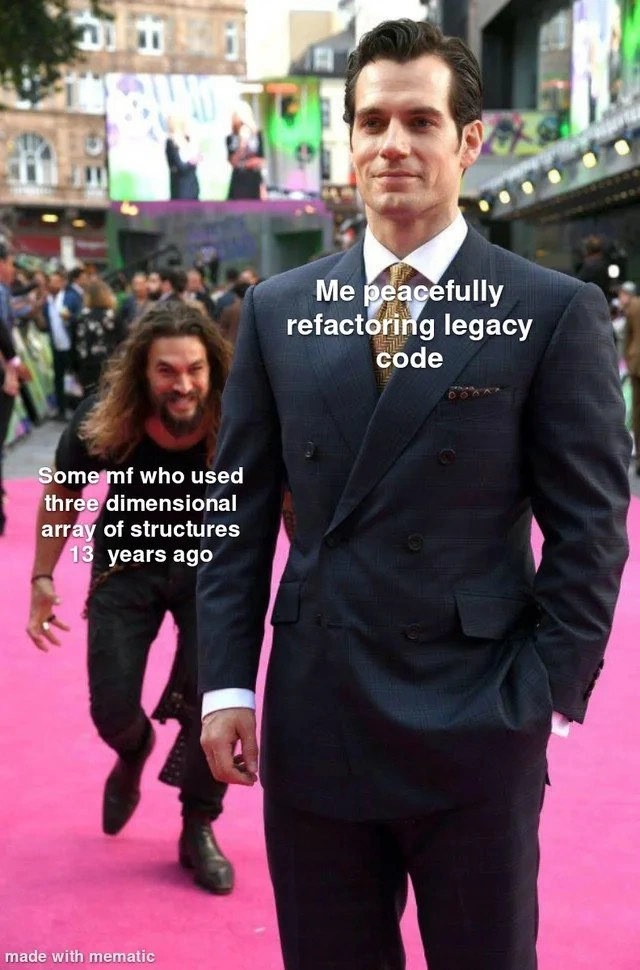
Me peacefully refactoring legacy code (the confident dev strolling in front)
Some mf who used three dimensional array of structures 13 years ago (the sneaky legacy code about to strike from behind)
In the image, a well-dressed man (actor Henry Cavill) casually walks forward, representing the calm, confident developer tackling a codebase cleanup. Behind him, Jason Momoa is mid-lunge, personifying that unknown coder from the past (the meme bluntly calls them "some mf") who wrote a three-dimensional array of structures 13 years ago. This visual gag perfectly captures a senior dev’s nightmare: you’re happily improving old code (a routine refactor), when an ancient piece of legacy code comes out of nowhere and tackles your plan. It’s funny because it’s true – any battle-scarred engineer knows that legacy systems love to hide surprises. The meme gets a laugh (and a groan) because “refactoring peacefully” is almost an oxymoron in big old codebases. Just when you think you’ve got things under control, some 13-year-old technical debt rears up like, “Remember me? I’m about to make your life interesting.”
Let’s talk about that villain of the piece: the 3D array of structures. This is a data construct from the depths of time (in tech years, 13 years might as well be a century). A three-dimensional array in C/C++ is essentially a contiguous block of memory accessed with three indices – think of it as a giant cube of data. And here each element in that cube isn’t a simple number but a struct (a C-style structure bundling multiple fields). So it’s like a Rubik’s Cube where each small cube is a mini-record containing numerous values. Back in the day, some developer thought it was a brilliant idea to allocate, say, dataMatrix[100][50][20] as a global or static structure. Why would anyone do that? Maybe in 2009 it made sense for performance: contiguous memory for fast access, no dynamic allocation needed, everything laid out nicely for the CPU cache. Or maybe it was just the quickest hack: “We need a multi-layered data table? Sure, I’ll slap a 3D array in there.” It might have solved an immediate problem, and then everyone moved on. Fast forward to now: that once-innocent decision has calcified into a code smell, a crusty oddity that signals “here be dragons.” Modern eyes see a hard-coded, triple-nested structure and immediately suspect trouble – it’s inflexible, probably poorly documented, and definitely not friendly to change.
For the senior dev (the one refactoring), stumbling across this is like finding a secret dungeon in a house you’re renovating. Suddenly, your simple clean-up mission turns into an archaeological dig. Over 13 years, this array has likely become entangled with everything. Dozens of functions might directly index it with magical constants (e.g. legacyGrid[7][3][4].value = 42; buried all over). There may be assumptions baked into the code that the size is exactly [100][50][20], because who would ever need more? (Until they did... and then hacked in a quick fix elsewhere.) Changing it means untangling a spiderweb of dependencies. It’s the classic refactoring nightmare: you tug on what looks like a harmless thread, and half the system comes with it. Need to expand one dimension of that array? Good luck – you’ll be chasing down for loops, memcpy calls, maybe even raw pointer arithmetic, all written by someone who’s long gone. One does not simply “drop in a modern container” in a legacy system without summoning the ghosts of past developers. The meme personifies that perfectly: the old coder’s choice is literally coming back to haunt and tackle you. It’s a sneak attack bug waiting to happen. The moment you try to change or remove that array, there’s a non-zero chance something else breaks in a far corner of the program (the dreaded side effects of touching legacy logic). Seasoned devs have a gallows humor about this – we’ve all muttered “Who wrote this... thing?!” only to find a comment header from 2009 (or realize with horror it was our own code from years ago). That visceral ugh is what the meme captures so well.
From an organizational standpoint, this scenario is painfully common and “Too Real.” Legacy codebases often accumulate these landmines because of years of tech debt and the motto “if it works, don’t touch it.” No one fixed that monstrous array for 13 years because it worked (more or less). Maybe everyone was afraid to touch it after the original author left, or there was always a more pressing feature to build. So it just sat there, an undiscovered time bomb ticking quietly. Now along comes a brave soul (you) to improve code quality, and boom – you trigger the trap. In the meme, Henry Cavill’s relaxed smile is the optimism every developer has at the start of a refactor: “This will clean up the code nicely.” Jason Momoa’s wild pounce is reality: “Refactor this? Hah, enjoy dealing with 13-year-old design decisions!” The juxtaposition is hilarious because it’s true: in software, the past literally jumps out to bite you. This shared experience is what makes the meme relatable: nearly every programmer with a few years under their belt has a war story of a legacy code ambush – that one ugly module or bizarre workaround from ages ago that turned a one-hour task into a week of debugging. We laugh (instead of cry) because we’ve all been there, wrestling the unwieldy beast that is someone else’s ancient code. The meme’s red carpet sneak-attack format nails that feeling in one image. Henry Cavill didn’t see Momoa coming; you didn’t see that legacy 3D array coming. And just like Cavill probably let out an “Oh sh–!” in surprise, you as the dev likely let out a sigh (or a scream) when you saw that part of the code. It’s the trauma and comedy of maintaining old software: part surprise, part frustration, and later, a funny story to tell the juniors so they know what not to do in their code 13 years from now.
Description
This meme uses the popular 'Jason Momoa Sneaking Up On Henry Cavill' template. In the foreground, a dapper Henry Cavill in a suit is labeled 'Me peacefully refactoring legacy code'. He represents a developer's calm, optimistic intention to clean up an old system. Sneaking up behind him with a mischievous and chaotic expression, Jason Momoa is labeled 'Some mf who used three dimensional array of structures 13 years ago'. Momoa embodies the ghost of a past developer and their horrifyingly complex and questionable coding decisions. The humor comes from the violent collision of present-day good intentions with the buried horrors of a legacy codebase. For senior engineers, this is a deeply relatable scenario: starting a seemingly simple refactoring task, only to uncover a bizarre, undocumented, and nightmarish data structure (like a 3D array of structs) that makes any change a dangerous and difficult endeavor. It perfectly captures the feeling of being ambushed by the technical debt of a long-gone predecessor
Comments
10Comment deleted
The original developer didn't just write code; they buried a digital landmine and left a comment that just said '// Good luck'
That 13-year-old int*** is still in prod because every senior who tried to figure out if it was row-major, column-major, or just majorly cursed got promoted to “architect” and strategically reassigned
The real horror isn't finding a three-dimensional array of structures in legacy code - it's discovering the comment above it that says 'temporary workaround, will fix in next sprint' dated from when Obama was still in his first term and the original developer is now a CTO at a unicorn startup
A 3D array of structs is just a database schema that chose violence - no indexes, no docs, and the third dimension is 'reasons the author was never promoted'
Ah yes, the classic three-dimensional array of structures - because why use a flat, cache-friendly structure-of-arrays when you can create a pointer-chasing nightmare that makes the CPU cry and every future maintainer question their career choices? Nothing says 'I understand memory locality' quite like forcing the processor to jump through three levels of indirection just to access a single field. The original author probably thought they were being clever with that 'flexible' design, but fourteen years later, you're the one dealing with cache misses that could fund a small data center's power bill
3D arrays for 2D problems: one dev's 'elegant abstraction,' every future engineer's multidimensional PTSD
Refactoring is zen until the 2012 3D array‑of‑structs shows up - suddenly it’s SoA migrations, cache‑miss roulette, and git blame pointing to vendor.zip
Nothing derails a refactor faster than discovering the 3D array‑of‑structs is a load‑bearing ABI - touch one index and prod’s cache lines become “business logic.”
3 dimensional? Pfffff....noob... Comment deleted
Yes Comment deleted