Skip to content
DevMeme
4221 of 7435
Cat dragged from nap when production pipeline breaks, the on-call struggle
OnCall ProductionIssues Post #4612, on Jun 29, 2022 in TG

Cat dragged from nap when production pipeline breaks, the on-call struggle

Why is this OnCall ProductionIssues meme funny?

Level 1: Dragged from Nap

Imagine you’ve just finished a really tiring day at school or work, and you finally get to lie down and rest. You’re as cozy as a cat taking a nap in a warm spot. Now picture that all of a sudden, someone comes and grabs you by the arm saying, “Quick! We have an emergency, you need to get up!” You’d be startled and pretty unhappy, right? That’s what’s happening in this meme, but with a cat. The cat thought it could relax because the day’s work was done, but then a big problem came up (represented by the person’s hand grabbing it) and pulled it away from its nap. The cat’s wide-eyed, panicked look is funny to us because it’s an exaggeration of how anyone feels when they’re yanked from comfort without warning. We laugh because we know that exact feeling of “No, I don’t want to get up yet!” Seeing it happen to a cat in such a dramatic, physical way makes it silly and relatable. In simple terms, the meme is joking that sometimes when you finally sit down to rest, something urgent will pop up and force you to jump back into action – and nobody likes that, not even a sleepy cat! It’s the mix of surprise and the poor cat’s flailing paws that makes it comical, while also making us go, “Yep, been there, done that.”

Level 2: On-Call Reality Check

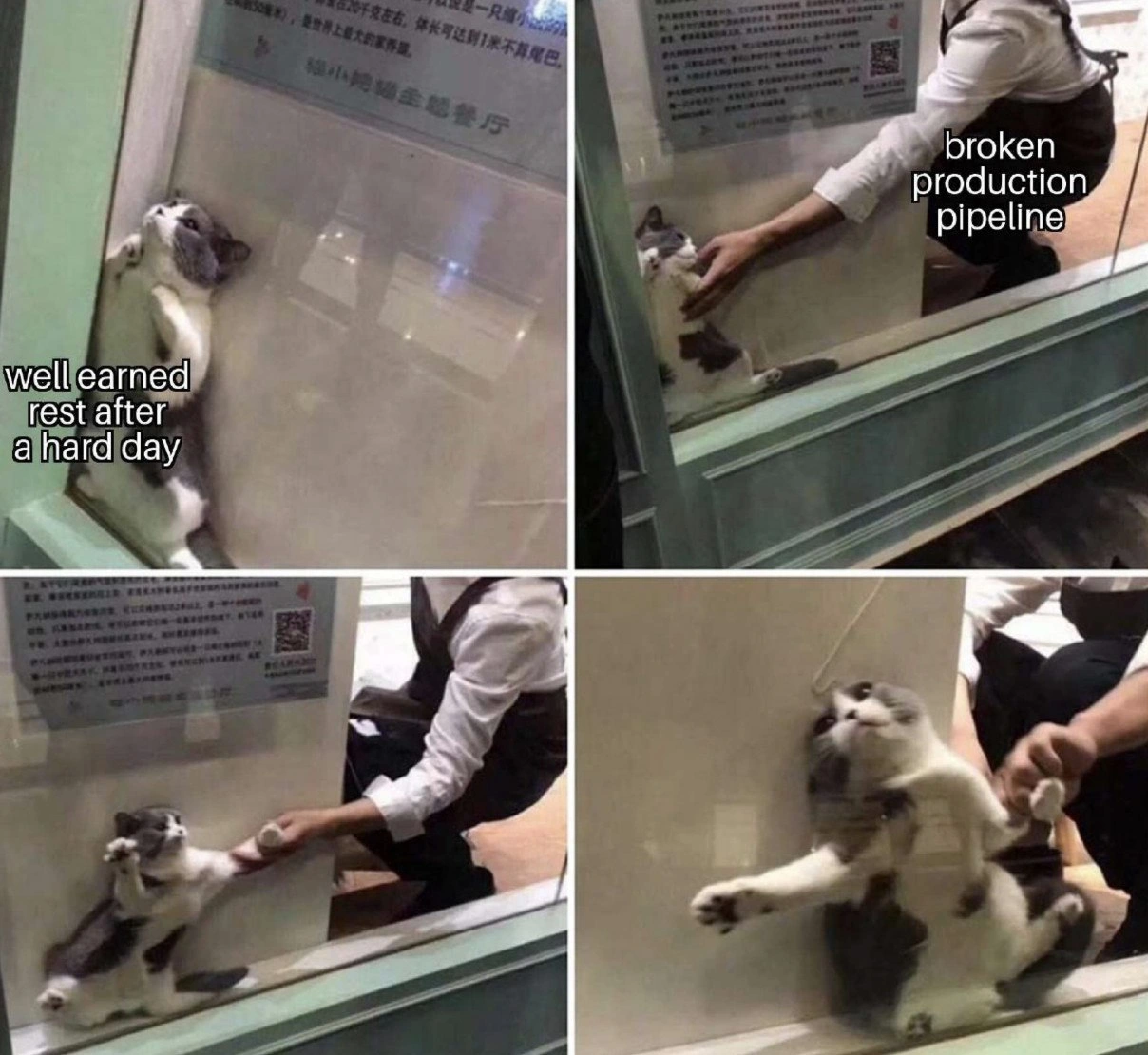
Let’s break down what’s happening in this meme in simpler terms. We have four images of the same cat. In the first image (top-left), the cat is completely relaxed, slumped against a glass window, eyes half-closed. There’s text over it that says “well earned rest after a hard day.” This represents a developer or IT engineer who has finished a long day of work and is finally relaxing. Think of it like a person flopping onto the couch after resolving a bunch of tough problems – they definitely earned that rest. The cat is our stand-in for that tired developer.

In the second image (top-right), a person’s arm reaches through a doorway and grabs the cat’s paw. The text by this arm says “broken production pipeline.” This is a metaphorical way of showing a problem reaching out and grabbing the relaxed developer. So, what is a production pipeline? In software development, a pipeline usually refers to a series of automated steps that build, test, and deploy code. “Production” means the live environment – the servers or system that real users are interacting with. Put together, a production pipeline (often part of what we call CI/CD, Continuous Integration/Continuous Deployment) is the process that takes new code and releases it into the production environment. When you hear “the pipeline broke,” it means something went wrong in that automated process. It could be a compilation error, a failed test, a script that had an error, or some part of the infrastructure (like the server doing the deployment) having an issue. In plain terms: the mechanism to update the live app or website has stopped working.

Now, if a production pipeline breaks, that’s a big deal. It might mean new updates can’t go out, or worse, the deployment stopped halfway and the live site is in a bad state. This is where on-call duty comes in. Many tech teams have an on-call rotation – that means at any given time, one team member is the designated person to respond if something goes wrong (ProductionIncidents and urgent ProductionIssues). Being “on call” is like being the firefighter or doctor on duty: if the alarm goes off, you have to drop everything and address the emergency. And yes, often the alarm goes off at inconvenient times, like late at night. Teams use monitoring tools that send alerts (sometimes literally to a pager or usually to a smartphone app) to the on-call engineer. That alert in the meme is symbolized by the hand grabbing the cat. It’s saying: “Wake up! Something broke in production and needs your attention.” This is often informally called a pager alert, hearkening back to when pagers were used for this purpose (now it might just be a loud phone notification).

The bottom two images (panels 3 and 4) show exactly the result: the once relaxed cat is now being dragged out, paws in the air, eyes wide open. It looks shocked and unwilling – pretty much how any person would feel if yanked from rest due to a sudden emergency. This is the on-call engineer being literally pulled back to work. Instead of the cat, imagine a programmer who was in pajamas or about to sleep, now rushing to their laptop to see why the BuildPipeline failed. Their heart is probably pounding from the sudden scare. They might even physically stumble out of bed like this cat being dragged. It’s a frantic situation.

To put this in context with real tools and terms: suppose the team uses Jenkins (a popular continuous integration server) to run tests and deploy the application. If Jenkins encounters an error – say a new code push causes tests to fail or a deploy script to crash – it could mark the pipeline as failed. Many setups will automatically send an alert if a production deploy fails, because that might require quick intervention. The on-call person then gets a message like, “Build failure in production pipeline!” Perhaps the site is frozen in maintenance mode because the deployment didn’t finish. The on-call engineer must rapidly figure out what went wrong. Maybe they check the pipeline logs (which could show an error like “Could not connect to database” or “Deployment script exited with code 1”). They might have to restart the job or apply a fix. For example, if a configuration file was missing, they’ll add it and re-run the deploy. If a server crashed, they might need to reboot it or switch over to a backup. All of this could happen at, say, 1:00 AM. It’s not fun, but it’s part of maintaining a 24/7 service.

So, the meme is capturing that scenario in a humorous, exaggerated way. DevOps and SRE folks (the people who combine development with operations and focus on site reliability) often share jokes about lack of sleep and being woken up by systems, because it’s a rite of passage in those fields. Terms like OncallNightmares, BuildFailures, and DeploymentHumor (all tags related to this meme) are all about those “oh no” moments that are terrifying when they happen, but later become stories you laugh about. If you’re new to this domain, just know: on-call means you have to be ready for emergencies, production pipeline is the live deployment process, and a broken pipeline in production is a fire you have to put out ASAP. And if you ever see a coworker share a cat meme like this, now you’ll understand they’re joking about that one time they got pulled out of a cozy evening to fix a surprise problem. It’s a way to make light of the challenging parts of keeping systems running.

Level 3: Integration Interrupted

For seasoned developers and SREs, this four-panel cat meme hits like a war flashback. You spent all day wrestling with deploys and finally collapsed into a well-earned rest after a hard day (as the meme text says). Then, of course, ping! – an alert about a broken production pipeline shows up, right when you got comfortable. In panel 2, the hand labeled “broken production pipeline” grabs the cat’s paw – that’s basically your pager or phone grabbing you, the on-call engineer. The remaining panels show the poor cat being yanked upright, paws flailing in panic. That visual is exactly how an on-call emergency feels. One moment you’re semi-conscious on the couch, the next you’re bolt upright, heart racing, scrambling to log in to the system. It’s a rude awakening in the most literal sense.

This is classic OnCallDuty life. Being on-call means even when you’re “off the clock,” you’re never truly off. If a ProductionIssue or ProductionIncident occurs, you’re the designated firefighter. And trust me, production issues have a twisted sense of timing. It’s never at 2 PM when you’re alert at your desk – it’s at 2 AM when you’ve finally drifted off. The meme nails this irony. The caption on the first panel (“well earned rest…”) is basically tempting fate. Every experienced DevOps engineer has muttered famous last words like “Eh, everything’s finally stable, I can relax now” – until it isn’t. Sure enough, something in the BuildPipeline or deployment process fails and drags you back. It could be anything: maybe the latest commit triggered a database migration that hung, or the artifact storage service went down so the deploy can’t fetch the new build. Perhaps a critical integration test started failing because of a corner-case data input at midnight. Suddenly, what was a green build all day turns RED in prod, and alarms are blaring.

Now it’s officially an on-call nightmare. You get that dreaded pager alert on your phone (often via a service like PagerDuty, which is basically an app that screams “WAKE UP!” when something’s wrong). The text “broken production pipeline” might as well be the notification banner lighting up your dark bedroom. The cat’s paw being grabbed = your shirt being tugged by duty. Panel 3 shows the cat’s stunned face, which is just like the bleary-eyed stare you have trying to read an error log through sleep-addled eyes. Panel 4, the cat with limbs outstretched in despair, perfectly depicts the mixture of reluctance and urgency you feel as you’re literally pulled away from rest to fix the mess. It’s R-rated SREHumor (for Sleep Really Ends humor, amirite?).

Why do we laugh? Because it’s DevOpsHumor that’s painfully relatable. That cat’s exaggerated flailing is basically us internally screaming “Noooo!” while we grudgingly pull out the laptop. It’s the kind of scenario you vent about the next day to your team: “I was dead asleep and Jenkins decided to fail deployment. I felt like a cat dragged by the tail.” Your teammates nod knowingly, maybe even share similar OncallNightmares, and you bond over the shared trauma. In the moment, it’s stressful and not at all funny. But later, you have to laugh to stay sane. It becomes DeploymentHumor folklore: “Remember that time the pipeline died at midnight and yanked Alice out of her cat nap?” – literally a cat nap! – “She was fixing servers in her pajamas.” These are the battle stories of on-call veterans.

There’s also an element of schadenfreude in the meme: anyone who’s been that cat is relieved it’s not them this time, and anyone who hasn’t yet… well, they get a forewarning of what’s coming in their career. The meme highlights the absurdity of our profession: we build super advanced automated pipelines to ship code continuously, but when they fail, we end up in a slapstick situation of chasing problems at ungodly hours. It’s Rube Goldberg machine meets Murphy’s Law. And importantly, it underscores why BuildFailures and late night incidents are taken seriously. After you rescue the pipeline at 3 AM, you can bet there will be a conversation about “how do we stop this from ever happening again?” Blameless post-mortems, root cause analysis, adding better monitoring – all these sober follow-ups stem from wild nights like this. But the meme skips to the punchline: the raw on-call struggle, captured as a silly cat fiasco. It’s funny, it’s chaotic, and it’s too real.

Level 4: Unscheduled Context Switch

At the most granular level, this meme illustrates a brutal context switch – not in code, but in real life. In computing, a context switch happens when a CPU is abruptly interrupted to handle a higher-priority task. Here you are the "processor" peacefully idling, and the broken production pipeline is like a hardware interrupt firing at 3 AM, yanking you out of a low-power state. Just as a CPU must flush its pipeline (yes, the CPU has a pipeline, too) and reload context, your brain has to drop its blissful rest and load up the entire state of the production system in an instant. The cat being grabbed is essentially the “interrupt request” being served – whether you were ready or not. It’s a sudden, unscheduled context switch from rest to firefight, with all the inefficiency and shock that entails. Your mental cache was nice and warm with thoughts of weekend plans, and now it’s been invalidated by an urgent need to recall why the deployment script might be failing.

From a systems theory perspective, this scenario is a case study in the inevitability of failure in complex systems. A modern CI/CD pipeline (Continuous Integration/Continuous Deployment pipeline) is a sprawling machine: source code repositories, build servers, test suites, artifact storage, container registries, deployment scripts, cloud infrastructure – each component can have its own hiccup. According to reliability engineering principles, as the number of components grows, the chance of an edge-case failure somewhere approaches 100%. In fact, failures often follow a kind of Poisson distribution (randomly over time), but humans swear by Murphy’s Law: it will hit at the worst possible moment. Here, “worst moment” translates to “right after you finally relaxed.” The meme captures that dark truth with comedic clarity. The DevOps holy grail is to automate away human intervention, but when a pipeline breaks in production in spite of all safeguards, it’s the ultimate reminder: complex systems will find new ways to fail, and sometimes humans are the final exception handler. SRE (Site Reliability Engineering) best practices call for building resilient, self-healing pipelines (auto-retries, rollbacks, circuit breakers) precisely so that 3 AM calls don’t happen. In theory, a well-designed system should degrade gracefully until morning – but in practice, some failures still page the human. Maybe an anomaly exhausted the system’s error budget (the tolerated failure time), triggering an alert as a last resort. In SRE parlance, the on-call engineer is the human fallback when automation can’t cover the outage. The cat being dragged through the window is basically the system saying, “I give up, I need a human.” It’s a brutal alignment of software and biology: the unforgiving logic of distributed build systems meets the fragile reality of human sleep cycles. The meme is hilariously poignant because it lays bare this fundamental friction between 24/7 system uptime and the engineer’s mortal need for downtime.

Description

Four-panel photo meme. Panel 1 (top-left): a grey-and-white cat lies slumped against a shop-window pane, eyes half-closed, with overlaid text: "well earned rest after a hard day." Panel 2 (top-right): a person’s arm reaches through a door, grabbing the cat’s paw; above the hand is the caption: "broken production pipeline." Panels 3 and 4 (bottom row) show the cat being yanked upright, paws flailing and face alarmed, as the person drags it toward the opening. The sequence visually captures a developer finally relaxing only to be pulled back by a failing CI/CD production pipeline, mirroring real-world on-call emergencies and DevOps firefighting
Comments

6
Anonymous ★ Top Pick Finally hit the nightly garbage-collection pause, then the pager issues a non-maskable interrupt because the CI pipeline discovered that null replicaCount in the Helm chart actually means “delete production.”
  1. Anonymous ★ Top Pick

    Finally hit the nightly garbage-collection pause, then the pager issues a non-maskable interrupt because the CI pipeline discovered that null replicaCount in the Helm chart actually means “delete production.”

  2. Anonymous

    After 15 years of fixing everyone else's deployment configs, I've finally achieved the architectural pattern where 'eventual consistency' means I'll eventually respond to your Slack message on Monday

  3. Anonymous

    Every SRE knows this exact sequence: you've just achieved that rare state of mental peace after resolving the week's incidents, maybe even closed your laptop - then Slack lights up with '@channel PROD DOWN'. The progression from 'well-earned rest' to complete chaos mirrors the internal state transition from IDLE to PANIC faster than a circuit breaker can trip. The real kicker? The pipeline broke because someone merged a 'quick fix' at 4:47 PM on Friday with the commit message 'should be fine, tested locally' - and by 'tested locally' they meant they ran it once without errors. Now you're doing a post-mortem at midnight, explaining why your MTTR included the time it took to find your laptop charger

  4. Anonymous

    Our on-call policy is eventual consistency for sleep; the CI pipeline enforces strong consistency in waking me the millisecond I hit REM

  5. Anonymous

    Pull‑based GitOps: when the pipeline breaks, the only thing it reliably pulls is the on‑call out of their well‑earned rest

  6. Anonymous

    Prod's rare stable nap, eternally pawed at by CI's ghost hand - glass of isolation layers strikes again

Use J and K for navigation