Tribute to the mythical developer who writes perfectly readable C++
Why is this Languages meme funny?
Level 1: Unicorn of Code
Imagine you have a gigantic box of LEGO bricks of every shape and size. Building something with it is fun, but it's really easy to end up with a huge mess of pieces all over the floor. Now, imagine a kid who can build whatever they want with this giant LEGO box without ever making a mess – every brick they use goes in exactly the right place, and by the end, the room is completely neat. That kid would be pretty amazing, right? They'd be as rare and magical as a unicorn!
In this meme, C++ is like that big messy box of toys or LEGO – it's a very powerful toolset, but it's easy to get things tangled and messy when you use it. Writing clean, readable code in C++ means keeping everything organized and clear, which is as hard as keeping that playroom spotless. The joke is saying: if there were a person who could always write C++ code that stays perfectly neat and easy to understand, they'd be one-of-a-kind. The quote humorously adds, "I haven't met this person, but if they existed, I'd really admire them." It's funny because it exaggerates how complicated C++ can be. In simple terms, it's like saying "I've never seen anyone tame this wild thing completely, but if someone could, they'd be a true coding unicorn!"
Level 2: Taming the C++ Beast
C++ is a powerful programming language, but it's also infamous for being complicated. When developers talk about clean code or code readability, they mean code that's easy for humans to understand and follow. Clean, readable code uses clear variable names, straightforward logic, and avoids weird, unnecessary tricks. In languages like Python or Java, writing in a clean style is a bit easier because those languages were designed to be simple and consistent. C++, on the other hand, is like a big toolbox with every tool imaginable – which is great, except it’s easy to accidentally make a mess with all those tools. This meme jokes that someone who can consistently write good, readable C++ (keeping everything neat and understandable) must be almost mythical because of how hard that is to do.
One reason it's hard is that C++ has a lot of features and quirks. It lets you manage memory manually using pointers (variables that hold memory addresses) and explicit allocation (new) and deallocation (delete). It has a rich, sometimes puzzling syntax: you'll encounter * and & symbols denoting pointers/references, -> arrows for accessing things through pointers, and :: double-colons for scope resolution. For a newcomer, reading a C++ program can feel like reading a dense technical manual full of special symbols. C++ also permits advanced concepts like macros (which are like find-and-replace code shortcuts during compilation) and templates (which let you write code that generates other code for different data types). These features are powerful – you can write very efficient and flexible code – but if they're overused or used without clarity in mind, the code can become very hard to follow. There's an old joke that C++ is a "Swiss Army chainsaw": it's extremely versatile and can cut through anything, but if you're not careful, you might cut off your own foot. In simpler terms, C++ gives you so much freedom that you can easily tie yourself (and your code) in knots.
For instance, let's look at a simple task: printing a number if it's greater than 5. There's a straightforward way to do it in C++, and there's a more convoluted way. Compare these two approaches:
// Over-complicated C++ way:
auto x = new int(42); // dynamically allocate an integer with value 42
if (x != NULL && **&x > 5) // check pointer is not null and double-dereference it to compare value
std::cout << *x << std::endl; // print the value pointed to by x
delete x; // free the allocated memory
// Cleaner C++ way:
int value = 42;
if (value > 5) {
std::cout << value << std::endl; // print the value directly
}
In the first snippet, the code uses a pointer (x) and some very convoluted logic (**&x) to check and print the number. It works, but you have to mentally untangle what's happening: we allocated an int on the heap, then **&x is an odd way to get the value (it takes the address of the pointer and dereferences it twice – effectively the same as *x, just far more confusing). This approach makes a simple task harder to read. We also had to remember to delete x at the end to avoid a memory leak, which is another thing to keep track of. In the second snippet, the code does the exact same job in a much simpler way: we use a normal int variable and an if statement with a clear condition, printing the value directly. There’s no pointer juggling, no unusual symbols – just straightforward logic. The second version is obviously easier to understand at a glance. This contrast shows what we mean by code readability: the cleaner version is the kind of code you'd prefer to see in a code review, because anyone reading it can immediately tell what's going on.
As a junior developer (or even an experienced one), you quickly learn that writing maintainable, clean C++ code is a challenge. C++'s flexibility means two different programmers might implement the same feature in very different ways – one of them clear, the other nearly indecipherable. Teams often use style guides and do code reviews to try to keep C++ code understandable. You might hear advice like "prefer clarity over cleverness" especially for C++. The joke in this meme exaggerates it: it's saying if you ever meet a programmer who always writes C++ so clearly that it's never a headache to read, that person is about as common as a unicorn. In other words, they're super rare! And yes, if such a developer exists, they would instantly earn a lot of respect from their peers. After all, every C++ developer strives to write clean code, but keeping a big C++ project clean is like trying to keep an entire zoo in order. This quote is just a humorous way to acknowledge that fact.
Level 3: The Unicorn C++ Dev
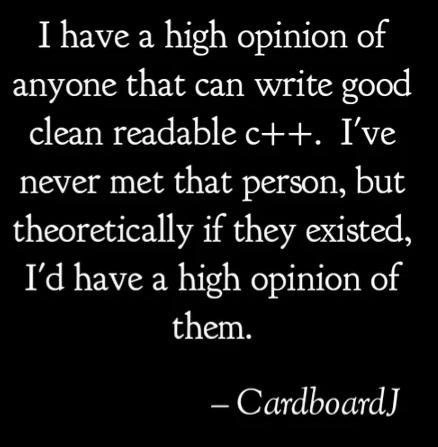
You can almost hear the weary chuckle behind this quote. It's essentially saying: "If someone out there can write good, clean, readable C++ code, I'd admire them... I've just never met such a person." The humor lands because writing truly clean, easy-to-read code in a language as complex as C++ often feels mythical. Seasoned engineers who've slogged through sprawling C++ codebases will smirk at the idea of a perfectly readable C++ wizard – that's basically a unicorn in the programming world. The meme is a tongue-in-cheek tribute to that mythical developer who writes flawless C++ (if they exist!), acknowledging how rare such a skill set truly is.
Why is it so hard to write consistently readable C++? C++ is a multi-paradigm language with a massive feature set and decades of legacy baggage. It's essentially several languages in one: you have low-level C-style pointers and manual memory management, high-level object-oriented classes, generic programming with templates, and even functional programming with lambdas. This immense language complexity offers a ton of power – but with that power comes endless ways to create confusion. There are often a dozen different ways to solve a problem in C++, ranging from the straightforward to the ridiculously convoluted. It's very easy for a codebase to turn into a dense thicket of symbols and clever tricks that is technically correct but practically unreadable. A developer trying to be "clever" might use template metaprogramming or macro magic to do in 20 obfuscated lines what could have been done in 5 simple ones. The result? Even senior C++ devs can struggle to understand what's going on when they read each other's code. Maintaining pristine code readability in a large C++ project often feels like chasing a mirage.
Many veteran C++ programmers have war stories about this. For example, debugging a template error at 3 AM that spews out ten pages of compiler gibberish, or inheriting a codebase where some genius thought it was a good idea to use macros to redefine language syntax. 🙃 Over the years, the community has introduced best practices, style guides, and Clean Code principles to tame this complexity. (Even Bjarne Stroustrup, C++’s creator, helped craft extensive Core Guidelines imploring us to write simpler, more modern C++.) But in the real world, these ideals often collide with harsh reality. Large legacy systems accumulate technical debt and weird quirks over time. Performance hacks and backward compatibility demands can force developers into writing uglier, more convoluted code than they'd like. Tight deadlines mean people sometimes prioritize "it works" over "it's clean." In theory, every developer wants elegant, self-explanatory code, but C++ gives you enough rope to hang those good intentions when you’re not careful.
So when CardboardJ jokes they've "never met that person" who writes perfectly readable C++, it resonates with programmers. It's a sly, sarcastic acknowledgement that while we all aspire to high CodeQuality, C++ makes it a constant uphill battle. The quote highlights the gap between best-practice theory and what really happens in production code. In other words, a developer who can wrangle C++'s power and still produce code that reads like a children's book is as rare (and as admired) as a unicorn. This meme strikes a chord in developer humor circles because it's painfully true and funny at the same time. It says: Sure, somewhere out there a flawless C++ coder might exist, and we'd all have a high opinion of them... but until one shows up, let's share a knowing laugh. We tip our hat to anyone who can keep C++ code clean — if you’re out there, you have our respect (and please share your secrets with the rest of us!).
Description
The meme shows white, centered serif text on a solid black background. It reads: "I have a high opinion of anyone that can write good clean readable c++. I’ve never met that person, but theoretically if they existed, I’d have a high opinion of them. - CardboardJ". There are no images, icons, or additional colors - just the humorous quote. Technically, the joke highlights C++’s reputation for complexity and the rarity of codebases that achieve true cleanliness and readability, a concern familiar to senior engineers focused on code quality and maintainability

Comments
6Comment deleted
Clean, readable C++ is like a five-nines SLA: the moment you announce it, someone enables -std=c++20 and checks in a 600-line constexpr template - there goes both promises
The same person who writes clean C++ is probably maintaining that COBOL system that somehow processes 95% of your credit card transactions without anyone knowing how it actually works
This perfectly captures the C++ paradox: we all aspire to write clean, readable code, yet after 40+ years of evolution - from K&R C to C++23 - the language has accumulated so many features, gotchas, and footguns that 'clean C++' has become an oxymoron. Between template metaprogramming nightmares, undefined behavior landmines, RAII gymnastics, and the eternal debate over smart pointer ownership semantics, writing truly maintainable C++ requires the wisdom of Bjarne Stroustrup, the discipline of a monk, and the patience of someone who enjoys reading 1,500-page ISO standards for fun. The real joke? We keep adding more features to 'simplify' it
“Readable C++” is when RAII, noexcept, and concepts line up - and ADL, SFINAE, and ODR behave. I’ve only seen that on Godbolt, never in a repo
Readable C++ is Schrödinger’s code - until you open the header‑only template, it’s both clean and invoking UB via ADL, SFINAE, and an innocent‑looking operator<=>
Clean C++: where 'readable' means surviving a code review without invoking the committee that wrote the standard