Skip to content
DevMeme
4222 of 7435
Choosing DALL-E over AlphaFold for protein structure predictions - what could go wrong?
AI ML Post #4617, on Jun 29, 2022 in TG

Choosing DALL-E over AlphaFold for protein structure predictions - what could go wrong?

Why is this AI ML meme funny?

Level 1: Painting a Rubik’s Cube

Imagine you have a Rubik’s Cube – you know, that colorful cube puzzle where each face should be one color when it’s solved. Solving it the right way means twisting and turning the pieces until all the colors line up on each side. Now picture someone who says, “Forget solving it properly, that’s too hard. I’m just going to paint each face the right color.” After they’re done, the Rubik’s Cube looks solved because each face is painted solid red, blue, green, etc. But did they really solve the puzzle? Not at all! They just made it look like it’s solved without doing the real work.

That’s exactly the kind of silliness the meme is pointing out, but in the world of AI and science. AlphaFold doing protein predictions is like methodically twisting the Rubik’s Cube – it’s hard work, but you end up with a genuinely solved puzzle (a correct protein structure). Using DALL-E for the task is like painting the cube – you get a pretty picture that might fool someone at first glance, but it’s not a real solution. It’s funny because it’s such an obviously wrong way to do it. We laugh because we all recognize the feeling of someone taking a lazy or wacky shortcut that misses the whole point. It’s a childlike mistake: focusing on appearances (“hey, it looks right!”) instead of actually solving the problem. In simple terms, the meme is saying: don’t try to cheat a tough problem with a flashy trick – you’ll end up with a goofy result! And indeed, everyone can see the result here is kind of goofy, which is why it makes us smile.

Level 2: Real Structures vs Random Ribbons

Let’s break down the key elements of this meme in simpler terms. We have two AI systems being contrasted:

  • AlphaFold: This is an AI model developed by DeepMind specifically for protein_structure_prediction. Imagine you have the list of building blocks of a protein (its amino acid sequence, kind of like a very long word spelled out in a 20-letter alphabet). AlphaFold’s job is to predict how that chain of blocks folds up into a 3D shape – basically figuring out what the protein will look like as a tiny molecular machine. It became famous because it can predict protein structures with impressive accuracy, something scientists had struggled with for decades. It’s a domain expert: it “knows” a lot about biology and physics (through the data it was trained on) and outputs detailed structural models that researchers can actually use. If you input the sequence for a T cell receptor and an MHC protein (major histocompatibility complex), AlphaFold might output a model where you see those two proteins docked together correctly, showing how the T cell receptor grabs onto the MHC – super useful for immunology research.

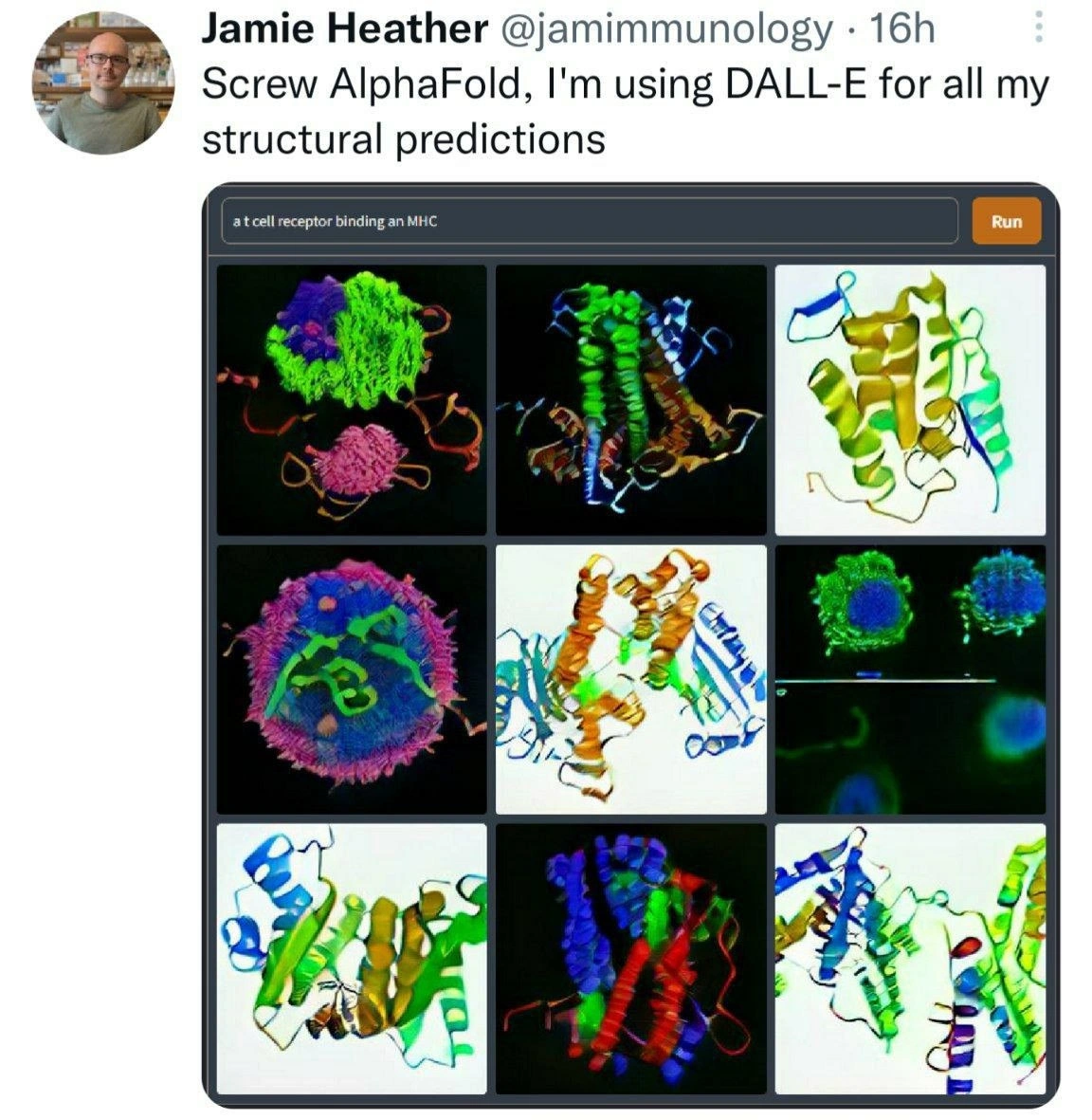
  • DALL-E: This is an AI model from OpenAI designed for AIGeneratedContent – specifically, it creates images from text prompts. Give DALL-E a description like “a cat riding a bicycle on Mars” and it will paint you a unique image of exactly that. It’s very general and creative. But importantly, DALL-E does not understand the world at a scientific level; it just learned to draw by studying a huge number of images and their captions. In the meme, someone typed the prompt “a t cell receptor binding an MHC” into DALL-E. Now, DALL-E likely has seen terms like “T cell receptor” or “MHC” in its training, maybe paired with images of immune cells or structural diagrams. So what did it do? It produced nine images that look kind of like ribbon diagrams of proteins. A ribbon diagram is how scientists often draw protein structures: imagine a long ribbon twisted into loops and coils – ribbons for helices and arrows for sheets – to visually simplify the protein’s 3D shape. The results from DALL-E have those bright ribbon-like shapes in greens, blues, oranges, etc., on alternating black or white backgrounds. At a quick glance, yes, they resemble pictures you might see in a biology paper. But they’re essentially random ribbons – DALL-E has no clue how an actual TCR binds an MHC, it’s just giving nine artistic guesses that match the keywords in a very superficial way.

So why is it funny to suggest using DALL-E for “structural predictions”? Because structural predictions (like what AlphaFold does) are rigorous and data-driven, whereas DALL-E’s images are invented. It’s like the difference between a calculator and a caricature artist. One gives you precise, meaningful answers; the other gives you a pretty drawing that might not have any correctness to it. Developers often talk about using the “right tool for the job.” Here, AlphaFold is the right tool to predict a real protein structure – it’s actually built for that purpose. DALL-E is the wrong tool – it’s built to make visual art, not scientific models. The meme is showing someone intentionally using the wrong tool because it’s the new cool thing. It highlights a common situation in tech: sometimes people get so excited about a new technology (the latest library, framework, or AI model) that they try to use it for everything, even where it doesn’t fit.

To put it in a developer analogy: imagine you have to store some important structured data (like bank transactions). Using AlphaFold for protein folding is like using a reliable SQL database for those transactions – it’s designed to handle that specific structured task. Using DALL-E for protein folding would be like saying “Hey, SQLite is boring, I’m going to use a video game engine to store my bank data because video game engines are cool and can render awesome graphics.” 😅 It just doesn’t make sense – the video game engine might produce something visual or entertaining, but it won’t give you the correct ledger of transactions! In the same way, DALL-E produced colorful images of “something protein-like,” but not the actual correct protein structure that AlphaFold would give.

Let’s clarify some of the terms from the meme for those new to them:

  • AIHype / IndustryTrends_Hype: In tech and AI, hype refers to when a technology is talked about as if it can do everything (sometimes overselling its capabilities). DALL-E in 2022 had a lot of hype because it felt like magic to type a sentence and get a picture. The meme cleverly points out this hype by joking about using DALL-E for a task it clearly isn’t meant for.
  • MachineLearning/DeepLearning: Both AlphaFold and DALL-E use deep learning under the hood. That’s a kind of machine learning with multi-layered neural networks. But crucially, what they learned is different. AlphaFold was trained on protein data (sequences and structures) – essentially learning the language of proteins. DALL-E was trained on images and captions – learning the language of pictures.
  • Bioinformatics & Structural_Biology: These tags relate to the field that AlphaFold operates in. Bioinformatics is about using computers to understand biological data, and structural biology is about studying the shapes of biological molecules. AlphaFold is a huge deal here, because knowing a protein’s shape can help explain how it works or how to design drugs that interact with it.
  • Generative_AI_vs_Physics_Models: This context is exactly what we’ve been discussing. A generative AI like DALL-E generates data (images) that look plausible, using patterns from training data. A physics-based model or at least physics-aware model like AlphaFold produces results that have to obey certain real-world rules (like molecular physics rules). AlphaFold isn’t purely running physics simulations, but it’s constrained by that domain’s truth (it outputs something that could exist in reality). The meme jokes about swapping the latter for the former – highlighting how domain-specific knowledge can’t just be replaced by a general model without consequences.

For a junior developer or someone early in their tech journey, the takeaway is: use the right tool for the job and be wary of hype. Just because something is built on fancy DeepLearning doesn’t mean it’s interchangeable with another ML tool. Each model has strengths and limitations. If you misuse them, you might get results that are entertaining but useless. In the image, those nine protein-like pictures from DALL-E are fun to look at (bright colors! coils! looks science-y!), but they won’t help, say, a scientist trying to design a new vaccine or drug. In contrast, the kind of output AlphaFold gives – a detailed 3D structure – could directly inform such work. This meme uses humor to show that difference.

So, summarizing in simple dev terms: AlphaFold is like a specialized function that returns real, valuable data about protein shapes. DALL-E is like a random image generator function. Calling the image generator when you needed the protein data is a type error – the program might run (you get an image), but the output is nonsense for the intended application. It’s a reminder that just because two things are AI doesn’t mean they do the same job. Context and domain matter a lot!

Level 3: Painting Proteins with AI Hype

For seasoned developers and researchers, this meme hits on a familiar theme: the absurd outcomes when hype outpaces domain knowledge. The tweet format – “Screw AlphaFold, I’m using DALL-E for all my structural predictions” – reads as a deliberately brash, overconfident proclamation. It’s immediately recognized as satire because AlphaFold and DALL-E belong to very different realms of AI, and anyone experienced in either domain can sense the tongue-in-cheek vibe. We’ve seen this pattern in the tech world before: a groundbreaking, specialized tool emerges (AlphaFold solving protein folding, a huge deal in bioinformatics), and then along comes a flashy general-purpose toy (DALL-E’s dazzling image generation grabbing headlines in the AIHumor and creative tech communities). The joke is essentially, “Who needs serious, physics-grounded solutions when we have this trendy new generative model that makes pretty pictures?!” – a classic case of AI_hype taken to a ridiculous extreme.

The humor really lands with those who know how each system is actually used. AlphaFold is used by scientists trying to understand real proteins – for example, predicting how a t cell receptor binding an MHC might look, to study immune response. Its outputs are detailed 3D coordinates that researchers can analyze, rotate on screen, even use to design experiments (it outputs something like a PDB file: atomic positions of each amino acid). On the other hand, DALL-E is used by artists, designers, and meme-makers to generate images like “cat in a spacesuit” or “virtual landscape in Van Gogh style.” Its output in this meme appears as a 3x3 grid of nine colorful ribbon_diagram_images – visually reminiscent of protein structures but clearly warped and incorrect to a trained eye. The backgrounds alternating black and white, the neon green coils and multicolored helices tangled randomly – it’s basically DALL-E’s AIGeneratedContent pastiche of what protein structures look like in general, without any regard for whether those ribbons form a coherent, valid complex. This disconnect is hilarious to insiders. It’s the tech equivalent of saying, “Forget the engineer, let’s ask the abstract painter to design our bridge.” Every senior developer or researcher chuckles because they’ve witnessed some form of this mindset during hype cycles.

Consider the broader IndustryTrends_Hype context: whenever a new technology trend hits (be it MachineLearning, blockchain, microservices, you name it), there’s a tendency to hammer it into every problem, appropriate or not. Veteran devs have seen juniors (and occasionally overeager managers) try to apply a trending tool to a task it’s woefully unsuited for. This tweet encapsulates that in one line. It’s not just about science; it resonates with any scenario where someone proposes a one-size-fits-all magical solution. In AI specifically, we know DALL_E is amazing at generating art or funky concept images, but it has no concept of molecular biology. By saying “Screw AlphaFold, I’m using DALL-E,” the author (an immunologist on Twitter, no less) is knowingly flouting common sense for comedic effect, implying an attitude of “Who cares about carefully honed domain models? I’ll just use the coolest new AI toy for everything!”

That wry tone carries an implicit understanding: this will obviously go wrong – hence the subtitle of the meme: “what could go wrong?” (with a wink). Developers who lived through, say, the period where every startup wanted to replace relational databases with some trendy NoSQL for absolutely everything will recognize the flavor of this joke. It’s poking fun at the overconfidence that comes with hype. And indeed, the consequences here are immediate and visible: instead of an accurate protein model, you get a bunch of neon spaghetti art. For a senior person, there’s also an appreciation of how domain-specific models (like AlphaFold, which was painstakingly built incorporating years of research) can easily be undervalued when something more general and flashy appears. There’s almost a protective instinct: “We finally have a tool that actually works for protein folding – don’t throw it away for a gimmick!” The meme underscores that misapplying AI can yield laughably useless results, serving as a light-hearted reminder that not all “AI” is interchangeable.

In the image, the DALL-E UI with the prompt “a t cell receptor binding an MHC” and the little orange “Run” button is a snapshot many tech folks know from mid-2022, when everyone was testing outrageous prompts in DALL-E’s system. The choice of prompt by the meme’s author is itself a punchline: it reads like a legitimate scientific query, something you’d feed to a sophisticated bioinformatics pipeline – but here it’s fed to an art generator. The nine results, those brightly-colored ribbon diagrams, superficially resemble the ribbon models we see in textbooks for proteins, but any immunologist or structural biologist would immediately notice they’re gibberish as actual structures. It’s the AI equivalent of cargo cult science – the images have the outer trappings (ribbons, subunits, colorful domains) but none of the substance (correct folding, proper binding interfaces, etc.). Developers might not grasp the specifics of TCR-MHC binding, but they get the general idea: DALL-E is just making stuff up. And that’s the joke – the clash of serious scientific intent with a tool that happily generates random content.

Ultimately, the meme’s humor works on multiple levels of insider knowledge. You have to know what AlphaFold is (a big deal in AI-for-science, highly specialized) and what DALL-E is (a viral image generator producing often funny or surreal results). You also should grasp that using the latter in place of the former is inherently absurd. If you do, the tweet reads as a brilliantly facetious statement that mocks the tendency to overgeneralize AI’s capabilities. It’s a gentle jab at the AI community’s own hype: even as we celebrate each new model, we have to remember the limitations – not every model is suited for every task. In summary, the senior perspective finds this meme funny because it captures that “oh no, someone is using the wrong tool again, ha!” feeling in a scenario that’s both niche (immunology research) and broadly relatable (trend-chasing in tech). Plus, it’s packaged as a snappy tweet, which is the modern medium for sharing these collective sighs and laughs in the developer and researcher world.

Level 4: Energy Landscapes & Latent Space

At the cutting-edge intersection of AI_ML and structural_biology, this meme pits two radically different AI approaches against each other: DeepMind’s AlphaFold versus OpenAI’s DALL-E. Understanding why this is absurdly funny requires a deep dive into how each model tackles problems – one grounded in physics and biology, the other in pattern generation.

AlphaFold essentially operates in the realm of protein energy landscapes – the complex hypersurface defined by a protein’s many possible conformations and their corresponding free energies. Finding a protein’s folded shape is like searching that mountainous energy landscape for the lowest valley (the most stable state). In theory, a brute force search through all possible fold configurations is intractable – there are astronomically many ways even a small protein can twist and bend (a classic realization known as Levinthal’s paradox). Instead of brute force, AlphaFold’s breakthrough was to treat folding as a machine learning problem. By training on thousands of known protein structures, it learned statistical patterns (like which amino acids tend to end up close together, forming helices, sheets, and binding interfaces) and effectively generalized the physics and evolutionary history inherent in those examples. The result? Given a new amino acid sequence, AlphaFold’s neural network can predict a 3D structure that (usually) sits in a low-energy valley – a configuration nature might actually use. Under the hood, it uses techniques like attention-based networks to consider relationships between all parts of the sequence (capturing structural motifs and constraints) and iterative refinement to ensure geometry makes sense. It’s not explicitly simulating physics equation-by-equation, but its design biases and training data (from the Protein Data Bank, etc.) imbue it with an implicit understanding of chemical bonds, steric hindrance, and even the water environment. Essentially, AlphaFold operates with ground truth constraints: a predicted structure must be physically plausible, much like how a solved Rubik’s cube must obey the cube’s mechanics.

Now enter DALL-E – a generative_ai model built not for molecular fidelity but for visual creativity. DALL-E works in a latent space of images, having digested millions of pictures (from cats and landscapes to diagrams and yes, likely some protein ribbon images too). It uses a form of deep learning (for instance, diffusion or transformer models) to generate novel images that match a text prompt. However, DALL-E’s goal is not to obey the laws of physics or chemistry – it only aims to produce pixels that a human might label as “plausible” for the given description. It treats images as patterns to mimic, without any notion of molecules, atoms, or binding affinities. In technical terms, DALL-E’s decoder has no concept of an “energy minimum” or “valid bond angle”; it only knows how to synthesize an image that scores high on looking like things it has seen associated with your words. If AlphaFold is navigating a physics-defined energy landscape, DALL-E is freewheeling in a learned manifold of visual features. Generative models like DALL-E are sometimes dubiously called ’stochastic parrots’ because they statistically regurgitate patterns from training data without true understanding. That’s exactly the crux here: DALL-E might draw something ribbon-like for “a T cell receptor binding an MHC” because it has seen illustrations of immunological complexes, but it has zero clue about the structural prediction problem – the output is pure hallucination constrained only by aesthetic resemblance, not by the amino acid sequence or physical forces.

This leads to the fundamental comedic contrast: AlphaFold’s predictions live in the rigorous world of structural biology, whereas DALL-E’s outputs emerge from the dreamland of visual association. In AlphaFold’s world, a slight change in sequence can dramatically alter folding and function (something governed by real interactions like hydrogen bonding, hydrophobic packing, etc.); in DALL-E’s world, a slight tweak in prompt might just swap the background color or produce a different abstract ribbon pattern, because it’s essentially drawing from a grab-bag of image fragments. The tweet’s proposal of using DALL-E for “all my structural predictions” is a tongue-in-cheek mockery of ignoring those fundamental constraints. It’s like replacing a lab full of precise pipettes and X-ray crystallography apparatus with an arts-and-crafts table. From a theoretical standpoint, it’s almost heretical: you’re discarding the fifty years of protein folding research – from Anfinsen’s thermodynamic hypothesis to modern co-evolution analysis – in favor of a model with no concept of atoms or physics. This humorously highlights a key principle in advanced AI: the importance of domain-specific architectures. AlphaFold’s architecture encodes domain knowledge (even the network layers respect 3D geometry, e.g., by computing distances between residues); DALL-E’s architecture encodes general image composition ability and nothing about 3D realism or molecular laws. In other words, AlphaFold is a specialist, DALL-E is a fantastically talented generalist – asking the latter to do the former’s job is guaranteed to produce artistic nonsense rather than scientific insight. The meme is funny to experts because it underlines this inevitability: If you ignore the math and physics (AlphaFold) and rely on pure imaginative interpolation (DALL-E), you’ll get pretty pictures devoid of truth. It’s a clever jab at the trend of seeing a shiny new AI hammer and thinking every problem – even deeply scientific ones – is a nail for it.

Description

The image is a screenshot of a tweet that reads: “Jamie Heather @jamimmunology • 16h Screw AlphaFold, I'm using DALL-E for all my structural predictions.” Below the tweet text is the DALL-E web UI with the prompt field showing “a t cell receptor binding an MHC” and a small orange “Run” button. The interface displays a 3 × 3 grid of nine brightly-coloured ribbon diagrams that resemble - but clearly distort - protein structures; backgrounds alternate between black and white, and shapes range from neon green coils to multicoloured helical tangles. The meme humorously implies replacing AlphaFold’s physics-based protein-folding model with a purely generative image model, poking fun at AI hype and the misuse of machine-learning tools. For developers, it underscores the importance of domain-specific models versus generic generative AI and highlights the limitations of over-applying trending tools
Comments

6
Anonymous ★ Top Pick Why spend GPU-years on AlphaFold when DALL-E gives us nine equally wrong conformations we can call a “multimodal ensemble” and still hit sprint velocity?
  1. Anonymous ★ Top Pick

    Why spend GPU-years on AlphaFold when DALL-E gives us nine equally wrong conformations we can call a “multimodal ensemble” and still hit sprint velocity?

  2. Anonymous

    Finally, a protein folding solution that passes code review because it looks good in the PR screenshots, even if it violates every law of physics and chemistry known to mankind

  3. Anonymous

    When your stakeholders ask why the protein structure prediction pipeline takes 3 days to run, just show them this and explain you could get 'results' in 30 seconds with DALL-E. Sure, the structures would be biochemically impossible and violate every known law of thermodynamics, but they'd look *fantastic* in the quarterly presentation. It's the computational biology equivalent of using Excel as a database - technically possible, impressively creative, and absolutely horrifying to anyone who understands what's actually happening under the hood

  4. Anonymous

    AlphaFold: precise PDB with plDDT scores. DALL-E: vibes-based folding, zero RMSD guarantees

  5. Anonymous

    Why wrestle with pLDDT when you can sort by CLIP score and ship the prettiest helix to production?

  6. Anonymous

    Replaced AlphaFold with DALL‑E - beautiful helices, zero coordinates; turns out the wet lab can’t pipette a JPEG

Use J and K for navigation