The Classic CS Student's First Existential Crisis
Why is this CS Fundamentals meme funny?
Level 1: Tricky First Question
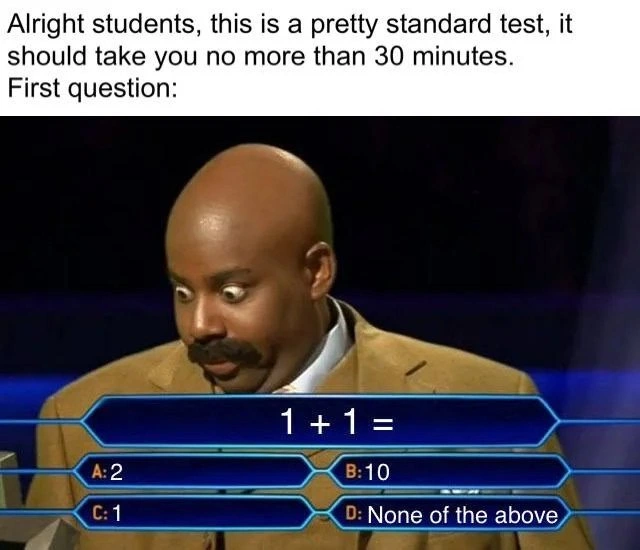
Imagine your teacher promises a super easy quiz that should only take a short time. You relax, thinking, “No problem, I know this stuff.” The very first question is “What is 1 + 1?” You smile because that’s the simplest question ever – of course 1 + 1 = 2! But then you look at the choices given as answers, and they are “2” and “10.” Huh? 🤔 You know 2 is right, so why is “10” there? “10” usually means ten, which is way more than 2. It’s as if the teacher secretly wrote the answer in another language or code. In fact, “10” in a special computer code (binary) actually means 2. If you didn’t know that, you’d be really confused. You’d double-check the question, scratch your head, and maybe start to doubt yourself: “Is this a trick? How can 1+1 possibly be 10?!” It’s funny because the teacher turned a super simple question into a confusing puzzle by switching how the answer is written. It’s like asking, “What comes after one?” and giving the options “two” and “dos.” If you don’t realize “dos” means two in Spanish, you’d be pretty puzzled. In the meme, the student (and even the game show host on screen) is left with a big wide-eyed stare. The joke is that something as basic as 1 + 1 suddenly feels like a sneaky trick question, making everyone laugh and say, “Oh, I see what you did there!”
Level 2: Not So Simple Sum
So, why is “1 + 1” suddenly complicated here? The key is understanding binary vs decimal. Decimal is the normal way we count using ten digits (0 through 9). Binary is a base-2 number system that computers use, with just two digits: 0 and 1. When you count in binary, after 1 you don’t go to 2 (because 2 doesn’t exist as a single digit in base-2); instead, you roll over to the next place value – like how 9 rolls over to 10 in decimal. In binary:
1(base-2) is one.10(base-2) looks like “ten” but actually means 2 in decimal, because it’s 1×2^1 + 0×2^0 = 2.
Now look at the meme’s multiple-choice answers: A: 2 and B: 10. They represent the same quantity; both are “two,” just written in different systems. Option A is 2 in our everyday decimal, and option B is “10” in binary (which a CS student recognizes as also meaning 2, not ten). The test question doesn’t say “in decimal” or “in binary,” it just asks 1 + 1 = ?. If you assume normal math class context, 2 is correct. If you’re a sneaky computer science teacher or a wary student, you notice 10 could also be correct if the question is interpreted in binary. This ambiguity is the joke! It’s a multiple-choice confusion that makes you second-guess something as simple as adding one and one. The tag mcq_confusion fits perfectly: it’s a multiple-choice question where more than one answer seems right.
For a new learner or junior developer, this is a classic learning curve moment. The first time you encounter different number bases, it’s a bit mind-bending. You realize “10” doesn’t always mean ten; its value depends on the base. A common introductory CS assignment might be converting numbers between binary and decimal, explicitly to drive home that context matters. This meme basically turns that lesson into a prank. The professor’s line “pretty standard test... 30 minutes” sets the expectation that it’s easy, maybe just checking basic addition. Then BAM 💥 – First question: 1 + 1 = ? with answers that reveal a base trick. If you’re not careful, you’ll either confidently answer “2” (and later find out the teacher wanted “10” just to teach about binary), or you’ll overthink and stress, “Is this a trick? Do they want 10? But 10 isn’t 2... oh wait… 10 is 2 in binary!” It’s equal parts confusing and enlightening.
The use of the Who Wants to Be a Millionaire game-show style amplifies the humor. That show is known for making people sweat over answers, complete with dramatic music and lifelines. Here it’s applied to a simple math question to exaggerate the feeling of pressure. The host’s comedic wide-eyed stare in the image matches the student’s internal state of shock: even this TV host character is like “Hold on, what kind of test is this?!” For someone learning computer science, it captures that feeling when a straightforward problem suddenly requires you to apply your newly acquired knowledge of binary. It’s equal parts stressful and funny. The meme falls into TechHumor and Learning categories because you kind of have to know the computer science context (binary numbers) to get why it’s funny, and once you do, you remember your own experience of learning that concept. It’s the kind of joke you’d see on a CS classroom bulletin board or a programming forum where newbies and vets alike can chuckle. Essentially, “1 + 1 = 10” is a tongue-in-cheek reminder that in tech, things can be correct in more than one way — it all depends on how you look at it (or what base you count in!).
Level 3: Base-2 Bamboozle
At first glance, this meme drops us into a classic ComputerScienceHumor scenario: an ostensibly simple addition problem that hides a binary vs decimal twist. The format parodies Who Wants to Be a Millionaire? – complete with multiple-choice answers – but the real star is the question “1 + 1 =” with options A: 2 and B: 10. To an experienced developer or computer science student, this screams “radix trick.” In our usual decimal (base-10) system, $1 + 1 = 2$. In binary (base-2), the very same sum is represented as $10_{2}$ (which reads as “one-zero” in base-2, equal to 2 in decimal). The meme gets its punch because both A and B are correct, depending on which number system you assume. It’s a Base-2 bamboozle: the test question ambushes students with ambiguous notation, turning a grade-school arithmetic fact into a moment of confusion.
From a seasoned perspective, this humor taps into core CS_Fundamentals. It recalls that “aha!” moment when you first learned that computers speak in bits: ones and zeros. Suddenly, the simple act of writing the number two can have dual representations. The professor’s deadpan setup — “pretty standard test… no more than 30 minutes” — followed by a binary gotcha, is a wink to instructors who love sneaking fundamentals into questions. Senior devs and CS majors know this trick well. In fact, there’s a classic nerd t-shirt that reads: “1 + 1 = 10 (in binary)”. 😅 We laugh because we’ve been on both sides: first as confused learners, later as the ones in on the joke. The meme exaggerates it further by using the WhoWantsToBeAMillionaire format: a goofy contrast between high-stakes quiz show drama and a trivial math problem. The host’s bulging-eyed expression (even with the face blurred, the shock is palpable) mirrors a student’s internal panic: “Wait… which one do I choose?!” It’s TechHumor gold because it exploits a tiny technical detail—number bases—and makes everyone feel the LearningCurve all over again, if only for a moment.
On a deeper level, there’s an element of truth under the fun. In real computing, interpreting numbers correctly is important: e.g., some programming languages historically treat a number with a leading 0 as octal (base-8), causing easy_test_harder_than_it_looks bugs. Forget to specify a number’s base or context, and you get the same kind of confusion seen in this meme. Seasoned developers grin because they know specifying the radix (the base of a number system) is no trivial matter. Ambiguities can bite. But here, it’s safely packaged as a joke in a classroom test scenario. It satirizes that one professor who might toss in a multiple_choice_trick question to keep students on their toes. And you can bet every enthusiastic educator who sees this meme is thinking, “Gotcha! Bet you’ll remember binary now!” The combination of a supposedly easy question, a game-show dramatic flair, and a binary curveball makes this meme painfully relatable and hilarious to anyone who knows that in computing, context is everything.
Description
A meme using a still image of a shocked-looking Steve Harvey from a game show. The top text reads, 'Alright students, this is a pretty standard test, it should take you no more than 30 minutes. First question:'. The image below shows the game show screen with the question '1 + 1 =' and four multiple-choice options: A: 2, B: 10, C: 1, D: None of the above. The humor lies in the ambiguity of the question within a computer science context. While the obvious answer in decimal is 2, the answer in binary is 10. This creates a moment of panic and overthinking for a CS student, perfectly captured by Steve Harvey's bewildered expression, as they try to figure out the expected context (base 10 or base 2) for what should be the simplest question on the test
Comments
7Comment deleted
The correct answer is obviously D. Without knowing the data type, '1' + '1' could just as easily be '11'. This is why we have TypeScript
“1 + 1?” Sure - decimal gives 2, the binary wire format gives 10, and after three gRPC hops through microservices it comes back null, so which consistency model are we grading me on?
This is the same energy as a principal engineer asking "should we use Kubernetes?" and watching the junior dev confidently say yes before realizing they now need to explain container orchestration, service mesh, ingress controllers, and why the answer depends entirely on whether you have 3 users or 3 million
The correct answer depends entirely on your runtime environment: it's 2 in decimal, 10 in binary, 1 in boolean OR, and 'None of the above' if you're working with floating point arithmetic where 1.0 + 1.0 might equal 2.0000000001 due to precision errors. This is why senior engineers spend 29 minutes of a '30-minute test' clarifying requirements before writing a single line of code - because the real test isn't solving 1+1, it's knowing which 1+1 you're being asked to solve
Pro tip: Always confirm the radix before math questions - because in tech interviews, 1+1 is rarely 2
Only in engineering does 1+1 require an ADR - specify base, literal types, and '+' semantics, or we ship “10” and write a postmortem
Senior dev life: 1+1 is 2 in decimal, 10 in binary, 1 in boolean algebra - and none of the above until the spec says which + we overloaded