Skip to content
DevMeme
1068 of 7435
When the Entire World Becomes a DDoS Attack
OnCall ProductionIssues Post #1199, on Mar 28, 2020 in TG

When the Entire World Becomes a DDoS Attack

Why is this OnCall ProductionIssues meme funny?

Level 1: The Overworked Chef

Imagine a small restaurant kitchen on a normal day – one chef can easily handle the orders coming in. Now suddenly a whole crowd of hungry people shows up all at once, way more than usual. The chef only has so many stovetops and pans. He’s rushing around, every burner is on high, pots are boiling over, and he's chopping and stirring as fast as humanly possible. The restaurant manager (like the "Captain") keeps asking, "Can we serve more people? More orders coming!" and the exhausted chef shouts, "I'm cooking as fast as I can! I can't go any faster!" It's a hectic, almost cartoonish scene.

This meme is just like that situation: too many people online at the same time (the huge crowd of customers), and the servers are like that small kitchen, already using every bit of capacity. The engineer in the picture is that overworked chef, basically saying to his boss (the Captain), "We've done everything we can, there's nothing left to give!" It's funny because we can picture that frantic effort and sympathize with it – whether it's a kitchen or a server room, there's a limit to how much can be handled at once. When someone is desperately trying not to let things fall apart, it's stressful for them but a little humorous to observe, especially once you realize they're heroically keeping things running against the odds.

Level 2: Servers Under Pressure

In plain terms, this meme is about servers (the powerful computers behind these online services) struggling to handle a sudden surge of users. Think of Skype, Zoom, Netflix – each relies on lots of machines in data centers (or the "cloud") to run. Scalability means that as more people use the service, you can handle it by adding more machines or resources rather than breaking down. Modern apps use CloudInfrastructure from providers like Amazon or Microsoft, which let them rent thousands of servers on demand. They even set up Autoscaling rules so that if traffic goes up, the system automatically launches extra server instances to share the work and keep things smooth.

But in early 2020, usage spiked so quickly and so high that even these automatic systems were racing to keep up. Imagine you're a junior dev who built a small website, and suddenly it goes viral – what do you do? You'd scramble to upgrade your server or add another one because the site is getting slow. That's basically what happened here, but on a massive scale. The engineers on OnCallDuty (meaning the ones assigned to respond to emergencies at that time) got paged repeatedly. ProductionIncidents is the term for major problems in the live system – for example, if users can’t connect to a Zoom meeting or their Netflix keeps failing to load, that’s an incident. And indeed, PerformanceIssues were the first red flags: video calls started lagging, voices were cutting out, and streams began buffering or dropping to low quality. Those symptoms told the teams, "Uh-oh, we're at our limit – the system can't comfortably handle this load." It was all hands on deck for those IT teams. They likely had to jump in to manually add capacity, tweak settings, and do anything possible to keep things running. This is what being "on-call" is all about: when something goes wrong at 2 AM, you wake up and fix it, whatever it takes.

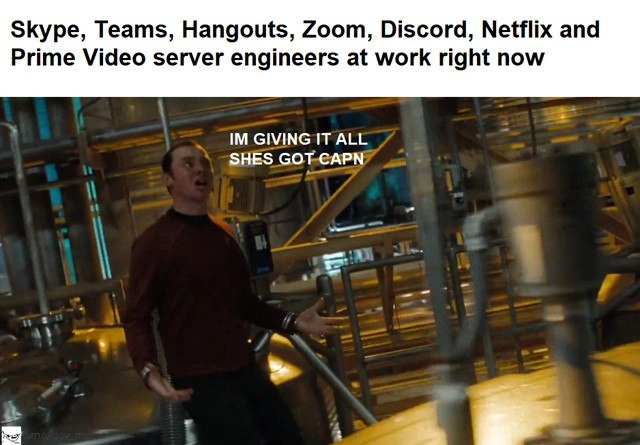
The picture of the mechanical engine room is a metaphor for the tech infrastructure behind these services. All those metallic pipes and glowing panels in the image are like the network cables, cooling systems, and server racks humming in real life. The panicked guy in the red shirt represents an IT or ops engineer rushing around trying to keep everything working. In the actual Star Trek scene, the spaceship’s engineer (Scotty) is warning Captain Kirk that the engines are at maximum power and can't go any faster without blowing up. Translated to this meme, the engineers were basically telling their bosses or teammates, "We've added all the servers we can; the system is at full capacity!" These companies use huge DistributedSystems – basically thousands of computers working together around the world – so that no single machine has to handle everyone. That usually allows them to serve millions of users by spreading the load. But even a vast distributed cluster can feel the strain when literally everyone is online at the same time. Keeping HighAvailability (which means the service is up and running reliably without interruptions) became a real challenge when usage was off the charts. The meme highlights that behind the scenes of all our video calls and movie binges, there were frantic tech people in a digital "engine room," doing everything they could to prevent a collapse.

Level 3: Engineering Red Alert

For seasoned engineers, this meme instantly triggers a knowing grin (or perhaps a sympathetic groan). The caption literally lists every major video conferencing and streaming platform of 2020, implying all their server teams are in the same crunch. And it's funny because it's true: overnight, folks at Skype, Teams, Hangouts (Google Meet), Zoom, Discord, Netflix, Prime Video... they all became Scotty in the engine room. The image of the frantic engineer in a red shirt yelling "I'm giving it all she's got, Cap'n!" perfectly captures what those on-call teams were probably shouting into Slack or Zoom war rooms. This iconic Star Trek line has long been an inside joke among developers whenever hardware is maxed out and someone (usually management or customers) is demanding more. Here it's used literally – the engineers are flat-out telling leadership that the CloudInfrastructure is at its limit and straining.

In March 2020, at the start of lockdowns, that scenario was reality. Suddenly every meeting became a video call and every night was a streaming binge. Traffic soared beyond all forecasts – a massive pandemic_traffic_surge that turned calm weekdays into Black Friday-level events, day after day. Those on OnCallDuty started seeing critical alerts triggered by sheer overload in ways they'd never encountered. The ultimate Scalability gauntlet was thrown down, and naturally things began to buckle: PerformanceIssues emerged as servers strained (think stuttering Zoom audio, or Netflix streams dropping to potato quality). These were the early warning signs that triggered ProductionIncidents. You can picture the pager alerts going off non-stop. Many of us have felt that dread at 2 AM, but here it was company-wide virtual_meeting_overload with no quick fix. The meme nails the chaos: multiple systems hitting redline simultaneously. It was a nightmare for SREs and ops teams, yet there's dark humor in commiseration – "we're all Scotty now", doing impossible overtime to keep the world connected.

From an engineering management perspective, this was both terrifying and oddly validating. Suddenly there was zero pushback on spinning up hundreds of new servers or maxing out cloud budgets – uptime became priority #1. All those Autoscaling settings tuned for cost efficiency had to be thrown out the airlock. Say your cluster was set to scale between 10 and 50 instances; well, overnight 50 became 500. Limits that were considered sensible got raised in emergency patches. For example, a typical auto-scaling config might have gone from:

max_replicas: 50   # pre-crisis limit
# ... later that week, after frantic calls ...
max_replicas: 500  # post-crisis emergency limit

In some war-room call, a harried lead engineer might have yelled, "Double the capacity everywhere, worry about the bill later!" It’s funny in hindsight because it's a reversal of the usual corporate stance. The CFO who normally frets about cloud costs was now silently nodding as the team essentially went to warp 10 on spending to avoid an outage. This crisis exposed any hidden bottlenecks too: maybe an old Skype service still running on one datacenter, or a Discord voice server cluster that suddenly needed sharding across regions. You don't want to discover – in the middle of a global event – that a single database or service is the choke point, but many teams did find exactly that. It’s the classic senior-dev war story: an unknown constraint that only appears under extreme load, revealed at the worst possible time. The meme gets a laugh because every veteran engineer has a tale of "that one time we hit a limit we didn't even know existed".

And let's not forget the human angle. Behind that blurred, frantic face in the meme are real engineers likely running on caffeine and adrenaline. If you were on these teams, you basically lived in a "war room" chat for weeks. There's a camaraderie (and plenty of gallows humor) that forms during such crises. Someone might crack a Scotty joke in the middle of chaos just to ease the tension. The meme resonates because every experienced dev has had that "OMG, everything is on fire!" moment. It's both stressful and absurd – you're watching graphs do impossible leaps, juggling hot-fixes on the fly, all while assuring the Captain (CTO or manager) that you're doing everything you can. The image captures that vibe: the absurd heroism of keeping systems alive when demand goes off the charts. It's funny after you survive it. As memes go, this one is a tip of the hat to the unsung heroes (in hoodies) who kept Zoom meetings and Netflix marathons running in those crazy early-pandemic days.

Level 4: Breaking the Cloud Barrier

In this scenario, distributed systems theory meets a Star Trek-level crisis. A sudden, global wave of video traffic effectively stress-tested the assumption of infinite cloud elasticity. Under normal operation, systems scale horizontally across data centers to maintain HighAvailability, but here demand spiked beyond even generous capacity models. It's like trying to push a starship beyond warp 9 – eventually, fundamental limits kick in. In queueing theory terms, when the incoming request rate (λ) vastly exceeds the total service throughput (μ × number_of_servers), queuing delays grow without bound. No amount of heroic engineering can cheat those mathematics: if you get 10 million streaming requests all at once but can only serve 5 million concurrently, the rest must wait or fail. This is essentially Little's Law at play, and those basics say backlog (L) = arrival_rate × wait_time – if arrival_rate jumps and capacity can't instantly follow, wait_time skyrockets. As Scotty might lament, "I cannae change the laws of physics!" – here those laws are CPU cycles, network bandwidth, and memory limits, all being redlined.

For these platforms, Autoscaling systems did try to spin up new servers or containers in response. However, there's an inherent lag – provisioning VMs, warming up caches, and rerouting traffic isn't instantaneous. At peak surge, those delays meant the existing servers had to absorb a huge load in the interim, running flat-out at 100% CPU, saturating network interfaces, and pushing databases to throughput limits. We see phenomena like backpressure kicking in: services start rejecting new requests or shedding load rather than letting queues overflow and crash the whole system. Some systems implement brownout logic where they intentionally degrade non-essential features (for example, reducing video resolution or disabling high-bandwidth options) to prioritize core functionality under strain. This is like Scotty diverting all remaining power to life support and shields – dropping luxuries to keep the core systems alive. Even global CloudInfrastructure isn't infinite: data centers have finite servers and bandwidth. If every major platform is scaling up at the same time (Zoom on AWS, Netflix on AWS, Teams on Azure, etc.), they might even start contending for underlying cloud capacity – the same way multiple starships could compete for energy from a single starbase. It was a rare situation where everyone was pushing the envelope in unison, effectively bending (if not outright breaking) the usual safety margins of large-scale design.

Description

A meme featuring the character Scotty from Star Trek in what appears to be an engine room, looking stressed and shouting. The top text reads, 'Skype, Teams, Hangouts, Zoom, Discord, Netflix and Prime Video server engineers at work right now'. An overlay on the image quotes Scotty's famous line, 'IM GIVING IT ALL SHES GOT CAPN'. This meme, posted in late March 2020, perfectly captures the immense pressure on the infrastructure of communication and streaming platforms at the onset of the COVID-19 pandemic. The sudden global shift to remote work and home entertainment created an unprecedented and sustained surge in traffic, effectively acting as a massive, unplanned stress test. The image humorously equates the server engineers' frantic efforts to keep services online with Scotty trying to prevent the Enterprise's warp core from breaching

Comments

7
Anonymous ★ Top Pick The moment when 'horizontal scaling' stops being a buzzword on a design doc and starts being a desperate prayer whispered into a rack of overheating servers
  1. Anonymous ★ Top Pick

    The moment when 'horizontal scaling' stops being a buzzword on a design doc and starts being a desperate prayer whispered into a rack of overheating servers

  2. Anonymous

    Autoscaling spun up 30 new pods in 20 seconds, but I’m still yelling “She can’t take any more, Cap’n!” - because the single-node Postgres underneath just red-lined its IOPS

  3. Anonymous

    That moment when your carefully planned capacity model based on three years of gradual growth gets invalidated by a global pandemic in 72 hours, and suddenly you're explaining to the CFO why you need to 10x your AWS bill while simultaneously rewriting your entire autoscaling logic in production

  4. Anonymous

    When your autoscaling policies are maxed out, your CDN edges are at 99% capacity, your database connection pools are exhausted, and product just Slacked asking why latency increased by 50ms - but hey, at least you're not getting paged because the circuit breakers are actually working as designed. This is what 'cloud-native resilience' looks like when half the planet decides to have video meetings simultaneously

  5. Anonymous

    Captain, she's givin' all she's got... but with these autoscalers pegged at 100% and no more spot instances, we're one Zoom breakout room from warp core breach

  6. Anonymous

    You know it’s bad when the join storm outpaces autoscaler warmup, so the fix is shipping a lower ABR floor and calling it graceful degradation

  7. Anonymous

    Skype/Zoom SRE rite of passage: ABR drops to 240p, TURN saturates, P99 jitter goes vertical - you flip on edge load-shedding and yell “she’s got, cap’n,” right before the autoscaler pages the CFO

Use J and K for navigation