Skip to content
DevMeme
1307 of 7435
The Bug That Fights Back
Bugs Post #1461, on May 1, 2020 in TG

The Bug That Fights Back

Why is this Bugs meme funny?

Level 1: Little Bug, Big Trouble

Imagine you see one little ant crawling on your kitchen counter. You squish that one ant and think, “There, all done!” It was easy, right? But a bit later, you return and find a whole trail of ants marching across the counter looking for crumbs. That one tiny ant turned out to be part of a much bigger problem, and now you’ve got a bunch of ants to deal with! You feel surprised and overwhelmed because you thought it was just a quick fix. This meme is funny in the same way: the person fixing the computer bug thought it was just a small, simple problem (like the one ant). Later, that same problem came back much bigger (like the ant’s whole family showing up). It’s a big surprise and a little bit silly. The joke is that something that looked easy at first suddenly became a lot of trouble. People who make software find this funny because it happens to them – they feel just like that cat in the picture, getting unexpectedly “eaten” by a problem they thought they solved!

Level 2: Quick Fix Gone Wrong

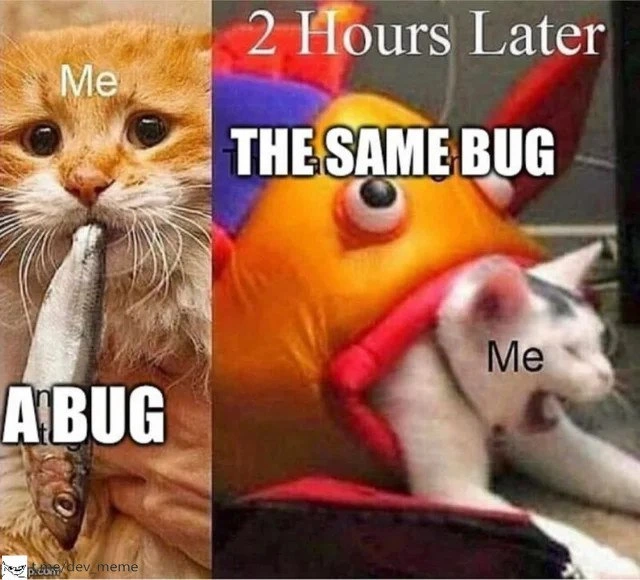
In software, a bug is a mistake or problem in the code that causes the program to act in unexpected or wrong ways. Fixing a bug (often called bug fixing) might sound straightforward: you find the error and correct it. But this meme humorously shows how debugging (the process of finding and fixing bugs, i.e. Debugging_Troubleshooting) can trick you. Initially, the developer (represented by the cat labeled “Me” in the first panel) thinks they’ve caught the issue easily. The small fish labeled “A BUG” represents that seemingly tiny software bug they grabbed. The attitude is casual – like “Got it, that was easy.”

However, two hours later, things change drastically. The phrase “2 Hours Later” is a common playful caption (you might have seen it in cartoons or memes) to show that some time has passed. In the right panel, the same bug that looked small has now grown into a huge problem (the bright inflatable fish labeled “THE SAME BUG”). The developer, also labeled “Me,” is now the one being caught – the kitten is halfway stuck in the big fish’s mouth! This silly image is a metaphor for how the same bug resurfaces and suddenly the problem is much bigger and more frightening than before. In real debugging, this means the bug wasn’t really gone or solved. Perhaps the initial fix didn’t actually address the root cause of the issue. The bug might still be in the code, or maybe the “fix” caused another issue. So the developer ends up spending hours getting devoured by the problem, struggling with what they thought was an “easy” fix.

For a newer developer or anyone learning to code, this situation is a valuable lesson: software_bug_persistence is real. A bug that seems simple can hide complexity underneath. You might fix one part of it quickly, only to discover later (as you test or use the software more) that the bug is still there or has popped up in a different way. This leads to a lot of debugging frustration and developer frustration – you feel tired and a bit desperate, just like that poor kitten in the meme. It’s common for a programmer to say “I thought I fixed it!” only to find out the bug is back. The humor here is very relatable to anyone who writes code, because we’ve all had a moment where a small task unexpectedly turned into a huge time-consuming challenge. The meme uses an exaggerated, funny animal scenario to capture that feeling. It basically says: “Remember that simple bug? Yeah, two hours later it’s going to eat you.” It’s a lighthearted way to acknowledge a frustrating part of the developer experience, and seeing it in a meme helps programmers laugh at their own past debugging battles.

Level 3: The Bug Bites Back

This meme captures a painfully familiar scenario in software development: the “easy” bug that turns into a nightmare. In the left panel, a cat (tagged Me) casually holding a small fish labeled “A BUG” symbolizes a developer confidently catching what appears to be a trivial issue. It’s the kind of bug you initially scoff at – maybe a tiny UI glitch or a one-line error. But the right panel, captioned “2 Hours Later”, reveals the reversal: now a wide-eyed kitten (again Me) is half-swallowed by a giant inflatable fish labeled “THE SAME BUG.” This witty contrast nails the dark humor of debugging: a minor BugsInSoftware issue ballooning into a DebuggingHell of problems that overwhelms the developer.

Why is this so relatable? Because every seasoned programmer has uttered the famous last words: “It should be a quick fix.” We’ve all been that cat, triumphantly holding our bug trophy, only to have the same_bug_resurfacing moments later and practically swallow us whole. In real life, a “simple” bug might hide complex causes – a misused API that triggers a cascade of failures, an off-by-one error masking a deeper logic flaw, or a memory leak that seemed innocuous until it crashed the system. The meme’s humor comes from shared experience: the DeveloperFrustration of thinking you’ve slain a bug, only to have it rise from the dead like a zombie in your codebase. It’s a staple of developer folklore and RelatableHumor in the office Slack: “Remember that one-line fix that took all afternoon?”

Technically, what’s happening is a lesson in proper Debugging_Troubleshooting. The developer likely fixed a symptom, not the root cause. The bug’s persistence (that software_bug_persistence where an issue keeps returning) indicates something deeper was wrong – perhaps a forgotten edge case or an interaction effect in a complex system. This is why we write tests and do careful root-cause analysis: a quick patch might silence the error for a moment, but if you don’t understand why it happened, it can come roaring back (sometimes in a bigger, scarier form, as the inflatable fish suggests). Seasoned devs learn to be a bit cynical when someone says “just a small bug,” because they know even a small fish can hide some sharp teeth.

The DeveloperExperience here swings from confidence to chaos in just two hours. That “2 Hours Later” caption (a nod to the SpongeBob-style two_hours_later_meme_format) highlights how time slips away when you’re lost in a debugging rabbit hole. It’s practically a rite of passage in programming: you plan a quick fix before lunch, and next thing you know the sun has set and the bug is still reproducing. As a community, we cope with this frustration by joking about it. This meme falls into the Bugs and DebuggingFrustration genre that makes us laugh and wince at the same time. We laugh because it’s true – we’ve underestimated tasks like this – and we wince because we remember the debugging_exhaustion of those long bug hunts. In short, the visual metaphor of the predator becoming the prey perfectly encapsulates how a tiny coding issue can turn the tables and devour your whole afternoon (or worse).

Description

A two-panel meme illustrating the treacherous nature of debugging. On the left, an adorable orange kitten labeled 'Me' proudly holds a small fish in its mouth, which is labeled 'A BUG'. This represents the initial, seemingly successful fix. The right panel, captioned '2 Hours Later', shows a white cat, also labeled 'Me', being devoured by a person in a giant, comical, orange fish costume. The costume is labeled 'THE SAME BUG'. This humorously portrays the common and frustrating developer experience where a seemingly small, conquered bug turns out to be a manifestation of a much larger, more complex, and overwhelming underlying issue that comes back to consume all of their time and effort

Comments

7
Anonymous ★ Top Pick The first fix was just a patch to the data transfer object. The second fix involves rewriting the entire asynchronous processing pipeline it was part of
  1. Anonymous ★ Top Pick

    The first fix was just a patch to the data transfer object. The second fix involves rewriting the entire asynchronous processing pipeline it was part of

  2. Anonymous

    “I called it a one-line null check; two hours later I’m tracing a race condition through six microservices, basically being eaten alive by Schrödinger’s Null.”

  3. Anonymous

    The bug started as a simple null pointer exception, but after two hours of 'fixing' it, you've somehow broken the CI pipeline, corrupted the git history, and now production is asking why the database migrations are running backwards

  4. Anonymous

    Every senior engineer knows this progression intimately: 'Oh, just a null pointer, five-minute fix' transforms into discovering your entire state management architecture has been built on a foundation of race conditions, undefined behavior, and three different interpretations of what 'thread-safe' means across teams. Two hours later, you're questioning every life choice that led you to this codebase, the bug has spawned six more issues, and you're seriously considering whether that COBOL maintenance job your recruiter mentioned might actually be less painful

  5. Anonymous

    When the bug returns exactly two hours later, you didn’t fix it - your 7,200‑second cache TTL resurrected the race condition hiding behind sticky sessions

  6. Anonymous

    Two hours after “fixing” a prod bug: same bug, new layer - now hiding behind the cache, wrapped in retries, and already featured on a Grafana dashboard with my name on it

  7. Anonymous

    That rare moment you squash a bug, only for it to respawn distributed across your microservices with exponential backoff

Use J and K for navigation