Skip to content
DevMeme
1308 of 7435
The Semicolon Incident Cascade
Bugs Post #1462, on May 1, 2020 in TG

The Semicolon Incident Cascade

Why is this Bugs meme funny?

Level 1: Tiny Mistake, Big Mess

Imagine you’re writing a long story by hand and you accidentally forget to put a period at the end of one sentence. The next sentence runs together with it, and your teacher gets completely confused. Suddenly, the teacher marks a bunch of things as wrong in that paragraph because one little dot was missing. In reality you only made a small mistake, but it caused a big chain reaction of misunderstandings. This meme is joking about the same idea: how one tiny slip-up can snowball into a huge mess. It’s funny (and a bit comforting) because we’ve all had moments where a little error leads to an over-the-top reaction. In the end, fixing that one small thing makes the whole “disaster” disappear, and you can’t help but chuckle at how such a minor goof caused so much drama.

Level 2: Lost in Compilation

Let’s explain the joke in straightforward terms. In many programming languages — especially C-like languages such as C, C++, or Java — you must put a semicolon (;) at the end of each statement. Think of the semicolon like a period at the end of a sentence: it tells the computer “I’m done with this instruction; now move on to the next.” The program that checks and runs your code is called a compiler, and it’s very strict about punctuation and formatting (the rules it follows are called the language’s syntax).

If you forget a semicolon where one is needed, the compiler becomes confused. It’s like reading a paragraph with a missing period – suddenly the sentences run together and nothing makes sense. In a big file (imagine 700 lines of code!), one missing semicolon can throw off the compiler for everything that comes after it. The result? A flood of syntax errors. A syntax error is basically the compiler waving a flag saying “I expected something (like a semicolon) and it’s not here. This doesn’t look right!”

Usually, the very first error message will hint at the real problem. For example, it might say something like “error: expected ‘;’ before ___” at a particular line. That’s the compiler trying to tell you “Hey, I think you forgot a semicolon here.” However, after that point the compiler doesn’t really know how to read the rest of your code correctly, so it might start complaining about lots of other things that aren’t actually wrong. This is the compile error cascade in action: one small mistake causes the compiler to misread everything that follows, leading to many error messages. It’s not that you suddenly wrote 50 bad lines; it’s that one tiny omission made the compiler get lost and blame everything under the sun.

Here’s a simple example in C++-style pseudocode:

int main() {
    int x = 5    // <-- Forgot the semicolon at the end of this line
    int y = x + 1;
    return y;
}

If you compile this, the compiler will first point out the missing semicolon after x = 5. Then it might spit out additional errors because it didn’t realize you ended the first line. You could see errors like:

error: expected ';' before 'int'
error: redefinition of 'x'
error: 'y' undeclared (first use in this function)

(The above messages are an example of what could happen — the exact wording depends on the compiler, but the idea is that a lot of errors show up.)

The important thing to realize is that almost all those errors are caused by the single missing semicolon. The compiler got the code jumbled in its head. In the example, after missing the ; it thought the second line int y = x + 1; was a continuation of the first line, which didn’t make sense. So it got confused and complained that x was being defined again or that y was coming out of nowhere, and so on. None of those would have happened if the semicolon was there to properly end the statement.

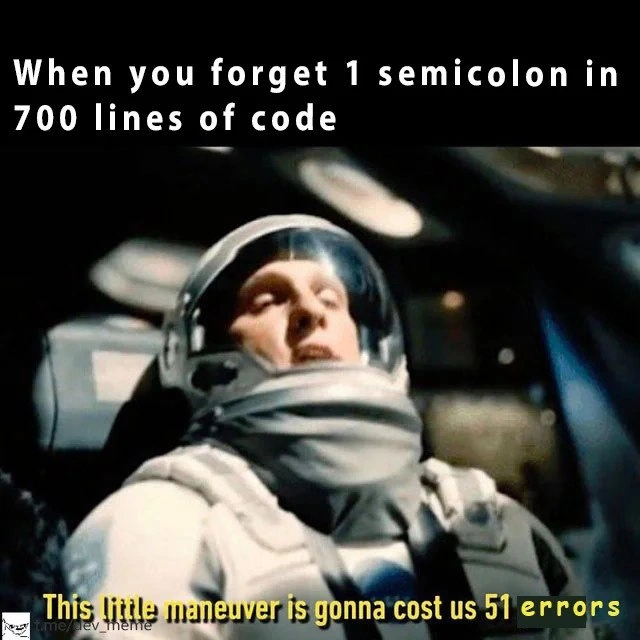
The meme exaggerates this situation with humor. The text says “This little maneuver is gonna cost us 51 errors” – as if the computer is dramatically announcing that one tiny misstep (a missing ;) resulted in 51 errors. In real life, you might not get exactly 51 errors, but it can definitely feel like dozens of errors scrolling by for just one typo. It highlights a feeling every coder knows: “I missed one character and now everything looks broken!” It’s both frustrating and funny. Frustrating, because you have to sift through a huge list of scary-looking errors. Funny, in hindsight, because fixing that one character (putting the semicolon in) often makes all those wild errors disappear instantaneously. It’s like magic — or like realizing the big “monster” in the dark was just a coat on a chair all along.

If you’re new to programming, the takeaway is not to be intimidated by a barrage of compiler errors. Often, they’re just echoes of the same problem. Seasoned programmers will tell you: focus on the first error message. In this scenario, find where the compiler first complained about a missing ; (or some unexpected symbol). Fix that, and chances are the next compilation will go through without a peep of those other errors. In other words, don’t panic when you see 51 errors — chances are, you really only need to fix one thing. And thanks to modern IDEs (Integrated Development Environments) and code editors, you’ll usually get a quick highlight or alert exactly where a semicolon is missing, which helps catch the mistake early. But when you do end up in a situation like the meme, just remember: it’s a common goof, and every developer has a war story about the time a single semicolon (or bracket, or brace) caused a morning’s worth of debugging. It’s all part of the learning (and laughing) process in coding.

Level 3: Punctuation Pandemonium

Every seasoned developer has faced this exact scenario: you run the compiler on a huge chunk of new code, only to be bombarded with a wall of errors that looks absolutely catastrophic. Your first reaction might be pure dismay—“51 errors?! I’ve broken everything!”—but a moment later comes the facepalm as you discover it was all caused by one lonely missing semicolon. This meme nails that experience and cranks the drama up to cinematic levels. The top text sets the scene: “When you forget 1 semicolon in 700 lines of code”. Then the punchline twists a famous movie quote: “This little maneuver is gonna cost us 51 errors.” In the actual film (Christopher Nolan’s Interstellar), that line was about a risky move costing 51 years due to relativistic time dilation. Here, it’s joking that one minor coding slip-up “costs” you 51 error messages – a playful hyperbole every programmer can relate to.

Why is this so funny and familiar? Because it captures a relatable dev experience: a trivial typo triggering an avalanche of compiler errors. In a language like C++ or Java, leaving out a semicolon — essentially a punctuation bug — can confuse the compiler so much that it reports error after error, seemingly freaking out. The humor comes from the sheer disproportion of it. It’s just one character missing, yet the compiler responds as if the entire codebase fell apart. If you’ve been through it, you know the pattern: the compiler reports an error at the line with the missing ;, and then dozens of errors on subsequent lines like dominoes. Those later errors are usually nonsense from the compiler being out of sync with your code. Seasoned developers learn to laugh it off (after maybe groaning) because we know the trick: fix the first error, and all the others will likely vanish. It’s a rite of passage in Debugging_Troubleshooting to realize that the scariest-looking error list might have a very simple cause.

The meme’s drama is also amusing because it mirrors how it feels in the moment. The image of an astronaut resignedly saying “this little maneuver is gonna cost us…” is every developer realizing their simple mistake after minutes (or hours) of head-scratching. It’s like saying, “Welp, this one silly thing is about to make me waste a ton of time.” We’ve all been there, and seeing it presented with Hollywood-level stakes is both cathartic and comic. It’s the classic developer hyperbole: deploying to production feels like diffusing a bomb, a minor syntax goof feels like triggering a space-time catastrophe. Here, a forgotten semicolon spawns 51 errors, as if one missing piece doomed an entire mission.

From an experienced perspective, this scenario is also a gentle reminder of best practices. Writing 700 lines of code without compiling in between is asking for trouble – it’s like piloting blind for too long. Many of us have learned to compile early and often precisely to catch things like a missing semicolon before it snowballs. But of course, in reality there are times you end up with a big batch of new code and you hit “build” hoping for the best… then CompilerErrors galore. The first time it happens, it’s panic. The tenth time, it’s facepalm and chuckle. You develop that instinct to scroll up to the very first error message and virtually every time, it’s the only one that actually matters. The rest is error spam — essentially the compiler’s confusion echoing down the code.

The shared understanding of this fiasco is what makes the meme instantly resonate in coding communities. It turns a moment of DebuggingFrustration into a laugh. It says, “Hey, we’ve all done this, and isn’t it ridiculous how a missing semicolon can feel like a space disaster?” By referencing Interstellar, the meme elevates a mundane bug to epic proportions for comedic effect. The contrast between the high-stakes astronaut dialogue and the low-stakes reality of a typo is pure geek humor. It bonds us through the awkward knowledge that, yes, our super fancy software can be brought to its knees by something as petty as forgetting a ;. In short, the meme is both a parody and a badge of honor: if you find it funny, you’ve likely been battle-tested by the infamous semicolon saga yourself. And like a veteran pilot who can now laugh about that one turbulent flight, you’ve earned the right to joke about the time a tiny bug caused a big mess.

Level 4: Syntactic Singularity

In C-like languages (such as C++, Java, or C#), the semicolon (;) serves as a crucial terminal symbol in the grammar — it’s the designated statement terminator in the language’s context-free syntax. Forgetting a single semicolon in a 700-line program violates the language’s rules, causing what the compiler perceives as a syntax error. Under the hood, a typical compiler’s parser (often an LL or LALR variant) reads your code and tries to build an Abstract Syntax Tree (AST) according to the grammar. When it encounters an unexpected token (in this case, the end-of-line or next keyword where a ; should have been), the parser goes into error recovery mode. Classic compiler theory (as taught by the famed Dragon Book) describes strategies like panic mode error recovery: the parser, upon hitting an irreconcilable symbol, will “panic” and start discarding tokens until it finds a recognizable recovery point (often a ; or }) to resume parsing.

But until the parser regains its bearings, all bets are off. The absence of an expected semicolon at the right place can make the parser misinterpret everything that follows. It’s as if the source code’s timeline diverged into an alternate reality. The compiler might think that your next line int y = x + 1; is still part of the previous statement (since it never saw a ; to end it), or that subsequent code is inside a phantom block. This misalignment triggers a cascade of compile errors. Each token after the missing semicolon potentially generates a new complaint because it no longer fits the parser’s expected pattern. The compiler essentially falls into a syntactic black hole — a singularity of syntax — where that one missing character sucks in the surrounding context and wreaks havoc on the AST. In tongue-in-cheek terms, the code’s structure undergoes error spaghettification: a tiny omission stretches into a long strand of nonsensical errors.

This is why you might see dozens of CompilerErrors scroll by for what truly is a one-character mistake. The first error will usually be something precise like “error: expected ‘;’ before ...”, flagging the exact spot of the missing semicolon. Everything after that tends to be collateral damage: the parser, having lost the plot, starts complaining about symbols and statements that would have been perfectly fine if the code were parsed correctly. In formal language terms, the parser’s state machine took a wrong transition and went off the rails, leading to a chain reaction of errors. Each subsequent SyntaxError is essentially the compiler saying “I still can’t make sense of this!” as it tries to parse the remainder of the code in a broken context.

Interestingly, modern compilers employ smarter heuristics to mitigate this error cascade. For instance, some compilers will attempt to automatically insert a missing semicolon in their mind and continue parsing, or they’ll limit the number of follow-on errors reported for a single mistake. You might even see a hint like “Did you forget a ';'?” because the compiler recognizes the pattern of a likely missing_semicolon. This is the compiler being a bit intelligent – it’s effectively guessing the root cause (a stray punctuation error) behind the flood of messages. Still, there are fundamental limits to error recovery; the compiler can’t perfectly read the programmer’s mind. In a language that demands explicit separators between statements, failing to provide one is a fatal error for the parser’s logic, and the fallout is that slew of messages.

From a theoretical perspective, this meme humorously highlights how a tiny breach of a formal system’s rules can lead to disproportionately big consequences. It’s reminiscent of chaos theory in software: a single character out of place sends the deterministic compiler into a frenzy. The meme exaggerates it with the line “This little maneuver is gonna cost us 51 errors,” parodying Interstellar’s dramatic “51 years” quote. In the film, a small navigational choice led to massive time dilation; in our code, a small typo leads to a massive error dilation. The juxtaposition is both absurd and intellectually satisfying. The joke lands because developers know this scenario all too well: the laws of compilers are as unforgiving as the laws of physics. A forgotten semicolon might as well be a breach in the space-time continuum of your code, yielding a vortex of errors. It’s a comedic reminder that in programming, like in astrophysics, even the smallest elements can have astronomical repercussions.

Description

A two-part meme featuring a scene from the movie 'Interstellar'. The top section has white text on a dark background that reads, 'When you forget 1 semicolon in 700 lines of code'. The bottom section shows the character Cooper, an astronaut in a helmet, with a stressed expression during a high-gravity maneuver. The caption at the bottom, mimicking a movie subtitle, reads, 'This little maneuver is gonna cost us 51 errors', with '51 errors' highlighted in yellow. The meme humorously adapts the original line ('51 years') to the developer experience. It highlights the frustration of how a single, tiny syntax error, like a missing semicolon in languages like C++, Java, or C#, can cause the compiler to lose context and generate a massive, cascading flood of seemingly unrelated error messages, turning a simple fix into a daunting debugging session
Comments

7
Anonymous ★ Top Pick The modern linter is the Endurance spacecraft's AI, yelling at you about the semicolon before you even get close to the black hole of compilation
  1. Anonymous ★ Top Pick

    The modern linter is the Endurance spacecraft's AI, yelling at you about the semicolon before you even get close to the black hole of compilation

  2. Anonymous

    One missing semicolon and clang goes full Interstellar: five seconds to type, forty-five minutes of template-instantiation stack traces - relativity for C++ builds

  3. Anonymous

    The real tragedy is when you fix the semicolon and discover the other 50 errors were legitimate architectural decisions you made at 3 AM

  4. Anonymous

    The real tragedy isn't the 51 errors - it's that 50 of them are just the compiler's increasingly desperate attempts to make sense of what you meant after that first semicolon went missing. It's like watching a senior architect try to salvage a requirements doc where the client forgot to mention they need the system to be 'web scale.'

  5. Anonymous

    The first error is the bug; the next 50 are the parser’s fan fiction - set -ferror-limit=1 and suddenly you’re a hero

  6. Anonymous

    One missing semicolon and the AST collapses; CI invents 51 errors, and your one-character commit is titled “fix everything.”

  7. Anonymous

    One missing semicolon: the parser's polite way of turning your syntax tree into a 51-node error forest

Use J and K for navigation