The Agony of the 'Easy' Bug Fix
Why is this Bugs meme funny?
Level 1: Tower of Blocks
Imagine you built a tall tower of blocks that’s a bit wobbly. There’s one block in the middle sticking out slightly crooked. Your friend comes over, points at that block and says, “Hey, just push that block back in, it’s an easy fix!” To your friend, it seems simple to do. But you, the builder of the tower, get nervous. You remember that the tower is delicate – if you touch the wrong piece, the whole thing might come tumbling down.
In this story, your friend is like the tester and you are like the developer. The friend (tester) only sees that one block out of place (one obvious problem) and thinks fixing it will be quick and easy. They’re sitting there confident, like it’s no big deal. But you (the developer) know that block is actually helping balance a bunch of other blocks. Pushing it in “just a little” could upset everything. You might end up with a pile of blocks on the floor instead of a nice tower!
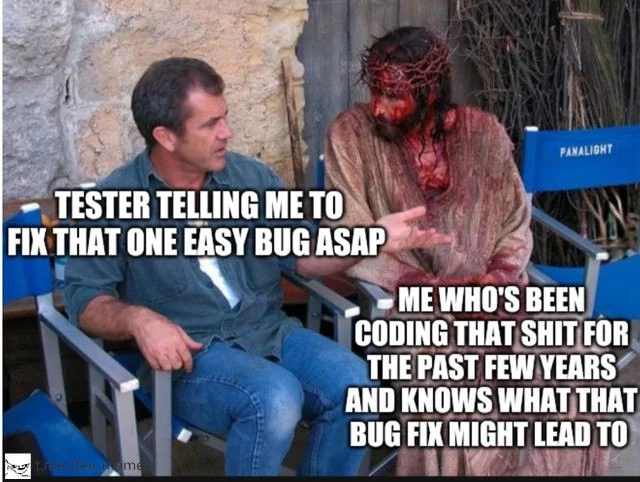
The meme uses a funny picture to show this idea. The tester is represented by a calm person giving directions, and the developer is shown as a tired, beat-up person (someone who looks like they’ve been through a disaster). It’s an exaggerated way to show the feeling: the tester thinks it’s easy-peasy, while the developer is thinking, “Oh no, if I do that, the whole thing could collapse and I’ll be in big trouble.”
So, put simply, this meme is funny because it’s true: sometimes fixing a small thing isn’t simple at all. It’s like pulling on a loose thread in your sweater and then the whole sweater starts to unravel. The person who didn’t knit the sweater might say “just cut that loose thread off!” not realizing that thread is holding a lot together. Likewise, the friend who didn’t build the block tower doesn’t know how fragile it really is. They innocently say “just fix it!” while you worry that one tiny change could cause a big mess. The picture of a relaxed director next to a bloodied actor makes us laugh because it’s a playful way to show how one person can be carefree while the other is stressed out, even though they’re looking at the exact same problem.
Level 2: Tech Debt Landmines
This meme is all about a classic conflict in software development: a tester thinks a bug is trivial to fix, but the developer knows the code is fragile. The text in the image sets the scene: Tester – “telling me to fix that one easy bug ASAP,” versus Me (Developer) – “who’s been coding that for years and knows what that bug fix might lead to.” In the picture, a film director (the tester) casually gives feedback, while the actor dressed as a bloodied Jesus (the developer) represents how a “quick fix” could turn into a world of pain.
Let’s break down the roles and terms. A software bug is a mistake or glitch in the code that causes the program to behave incorrectly. A tester (part of Quality Assurance, or QA) is someone who finds these bugs and reports them so developers can fix them. Testers often expect issues to be resolved quickly, especially if on the surface it looks like a small problem. When a tester says a bug is “easy” or wants it fixed ASAP, it suggests they think it’s a straightforward tweak.
The developer, however, may have a different perspective. They’ve worked on that code for a long time and know its inner workings. If the code has a lot of technical debt (old, messy code or quick-and-dirty solutions left in place to meet past deadlines), then even a tiny change can be risky. Technical debt is like a debt in code: you “borrow” time by using a quick hack or skipping best practices, but you “pay for it” later because the code becomes harder to maintain. Over years, such code can turn into spaghetti code – a tangled mess where everything is interconnected in confusing ways. In a spaghetti-code system, fixing one thing might unexpectedly affect something else, just like pulling one noodle can jiggle a whole bowl of spaghetti.
The meme’s humor comes from this mismatch in thinking: the tester sees a quick win, the developer sees a potential minefield. Here’s a comparison:
| Tester’s Perspective | Developer’s Perspective |
|---|---|
| “It’s just a minor bug, one small fix should do it.” | “This bug is tied into a lot of other logic. Changing it might break something else.” |
| Expects a simple change with no side effects. | Worries that even a small code change could have side effects in other parts of the application. |
| Wants the fix as soon as possible to pass tests or meet the deadline. | Knows rushing could trigger regression bugs – new bugs appearing in features that were working before. |
| Sees the issue in isolation (just fix this one thing). | Sees the issue in context (recognizes tech debt and fragile areas that make the fix risky). |
A regression bug is what we call it when a change in the code unintentionally causes an old bug to come back or creates a new bug in a previously working part of the software. For example, imagine the app has a flaw in its login screen. The tester says, “Just fix the login button’s alignment, it’s an easy HTML tweak.” But the developer knows that the login button’s position is calculated by a function that many different pages use. If they alter that function for the login page, five other pages might suddenly look wrong or have buttons that move out of place – now those are regression bugs caused by the “fix.” This is why the developer in the meme looks so anxious (and beat-up) – they anticipate that fixing this one thing could unintentionally mess up others.
Tech debt landmines refers to hidden problems in the code that are lying in wait. Just like stepping on a buried landmine, touching a piece of fragile code can set off explosions elsewhere. The developer has probably encountered these traps before. Perhaps in the past they tried to fix something “small” and ended up spending days sorting out the chain reaction of issues that followed. That’s why, when the tester insists it’s a quick fix, the developer might groan or hesitate. They’re thinking, “If only you knew how risky that change is...”
In the image, the battered-looking “Jesus” developer symbolizes how painful this process can be. He’s basically saying, from experience, “I know this isn’t just a one-line fix – this could be a crucifixion of my time and sanity.” Meanwhile, the tester (the director in normal clothes) is relaxed because he doesn’t have to deal with the consequences — he just wants the bug gone. This exaggerates a real-life situation: often the people finding bugs (testers or users) are calm or insistent that it be fixed quickly, unaware of the chaos it might unleash for the person doing the fixing.
So, the key point for a junior developer or anyone new is: a “simple” bug fix isn’t always simple under the hood. Codebases accumulate complexity over time. If the code is well-designed and modular, then a small fix can indeed be isolated. But if the code is tightly coupled or full of technical debt, one change can require extra caution and lots of testing. The meme is popular in Developer Humor circles because it highlights that what looks easy from the outside can actually be a Pandora’s box of problems. The seasoned dev isn’t trying to be difficult — they’ve learned (sometimes the hard way) that even “small” fixes need to be approached carefully in a complex system.
Level 3: Small Fix, Big Fallout
It always starts with “just one easy bug”, doesn’t it? The tester breezily assumes a quick patch will do — meanwhile, every seasoned developer cringes internally. In this meme, that contrast is literal and darkly comic. On one side, the tester (portrayed by a relaxed film director in jeans and a denim shirt) is calmly implying “go on, fix it ASAP, what’s the holdup?”. On the other, the developer — depicted as a bloodied, exhausted Jesus from a biblical movie set — sits knowing he’s about to be martyred by the code. The humor hits because we’ve all been that battered dev who understands how a “simple” bug fix can spiral into a crucifixion-scale fiasco.
Why such drama over an easy fix? Because that 'one easy bug' is never as isolated as it looks. The developer has been knee-deep in this system for years; they know the codebase is basically a house of cards held together with technical debt and duct tape. You tug one card (change one line) and the whole structure might wobble or collapse. This is classic bug-fix anxiety. Maybe the bug lies in a core module or a spaghetti-code function that everything else secretly calls. The QA tester sees a small glitch in output, but the dev sees tangled dependencies lurking beneath. It’s the difference between surface simplicity and underlying complexity.
Picture a spaghetti-code scenario: fixing the bug requires changing a utility function that’s reused everywhere. The tester expects a surgical one-line tweak. The dev, however, is sweating because that "one-line" tweak could have side effects all over the application. Today’s minor UI fix might suddenly foul up the payment logic or user logins tomorrow. Why? Because some legacy code was written under a deadline two years ago with a hardcoded assumption that the “bug” (now being fixed) would never change! The code has tentacles in multiple places. The developer’s seen this movie before — one innocuous change unleashes a swarm of new problems, turning a quick fix into a week-long bug bash.
There’s an old programming joke that captures this perfectly:
99 little bugs in the code,
99 little bugs.
Take one down, patch it around,
127 little bugs in the code...
Every senior dev chuckles (and winces) at that rhyme because it’s true: a small bugfix can regress other functionality, multiplying problems. These dreaded regression bugs occur when squashing one issue revives old ones or spawns brand new nightmares. Our poor developer in the meme isn’t being melodramatic; he’s bracing for that familiar cascade of “fix one thing, break two others.” He knows that a so-called simple fix might necessitate a broader refactor or tons of careful testing. And if he rushes it “ASAP” to please QA, he could be the one getting paged at 3 AM when the app starts crashing. Nothing says developer humor like the dev quietly thinking, “Sure, let’s ‘just fix it’... and later you can watch me get crucified during the sprint retrospective.”
In short, the meme nails a core developer pain point: testers (or managers) often underestimate the hidden complexity of a change, while developers, weary from past on-call crucifixions, know the code’s dark secrets. It’s funny because it’s true — in software, even a supposedly simple change can carry big risk. That blood-soaked Jesus lookalike is every programmer who’s suffered for their codebase’s sins, painfully aware that sometimes a “quick fix” can lead to a much bigger downfall.
Description
A meme using a behind-the-scenes photo from the film 'The Passion of the Christ'. The image shows director Mel Gibson in conversation with actor Jim Caviezel, who is in costume as a severely beaten and bloodied Jesus, complete with a crown of thorns. Both are sitting in director's chairs. The text overlaid on Mel Gibson reads: 'TESTER TELLING ME TO FIX THAT ONE EASY BUG ASAP'. The text overlaid on the suffering Jesus figure reads: 'ME WHO'S BEEN CODING THAT SHIT FOR THE PAST FEW YEARS AND KNOWS WHAT THAT BUG FIX MIGHT LEAD TO'. The humor stems from the dramatic contrast between the tester's casual perception of an 'easy' bug and the developer's deep, painful awareness of the system's fragility. The developer understands that touching one seemingly simple part of the complex, possibly legacy, codebase could trigger a cascade of failures, making the 'fix' a torturous and risky endeavor
Comments
6Comment deleted
The bug is 'easy' in the same way that defusing a bomb is easy. You just have to cut the right wire, but you also know the entire codebase is wired to the red one
QA: “It’s a one-line fix.” Me: “Sure - right after I refactor the event-sourced monolith, untangle the distributed cache invalidations, and pencil in my crucifixion for the rollback window.”
That "easy fix" is actually load-bearing code from 2009 that seventeen different services assume will always return null on Tuesdays, and changing it will somehow break authentication in production but only for users whose surnames contain umlauts
Every 'simple' bug fix in a legacy system is like pulling a Jenga block from the bottom row - sure, it looks easy from the outside, but the developer knows exactly which pieces are load-bearing and which ones will bring down the entire tower. That 'quick fix' the tester wants? It touches three deprecated APIs, two undocumented workarounds, and a race condition that's been 'working fine' for four years because nobody dares to breathe near it
That 'easy bug' is the load-bearing if-statement in a 15-year monolith - pull it, and the whole service orchestra falls silent
'One quick fix' is always the line that's a DB enum, a cache key, a metrics tag, and a feature-flag name across five services - the Jenga piece our SLA is taped to