When code-review drama hits Teams and you’re just there with popcorn
Why is this Communication meme funny?
Level 1: Enjoying the Show
Imagine you’re at home and your two older siblings start arguing loudly about something silly, like whose turn it is to use the new video game. They get more and more into it, each one insisting they’re right. Meanwhile, you’re not part of the fight at all — you’re just sitting on the couch with a bowl of popcorn, watching them like you’re watching your favorite cartoon. You even make a little joke by holding up a popcorn piece as if to say, “This is getting good!” Your mom is in the room too, looking over from the kitchen like one of those big watchful dogs, trying to decide if she needs to step in. This situation feels funny in a weird way: you know it’s a real argument, but since it’s not about you, it almost feels like entertainment. The meme is just like that, but in a work setting. Two coworkers are fighting (with words) about something techy during a team video call, and you’re the kid with the popcorn, quietly watching the drama and finding it a bit amusing. It’s funny because you’re not involved — you can just enjoy the show without worry, just like a kid seeing a playful fight and happily munching away.
Level 2: Popcorn in Chat
This meme revolves around a common situation in modern software teams: two developers arguing during a remote meeting, and everyone else quietly watching. Let’s break down the key parts for a less experienced developer or someone new to this kind of office humor:
Microsoft Teams: This is an application many companies use for online collaboration. It’s similar to Slack or Zoom, combining group chat, video calls, and file sharing. In a remote work setting (like many teams in 2020), Teams is where daily stand-ups, project discussions, and yes, even arguments happen. Here, the meeting is on Teams, and specifically, the two teammates are arguing via the Teams chat feature. Instead of speaking out loud, they’re typing messages back and forth in a chat window that everyone in the meeting can see.
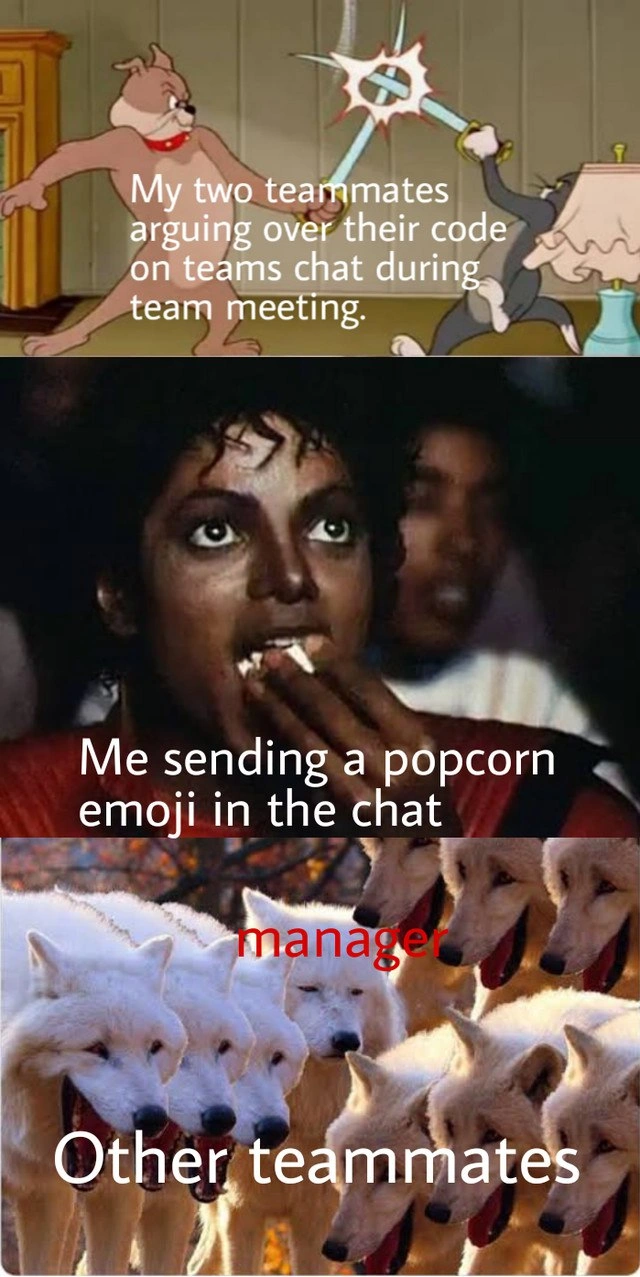
Code review: This is a process where developers check each other’s code before it gets merged into the main project. For example, if Developer A wrote a new feature, they create a pull request (often abbreviated PR) for that code. Developer B might review it and suggest changes or point out issues. The goal is to catch bugs, improve code quality, and share knowledge. However, code reviews can sometimes become contentious if people disagree. One person might feel criticized or strongly believe their solution is best, and another insists on a different approach. This can lead to arguments, especially if the feedback isn’t given tactfully or is taken personally. In the meme, the fight is likely over a code review issue (maybe one dev didn’t like how the other wrote a function or implemented a feature). The text in panel 1, “My two teammates arguing over their code on Teams chat during team meeting,” tells us exactly that scenario: instead of calmly discussing, they are arguing — trading barbs about whose code or approach is right.
Popcorn emoji: The popcorn 🍿 emoji is often used to signify “I’m just here to watch the drama.” Imagine someone sitting in a movie theater munching popcorn during an exciting scene — but here the “movie” is your coworkers’ argument. In many team chats or group texts, dropping a popcorn emoji means: “This is interesting, I’m watching intently (and maybe with a bit of humor).” It’s a playful, slightly cheeky response. In panel 2 of the meme, instead of intervening in the argument, “Me” (the person making the meme or any bystander) is just sending the popcorn emoji in the chat. The image used (Michael Jackson eating popcorn from the Thriller music video, a famous meme image) is basically the visual version of that same idea. By sending 🍿, this person indicates they are only observing, not taking sides, possibly finding the whole thing entertaining. It’s a way to lighten the mood, or sometimes to hint “this argument is getting out of hand.” Many messaging platforms, including Microsoft Teams, allow you to send emojis or even GIFs. So during this heated Teams chat exchange, one user responds with a single popcorn emoji as a humorous commentary.
Other teammates and manager as wolves: In the third panel, we see a pack of white wolves staring intensely. One of those wolves is labeled “manager” (in red text) and the caption says “Other teammates.” This represents everyone else in the meeting — basically the rest of the team, plus the manager — watching the argument. The wolves imagery suggests they’re all focused and maybe a bit on edge, like a pack of animals watching something unfold. It’s a funny way to illustrate the feeling in a video meeting when two people start fighting: all the other participants usually go quiet, perhaps wide-eyed, listening or reading along, not sure what to do. No one wants to jump in immediately; they’re possibly waiting to see if it resolves, or waiting for the manager to step in. The manager being one of the wolves shows that even the boss is just watching intently at this point. In real life, a good manager might intervene to calm things down, but sometimes even managers pause because they’re surprised or gathering their thoughts. The meme exaggerates this by having everyone just stare like a captivated audience.
Putting it together in a narrative: We’re in a remote team meeting (everyone is on their computers, likely on a group video call using Microsoft Teams). Two developers — let’s call them Alice and Bob — start bickering in the meeting’s chat window about a piece of code. Maybe Alice reviewed Bob’s code and commented that something was done incorrectly. Bob defends his code, Alice insists on a change, and back-and-forth it goes, increasing in intensity. All of this is happening in writing for the whole team to read. Meanwhile, the rest of the team isn’t saying anything; they’ve essentially frozen, watching the text argument scroll by. One of those silent watchers is me (the person describing the meme). I decide to respond not with words, but with a single 🍿 emoji, basically joking that I’m just here watching this “show.” A couple of other teammates might be chuckling privately or messaging each other on the side, “Wow, this escalated quickly.” The manager is also in the meeting, likely with eyebrows raised, carefully observing how her direct reports are handling this conflict. The team, manager included, is depicted as a pack of wolves to humorously emphasize how they’re all just looking at what’s happening, almost like how wolves fixate on a target. No one else has stepped in yet; it’s that awkward moment of silence from everyone except the two fighting.
This scenario is very relatable in developer culture and indeed in any remote work environment. Many of us have sat in a meeting where two people suddenly started arguing — be it over code, design, or some decision — and the rest of us didn’t know what to do. It’s even more common with remote meetings because side conversations that might have been whispered in person (like “Should we intervene?” or “This is awkward!”) now happen via chat or not at all. So people tend to either pretend nothing is happening or throw in a light-hearted emoji hoping to diffuse the tension. The popcorn emoji in particular is a bit mischievous; it’s like saying “I acknowledge this conflict and find it a bit entertaining,” which can sometimes remind people to not take themselves too seriously. However, it can also be seen as unprofessional if overused — it really depends on team culture. In a lighthearted team, everyone might laugh when they see the 🍿 emoji and realize “Okay, maybe we’re being a bit ridiculous.” In a more tense environment, it could annoy the fighters more. But in the context of this meme, it’s clearly meant as a joke that most developers would chuckle at, because they’ve been that person with popcorn, at least metaphorically.
Key terms explained for clarity:
Teams chat argument: A disagreement happening via text messages in Microsoft Teams (instead of out loud). This can happen if, say, one person is presenting and two others start discussing (or arguing about) something in the chat box. In this meme, it’s fully an argument conducted in writing, probably because it started as a typed code review comment or because the folks arguing feel more comfortable hashing it out in text than speaking over each other on the call.
Popcorn emoji reaction: Using 🍿 to react to a situation. In many chat apps, you can either post the emoji as a message or even react to someone else’s message with an emoji. It’s an informal way to show “I’m observing, and this is interesting”. Think of it as the equivalent of someone smirking and leaning back if two colleagues started debating heatedly in a meeting room. The internet made this a well-known meme: people often post GIFs or emoji of eating popcorn in forums or comment threads when a debate or “drama” unfolds, signaling they’re just watching for the entertainment value.
Remote meeting dynamics: In a remote meeting (everyone is not physically together, but connecting from home or different offices), communication cues are different. People might be talking on video/audio, but there’s also a chat channel. Some might have cameras off. It’s easier for misunderstandings to happen because you can’t read body language or tone as well. Our meme scenario is a textbook CommunicationBreakdown in a remote context: text flew back and forth without the calming influence of face-to-face discussion, and it probably spiraled more than it would in person. The rest of the team feels like an audience because in a remote call, you can’t quickly lean over and say “Hey, should we step in?” — you just watch the chat or the video grid, unsure how to react.
Team/Manager watching: The image of the wolves is a playful representation. Imagine all your coworkers and your boss just silently watching your chat messages. It feels daunting! But also, from the other side, if you’re one of those watchers, you feel like a spectator. The meme emphasizes how the whole team is collectively witnessing this event. Everyone being wolves suggests a bit of a primal or instinctual vibe — as if everyone’s inner thought is “Uh oh, a fight… watch closely.” No one wants to become the prey (i.e., the next target of criticism), so they stay back. The manager as a wolf indicates the boss is not above being an observer at first, though we’d hope they resolve it if it goes too far.
In simpler terms, level 2 is helping you visualize exactly what’s going on and why it’s amusing:
- Two devs are fighting over code in a public chat,
- One person is jokingly enjoying the spectacle (popcorn emoji),
- Everyone else including the boss is quietly watching like it's a tense scene in a nature documentary.
The humor comes from recognition: if you’re new to a dev team, you might not have seen this yet, but stick around long enough and you probably will. It’s funny because it’s true — arguments over code can get that heated, and when you’re not in the hot seat, it really can feel like watching a TV drama (with a bit of secondhand embarrassment thrown in). This meme captures that awkward-funny experience in a way that developers, especially those working remotely, find very relatable.
Level 3: Refactor Rumble
At the highest level, this meme highlights a code review showdown playing out over a remote meeting — practically a digital duel. In the first panel, two cartoon characters (Spike the bulldog and Tom the cat from Tom & Jerry) are literally sword-fighting. This perfectly symbolizes my two teammates arguing over their code on Microsoft Teams chat during a team meeting. In software teams, especially during code reviews, it’s not uncommon for a simple comment on a pull request to escalate into a full-blown sparring match. Here, that sparring spills into the open during a meeting, turning a routine sync into a spectator sport. The situation is hilariously relatable: what was supposed to be a calm discussion of project updates has transformed into a CommunicationBreakdown over coding style or architecture choices, all unfolding in real-time for everyone to witness. It’s developer drama at its finest, a mix of DeveloperHumor and uncomfortable reality. The meme nails that absurd contrast: professional meeting on the surface, Teams chat argument in the backchannel, and everyone else caught in the middle with front-row seats.
Why do these arguments happen? Often it’s the clash of strong opinions on how something should be coded or fixed. One developer might have commented on a pull request, “This function is too slow,” and the original author fires back defensively. Soon it’s a rapid exchange of messages: debate about algorithms, naming conventions, or whose approach is “correct”. In a healthy CodeReviews culture, peers critique code constructively to maintain quality. But throw in a bit of ego, tight deadlines, and text-based communication (where tone is easily misread), and you’ve got the recipe for a remote_meeting_drama. Because text chat lacks the nuance of voice, a simple suggestion can come off as an attack. Before you know it, colleagues are typing furiously, quoting style guides and past incidents: “We always initialize variables at the top!” — “That’s outdated, our new standard from last quarter allows inline initialization.” — “Well, your code still doesn’t handle nulls!” It’s a virtual_team_conflict that the whole team can see, akin to an open arena battle. In the Tom & Jerry panel, the sword points clashing represent those sharp code critiques crossing each other. It’s a TeamDynamics failure in action: instead of collaborating, two devs are duking it out to prove who’s right. The humor (and horror) comes from the fact that every developer with some experience has seen a trivial issue turn into a sword fight like this.
Just how trivial or absurd can these code review battles get? In practice, very. Some infamous CodeReviewPainPoints that spark debates or “holy wars” among developers include:
- Tabs vs. Spaces – the classic indentation battle that can ignite surprisingly passionate arguments (yes, people still duel over how to indent code).
- Naming Conventions – e.g., whether a variable should be
customerIdorcust_idorcustId. You’d think we’re choosing baby names with the intensity these debates can reach. - Code Style & Lint Rules – brace placement, line breaks,
ifstatement formatting. One teammate’s “clean code” is another’s “annoying nitpick”, and they’ll defend their preference like a knight with a sword. - Architecture Decisions – like whether to put logic in Module A or Module B. It quickly stops being about the code and becomes territorial: “Your design is cluttering my module!” – “No, your module should handle this!”.
- Efficiency vs. Readability – one dev wants a clear, readable solution; the other accuses it of being too slow and pushes a complex, micro-optimized chunk of code. Each thinks the other is missing the point, and the volume of their chat arguments rises.
These are the kind of issues that turn a simple code review comment thread into a heated debate. The meme doesn’t specify the exact CodeReviewPainPoints at play, but any experienced dev can fill in the blanks with their own war stories. It’s funny because it’s true: we’ve all seen colleagues essentially re-enact a Tom & Jerry fight over something like a 4-space indent. The text “arguing over their code on Teams chat during team meeting” implies this isn’t even an official code review meeting — it’s just a general team meeting that got derailed. That adds another layer of irony: instead of focusing on the planned agenda, the team is now watching two people thrash it out over code details. From a CorporateCulture perspective, it’s a perfect storm of remote work dynamics: the meeting host probably helplessly watches the agenda fly out the window as the chat sidebar explodes.
The second panel shifts perspective to me, the onlooker, who has mentally switched to spectator_mode. It shows a close-up of someone (famously Michael Jackson in a movie theater from a well-known meme) calmly munching on popcorn. The caption: “Me sending a popcorn emoji in the chat.” In developer and internet culture, the popcorn emoji (🍿) is the universal symbol for “I’m just here to watch the drama unfold.” By sending a 🍿 in the Teams chat, the observer signals: “This is getting good, I’m just going to sit back and enjoy the show.” It’s tongue-in-cheek because obviously workplace conflicts are not supposed to be entertainment… but let’s be real, when you’re not directly involved, it’s hard to look away. We could call it a guilty pleasure of DeveloperCulture – watching two opinionated devs bicker over code is both cringe-worthy and captivating. The popcorn reaction is a bit sarcastic: it highlights that the argument has become a spectacle. In a physical meeting, you might exchange knowing glances with the person next to you or quietly whisper “here we go again.” In a virtual meeting on Microsoft Teams, the equivalent is sending a quick 🍿 or a GIF of someone eating popcorn, visible to all in the chat. It’s a light way to say “this is entertaining, carry on,” possibly hoping to inject some humor and let the combatants know they might be going overboard.
Now, consider the setting: this is happening on Microsoft Teams, a tool meant for professional collaboration and meetings (think of it as the corporate cousin of Slack). Teams has a chat feature alongside video calls, so people often type comments or reactions during a meeting. Here that chat has devolved into a battleground. The fact it’s Teams (with that connotation of buttoned-up corporate environment) makes it funnier: it’s as if a serious conference room turned into a playground spat while everyone watches quietly. There’s also an implicit nod to remote_work life circa 2020: with so many developers working from home and meeting virtually, these kinds of side-chat dramas became more common. In an in-person meeting, two people might whisper arguments or step out to argue in the hallway. But in a remote meeting, if you start arguing in the group chat, it’s immediately visible to all, permanently logged, and hard to ignore. It’s right there on screen for the whole team, including your boss, to scroll through. This transparency is both horrifying and darkly comic. The meme capitalizes on that: everyone can see the fireworks, so the rest of the team might as well grab popcorn.
Speaking of everyone else — enter the pack of white wolves in the third panel. Here the meme labels the center wolf (in red text) as “manager” and the caption calls the group “Other teammates.” The image of wolves staring intently is a brilliant metaphor for the silent, wide-eyed audience in that Teams meeting. Wolves often lock onto something with intense focus, and a pack can symbolize a group mentality. In this scenario, the whole pack (the team) has their eyes on the dueling developers, much like wolves tracking prey or intruders. The manager, depicted as one of the wolves, is at the center, meaning they’re definitely watching closely. This is a humorous way to show that even the boss is part of the silent audience, likely thinking, “What on earth is happening in my team right now?” The manager’s presence adds tension: you just know that while the teammates are busy crossing swords, their boss is witnessing every cringey second. Will the manager intervene? Or will they just observe and address it later? In real life, managers vary — some might jump in with a diplomatic, “Alright folks, let's take this offline,” whereas others might let it play out to gather data on who’s being unreasonable. The meme suggests that at this moment, the manager is simply transfixed along with everyone else. Nobody wants to stick their hand in the blender, so to speak. It’s a collective spectator_mode: the rest of the devs plus the boss are united like a wolf pack, bonded by the shared astonishment (and perhaps slight amusement) at the spectacle unfolding.
From a team dynamics standpoint, this meme is poking fun at how conflict is handled (or not handled) in some tech teams. Instead of constructive discussion, it’s open conflict; instead of mediation, it’s silent observation. The CorporateCulture satire here is strong: many workplaces preach teamwork and respectful communication, yet we’ve all seen scenarios where things devolve exactly like this, even in a public forum like a meeting. It’s the kind of awkward situation people later vent about in private chats or at happy hour (“Did you see Jeff and Alice go at it today? That was wild!”). It also reflects how remote tools have changed the etiquette of meetings. On a video call, the main audio channel might stay polite or on-topic, while the side chat takes on a life of its own. Here presumably either the audio conversation has stalled out as everyone watches the text fight, or maybe the argument is entirely in chat to not completely disrupt the meeting’s audio — which is even more passive-aggressive! Either way, it’s a Communication train wreck you can’t look away from.
Technically inclined readers might also appreciate the irony that all this drama often gets preserved in chat logs or pull request comments. That means the “transcripts” of their sword fight go down in company history. Not only are the other teammates watching now, but anyone could read it later. In some cases, folks might screenshot the funny bits (like the popcorn emoji response) and share it in a private channel for laughs afterward. It’s developer folklore in the making. In fact, many of us have learned unwritten rules from witnessing such battles, like “Don’t argue in public chat, it never ends well,” or “If a review gets heated, take a breath or move to a call.” But of course, in the heat of the moment, that wisdom often goes out the window. The meme captures that lapse in a comical way.
In summary, this multi-panel meme uses a Teams chat argument as the stage for a comedic yet painfully familiar scene. Two devs are locked in a code review holy war (cartoon sword duel), I’m sending the 🍿 emoji essentially saying “I acknowledge this madness, but I’m not stopping it,” and the rest of the team (manager included) are staring like a wolf pack watching prey, not intervening yet. It’s funny because it’s exaggerated but true to life — remote work has turned us into observers of on-screen drama, complete with emoji reactions. The meme invites us to laugh at the dysfunction: it’s a lighthearted take on those uncomfortable moments of TeamDynamics when collaboration turns into combat. If you’ve been there, you’re laughing (or possibly groaning) in recognition. And if you haven’t? Well, consider this a peek into developer team life: sometimes, MeetingHumor writes itself when developers have strong opinions and a chat window at their disposal. So grab your virtual popcorn; this is the kind of everyday tech saga that’s equal parts amusing and instructive about how not to communicate.
Description
The meme is a three-panel vertical collage. Panel 1 is a Tom-and-Jerry cartoon frame where Spike the bulldog and Tom are sword-fighting; white caption text reads, “My two teammates arguing over their code on teams chat during team meeting.” Panel 2 shows a cinematic close-up of someone calmly watching (faces blurred for privacy); the white overlay says, “Me sending a popcorn emoji in the chat.” Panel 3 is a photo of a pack of white wolves staring intently; the wolf in the center is labeled in red text “manager” while large white text at the bottom says “Other teammates.” Together, it humorously depicts real-time Microsoft Teams chatter devolving into a code-style argument while the rest of the meeting silently spectates, a familiar scenario for remote dev teams navigating code reviews, communication breakdowns, and meeting etiquette
Comments
6Comment deleted
Teams arguments are my favorite consensus algorithm: two senior nodes compete, one eventually times out, and I just stream the logs with a 🍿 until the new leader force-pushes to main
The best code reviews happen when two senior engineers discover they've been solving the same problem in opposite ways for six months, and the rest of us get to watch the architectural philosophy debate unfold in real-time while pretending our microservices don't have the same issues
The real architectural decision here is whether to use the 'eyes' emoji or 'popcorn' emoji when your teammates are debating whether to use tabs or spaces during the sprint retrospective. Meanwhile, the manager is frantically searching Confluence for the 'Conflict Resolution' runbook that definitely exists somewhere in that 847-page engineering handbook no one has read since onboarding
Two devs arguing in Teams is Raft without a leader: endless elections, no log replication, manager watching timeouts, and the rest of us sending popcorn emoji heartbeats
Watching them argue in Teams is distributed consensus without quorum; I’m supplying liveness with popcorn while safety times out
Teams chat code wars: where bikeshedding escalates faster than unchecked tech debt, and popcorn's the only mergeable suggestion