Skip to content
DevMeme
2021 of 7435
Twitter poll debates cloning humans, dev replies with reference vs value punchline
CS Fundamentals Post #2251, on Nov 6, 2020 in TG

Twitter poll debates cloning humans, dev replies with reference vs value punchline

Why is this CS Fundamentals meme funny?

Level 1: One Toy or Two?

Imagine you and your friend both want the same toy. There are two ways you could have it. One way is to share one toy between the two of you – you take turns with the exact same item. If your friend draws on it or breaks it, you’ll see that change because, well, it’s literally the one single toy you’re both using. In a sense, you and your friend have the “same” toy. The other way is for you to get your own identical toy. It looks and feels just like your friend’s toy, but it’s actually a completely separate one. Now, if your friend scribbles on their toy, your toy stays clean, because you each have your own. In the meme, someone asks if a cloned person would be the same person. The funny answer a programmer gives is basically: “It depends on how you cloned them.” If we use the toy example, are we sharing one toy (one person in two bodies) or making two separate toys (two independent people that just look the same)? The idea of having two bodies but only one shared identity – versus two totally separate twins – is a silly way to think about it, and that’s why it’s funny. It’s like treating a really big life question as if it were a simple copy-paste problem! Even if you’re not a coder, the humor comes from how nerdy the answer is: instead of yes or no, the programmer says “it depends” and starts talking about types of copying. It’s comparing cloning a human to the way you copy things in a computer, which is a playful and unexpected way to answer a serious question. In simple terms, the joke is funny because it’s saying how you make the copy (share the original or make a new one) would decide if the clone is actually the same person – just like sharing one toy vs having two toys.

Level 2: Deep vs Shallow Copy

Let’s break down the technical joke for newer developers. In programming, cloning by reference means making a new variable that points to the same object as the original. It’s like having two names for one thing. No new object is created; you’re just referencing the existing object. So if one “clone” changes something, the other sees that change too, because under the hood it is the same object. By contrast, cloning by value means you actually create a new object with the same content as the original – a true copy. Now there are two separate instances in memory. Change one, and the other stays the same, because they’re independent. These ideas are often called shallow copy (reference) vs deep copy (value) in many contexts. Most programming languages have to deal with this concept, and it’s a common source of confusion for beginners. For example, in Python and JavaScript, objects and arrays are typically assigned and passed around by reference by default. If you do list_b = list_a in Python, you’re not making a new list – you’re just giving a second name to the same list. If you append to list_b, you’ll find list_a changed too! To actually copy the list’s contents into a new list, you’d do something like list_b = list_a.copy() (or use slicing like list_a[:]), which clones it by value. In JavaScript, doing let clone = originalObject will just copy the reference, not the entire object. To clone by value, you might use Object.assign({}, originalObject) or the spread { ...originalObject } for a shallow copy, or a library/structured cloning for deep copies. In Java, all non-primitive objects are references by default, so Person clone = original; means clone and original refer to the same Person object. To clone by value you’d need to instantiate a new Person and copy fields (or implement clone() properly). The meme’s joke answer, “Depends if you clone by reference or by value,” is directly referencing this concept. It implies: if you just copy the reference (a shallow copy), then the clone isn’t a separate person at all – it’s effectively the same person (the same instance) just accessed via a different reference. But if you copy by value (deep copy all the data into a new allocation), then you’ve made a truly separate person. This mirrors how in code we think about object identity. Two variables can either point at one object or each point at their own object that happens to have equal content. A junior dev might recall the first time they encountered this when modifying one object mysteriously affected another. It’s an “aha” moment: learning that doing a naive copy can lead to two names tied to one thing. Consider a quick demonstration in Python to illustrate:

original_person = {"name": "Alice"}
ref_clone = original_person         # clone by reference (alias to the same dict)
val_clone = original_person.copy()  # clone by value (new dict with same content)

# Modify the "reference clone"
ref_clone["name"] = "Eve"

print(original_person["name"])  # Output: "Eve" – ref_clone and original_person are the SAME object
print(val_clone["name"])        # Output: "Alice" – val_clone is a different object, still has original content

In this code, ref_clone didn’t create any new person; it’s just another reference to the original_person dictionary. Changing ref_clone["name"] to "Eve" changed the original’s name to Eve as well, because there was really only one dictionary in memory. That’s clone-by-reference: two variables, one object. Meanwhile, val_clone is a separate dictionary copied by value, so it kept the old name "Alice" even after we modified the original. This is clone-by-value: two separate objects. Now, bringing it back to the meme’s question – “If you clone a person, are they the same person?” – the developer humorously treats people like objects in a program. If the cloning was “by reference,” it suggests the clone would literally be the same entity (same consciousness or identity) in two places. If it’s “by value,” the clone would be a separate entity, just identical at the moment of cloning. It’s a clever twist because it applies a programming principle to a real-world philosophical debate. For a new developer, the key takeaway is understanding why devs found this funny: the tweet is essentially saying, “It depends on whether the clone shares the original’s internal identity (memory/reference) or not.” This concept of reference vs. value shows up all over in coding. It’s why modifying a copied list might still modify the original if you only copied the reference. It’s why some languages have a distinction between == (identity comparison) and an equals method (value comparison). It’s why deep cloning objects (making truly independent copies) can sometimes be tricky – you have to copy every nested object too. Once you’ve learned this, you start seeing it everywhere, and that’s why the joke lands so well among programmers. It’s referencing a foundational concept in a lighthearted context. The dev communities on Twitter love these in-jokes because they double as a nod to shared learning experiences. Now you know: clone by reference vs. clone by value is a core concept, and even a philosophical question about human clones can’t escape a programmer’s penchant for detail!

Level 3: Philosophy Meets Pointers

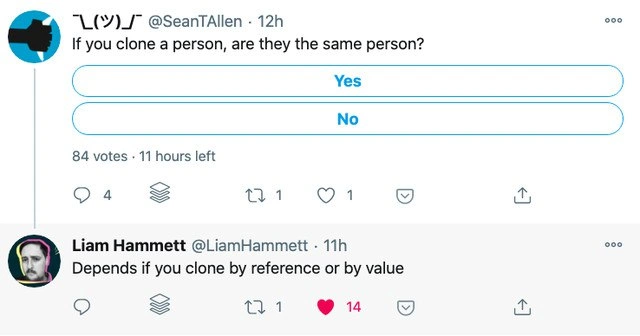
At first glance, this meme looks like a deep philosophical poll on Twitter: “If you clone a person, are they the same person?” – a classic identity conundrum. But one reply flips it into pure developer humor. The responder quips, “Depends if you clone by reference or by value.” This witty answer instantly bridges CS fundamentals with philosophy. Why is it so funny to seasoned devs? Because it sneaks a geeky “it depends” answer into a yes/no poll, highlighting a concept every programmer knows: the difference between copying something by reference versus by value. In coding, object identity is everything. A clone by reference isn’t a real copy at all – it’s just another pointer to the same underlying object in memory. That means two variables refer to one instance; any change through one variable shows up in the other. In human terms, that’s like two bodies sharing one single consciousness or soul (spooky!). On the other hand, a clone by value would create a brand new independent instance – a deep copy of all the data – resulting in two separate objects that just happen to look identical. That’s more like identical twins: two individuals with the same starting DNA but separate identities and minds. The humor here lies in a dev taking a serious question about personal identity and answering with a deadpan programmer’s perspective. It’s a joke that thrives in dev communities on Twitter: a philosophical query turned into a lesson on language quirks. Seasoned developers chuckle because we’ve all wrestled with bugs caused by misunderstanding references vs. values. For instance, maybe you thought you made a new copy of a configuration object, but ended up cloning aliasing the original – oops! Any change you made to the “clone” also altered the original, leading to those head-scratching moments in debugging. This tweet nods to that shared experience: the classic gotcha where two things pretended to be two, but were really one. It’s the kind of nerdy joke that gets an immediate knowing smirk from experienced programmers, because beneath the humor is a core truth: in software (and apparently in cloning people), everything comes down to implementation details. Clone-by-reference vs. clone-by-value is a fundamental concept taught early in CS, and here it’s cleverly applied to a sci-fi scenario. The poll expected a simple yes/no, but the dev gave the ultimate developer answer: “it depends” – specifically, it depends on copy semantics! This mixture of coding insight and everyday question is exactly why #DeveloperHumor on Twitter is so beloved. We love to flex our knowledge of obscure details like object copying in a fun way. In short, the meme is poking fun at how a programmer’s brain works: even a hypothetical question about human clones immediately triggers thoughts of pointers, memory, and whether the clone is a shallow copy or a deep copy of the original. It’s equal parts nerdy and brilliant, and it perfectly satirizes how devs can’t help but see the world through a lens of code. After all, ask a dev a profound question and you just might get an answer about garbage collection or pointer semantics!

Description

Screenshot of a Twitter conversation. At the top, a tweet from user "¯\_(ツ)_/¯ @SeanTAllen • 12h" asks, “If you clone a person, are they the same person?” Below the question are two thin, blue-outlined poll buttons labeled “Yes” and “No.” A status line reads “84 votes • 11 hours left.” Twitter action icons show 4 replies, 1 retweet, 1 like, and a share icon. Beneath, a reply from “Liam Hammett @LiamHammett • 11h” states, “Depends if you clone by reference or by value,” with icons showing 1 reply, 2 retweets, a red heart with 14 likes, and a share icon. Visually it mimics Twitter’s white UI with avatars on the left and grey metadata text. The technical joke compares human cloning to programming copy semantics: in many languages a shallow copy (reference) shares identity while a deep copy (value) creates a distinct object, highlighting CS fundamentals about object identity, memory, and equality that developers instantly recognize

Comments

10
Anonymous ★ Top Pick Clone a human by reference and you’ve got aliasing; clone by value and 18 years later you’re diff-ing two eventually-consistent life threads - good luck debugging free will with distributed tracing
  1. Anonymous ★ Top Pick

    Clone a human by reference and you’ve got aliasing; clone by value and 18 years later you’re diff-ing two eventually-consistent life threads - good luck debugging free will with distributed tracing

  2. Anonymous

    After 20 years in the industry, I've learned that the real question isn't whether the clone is the same person, but whether they'll inherit the original's technical debt and unresolved JIRA tickets. At least with reference cloning, you only have one set of legacy code nightmares to maintain

  3. Anonymous

    The real question is whether the clone shares the same memory address or if we've allocated a new instance with copied state. And if it's by reference, do we need to worry about one clone's existential crisis causing a segfault in the other? This is why senior engineers always clarify copy semantics in code reviews - because 'clone' without context is just asking for a philosophical merge conflict

  4. Anonymous

    Clone by reference: one headcount, two standups; clone by value: two headcounts, twice the cache-invalidation surface

  5. Anonymous

    Clone by reference: two engineers sharing one pager; clone by value: two pagers and twice the incident blame

  6. Anonymous

    Clone by reference: your twin inherits all mutable state bugs. By value: independent, but good luck with the serialization overhead

  7. @AmindaEU 5y

    Is reference like DNA and value like memories?

    1. @cfyzium 5y

      I'm fairly sure it is the opposite. Copying the physical will only make another separate instance, with the same state at best. Two instances will go their separate ways right after. To keep it the same person you will have to reference into memory, personality and whatever else — so that both previous and new instances would remain and continue to be the same object in the future. I think the question is not exactly correct in the first place. Cloning implies a copy, and since there are no references to humans IRL...

      1. Deleted Account 5y

        👍🏻.

  8. @gromilQaaaa 5y

    Memory and personality are still stored in body. So coping a body also copies the rest.

Use J and K for navigation