Seasoned developer concludes every programming question has one answer: it depends
Why is this DesignPatterns Architecture meme funny?
Level 1: The Right Tool for the Job
Imagine you ask a master carpenter, “What’s the best tool: a hammer or a screwdriver?” The carpenter will probably smile and say, “Well, it depends on what you’re doing!” 👷♂️ If you’re trying to put a nail into wood, a hammer is the best. If you need to tighten a screw, a screwdriver is the right choice. There isn’t one always-best tool – you choose the tool based on the task.
This meme is saying the same thing, but for programming. A kid might ask, “What’s the best crayon color to use?” and the answer would be, “It depends on the picture you’re drawing.” 🖍️ In coding, when someone asks “What’s the best way to do this?”, an experienced programmer answers “It depends” because they need more information – just like choosing the right tool or color depends on what you’re trying to build or draw.
Why is that funny? Because it’s true in a way that surprises people. Beginners often think there’s a single correct answer to every question, like a magic solution. But experts know you have to look at the situation first. It’s a bit like asking “Should I wear shorts or a coat?” – the answer is “It depends… on the weather!” ☀️🧥. Hearing an expert say “it depends” to every question is a playful exaggeration. It makes us laugh because we realize that in programming (and life), you always have to consider the context. There’s no one answer that works for every problem, and that simple phrase “it depends” is a quick way to say “we need to think about the details.” So the joke is really a teaching: the best answer is the one that fits the situation. Always choose the right tool for the job!
Level 2: No One-Size-Fits-All
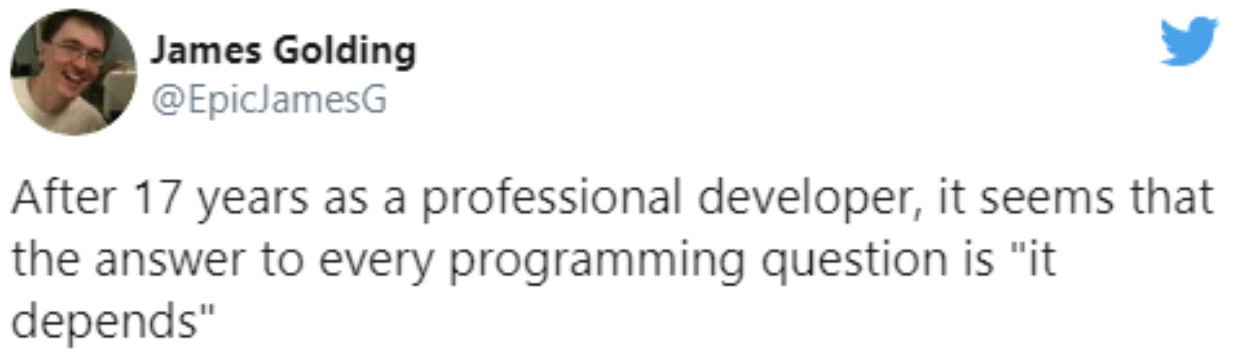
For a newer developer (or someone outside the field), hearing “it depends” as an answer can be confusing. Isn’t there a right answer? Don’t we follow best practices? 😅 This meme, a screenshot of a tweet by a developer of 17 years, highlights a key lesson in DeveloperExperience_DX: context matters for every decision. In programming, a “trade-off” means you give up one benefit to gain another. There’s rarely a solution that is best in all ways, so you have to choose based on what’s more important for your situation. That’s why an experienced engineer will respond to a question with “It depends” – they need more details about the situation to give a good answer.
Think of common programming questions you might ask: “Which programming language should I learn? Which framework should we use? Is this code good?” A senior developer will almost always reply by asking you about your goals or constraints. For example:
- Which language is best? – It depends on what you’re trying to do. Python might be best for quick development and readability, C++ might be necessary for high-performance or system-level work, and JavaScript is king in web development. Each has strengths and weaknesses.
- Should we optimize this code now? – It depends on whether the code is actually causing a problem. There’s a saying, “premature optimization is the root of all evil,” meaning don’t spend time making something faster until you’re sure it’s a bottleneck. If the code isn’t slowing anything down, keep it simple. But if you’re dealing with huge data sets or you’ve identified a performance issue, then optimizing is worth it.
- Is using a design pattern (like a Singleton or Factory) a good idea here? – It depends on the context. DesignPatterns_Architecture are like tried-and-true solutions to common problems in design, but using the wrong pattern or using it at the wrong time can complicate things. A design that’s great for a large, complex application might be overkill for a small script.
When an experienced developer says “it depends,” they’re not trying to dodge the question. They’re actually starting a conversation about requirements and constraints. Key factors like scale (how many users or how much data?), performance (does it need to be super fast or use minimal memory?), maintainability (will lots of other developers need to read and modify this code later?), and team expertise (what technologies is the team comfortable with?) all influence what the “best” answer is. This is what we mean by context-specific trade-offs: the answer changes based on the details of the situation.
In software, we also talk about Developer Experience (DX) – basically how pleasant or efficient it is for developers to build and maintain a system. Choosing one tool over another can hugely affect DX. For instance, using a cutting-edge framework might make development faster for one expert developer (great performance), but if the rest of the team isn’t familiar with it, maintaining that code could become a nightmare (poor maintainability). So... it depends on the team’s familiarity and long-term needs whether that choice is wise.
The tweet is funny to developers because it exaggerates a common scenario: after years of facing countless questions without a single always-right answer, a veteran developer jokingly declares that every programming question’s answer is “it depends.” It’s a bit of DeveloperHumor that rings true. By laughing at this, junior and senior devs alike acknowledge a shared reality: in programming, there’s no one-size-fits-all answer. Everything depends on the use case, the priorities, and the trade-offs you’re willing to make. So if you ask a seasoned engineer a question and they respond with a thoughtful “it depends,” don’t be frustrated – that’s your cue to provide more info, and have a deeper discussion about what’s really needed. That’s how good decisions are made in software design.
Level 3: Context is King
Every senior developer chuckles at this because they’ve lived it: nearly every design decision in software truly does depend on context. This tweet-format meme (a blurred profile and a wise one-liner in Twitter’s UI) hits home for experienced engineers who have spent years answering colleagues’ questions with “Well… it depends.” Why do we find this funny? Because it’s painfully true. Early in your career, you look for the correct answer – the best programming language, the right architecture, the perfect DesignPattern to apply. But veterans know there’s rarely an absolute “right” choice in engineering, only appropriate choices given your constraints. The humor comes from shared experience: ask a senior dev any question – SQL or NoSQL? Tabs or spaces? Microservices or monolith? – and watch them pause, furrow their brow, and reply with a version of “it depends” before launching into a list of counter-questions. For instance:
- Which database is better? It depends: on your data model and access patterns. A relational SQL database offers structured consistency, but a NoSQL store might scale better for certain unstructured data or high throughput needs.
- Should we use microservices? It depends: on the team’s size and the problem domain. Microservices can improve modularity and scalability for huge systems, but for a small app with one team, a simple monolith (single unified codebase) might be easier to manage and deploy.
- Is this code snippet efficient? It depends: on input size and usage. An algorithm that’s fine for 1000 records might fall over at 1 million. You might trade clarity for speed or vice versa depending on requirements.
In each case, the senior’s engineering tradeoffs radar is pinging. They’re thinking of factors like scale (how big or fast must it run?), performance (speed vs. resource usage considerations), maintainability (will this be easy to read and extend later?), team skill (can the team work with this tech or pattern?), and even business aspects (deadlines, budgets, user requirements). There’s a whole mental checklist acquired through hard knocks. SeniorEngineerWisdom often sounds non-committal at first – which can frustrate those looking for a quick fix – but it’s actually a sign of wisdom and decision-making maturity. The seasoned dev isn’t being evasive; they’re acknowledging the complexity that newer folks might not see yet. It’s a little philosophical too: a recognition that in software (and life), there are no absolutes. Even revered DesignPatterns are not magic bullets – a Singleton could be an elegant state manager or an inflexible bottleneck, depending on how it’s used. This contrasts with a junior’s expectation that an expert will immediately know “the correct answer.” The meme humorously elevates “it depends” as if it were the ultimate answer to everything – a bit like the programming world’s version of 42. In Hitchhiker’s Guide to the Galaxy, 42 is the answer to life, the universe, and everything; in programming, ask a guru and you get “it depends.” The joke lands because every developer with enough experience has both given and received this answer countless times. It’s a SharedExperience that unites devs across different languages and eras. In essence, the tweet is shorthand for the universal law of EngineeringTradeoffs: almost every technical question is really a request for guidance through a decision tree of considerations. The only honest opening to that discussion is “it depends” – followed by “tell me more about what you need.” This realistic outlook is the hallmark of a senior mindset: it might sound less confident than an absolute answer, but it’s far more reliable. The meme’s popularity shows that once you’ve been burned by enough “one-size-fits-all” solutions, you can’t help but laugh and agree: the answer to “X or Y?” is practically always “Well… it depends.”
Level 4: No Silver Bullet
In the architecture of software, there's a long-standing realization that no single solution fits every scenario – much like Fred Brooks’ famous “No Silver Bullet” essay warned decades ago. This meme’s humor hides a deep truth: software engineering is governed by trade-offs and context, a notion also echoed in theoretical limits. For example, the CAP theorem in distributed systems proves you can’t achieve all desirable properties at once – a database can’t be simultaneously perfectly Consistent, Available, and Partition-tolerant. You must choose, depending on which guarantee matters more for your application. Similarly, the No Free Lunch Theorem in optimization tells us that no one algorithm is best for every problem; its performance depends entirely on the specifics of the task and data. These formal results mirror the senior developer’s wisdom: every design decision – from choosing an algorithm to picking a cloud architecture – involves balancing priorities where improving one aspect often means compromising another. Over years of experience, engineers internalize that context is king. They’ve seen hyped one-size-fits-all solutions come and go (remember when XML was the answer to everything?), and learned the hard way that “universal best practices” often aren’t universal at all. Instead, everything in computing lives in a landscape of constraints and possibilities defined by your specific situation. The tweet’s punchline that “the answer to every programming question is ‘it depends’” resonates because, at a fundamental level, computing is a game of choices under constraints. There is beauty in this complexity: it’s the reason we have so many programming languages, frameworks, and design patterns – each optimized for certain contexts. Seasoned architects even use fancy terms like “contextual integrity” or “situational awareness” to justify this answer. In academia and practice alike, the wisest answer to tough technical questions often acknowledges these nuances. The meme nails that scholarly reality with a wink, compressing years of hard-earned theoretical insight into two little words that simultaneously frustrate and enlighten: it depends.
Description
Screenshot of a tweet with the typical Twitter layout: small circular profile photo (face intentionally blurred), bold display name in black, a light-gray handle beneath, and a small blue bird logo in the upper-right corner. The tweet text reads exactly: “After 17 years as a professional developer, it seems that the answer to every programming question is 'it depends'”. White background, standard Twitter fonts, no other graphics. Technically, the post captures the architectural truth that nearly all engineering decisions involve context-specific trade-offs; senior developers recognize that factors like scale, performance, maintainability, and team skill make absolute answers rare, hence the perennial “it depends”. This resonates as shared developer humor while underscoring real-world design and decision-making complexity
Comments
12Comment deleted
I’ve open-sourced “It Depends ™” as a microservice - every call returns HTTP 428 Precondition Required and a link to the architecture decision record
The real senior developer progression: Junior - 'Best practices say X!', Mid - 'Actually, Y is better', Senior - 'It depends', Staff - 'It depends, and here's a 47-slide deck explaining the decision matrix I built to evaluate the tradeoffs between 12 different approaches, none of which will survive first contact with production.'
After 17 years, you realize that 'it depends' isn't evasiveness - it's the most honest answer in software engineering. Whether it's microservices vs monolith, SQL vs NoSQL, or tabs vs spaces, the real answer always involves asking: What's your scale? What's your team size? What's your budget? What's your timeline? What's your risk tolerance? The junior says 'use Kubernetes.' The senior says 'it depends - are you Google, or are you three people in a garage with a $50/month budget?' Experience teaches you that context is the most important variable in any technical decision, and anyone who gives you an absolute answer probably hasn't been bitten by enough production incidents yet
“It depends” isn’t hedging; it’s the DI container for constraints you forgot to pass - latency budget, consistency model, blast radius, compliance, and who’s on call
“It depends” is just switch(context) over SLOs, data shape, consistency model, and budget; default: write an ADR
'It depends' is the three words that save you from YAGNI violations and premature optimization regrets
Not just programming. Any science or engineering discipline actually Comment deleted
"it depends on libc" Comment deleted
u r funny Comment deleted
*immediately rewrites everything in assembly* Comment deleted
with a magnet on a HDD Comment deleted
nah man. That's ancient technology. Now we just send the right electric signals into the CPU socket with a 9Volt battery and some wire. Comment deleted