Ad Targeting: Is it Black Magic or Just Big Data?
Why is this DataPrivacy meme funny?
Level 1: Someone Is Listening
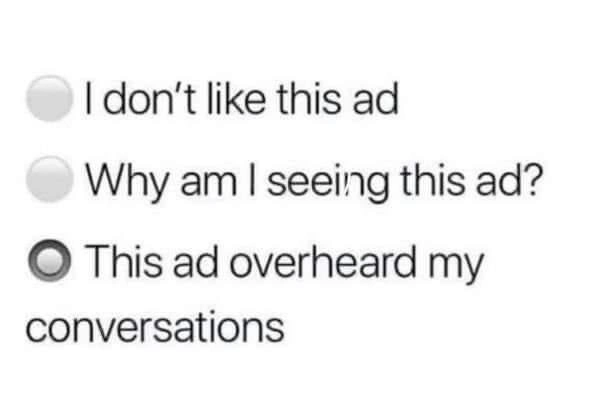
Imagine you’re talking with your friend about how you really want a new toy, and then, all of a sudden, you see an advertisement on TV for that exact toy. 😮 It would feel super weird, like the TV or your phone was listening to you secretly, right? This meme is making a joke about that feeling. It’s saying that when you click on the little “Why am I seeing this ad?” button (the thing you press to ask “Hey, why did I get this ad?”), one of the answers it gives is, “Because I overheard your conversations.” In real life, no phone or app will actually say that to you – they usually give more boring reasons – but we sometimes feel like it’s true. The joke is funny because it’s like your device finally admits, “Yep, I was eavesdropping on you!” It’s a bit like if you caught your little brother hiding around the corner listening to your secrets. You’d be like, “Were you spying on me?!” and he sheepishly says, “Okay, yes.” Here the ad is that sneaky little brother.
The reason this is funny-scary is that people often experience something odd: we talk about something and then an ad for it pops up later. It makes us wonder, “Is my phone alive and listening to everything I say?” That idea is both amusing and creepy. This meme turns that feeling into a simple picture with options, as if you could choose the reason and the truth is the most unbelievable option. Even if you don’t know the tech details, you get the basic human story: you said something in private, and then you saw it in an ad – spooky! So the meme makes us laugh by pretending the phone just comes out and says, “Yep, I did that, I heard you.” It’s like a playful wink, telling us we’re not crazy for thinking our gadgets act a bit like nosy neighbors sometimes.
Level 2: Creepy Personalization
Let’s break down what’s going on in simpler terms. This meme is referencing targeted ads – ads that are specifically tailored to you based on your data – and a common worry that our devices might be eavesdropping (listening in secretly) to target those ads. The image looks like the little menu you get on sites like Facebook or Instagram when you tap “Why am I seeing this ad?” Usually, that menu gives options like “Hide ad,” “I don’t like this,” or an explanation like “You’re seeing this because you visited [Website]” or “Because you are interested in [Topic].” In the meme, the first two options “I don’t like this ad” and “Why am I seeing this ad?” are normal things a user might click. But the third option – “This ad overheard my conversations” – is not something you’d ever actually see. The meme imagines a scenario where the website finally admits the real (and creepy) reason: the ad was chosen based on something you said out loud. It’s poking fun at the feeling we get when an ad is so spot-on to something we just talked about that it’s almost like our phone’s microphone was spying on us. Creepy, right?
To a junior developer or someone new to the tech world, here are the key concepts involved, in plain English:
AdTech (Advertising Technology): This refers to the software and systems that deliver online ads. It includes everything from simple banner ads to complex user profiling systems. These technologies track what users do online to show them ads they’re more likely to click. For example, if you search for new shoes, AdTech might note that and later show you shoe ads on a different site.
Targeted Ads: Ads that are targeted use information about you to decide what to show. Instead of everyone seeing the same ad, the system picks an ad it thinks you specifically will respond to. How do they decide? They look at your behavioral profile – basically data about what you like, where you go, what you search, who your friends are, etc. If it sounds like they know a lot about you, it’s because they do gather a lot of data! This data might come from cookies in your browser, your social media actions (like pages you follow), or even your location.
Data Privacy / Privacy Concerns: This is all about how personal information is collected and used. When we talk about data privacy, we mean making sure users have control over their information and that it isn’t misused. Privacy concerns arise when people feel their information (like what they do or say) is being collected without their full understanding or consent. In this meme, the privacy concern is “Are ads literally listening to my private conversations?!”. That falls under a big worry in our society often termed online privacy or surveillance capitalism – the idea that companies make money by surveilling (watching/listening to) users’ behaviors.
Microphone Privacy: Specifically, this is about apps or devices accessing your microphone. Modern smartphones and apps usually ask permission to use the microphone. For example, a messaging app might need it to send voice notes, or a voice assistant app needs it to hear commands. The fear is that once granted, an app might abuse this access and listen more than it should. Machine listening fear is a way to describe the worry that some algorithm is always listening through your phone’s mic, even when you haven’t activated it, to gather info on you.
Contextual Advertising vs Behavioral Advertising: Contextual advertising bases ads on the context of what you’re currently looking at. For instance, reading an article about guitars might show you ads for guitars – it’s about the content you have open. Behavioral advertising bases ads on your past behavior – what you have done historically (websites visited, items clicked, etc.). The meme hints at an extreme form of behavioral advertising: using something you said in real life as part of your behavior profile. That’s way beyond normal context – it’s personal behavior captured via microphone.
Now, why do people even suspect their mic is being used? It comes from real experiences: Perhaps you were chatting with a friend about, say, going camping, and a few hours later you see an ad for tents on Instagram. You don’t remember searching or typing anything about camping online, so it feels like the phone must have overheard you. It’s a spooky coincidence that many folks have noticed. Tech companies like Facebook and Google have officially denied using microphone audio to target ads. They often explain these incidents by saying, “It’s due to highly accurate targeting based on other data; we just know your interests really well.” Often, we do so much on our devices that it’s easy to forget one tiny action that could lead to an ad (like maybe you liked a camping equipment photo last week, or your friend you were talking to searched for tents, and you two have some online connection). The algorithms are very good at connecting the dots. But the fact that it happens right after a conversation is why the urban legend of phone eavesdropping persists. The meme takes this urban legend and jokes, “Hey, what if the social media app just straight-up told you, yes, we did that?” That’s the humor: it’s absurd, because no company would openly say that, but it addresses the elephant in the room.
In the image, the design with radio buttons (the little circles) and one filled in indicates a selection, so it looks like the user has selected “This ad overheard my conversations.” It’s a witty way to say: Out of all possible reasons, this is the one that fits. The first two options are normal and expected in an ad feedback form; the third is the punchline. It effectively captures creepy personalization in one line. It resonates with anyone who has felt that uncanny “how did they know?!” moment with an online ad.
For a junior developer, it’s a good reminder of why user privacy is such a hot topic. Technologies like machine learning are used heavily in ads now – for example, to recognize patterns about what users might want next. But when those patterns feel too intimate, users get uncomfortable. As a developer, if you end up working on any feature that uses personal data, you’ll need to think about how to do it ethically and transparently. Today, regulations like GDPR (in Europe) and various privacy laws elsewhere are in place to ensure users aren’t left in the dark. That’s why modern apps often explicitly ask “This app wants to access your microphone, allow or deny?” and why you might see indicators (like a little orange or green dot on your phone’s status bar) when the mic or camera is active. Those safeguards exist because the idea of an app quietly listening without permission is scary and has been abused in the past.
In sum, this meme is a lighthearted way to vent about privacy concerns with targeted ads. It uses a scenario that’s very easy to understand (ads listening to your talks) to highlight a real anxiety. It’s both a joke and a small caution: as tech gets smarter, it needs to respect boundaries. And if it doesn’t, well, we might end up seeing insane-but-funny disclaimers like this in the future!
Level 3: The Walls Have Ears
At the highest technical level, this meme pokes fun at the unnerving sophistication of AdTech and the realities of modern Surveillance Capitalism. The interface shown mimics a real social media ad preference dialog – those little menus behind “Why am I seeing this ad?” – but with a darkly honest twist. The selected option, “This ad overheard my conversations,” satirically suggests that the ad-targeting algorithms are literally eavesdropping through your device’s microphone. It’s a jab at how machine-learning-driven targeting can feel creepily personal. Developers with experience in big data and mobile platforms know that, while companies officially deny live audio snooping, the behavioral profiling and data collection practices in marketing tech are extremely advanced (and sometimes downright invasive).
From a senior developer’s perspective, the humor lands because it exaggerates an all-too-familiar suspicion with a grain of truth. Modern smartphones are always listening for voice triggers – think “Hey Siri” or “OK Google” – which means a low-power AI model is constantly monitoring microphone input locally. Now, officially this always-on mic is supposed to ignore everything until a wake word is detected. But the privacy paranoia arises from wondering: what if that pipeline isn’t as tame as we think? After all, numerous apps request microphone access (often for innocuous features like voice messages or video recording), and a rogue app could, in theory, capture snippets of audio in the background. An experienced dev will recall reports of apps found slyly using sensors they shouldn’t (like those mobile games that listened for ultrasonic beacons from TV ads to track what you watch). With such precedents, the idea that an ad network might pull “contextual advertising” data from overheard speech isn’t entirely beyond the realm of possibility. The meme nails this by presenting “overheard my conversations” as a first-class explanation – an admission you’d never see in real life, but which perfectly encapsulates users’ worst fears about OnlinePrivacy intrusions.
This also reflects a broader industry pattern: ads nowadays can be so accurate it feels like the system read your mind (or at least your private chats). There’s an entire backend economy trading in personal data – your location, purchase history, search queries, social connections – all to predict what you might want or do next. When an ad shows you something you just talked about at dinner, you get that spine-tingling “😱 they’re listening!” reaction. In reality, it might be due to less spooky but still intricate data synergy. For instance, if you discussed a new car and later you or your friend Googled it, various trackers (cookies, Facebook’s pixel, etc.) and data brokers might link these events. Maybe your phone’s GPS showed you were at your friend’s house, and that friend’s recent online searches influence ads on your device because some ad networks infer people in close proximity share interests. It’s MarketingTech wizardry – connecting dots between your relationships, habits, and environment. To a seasoned engineer, this is both impressive and alarming: distributed systems crunching enormous datasets in milliseconds during a real-time ad auction to decide which ad to serve you, all fueled by PrivacyConcerns as a byproduct.
The DataPrivacy aspect here is huge. Tech leads and architects have been grappling with the ethics: just because we can gather and analyze ambient audio or cross-reference every data point... should we? There’s a reason phrases like “If you’re not paying for the product, you are the product” and “privacy is dead” circulate in developer circles. This meme distills that unease into a dark joke: imagine a future update where the UI straight-up admits, “Yes, we’re basically an AI-powered stalker.” It plays on the shared experience of every developer who’s had non-tech friends ask, “Is my phone really listening to me?” and having to answer with a conflicted mix of skepticism (no, it’s likely just other tracking) and cynicism (but honestly, the data they do use is so extensive it might as well be).
In systems design terms, the meme is a wry commentary on black-box algorithms in personalized advertising. The user-facing explanations are infamously vague – e.g., “You’re seeing this ad because you’re in demographic X and like page Y.” The joke here is how refreshing (if terrifying) it would be if the system gave the real explanation like a log file in plain English: “Triggered audio keyword match on ‘ski trip’ from Tuesday’s conversation.” It hints at the kind of telemetry and event tracking that might actually be happening under the hood. While no major platform openly admits to using your microphone for ads, they do admit to using just about everything else. The modern ad delivery stack integrates machine learning models that predict interests from text snippets, images (yes, computer vision to see what you’ve posted photos of), and possibly audio if available. A senior dev might chuckle at this meme and think, “The scariest part is how plausible that option sounds.” This humor lands especially for those who have worked with data pipelines or read the fine print of SDKs: we joke that a misconfigured permission or a shady third-party library could indeed reduce the whole “how did it know?!” mystery to a simple case of surveillance by design. Eavesdropping becomes just another feature toggle in the grand scheme of targeted ads.
To summarize at this high level: the meme combines PrivacyConcerns with a deadpan UX parody, highlighting the uneasy truth that Marketing has gotten uncomfortably personal. It’s a senior-engineer laugh with a nervous edge – we laugh because it’s funny, then nervously laugh again because it might be true. In a world of ubiquitous sensors and aggressive data monetization, the line between coincidence and AI-driven inference gets blurrier by the day. This meme holds up a mirror to that reality and makes us confront the absurdity of it: What if those “Ad Preferences” dialogs were brutally honest? The answer is equal parts hilarious and horrifying.
Description
A close-up image of a multiple-choice feedback form for an online advertisement. Three radio button options are presented: 'I don't like this ad', 'Why am I seeing this ad?', and 'This ad overheard my conversations'. The third option, 'This ad overheard my conversations', is selected. The meme humorously captures the common paranoia and suspicion among users about how eerily accurate targeted advertising can be. While the general public often jumps to the conclusion that their devices are actively listening to them, experienced tech professionals understand that the reality is both less conspiratorial and, in some ways, more impressive. The joke resonates with developers who know that this level of targeting is achieved not by eavesdropping, but through the sophisticated aggregation and analysis of vast amounts of user data, including browsing history, social connections, location data, and predictive modeling

Comments
9Comment deleted
Users think their phone is listening. Devs know the truth is scarier: your social graph, abandoned shopping carts, and a single 'like' from 2014 are enough for an ML model to predict you needed that specific brand of artisanal pickles before you even did
Amazing: the ad SDK can turn sleepy mumbling into a hyper-personalized purchase funnel with exactly-once semantics, yet our payment service still needs a war room to commit a single Kafka offset
The real feature request is adding "This ad correctly predicted what I was thinking but hadn't said out loud yet" because apparently our ML models have achieved telepathy before we've achieved consistent microservice communication
The real joke is that selecting 'This ad overheard my conversations' probably just feeds their ML model more training data about which users are privacy-conscious enough to target with VPN ads
Real reason: a broker stitched your MAID to your spouse's loyalty card via the car's Bluetooth; a lookalike model dropped you in cohort 7f3c and RTB won at $0.14 - no mic required
When adtech merges the 'always-listen' feature branch without a privacy toggle or regression tests
Privacy says “we don’t store audio”; Growth says “we store embeddings.” Suddenly the ad knows you need a couch - no mic required, and that radio button is pure theater
https://t.me/sendmegifs/23 Comment deleted
Don't funny Comment deleted