The User's Unfair Trade Offer
Why is this Stakeholders Clients meme funny?
Level 1: That’s Not Fair
Imagine you help your friend with their homework perfectly – you give them all the right answers and spend a lot of time making sure it’s correct. Your friend’s problem is completely solved because of you. You’d expect them to be really grateful, right? But instead, when the teacher asks your friend how helpful you were, your friend says, “Not much, only one star out of five.” Now you feel confused and upset, because you did everything right but got a bad report. That’s not fair! This meme is just like that: one person did a great job helping (like fixing a big problem), and the other person still complained and gave a low score. It’s showing in a funny way how sometimes you can do something exactly right and still not get a “thank you” or a good rating. It feels wrong, but it happens – and that unfair feeling is why we nod and laugh at the joke. Just like sharing your toys nicely and your friend still pouting, the picture is joking about how someone got great help and still wasn’t nice in return.
Level 2: Unfair Exchange
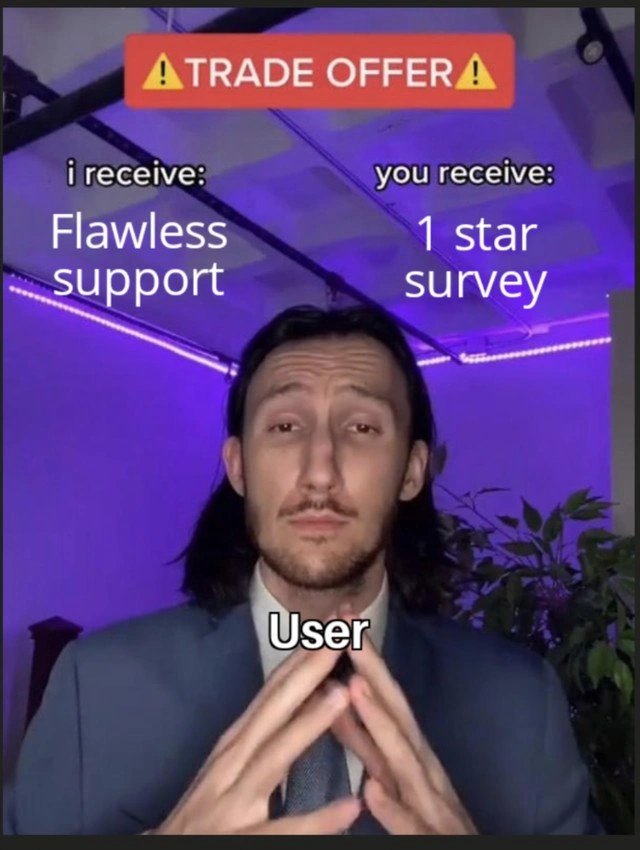
This meme plays on a well-known format called the "Trade Offer" meme. In that format, someone appears to propose a deal: they list what “I receive” and what “You receive.” It became a popular way online to joke about uneven trades or ironic exchanges. Here, the trade is intentionally lopsided for comedic effect. On the left side it says “I receive: Flawless support,” meaning the user is getting perfect help from the support/development team. On the right side it says “You receive: 1 star survey,” meaning in return the support team (or developer) gets a one-star rating on the customer satisfaction survey. The person in the middle with the label “User” is posed like they orchestrated this deal – he’s the one benefiting. The humor comes from how unfair this “deal” is: the user gets their problem fixed (great service), but the developer or support agent only gets blame and a bad review.
In real life, many tech companies and IT support teams send out a customer satisfaction survey after a problem is resolved or a support ticket is closed. Typically, the customer might be asked to rate the service on a scale (often 1 to 5 stars, where 5 is the best). Flawless support would normally deserve a 5-star rating – that’s when everything was handled perfectly. A 1-star rating is the worst possible feedback, basically saying “I’m very unhappy.” So seeing “1 star survey” in exchange for perfect help is a goofy exaggeration of something that unfortunately does happen.
Why would a user give a bad rating even if support was great? For a junior developer or someone new to support, this can be puzzling at first. A few common reasons:
- The user is still upset that they had an issue at all. Imagine a client who had an hour of downtime – even if you fixed it fast, they’re mad it broke in the first place, so they vent by giving a poor score.
- The solution fixed the technical problem but not the user’s expectations. Maybe they wanted a different outcome (like a new feature or a refund). If they don’t get exactly what they hoped for, they might mark the experience down, even if you technically solved what was asked.
- Miscommunication or misunderstanding. Perhaps the support agent used jargon or the user didn’t fully grasp the explanation. The issue is resolved, but the user felt a bit confused or uninformed during the process, leading them to feel it wasn’t “flawless” on a personal level.
- Some people just rarely give high marks. There are users (or even some bosses) who believe “5 stars means perfection, and nothing is perfect,” so they might default to 4 or 3 even for good service. In worst cases, a grumpy user might give 1 star because they think any issue happening at all is unacceptable.
For someone early in their career, encountering this scenario is a rite of passage. 😅 Suppose you’re a junior dev on support rotation: you work hard to solve a tricky bug for an end-user, double-check everything, and even explain the solution politely. The user says “Thanks, it’s working now!” and you feel proud. But later you see the feedback form they submitted with a 1-star rating and a comment like “Problem solved but took too long.” It’s a head-scratcher! You might even doubt yourself: Did I actually mess up? More likely, you did fine – this is just how UserExpectations sometimes differ from what we deliver. It’s an unfair exchange, just as the meme shows. The junior perspective realization here is learning that technical success doesn’t always equal customer satisfaction. You start to understand that part of the job in support or DevOps is managing expectations and communication, not just solving the technical issue.
Let’s break down the image elements a bit more:
- The red banner with warning icons and the words “TRADE OFFER” is a meme hallmark. It immediately sets up that we’re looking at a humorous “deal.”
- Left side text “I receive: Flawless support” represents what the user gets. In real support terms, this means the developer/agent provided excellent service – perhaps quick response, accurate fix, friendly communication. Flawless implies you really couldn’t do any better.
- Right side text “you receive: 1 star survey” is what the developer/support agent gets back. The one-star survey is essentially user feedback in its simplest (and harshest) form.
- The person in the suit labeled “User” with that little smirk – this is the meme’s way of showing the user as a bit shady or knowingly giving a raw deal. It’s exaggeration; in real life users aren’t villains, but when you get an unfair review, it feels like a betrayal. The purple-lit office background and plant are just the original meme’s style – the setting isn’t deeply significant except to mimic the known format.
For a new developer or someone not yet familiar with IT support culture, this meme is a lighthearted introduction to a common issue: customer support and developer experience teams often struggle with MisalignedExpectations. The technical team might be celebrating a perfectly resolved issue at the same time a customer is fuming about something peripheral. It teaches an important lesson: when dealing with stakeholders or clients, perception can matter as much as reality. You could write the cleanest code or give the best support answers, but if the user’s feelings or needs aren’t addressed the way they expect, feedback can still come back negative. This is why soft skills (like empathy and clear communication) are emphasized early in one’s career alongside pure technical skill – to avoid these “unfair trades” as much as possible. In summary, flawless technical work isn’t always enough; you have to ensure the person on the other end feels it was flawless too, or you might get an unwarranted one-star surprise.
Level 3: Misaligned Metrics
This meme distills a painful irony of the tech support world: an unfair trade-off between effort and feedback. It uses the popular Trade Offer format to lampoon how flawless support from a developer or help-desk can still earn a brutal one-star survey rating from the user. In the image, the User is depicted in a scheming pose, essentially saying, "I receive your perfect assistance, you receive my worst score." It's a darkly funny nod to the dreaded customer satisfaction (CSAT) survey where outcomes often don’t match reality. Experienced engineers immediately recognize this as the CSAT paradox: you can do everything right (resolved ticket swiftly, communicated clearly, went above and beyond) and yet the UserFeedbackCollection results come back negative. The humor lands because it’s both absurd and too real – we laugh, but it's the laugh of developer frustration with stakeholder logic.
Behind the laughter is a commentary on StakeholderExpectations versus developer reality. Companies obsess over metrics like 5-star ratings and NPS (Net Promoter Score) to gauge support quality, but these metrics can be wildly misaligned expectations. Why would a client give "flawless support" a 1-star review? Seasoned support engineers swap war stories about such incidents:
- Unmet Expectations: Perhaps the solution was perfect technically, but the customer wanted a different outcome. (e.g. The support team fixed the app issue, but user really wanted a refund – so they punish the survey rating).
- Misplaced Frustration: The user is angry about the problem existing in the first place. No matter how well the issue was handled, they're sour that they had to contact support at all. The one-star is a "shoot the messenger" situation.
- Policy or Limitations: Sometimes support can’t bend company policy or physics. The engineer might have delivered the best possible fix, but if the underlying product lacks a feature, the user might respond with "Well, thanks for nothing!" in survey form.
- Bias or Confusion: Some end-users have an end_user_bias where they never give full marks on principle ("there’s always room for improvement"), or they misinterpret the survey (believing 1 is the best). Yes, that happens – a perfect fix accidentally rewarded with a lowest-score due to misunderstanding.
In a real-world scenario, this meme’s exchange is basically a techie twist on "no good deed goes unpunished." You might resolve a critical incident at 3 AM, documenting everything impeccably (the holy grail of DeveloperExperience_DX in support). The next morning, you discover the customer’s survey comment: "Issue fixed, but took too long to resolve – very dissatisfied." 😑 All that heroism netted a 1-star because their expectation was a five-minute resolution instead of ten. The communication gap here is glaring: the developer assesses success by problem solved, the user judges by how the experience felt. It’s a classic Stakeholder-Developer disconnect – the kind that triggers PTSD in anyone who’s ever manned a helpdesk or handled support tickets.
The Trade Offer meme template brilliantly underscores the one-sided nature of these interactions. The user’s pose (suit, fingers clasped) mimics a sly dealer who knows they’ve got the upper hand. It implies a running joke in support circles: the customer always wins, even when they're objectively wrong. The meme resonates in any dev team meeting where support metrics come up. Everyone groans at the memory of that single unfair review dragging down the monthly CSAT score from 100% to 80%. One-star reviews are to support engineers what a NULL pointer bug is to developers – an infuriating surprise that can crash your perfect run.
Organizationally, this speaks to how internal performance metrics sometimes fail everyone:
- For Developers/Support Agents: Morale hits when your flawless support effort isn’t recognized. It feels like working in a vacuum where technical excellence doesn’t translate into perceived quality. Burnout and cynicism brew (“Why bust my tail if I get bashed anyway?”).
- For Management: Over-reliance on simplistic metrics like star ratings leads to knee-jerk reactions. One bad survey and suddenly there are all-hands meetings about “improving customer delight”. It’s analogous to chasing a high test coverage percentage while ignoring that the tests themselves might be meaningless – a metric for metric’s sake. Goodhart’s Law pops up here: when a measure becomes a target, it ceases to be a good measure. Teams might start gaming the system (only sending surveys when they’re sure the user is happy, or begging for good reviews), which in turn devalues the metric.
- For Users: Ironically, users might think a harsh review is giving feedback to the company, not realizing it can adversely affect the very people who helped them. It’s a communication breakdown – the survey is supposed to gauge how well support did, but users conflate it with how happy they are with the product or situation overall.
In the history of tech support, this disconnect has always existed. Think of old-school IT helpdesks: even before online surveys, a grumpy executive might call your boss to complain despite you saving the day. Today’s automated one-click surveys just amplify that effect – now every user has a megaphone to express misaligned expectations instantly. And as this meme highlights, the results can feel comically unjust. The next time you see a one_star_review on your support dashboard after a job well done, remember this meme and take solace that you’re not alone – it’s a shared joke across DevOps and support teams. The trade offer may be cruel, but at least we can collectively roll our eyes and laugh through the pain.
Description
This meme uses the popular 'Trade Offer' format, which originated on TikTok. It features a man in a business suit against a purple-lit background, presenting a proposition. At the top, a red banner reads 'TRADE OFFER'. The offer is split into two columns: 'i receive: Flawless support' on the left, and 'you receive: 1 star survey' on the right. The man is labeled 'User'. The meme humorously and painfully captures the frustration of IT support, helpdesk staff, and on-call developers. It highlights a scenario where a technical professional provides a perfect solution to a user's problem, only for the user to inexplicably leave the worst possible rating on a satisfaction survey. This is a deeply relatable experience for those whose performance is judged by user feedback metrics (like CSAT or NPS), which often fail to reflect the quality of the support given
Comments
8Comment deleted
Our ticketing system has two states: 1) ticket is open and the user is unhappy, or 2) ticket is closed and the user leaves a 1-star CSAT score. There is no success state
We hit five nines and sub-second MTTR, yet the user still drops a one-star because the confirmation email hit “Promotions” - turns out CSAT is the hardest distributed system
After 20 years in tech, I've learned that the probability of getting a 5-star review is inversely proportional to the number of hours spent resolving edge cases in their legacy SOAP integration that was 'working fine yesterday' despite not being touched since 2011
This perfectly captures the SLA paradox: you can have 99.99% uptime, sub-minute response times, and resolve issues before the user even finishes typing their ticket, but that one time you politely asked them to clear their cache? One star. 'Would not recommend.' Meanwhile, your performance review is tied to CSAT scores, and management wonders why the support team has a thousand-yard stare during sprint retrospectives
We hit all the SLOs and closed the ticket in 5 minutes; CSAT: 1★ - “there shouldn’t be bugs.” Cool, I’ll backlog the “abolish entropy” feature
Met SLA, restored service in single-digit minutes, zero regressions; still a 1‑star CSAT - availability is five‑nines, gratitude is eventually consistent
Customer support's CAP theorem: pick any two from Competency, Availability, and Positive surveys
and then I block him Comment deleted