Skip to content
DevMeme
6329 of 7435
The Project Timeline: Sync, Panic, and Ship
ProjectManagement Post #6940, on Jul 4, 2025 in TG

The Project Timeline: Sync, Panic, and Ship

Why is this ProjectManagement meme funny?

Level 1: Small Delay, Big Hurry

Imagine you have a big homework project due by Friday (Point B). You plan to do a little bit every day from Monday (Point A) to Friday so you won’t be rushed. On Monday, you start working and things go okay. Now it’s Tuesday, and right when you’re in the middle of building a LEGO section for your project, your teacher calls a quick meeting with you and your friends to “check on progress.” It only takes 15 minutes, but it interrupts you. You stop working to attend the meeting. After it’s over, you have to remember what you were doing and get back into it. Maybe you even learned in the meeting that you need to add an extra feature to your project that you didn’t plan before. Uh-oh. Now you lost some time and gained a bit more work.

By Wednesday, you realize you’re a little behind because of that meeting. You still think, “No problem, I can catch up.” But then maybe you get another interruption – like your parent asking you to help with a quick chore or another check-in meeting. Each small delay means you get less done that day than you wanted. You keep telling yourself these are just quick stops, but they’re adding up. Fast forward to Thursday night: the project is due tomorrow, and you still have a LOT left to do. Now you’re in a big hurry. You stay up super late, working frantically to finish everything before Friday morning. You’re racing against time, heart pounding, using every minute. It’s not fun – it’s stressful and tiring.

The meme’s picture of arches is just a fancy way to show that story. A small delay (like a short meeting or interruption – that’s the first small arch) can snowball into a big rush at the end (the huge arch leading to the deadline). It’s funny in the way that people who’ve been in that situation will chuckle and think, “Yep, that’s exactly how my week went.” It’s like if you were on a road trip and took a few extra pit stops; each stop seemed short, but suddenly you’re way behind schedule and have to speed like crazy to reach your destination on time. The lesson is simple: even little interruptions can make a straight road curvy, turning a calm journey into a last-minute sprint. And that mix of “it was just a tiny pause” and “now we’re sprinting to catch up!” is what makes the scenario both relatable and a bit humorous. After all, we often laugh at how something so small can lead to such a big, chaotic finish.

Level 2: Meetings vs Code

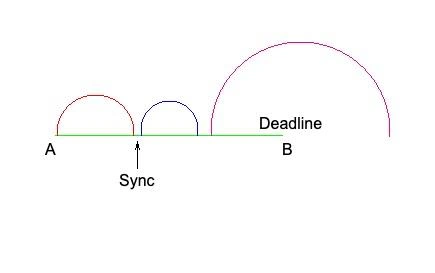
Think of a sprint as a short, focused period (usually 1-2 weeks in Agile development) where a team tries to complete certain tasks or features. In an ideal world, you start at Point A (sprint start) and steadily make progress each day until you reach Point B (sprint end or deadline) with all tasks done. That’s represented by the straight green line in the image – a smooth journey with no interruptions. But in real software projects, the journey is rarely that smooth. This meme’s diagram shows three arches between A and B, meaning our progress path went up and down instead of straight across. Why did that happen? Because of a meeting – specifically a “quick sync” meeting – inserted in the middle (as indicated by the black “Sync” arrow).

A quick sync is supposed to be a short meeting where team members or stakeholders “sync up” on the project status. Maybe a manager or client just wants an update or to resolve a question. It sounds harmless – just a 15-minute chat, right? But even a short meeting can disrupt the team’s flow. Flow is when a developer is really “in the zone,” fully focused on coding or debugging. It’s like when you’re reading a good book or solving a puzzle and you’re so into it that you lose track of time. Interruptions break that concentration. Programmers often need to keep a lot of details in their head (how different pieces of code fit together, what the next step is, etc.). When a meeting pops up, they have to pause their work, mentally put aside those details, and switch to a different mode (talking about the work, answering questions). After the meeting, it’s not like you can instantly pick up where you left off – you have to rebuild that mental map of the problem. This is called context switching, and it has a cost in time and productivity. It’s similar to how your computer might take a moment to reload a big program you closed earlier – your brain has to reload the codebase into memory, so to speak.

In the meme, the first small red arch after A could represent the initial part of the sprint going slightly off track (maybe some planning overhead or a small delay that happened naturally). No project goes exactly perfectly from the start – there’s always a bit of setup or maybe minor hiccups. But it’s small, and you come back down to the green line quickly. Now, that black arrow labeled "Sync" points to where a meeting was inserted. After that point, we see a blue arch that’s taller. That means after the meeting, things took longer or got more complicated than expected. Why might that be? Perhaps in the sync meeting, the team realized they misunderstood a requirement and had to add more work (that’s often called scope change or scope creep – when the project’s scope/requirements grow beyond the original plan). Or it could be simply the time lost due to the meeting and the lost focus afterward made the remaining work pile up more. If the meeting was meant to last 15 minutes but turned into an hour (sound familiar?), that’s a chunk of time gone. And even if it was short, people might come out of it with extra action items (“Let’s also prepare a demo for the client,” for example), effectively increasing the workload.

Now the team is a bit behind schedule because of that intermission. But Point B (the deadline) hasn’t moved – it’s still the same date. So what happens? The work that remains gets condensed into less time. That’s shown by the huge purple arch leading up to point B labeled "Deadline". This big arch is basically the crunch time – the frantic push at the end to get everything finished. If you’ve ever pulled an all-nighter to finish a school project right before it’s due, you know what crunch time feels like! In a software context, crunch time means developers might be working late nights, maybe weekends, rushing to fix bugs and complete features because there’s no more slack in the schedule. Why do they have to rush? Because earlier in the sprint, time that could have been used for coding was spent in meetings or dealing with changes that came from those meetings.

The meme is joking that a so-called “quick sync” meeting (or possibly a series of meetings) can unintentionally turn a straightforward sprint into a mini rollercoaster ride, with the biggest drop at the end. Meetings vs Code is the battle here: time spent talking about work versus time spent doing the work. Developers often feel there are too many meetings, which they call MeetingOverload, and that cuts into their productive coding time. Agile methodology, which many teams use, prescribes only a few necessary meetings (often called Agile ceremonies, like daily stand-ups, sprint planning, retrospectives) to keep everyone aligned without derailing the work. A “quick sync” is usually meant to be an extra, impromptu check-in outside those regular ceremonies. The meme suggests even one extra meeting can have a bigger effect than you’d think. For a junior developer (or anyone new), it might be surprising how much a calendar full of meetings can slow down actual progress. As an early-career dev, you might have noticed that on days filled with meetings, you write much less code or finish fewer tasks – that’s exactly the point here. DeveloperProductivity suffers when you can’t get extended time to concentrate.

Let’s decode the humor and pain point in simpler terms: Everyone on the team started the sprint intending to go straight to the goal. But then someone said, “Hey, let’s have a quick sync to see where we are.” After that, nothing is quick anymore! Maybe you’ve seen something similar in a group project or an internship: the team was on track, then a manager asked for a mid-project review meeting. Suddenly, new issues were brought up, or team members got sidetracked discussing things, and you lost a day of work. Then as the deadline approached, there was a scramble to get everything done because that one day lost meant you’re now behind. The DeadlinePressure kicks in hard. Developers jokingly call this situation “when meetings attack” – the idea that meetings (meant to help) end up attacking your schedule. It’s relatable because it happens a lot. Instead of a calm, evenly paced sprint, you get quiet lulls (during meetings or waiting on feedback) and then stressful rushes to catch up. The arches in the meme visualize those rushes – each arch is like a burst of effort that was larger than it needed to be, caused by interruptions.

In summary, the meme is a tongue-in-cheek way of warning: be careful with unnecessary meetings. Especially those “quick syncs” which we assume are minor. They can break a developer’s concentration (their coding flow) and cause delays that aren’t obvious at first. When you’re new, a meeting might just feel like another task on your calendar. But experienced devs have learned to be wary of too many meetings, because they know every meeting has a hidden cost in time and momentum. The final arch labeled "Deadline" essentially shows crunch time – something most developers experience sooner or later. It’s that final intense push to meet a deadline, often brought on because earlier work got delayed. And one big cause of delays, as the meme jokes, is all those sync-ups and check-ins that were meant to keep things on track. The humor is that a “quick sync” (which sounds helpful and harmless) can inadvertently morph a smooth project timeline into a chaotic race against time – a scenario both frustrating and comically familiar to people in the software world.

Level 3: Arc Nemesis: The Quick Sync

On paper, a sprint is supposed to be a straight shot from Point A (start) to Point B (finish) with a steady pace. In this diagram, that ideal path is the thin green line. But reality rarely cooperates. Those three arches curving above the line are the hills of inefficiency we end up climbing, and each arch grows taller and wider. Why? Because of a so-called “quick sync” meeting that knocks the whole plan off course. The black arrow labeled "Sync" points to the junction between the first small red arch and the next blue arch – right where an innocent status meeting sneaks in and shatters the flow. What was a simple sprint gets deflected upwards into extra loops of work and delay. By the time we approach Deadline B, all the lost focus and added scope have snowballed into that giant purple arc – a monumental last-minute crunch. It’s the final panic-driven push that every seasoned engineer recognizes with a mix of dread and dark humor.

This meme hits on a painfully familiar dynamic in software teams: interruptions fragment our flow and inflate our remaining effort. The red arch starting at A is small – think of it as the normal up-front overhead (maybe initial planning or a daily stand-up). No big deal. But then comes the mid-sprint “just a quick sync” – perhaps a stakeholder check-in or a half-day “status update” call – and that seemingly minor meeting triggers the blue arch. Now the work after the sync isn’t on a flat road anymore; it’s an uphill battle. Why does a short meeting cause a taller arch (more work)? Because context switching is costly. Dropping what you’re doing to jump into a meeting can flush your mental cache. All the intricate state about the code in your head? Poof – gone. After the meeting, you have to reload that context from scratch, like a cold start. It’s analogous to a CPU pipeline being cleared or your development environment rebooting: nothing happens instantly. So that “quick” sync (often not actually quick) imposes a hidden tax on DeveloperProductivity – you lose time in the meeting and more time getting back into your work. The result: less progress made by the midpoint than planned, and perhaps even some new tasks or scope creep uncovered during the sync that add to the workload. The second arch grows larger because now the team is behind and possibly chasing extra requirements uncovered by all that helpful discussion.

By the time you near Point B, everything that was supposed to be done gradually is now crammed into the final arc. Notice how the purple Deadline arch dwarfs the others. This is the classic CrunchTime scenario: all the slack is gone, and the team has to surge at the end to meet the fixed date. In Agile lore, sprints are meant to avoid the big-bang crunch of Waterfall projects by delivering incremental value continuously. But here we’ve come full circle – the sprint became a mini-waterfall with a big bang at the end anyway. The joke bites because it’s true: even in “Agile” environments overflowing with AgileCeremonies, a single “quick sync” can cascade into a MeetingOverload that wrecks the sprint’s smooth progress. Each arch can be seen as work expanding to fill the new gaps left by interruptions (a twist on Parkinson’s Law: instead of work expands to fill the time available, it’s work expands because time was wasted elsewhere). It satirizes a common anti-pattern where managers, under StakeholderPressure and DeadlinePressure, think more meetings will create clarity or urgency. Spoiler: they usually just create more work or delays. Engineers end up context-switching so much that the real coding happens only in frantic bursts after the meetings finally end.

Every senior developer has lived this timeline. We start with optimism about a straight sprint, then endure the reality of “just 5 minutes, I promise” syncs that derail half a day. The meme’s arches vividly depict that lost_focus_switch_cost: a tiny meeting causes a big productivity pothole. The red arch is maybe a day of work; the blue arch is a couple days more – because that sync turned out to be not so quick – and the purple arch is the desperate scramble of CrunchTime compressed into the last remaining days. It’s basically the death march phenomenon in miniature: all the real progress deferred until it’s almost too late. The humor has a bitter edge: we laugh to keep from crying, because we know exactly how a trivial check-in can morph a calm sprint into a hellish race. The drawing may be simple, but it’s architecting a burn-down chart from hell.

Let’s also appreciate the engineering cynicism here. The meme implicitly asks: What derailed the nice flat line? The answer: meetings that break our “flow”. Flow is that state of deep concentration where a developer can solve problems efficiently, juggling a complex mental model of the code. It’s fragile – once broken, it takes serious effort to rebuild. So every sync_meeting_interruptions event resets the flow. You can almost hear the collective groan through the image: “Who scheduled a sync now?!” That arrow might as well be labeled “Here be dragons: context switch ahead.” After the sync, nothing is the same. Priorities might have shifted (thanks to some “valuable stakeholder feedback” delivered in the meeting), or simply the momentum is lost. Now the team’s velocity (work done per sprint) nosedives, but the deadline stays fixed. So what happens? Long days, late nights – the purple arch of doom. This is the infamous “crunch mode” where developers attempt to brute-force productivity to recover lost ground. Caffeine-fueled coding sessions, weekends sacrificed – all compressed in that last arch. It’s drawn huge to show how out-of-proportion the final effort becomes compared to the initial plan. That huge arc ending at Deadline B screams DeadlinePressure: everything that couldn’t get done earlier (because people were busy talking about getting things done) now must happen in one heroic push.

The meme resonates especially with senior engineers because it captures a systemic failure we’ve all seen: process overhead cannibalizing execution time. It’s poking fun at how our well-intentioned processes (Agile, stand-ups, syncs, status reports) can backfire. Agile’s iterative development is meant to prevent the last-minute crunch by keeping a steady pace and continuous feedback. Yet, misapplied Agile can lead to Agile-fall – where you have all the ceremonies (like daily syncs, endless planning) plus old-school fixed deadlines. The result is the worst of both worlds: frequent interruptions and a giant crunch. The purple arch is basically a waterfall-style grand finale sneaking in under the guise of a sprint. And what triggered it? Probably a mid-sprint status review where some executive said “This needs to also do X,” or “Why is this taking so long? Let’s regroup.” Ironically, that regrouping meeting made it take even longer. In essence, the quick sync turned into a self-fulfilling prophecy of delay. As the caption brilliantly puts it, it “morphs a straight sprint into one giant deadline arc.”

It’s worth noting how relatable this is across the industry. The tags like MeetingHumor and RelatableDeveloperExperience aren’t just for laughs – they indicate a shared truth. We’ve all joked that “This meeting could have been an email.” Here, one might say “This quick sync could have been us just continuing to work.” The meme exaggerates it with visual geometry: a little bump turning into Mount Everest by the end. But ask any dev, and they’ll confirm it’s not far from reality. There’s a tongue-in-cheek nod to how AgileCeremonies aimed at improving communication can overshoot, drowning developers in chatter and killing their focus time. Senior folks have scars from release crunches that were exacerbated by such mid-journey “alignments”. It’s almost an equation now: More meetings == less coding, and the fewer the coding days, the crazier that final stretch becomes. Why do we keep doing this? Partly because of fear and anxiety around Deadlines – managers fear something’s off track and intervene, not realizing the intervention is what derails the track. It’s a vicious cycle: fall a bit behind, add more syncs to address it, which steals more time, making us further behind… until voila, the final deadline arch is the only way to catch up. The meme’s dark humor lies exactly in that irony. Everyone in the room knows those “quick syncs” are supposed to help, yet we watch them make things worse, time and again. Cynical veterans of software development will chuckle and wince because we’ve seen brilliant plans reduced to frenzied last-minute deployments purely due to meeting-driven fragmentation. It’s funny because it’s tragically true: sometimes the road to missed deadlines is paved with good intentions and too many meetings.

Description

A simple, minimalist diagram illustrating a common project management anti-pattern. On a white background, a horizontal green line represents a timeline, starting at point 'A' on the left and ending near point 'B' on the right, which is labeled 'Deadline'. Above the first half of the line are two small, gentle arcs, one red and one blue, suggesting minor, incremental progress. Between these two arcs, an arrow points up from the timeline labeled 'Sync'. Immediately following the 'Sync', a massive purple arc begins, towering over the previous ones and extending far beyond the deadline. This diagram visually represents the universal developer experience of a project that seems to be progressing smoothly with small tasks until a mid-project sync-up reveals the monumental scale of the remaining work, leading to a period of intense, panicked effort ('crunch time') to meet the deadline


Comments

7
Anonymous ★ Top Pick Ah, the classic post-sync refactoring sprint. We've synchronized our watches, now let's synchronize our panic as we realize the second half of the project is 90% of the work
  1. Anonymous ★ Top Pick

    Ah, the classic post-sync refactoring sprint. We've synchronized our watches, now let's synchronize our panic as we realize the second half of the project is 90% of the work

  2. Anonymous

    Sure, let’s wedge a “quick 15-minute sync” right here - because what’s another O(n²) expansion to the schedule between A and B?

  3. Anonymous

    The only thing that scales linearly with team size is the number of sync meetings required to explain why nothing is scaling linearly

  4. Anonymous

    This diagram perfectly captures the universal law of software delivery: work expands geometrically to fill the time available before the deadline. The 'Sync' point represents that brief moment of optimism when you think integration will be trivial, before the final arc reveals the exponential reality of merge conflicts, integration bugs, and the realization that 'it works on my machine' doesn't count as done. Senior engineers recognize this pattern immediately - it's why we advocate for continuous integration and incremental delivery, though stakeholders still somehow expect the entire arc to remain uniformly small

  5. Anonymous

    In theory, continuous integration; in practice, deadline desynchronization

  6. Anonymous

    The shortest path from A to B is linear - unless every ‘quick sync’ is a blocking consensus round, in which case the schedule turns into stop-the-world GC right before the deadline

  7. Anonymous

    A ‘sync’ that doesn’t touch trunk is just accruing merge‑conflict interest - the invoice arrives titled “Deadline.”

Use J and K for navigation